
- state the two aspects of care and maintenance of fabrics and why they matter
- explain washing, drying and ironing equipment: the models, kinds and operations of washing machines
- describe how household laundry, dhobis, commercial laundries and institutional laundries (hospitals, hotels) work
- write the 10-step laundry process of a hospital and its record (receipt) system
- describe how to prepare for a career in this field and its scope, and carry out the stain removal practical
1 Introduction: why fabrics need care
- Everyone knows the use of fabrics in a family for apparel and household articles
- Some special fabrics are used for industrial purposes
- In institutions, fabrics are used in interiors for heat and sound insulation
- In hospitals, special fabrics are used for bandages, masks etc.
- Fabrics with specific properties are selected for a specific use and function (the job they must do)
- So these properties must be retained for the expected life of the material
- Taking good care of a product prolongs its period of serviceability (the time it stays usable)
Care and maintenance of fabrics includes two aspects: (1) keeping the material free of physical damage and rectifying any damage that may have occurred during its use; (2) retaining or refreshing the appearance in terms of removal of stains and dirt and retaining the textural and visual characteristics (how it feels and how it looks).
2 Basic concepts
- Clean, fresh, hygienic clothes and spotless, crisp household linen are the outcome of successful laundering or dry-cleaning
- (General knowledge) Dry-cleaning means cleaning without water, using a solvent (a cleaning liquid)
Laundry is both a science and an art. It is a science because it is based on the application of scientific principles and techniques. It is also an art since its application requires the mastering of certain skills to produce aesthetically pleasing results.
2.1 What care depends on
The care and maintenance requirements of different fabrics depend on these five things:
Fibre content
which fibre or fibres the fabric is made of
Type of yarn
the kind of yarn used
Fabric construction
the technique used to make the fabric
Finishes given
the finishes applied to the fabric
Purpose of use
what the fabric is used for
- Processes you already know: the process of laundry, stain removal, role of water, suitability of soaps and detergents, methods of washing, finishing treatments, ironing and hot pressing, folding
- These activities need equipment; there are mainly three types of equipment in common use
- At household level, a large amount of washing is done manually (by hand)
- It uses equipment like buckets, basins, bowls, scrubbing boards and brushes
- In some cases, basic washing machines have been added
3 A. Washing equipment: washing machines
3.1 Two models
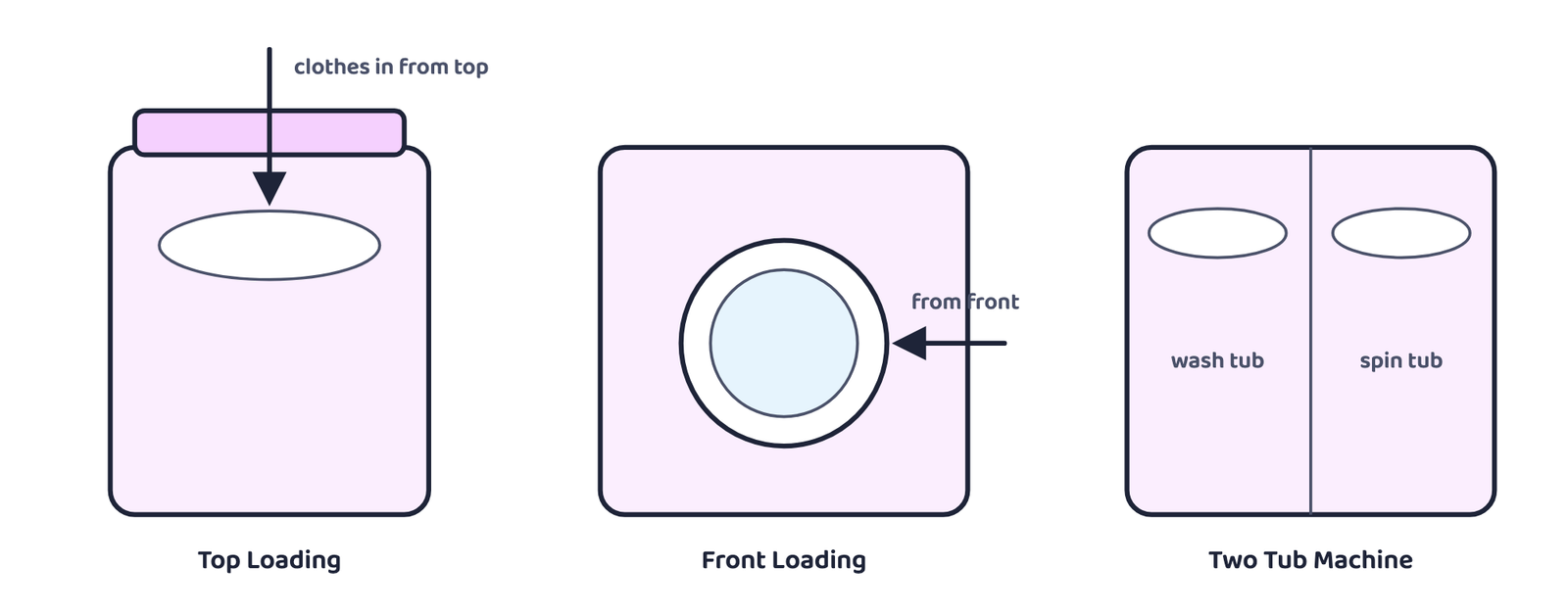
- Top loading: the garments are put into the machine from the top
- Front loading: the garments are put into the machine from the front side
3.2 Three kinds of machines
These machines have a single time setting of controls for each use, i.e. water filling, temperature of water, wash cycle and number of rinses. No further intervention of the operator is required.
These machines require intervention of the operator at frequent intervals. Rinse water in such machines has to be filled and drained out with each cycle. These are generally two-tub machines.
In these machines, 50 per cent or more of the work is manually done by the operator (the person running the machine).
| Kind (summary) | Operator’s intervention | Key words |
|---|---|---|
| Fully automatic | none after setting | single time setting |
| Semi-automatic | at frequent intervals | two-tub |
| Manually operated | the most | 50% or more by hand |
3.3 Operations of an automatic washer
- a. Filling up water: the machine fills the wash water
- b. Water level control: also an important feature; the water level is controlled either automatically or manually
- c. Regulation of temperature of water: the machine has a button, dial or panel indication for selecting the desired temperature of the water
- The temperature may be the same for wash and rinse or different for the two operations
3.4 d. Washing: three methods
To keep the fabric in movement in the washing solution to carry away the dirt. The major methods of doing this are three.
Used in top loading machines. The agitator has blades which may rotate (movement in one direction) or oscillate (alternate movement in two directions). This causes the creation of a current in the tub, forcing water into the fabric.
Also used in top loading machines. The movement is caused by a vertical pulsator, which has very rapid vertical (up and down) movements.
Used in front loading machines. Washing takes place in a horizontally placed perforated cylinder (a drum with holes) which revolves in a partially filled tub. With each revolution the clothes are carried to the top and then dropped in the wash water. So the clothes move through the water, rather than water moving through the clothes as in agitation and pulsation.

| Method (summary) | Machine model | Key part | What moves through what |
|---|---|---|---|
| Agitation | top loading | agitator blades | current forces water into the fabric |
| Pulsation | top loading | vertical pulsator | water moves through the clothes |
| Tumbling | front loading | horizontal perforated cylinder | clothes move through the water |
- Depending on the size of the machine and the type of fabrics, agitators are made of plastic, metal (aluminium) or bakelite
- They are made so that they are not affected by detergents, bleaches, softeners etc.
- Agitation speed can be varied depending on the type of fabric
3.5 e. Rinsing
- This is an important phase in the wash cycle
- If the rinse is not thorough, the clothes may look grey and dull and have a harsh texture
3.6 f. Water extraction: three ways
Water is extracted after the wash phase and after each rinse phase of the cycle.
Spinning at speeds greater than 300 rpm (revolutions per minute) generates a centrifugal force (a force pushing outward from the centre), which throws the water up and out. This water is pumped down the drain.
| Way | How it works | Feature |
|---|---|---|
| i. Spinning | see Definition 9 | above 300 rpm |
| ii. Bottom-drain | machines with perforated tubs stop at the end of the wash phase and at the end of the rinse phase and drain through the bottom | at the end of the drain period the tub spins to remove the remaining water |
| iii. Combination bottom-drain and spin | drains through the bottom without stopping, i.e. the bottom draining occurs during the spin period | best water extraction; removes the heavy dirt at the bottom and the dirt in suspension (floating) in water |
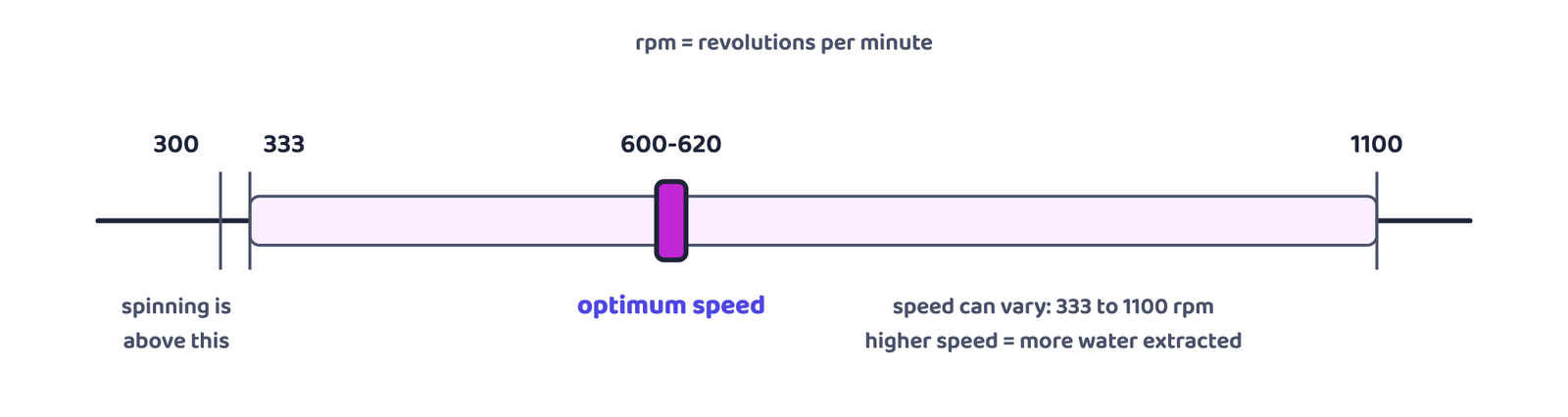
- The amount of water extracted during spinning is directly affected by the speed at which the tub spins
- The speed can vary from 333 to 1100 rpm
- Spinning to near dryness is avoided, because it may cause wrinkles which are difficult to remove during ironing
- The optimum speed is approximately 600-620 rpm
Do not mix up the three numbers: greater than 300 = speed at which spinning throws water out by centrifugal force; 333 to 1100 = the range of spin speed; 600 to 620 = the optimum speed.
4 B. Drying equipment and process
- Apart from drying in the open, driers are used at commercial and institutional level
- There are two types of circulation systems (ways of moving the air) in driers

| Point | (a) First system | (b) Second system |
|---|---|---|
| Air temperature | relatively low | high |
| Air movement | high velocity | slow |
| Path of air | room air enters from under the front panel → passes over the heat source → through the clothes → leaves through an exhaust | air enters and passes over the heat source → drawn by a small fan through perforations at the top → downwards through the clothes → out through the exhaust |
| Result | the temperature and humidity of the room stay normal | air moves slowly, so the relative humidity of the exhausted air is high |
5 C. Ironing and hot pressing
Ironing is the process of smoothening out wrinkles created with use or during washing. Pressing helps to put creases, such as in sleeves, trouser legs and pleated skirts.
- Most households have an iron and a temporary or permanent place for work
- Irons have a smooth metal surface which can be heated
- Most electric irons have an inbuilt thermostat, which adjusts the temperature to suit the fabric
- The iron may also have a system of producing steam while in use
- The weight of the iron varies from 1.5 to 3.5 kg
- At household level light weight irons are preferred; heavier articles like curtains and bed covers may require heavier irons
- In most cases the heating is with electricity, but in India one can still see some charcoal irons
- A charcoal iron is like a metal box with a lid, in which live coal pieces are put to heat the iron

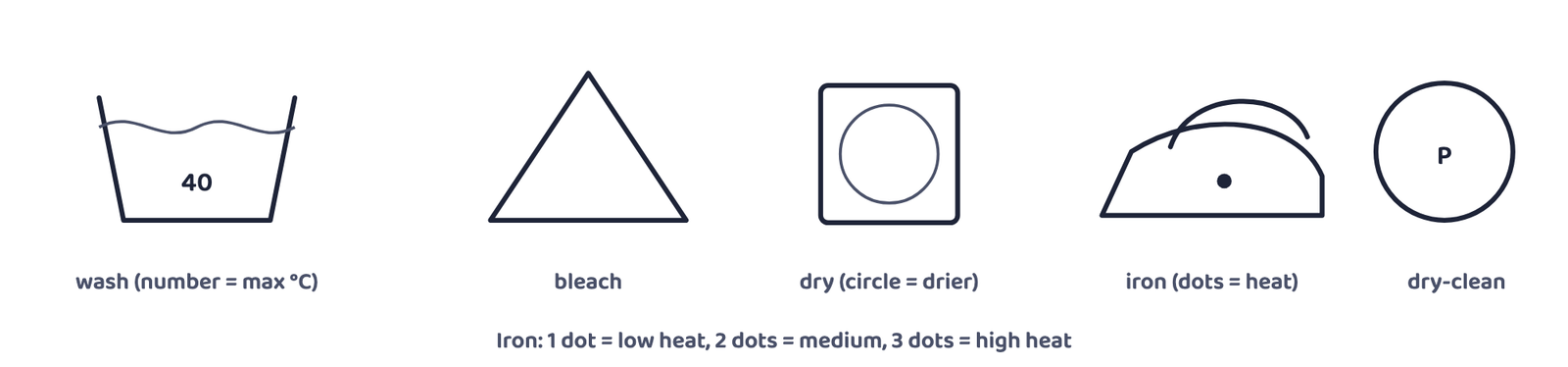
The book refers to the Class XI textbook for fabric care in detail. The care label on a garment uses these five basic symbols; a cross (×) on a symbol means “do not”.
6 Levels of care: home, dhobi and laundry
Care and maintenance of apparel and household articles within the family may be done at different levels:
Household laundry
takes care of clothing and small articles of daily use
Commercial laundries
bigger articles of household linen and some special articles are sent here
Individual professionals (dhobis)
hired to collect material from the household for washing and/or ironing and finishing
- Such professionals are often called dhobis
- They serve individual households and institutions like student hostels, small hotels and restaurants
- They generally work from their homes
- For washing they use specially marked places in towns and cities called dhobighats
6.1 Laundries and dry-cleaning shops
- The concept of individual workers (dhobis) grew up into ‘Laundries’ or ‘Dry-cleaning’ shops
- Here the customer takes the articles for cleaning and comes back a few days later to collect the finished articles
- The customer may be an individual or an institution
- Bigger laundries often have several centres or shops in different parts of the city
- Some laundries also provide transport of material to and from the customer
- This is especially so for institutions like hostels, small hotels, restaurants, small hospitals and nursing homes
7 How a commercial laundry is organised
Commercial laundries are organised in different sections. Each section deals with a specific job.

7.1 Equipment and capacity
- These laundries have bigger equipment and in larger numbers
- Their washing machines can handle 100 kg or more of load in one cycle, as against 5-10 kg in domestic washing machines
- They have separate machines for dry-cleaning
Other equipment:
- Hydro extractors: machines that remove water from clothes by centrifugal motion
- Driers
- Flat bed ironing and pressing equipment
- Roller ironing and calendaring machines (general knowledge: a calendaring machine passes cloth between heated rollers to make it smooth)
- Folding and packaging tables
- Trolleys to carry material from one place to another
A tunnel washing system (tunnel washer) is used in large laundries: the clothes move step by step through the many compartments of one long machine, getting washed and rinsed in turn.
7.2 Record keeping
8 Institutions: hospitals and hotels
- Large institutions like hospitals, prisons and hotels need a constant flow of clean linen, working-clothing or uniforms
- So they usually have their own laundry departments
- The organised collection, laundering and timely delivery of processed material is essential to the running of the institution
- Two types of institutions have in-house laundry and maintenance set-ups (within the organisation): hotels and hospitals
- Both have a large quantum of bed linen and other room furnishings, staff uniforms and accessories such as aprons, caps, head dresses and masks
Hospital laundry
- Takes care of hygiene, cleanliness and disinfection (killing germs)
- Many hospitals use disposables where there is a threat of infection; these are destroyed by burning
- Most articles are cotton, dyed in colours specific to the hospital and department, with dyes of excellent wash-fastness
- Only the blankets are woolen; daily laundry is mainly about cleanliness of cotton
- Stubborn stains may not be taken notice of; starching and whitening are not included
- Ironing and pressing may not be done to perfection
- Repair, mending and condemnation (rejecting) of unusable material may or may not be part of the service
Hotel and restaurant (hospitality sector) laundry
- Aesthetics and final finish of the articles are the most important
- Articles may be of different fibre contents compared to hospitals
- Final finishing is emphasised: starching, ironing, pressing and correct and perfect folding
- They also take care of guests’ personal laundry when required
- Smaller hotels may have link-ups with commercial laundries from outside
9 Process of laundry functioning in hospitals
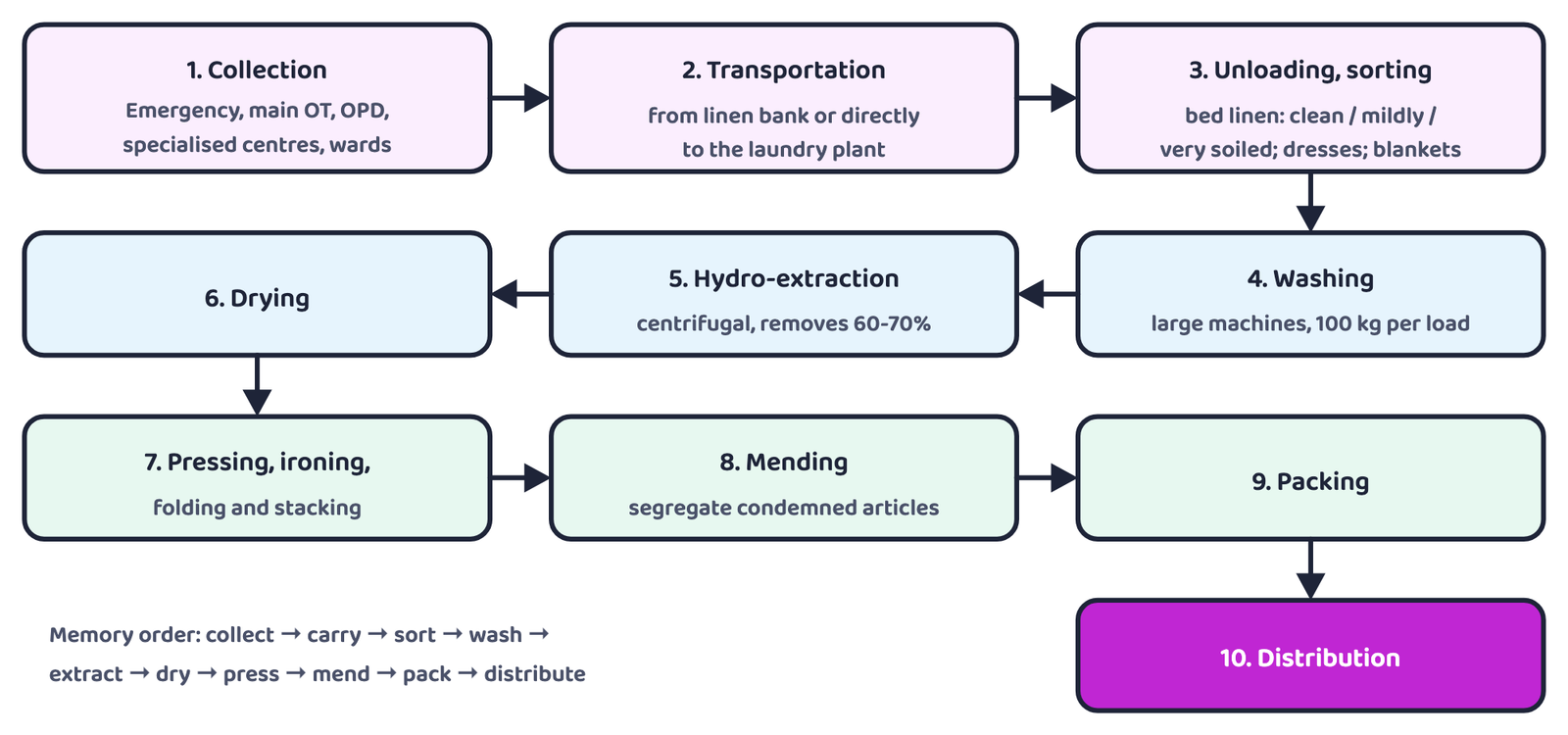
- OT = Operation Theatre; OPD = Out Patient Department
- Condemned articles are linen too worn to use; they are set apart at step 8
9.1 Quantum of work
- The quantum of work, especially for bed linen, is much larger for hospitals than for hotels
- Each set normally consists of a bed sheet, draw sheet and a pillow slip
- The blankets are not changed daily unless soiled
- Besides linen for the patient’s bed, other articles to be laundered: dress for patients (gowns, kurta, pyjamas etc.)
- Dress for doctors (coats, gowns, kurta and pyjama): generally a different colour from the patients’ dress, and may be of tericot material
- Some general material like table cloths and curtains
9.2 Hospital record: Receipt for Washable Linen
As in commercial laundries, the hospital keeps a record of collection and disbursement (giving back) of material to each department. The book’s example:
| NAME OF THE HOSPITAL · Receipt for Washable Linen · Receipt No. ____ · Received from ____ · Dated ____ · Time ____ | |||
|---|---|---|---|
| S.No | Name of the clothing | S.No | Name of the clothing |
| 1 | Bed Sheet | 10 | Towel Hand |
| 2 | Draw Sheet (White) | 11 | Face mask |
| 3 | Draw Sheet (Green) | 12 | Baby Frocks |
| 4 | Patient’s Kurta | 13 | Blanket Big/ Baby |
| 5 | Patient’s pajama | 14 | Pillow Cover |
| 6 | Doctor’s Kurta | 15 | Slings |
| 7 | Doctor’s Pajama | 16 | Apron |
| 8 | Doctor’s Gown | 17 | Dirty Linen Bag |
| 9 | Towel split | each row also has a “No.” and a “Remarks” column | |
10 Commercial laundry versus hospital laundry
Putting the book’s two descriptions side by side (Review Question 4):
| Point | Commercial laundry | Hospital laundry |
|---|---|---|
| Customers | individuals or institutions; several centres or shops; transport service | the hospital’s own departments (Emergency, OT, OPD, wards) |
| Fabrics | may have separate sections for dry-cleaning, for woolens, silks, synthetics and for blankets, carpets | mostly cotton with excellent wash-fastness; only the blankets are woolen |
| Main focus | cleaning and finishing; some also offer dyeing and special finishes like zari polishing | hygiene, cleanliness and disinfection |
| Finishing | pressing, ironing, folding, packaging | no starching or whitening; ironing and pressing may not be perfect |
| Stains | stain removal is part of the pretreatments | stubborn stains may not be taken notice of |
| Process | check → record damage → invoice → code tags → sections for washing, extraction, drying, pressing | 10 steps from collection to distribution; sorting by degree of soiling |
| Record | customer’s invoice with matching code tags | receipt for collection and disbursement for each department |
| Machines and volume | 100 kg or more per cycle | 100 kg per load; 1,800-2,000 beds; sheets changed 5 or more times a day in some wards |
11 Preparing for a career, and scope
Care and maintenance of fabrics is a technical field. Its four primary requirements are:
Knowledge of the material
fibre content, yarn and fabric production technique, and the colour and finishes applied, in terms of the effect of care required
Knowledge of the processes
the processes involved in care
Knowledge of the chemicals
chemicals and other reagents used in the process and their effect on the fabric
Working knowledge of machinery
machinery requirements and how the machines function
- Generally, Laundry Management courses are short term programmes
- They offer: coaching, job placement assistance, assistance to start a business, practical training with stipend in a hi-tech laundry
- Job opportunities: airways, ship, railways, hotels and hi-tech hospitals
- Each set-up may have different equipment and requirements, so a practical training or internship would be required
- Qualifications in Textile Science, Textile Chemistry, Fabric and Apparel would be extremely useful
- These are offered as a specialisation in the graduate degree by several Home Science institutions across the country
11.1 Scope
- Persons with specialisation in Textiles and Clothing, Fabric and Apparel can venture into entrepreneurial activities (their own business) here
- These services give much needed help to end users in metropolitan areas, especially where women are working outside the home
- There may also be many nursing homes, small hospitals, day care centres etc. that need such services regularly
- One may also choose to work in hi-tech laundries of railways, airways, shipping lines, hotels and hospitals, i.e. organisations with in-house programmes for care of fabrics and textiles
In a “preparing for a career” answer, write the four primary requirements first, then Laundry Management courses and the useful qualifications. In a “scope” answer, write both routes: your own enterprise, and jobs in in-house institutional laundries.
12 Practical work: stain removal (Practical 1)
CBSE 2026-27 Practical 8: removal of ball pen, curry, grease, ink, lipstick, tea and coffee stains from white cotton cloth. The HBSE list also has blood. UP Board: a project file on sewing and laundry. The book’s Activity 1 (survey of washing machines) and Activity 2 (categorising home fabric articles) are also file work; how to do both is in the NCERT Solutions post.
A stain is an unwanted mark or colouration on a fabric caused by contact and absorption of foreign matter, which needs special treatment before the actual washing process.
- To use the right procedure for removing a stain, it is important to identify the stain
- The book refers to “Chapter 17 in Class XI textbook for HEFS, Care and Maintenance of Fabrics” for details
- Procedure: take two samples of each stain on white cotton cloth of 4″ × 4″
- Treat one and keep the other as the controlled sample (for comparison)
- Remove the stain using the table below
- Note: after the practical, stick the control and treated samples in your file
| Stain | Condition | Cotton and Linen | Silk and Wool | Synthetics |
|---|---|---|---|---|
| 1. Blood | Fresh | Soak in cold water, then wash in dilute ammonia | Sponge with cold water | Wash in cold water |
| Old | Steep in cold water and salt until the stain is removed (1 oz to 2 pints) | (1) Same as for cotton (2) Apply starch paste, leave it to dry and brush it | (blank in the book) | |
| 2. Ball pen ink | (not given) | (1) Steep in methylated spirit (2) Wash with soap and water | Same as cotton | Same as cotton |
| 3. Curry stain | Fresh | (1) Wash with soap and water (2) Bleach in sunlight and air | Same as cotton | Same as cotton |
| Old | (1) Same as for fresh (2) Bleach with javelle water | Treat with potassium permanganate and ammonia; dip the stained portion alternately in the two solutions | Bleach with sodium perborate | |
| 4. Grease | Fresh | Wash with hot water and soap | (1) If washable, same as cotton (2) If unwashable, spread French chalk on the stain; brush off the powder after an hour | Same as silk and wool |
| Old | (1) Treat with grease solvent (petrol, methylated spirit) (2) Wash with hot water and soap | Same as cotton | Same as cotton | |
| 5. Ink | Fresh | (1) Rub the stain with a cut tomato and salt, wash (2) Soak at once in sour milk or curd for half an hour, wash (3) Apply salt and lime juice, leave for half an hour, wash | Treat with sour milk or curd as for cotton | Same as silk and wool |
| Old | (1) Try methods 2 and 3 above with prolonged treatment (2) Steep in dilute oxalic acid (3) Rinse thoroughly with dilute borax solution | (1) Same as cotton (2) Rinse in dilute ammonia solution | Same as silk and wool | |
| 6. Lipstick | Fresh | Steep in methylated spirit and wash with soap and water | Same as cotton | Same as cotton |
| Old | Moisten and soften by working glycerine into the stain; leave for a short while; rinse, then wash with soap and water | Same as cotton | Steep in kerosene or turpentine; wash with soap and warm water | |
| 7. Tea and coffee | Fresh | Pour boiling water through | (1) Steep in warm water (2) Steep in dilute borax solution (1/2 tsp to 2 cups of water) | Steep in warm sodium perborate solution (1 tsp to 1 pint) |
| Old | (1) Spread borax over and pour boiling water through (2) Steep in glycerine until the stain is removed | (1) Steep in borax solution (2) Treat with dilute hydrogen peroxide | (blank in the book) |
Remember one clue for each: ball pen and fresh lipstick = methylated spirit; fresh tea or coffee = boiling water; unwashable grease on silk or wool = French chalk; old curry on cotton = javelle water; old ink on cotton = oxalic acid; blood = cold water.
- Two aspects: free of damage + rectify; retain or refresh appearance. Laundry = science + art
- Care depends on: fibre content, yarn, fabric construction, finishes, purpose. Three equipment: washing, drying, ironing
- Models: top / front loading. Kinds: fully automatic, semi-automatic (two-tub), manually operated (50%+)
- Operations: filling water, water level, temperature, washing, rinsing, water extraction
- Agitation, pulsation (top loading); tumbling (front loading); agitators of plastic, aluminium or bakelite
- Spinning above 300 rpm; range 333-1100; optimum 600-620; combination = best extraction
- Driers: low temperature, high velocity (room normal) / high temperature, slow (exhaust humidity high)
- Iron 1.5-3.5 kg, thermostat, steam; charcoal iron = metal box with a lid
- Dhobis, dhobighats → laundries and dry-cleaning shops; machines 100+ kg (home 5-10 kg); invoice + code tags
- Hospital: disinfection, cotton, wash-fast dyes, only blankets woolen, no starching. Hotel: aesthetics, final finish, guests’ laundry
- Hospital 10 steps; 100 kg per load; 60-70% moisture; 1,800-2,000 beds; 6 sets; 5+ changes
- Career: 4 kinds of knowledge, Laundry Management (short term), internship; scope: own enterprise, metro cities, railways, airways, shipping
- Can I write the three kinds of washing machines and the three washing methods, with the machine model for each?
- Can I name the three ways of water extraction and the three spin-speed numbers?
- Can I write the difference between the two circulation systems in driers?
- Can I write the 10 steps of hospital laundry in order?
- Can I write five differences between hospital and hotel laundries?
- Can I give the cotton treatment for each of the seven stains?