
- Explain the meaning of hospitality, the importance of hospitality management, and tell a hotel, motel, lodge, resort, furnished apartment and furnished camp apart
- Explain the four stages of the Guest Cycle in order
- Describe the functioning of the front office, draw its organisation chart and write the duties of its staff
- Describe the functions, sections, organisation chart and personnel of the housekeeping department
- Explain the food and beverages department (kitchen, kitchen stewarding, restaurant), the support service departments and the management functions
- Know the competencies, courses and career opportunities in this field
1 Introduction and significance
This chapter is part of Unit V, Resource Management. The unit introduction notes that hospitality is an integral part of services, needed daily in hotels, hospitals and other service organisations such as hostels, service apartments and corporate houses. Many companies now outsource hospitality related activities, so the area offers tremendous potential for entrepreneurial ventures.
1.1 Introduction: Athithi Devo Bhava
- When we go to a restaurant or hotel, we expect to be greeted and served properly
- If not, we are unlikely to repeat the visit
- In Indian culture guests are regarded as God-like and treated accordingly, as captured in the words “Athithi Devo Bhava”
- This means each and every guest must be received with warmth and given the best possible care and service in all respects
Ancient times
- People generally stayed with relations or friends
- or in ‘dharmashalas’
Modern times
- Trade and commerce increased within the country and between countries
- This made paid services for hospitality necessary
1.2 Significance of hospitality management
- With globalisation, the world has become a small place
- People travel within the country and internationally for many reasons
Work
Business purposes, marketing products, official purposes
Study and faith
Study, pilgrimages
Health
Seeking health care, called medical tourism
Leisure and family
Enjoying leisure time or a vacation, visiting relatives, shopping
Sightseeing
Experiencing different cultures, seeing heritage monuments, wildlife or natural beauty
Festivals and events
Shopping festivals, wildlife tours, the Pushkar and Kumbh melas, the Dusshera festival in Mysore, the Ganapati festival in Mumbai and Pune
- Everyone who visits such events needs a place to stay that is comfortable, safe and hygienic
- If not, they carry unpleasant memories
- So tourists need comforts and facilities similar or close to what they are used to at home
A tourist is one who travels and stays temporarily in another place.
The hospitality industry has grown to provide “A Home Away From Home”.
The book calls it one of the fastest growing industries
2 Basic concepts
2.1 What is hospitality
Hospitality is the relationship between the guest and the host. It is the act or practice of being hospitable, including friendly, generous reception or welcoming of guests, their entertainment, and providing services with warmth and courteousness.
- Basically, hospitality is concerned with providing a place to stay, food, entertainment and other facilities to make the stay comfortable
- Being hospitable means being warm and welcoming towards guests
2.2 Establishments that offer hospitality services
| Establishment | Meaning as per the book | Key point |
|---|---|---|
| Hotel | A commercial establishment offering lodging, meals and other services to its guests | Lodging + meals + other services |
| Motel | Provides services like a hotel, and a parking facility near the room, or a room door that opens out onto the parking lot | Parking near the room |
| Lodge | Offers rented accommodation especially for sleeping; may not offer food and other services | Mainly a place to sleep |
| Resort | Known for its leisure attraction; a broad range of amenities, sports facilities and leisure activities for a total vacation experience | Total vacation experience |
| Furnished apartments | Provide all essential amenities needed by the guests | All essential amenities |
| Furnished camps | Provide hospitality to people who go hiking, undertake adventure sports etc. | Hiking, adventure sports |
Do not mix up a motel and a lodge. A motel gives hotel-like services plus parking near the room; a lodge is mainly for sleeping and may not offer food and other services.
Hospitality services are also an integral part of the services at:
- Organisations which provide hospitality generally have management departments
- The fundamental principles of hospitality management are applicable to one and all
- For smooth and efficient functioning, the tasks are carried out by different sectors or departments (book’s Fig. 17.1)

Suite: hotel accommodation with two rooms, one used as a living-cum-dining area and the other as the bedroom. An ordinary room is a single room.
3 The Guest Cycle
The “Guest Cycle” starts even before the guest physically steps into a hotel, and consists of four stages: pre-arrival, arrival, occupancy and departure.
- To understand the different departments of a hotel, one must first understand the Guest Cycle
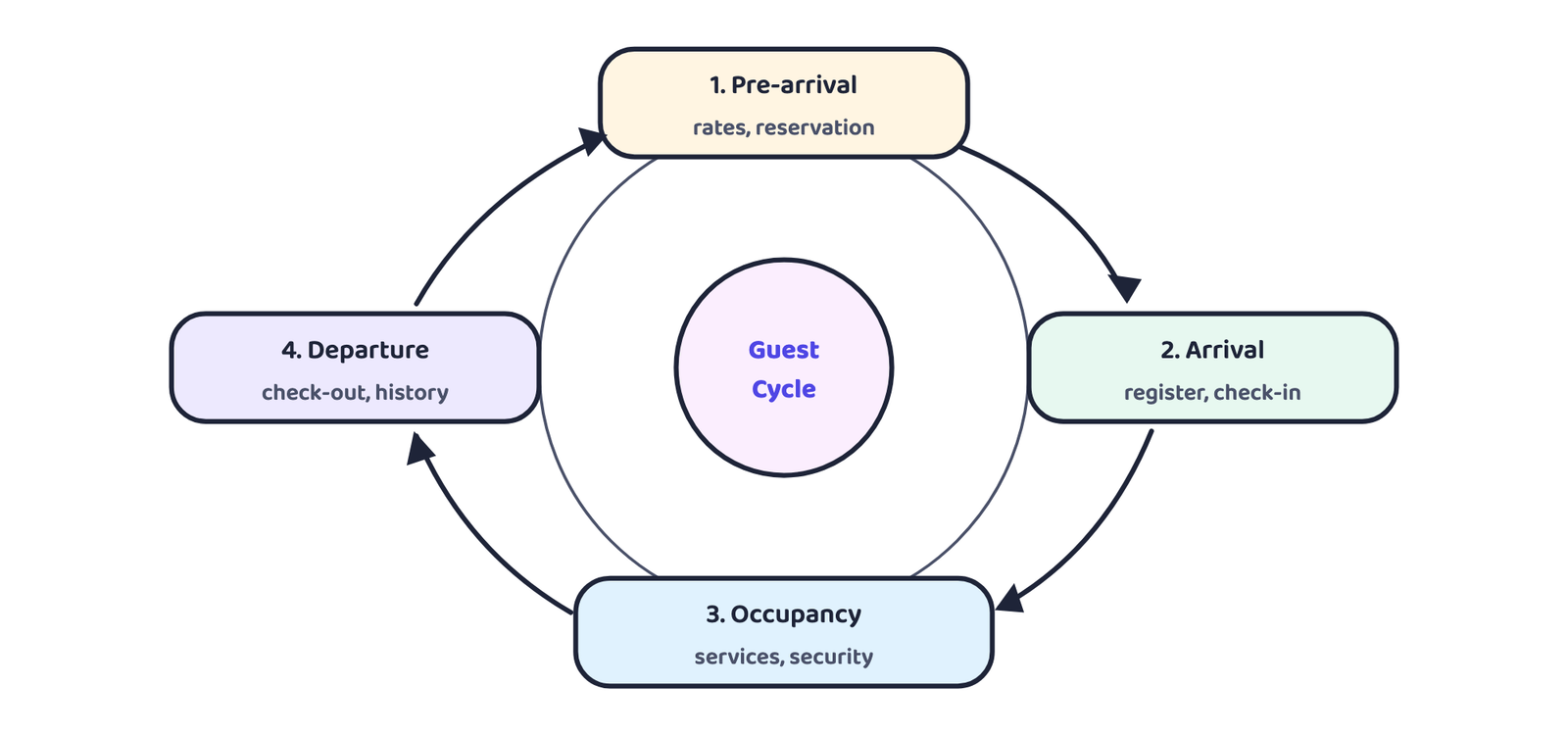
| Stage | What happens |
|---|---|
| 1. Pre-arrival stage | (i) quoting rates for a guest; (ii) reserving a room as a part of the central reservation system or the reservation department |
| 2. Arrival stage | The guest actually arrives and registers or checks-in |
| 3. Occupancy | Providing various services as per the guest’s requirements, ensuring security of the guest and co-ordination of guest services. The main focus is guest satisfaction, so that the guest uses the establishment again; in other words, to obtain and retain ‘customer loyalty’ |
| 4. Departure | The final stage: the guest is ready to leave or “check-out”. An up-to-date record of the guest’s room occupancy is kept with other information about the guest, known as ‘guest history’, including the guest’s feedback about the services |
P-A-O-D: “Please Arrive On Day-one”
Pre-arrival → Arrival → Occupancy → Departure.
4 Front Office
4.1 Importance of the front office
The front office is where the guest arrives and comes in contact with the staff of the hospitality industry for the first time. The guest cycle falls largely under its domain, so the front office is the focal point of any hotel.
- Interaction between the guest and the staff is very critical to develop a good relationship between the guest and the organisation, and to build a good image
- The manner in which services are offered plays a central role in image building and ultimately determines the revenue generated
- No guest wants to be greeted or served by a person who is expressionless and indifferent
4.2 Services offered by the front office staff
- Welcoming guests, meeting and greeting them
- Organising reservation status of room availability
- Registering guests and allocation of rooms
- Maintaining records of check-in and check-out details
- Porter services
- Issuing room keys to guests
- Passing messages to customers
- Coordinating with other guest services
- Providing in-house and external information to the guests
- Preparing and settling their bills
The front office staff also coordinate with these departments to provide services to guests:
4.3 Organisation of the front office

4.4 Front office personnel and their duties (book’s Table 17.1)
| Designation | Functions/Duties |
|---|---|
| Front Office Manager | Manages the front office, lobby and transport activities. Schedules shifts/staff rotations and duties of staff in shifts, since all hotels work for 24 hours. Checks the arrivals of the day and the “V.I.P.”s; coordinates with housekeeping and other departments |
| Front Office Supervisor | Responsible for a shift. Meets and greets all arrivals, ensures accurate and speedy rooming procedure, checks occupancy |
| Front Office Cashier | Maintains the guests’ bills and receives payments when guests check out |
| Telephone Operator / Information assistant | Provides information and communicates with in-house guests and visitors |
| Assistant Manager-Front Office | Organises and supervises the front office in the absence of the front office manager and ensures smooth functioning |
| Lobby Manager | Organises, supervises and controls all uniformed services |
| Receptionist (Front office Agent) | Reserves, registers and assigns rooms to guests; provides information to guests as and when necessary during their stay |
| Bell Captain | Organises, supervises and controls all uniformed services and bell boys in the lobby; supervises all baggage movement during check-in and check-out |
| Bellboy | Shifts the guests’ baggage within and out of the room |
| Doorman | Welcomes guests upon arrival and escorts them to the registration desk |
For “responsibilities of any three members of the front office staff”, underline each designation and give two duties for each. The manager, the receptionist and the bell captain are the easiest three to write.
5 Housekeeping Department
5.1 Role of the housekeeping department
The housekeeping department is primarily responsible for providing a healthy environment by ensuring cleanliness and maintaining high standards of hygiene, along with ensuring that the aesthetics of the entire establishment are maintained.
- A guest’s decision to stay and visit the hotel repeatedly depends largely on the quality of the services
- In hotels, room decor, facilities in the rooms, safety, cleanliness and hygiene are most important
- Many organisations, including corporate offices, now hire housekeeping services on a contractual basis
- This gives many people an avenue to start their own enterprise
- Housekeeping consultancy on a commercial basis has more activities and challenges; maintaining numerous rooms and public areas becomes a gigantic and complex task
- So the department must be planned and organised with various sections and trained staff
5.2 Functions of the housekeeping department
Its prime function is to maintain cleanliness and space hygiene. It is responsible for:
Cleaning
Cleaning of public areas and guestrooms
Linen and uniforms
Supply, upkeep of laundry and exchange of various linen and uniforms
Flowers and garden
Internal flower arrangement and maintenance of the external landscape or garden
Coordination
Coordination and communication with front office, restaurants, engineering, accounts etc. through the control desk
Pest control
Pest control is also this department’s responsibility
5.3 The seven sections of housekeeping
| Section | Work |
|---|---|
| 1. Housekeeping control desk | Passes on information to housekeeping staff working in various parts of the hotel |
| 2. Housekeeping management | Plans, organises and controls all the activities of the department |
| 3. Guestroom brigade | Upkeeps and cleans the guestrooms |
| 4. Public area brigade | Maintains cleanliness of the foyer, lobby, front office and other common areas |
| 5. Linen and uniform room | Coordinates with the laundry; provides clean linen to the entire establishment and uniforms to all the staff |
| 6. Horticulture and flower arrangement team | Maintains the hotel’s landscape and arranges flowers in rooms and at various places |
| 7. Lost and found section | Deposits the misplaced luggage of guests |
The CBSE 2026-27 sample paper has a case of a guest who left his wristwatch in a hotel room. Apart from the lost and found section, you can write the housekeeping control desk (passes on information) and the guestroom brigade (cleans the guestrooms) as departments, and the desk control supervisor and floor supervisor/room attendant as personnel.
5.4 Staffing pattern of housekeeping
- To run the department efficiently, appropriate manpower must be selected for each post
- The organisational structure and hierarchy may vary from one hotel to another
- A hotel may appoint different people to different posts, or have some staff ‘multi-tasking’

5.5 Responsibilities of housekeeping personnel
| Personnel | Responsibility |
|---|---|
| Executive Housekeeper | Manages the functioning of the department through judicious use of manpower, materials, money, time and other resources; checks schedules, cleanliness and all functioning of the department |
| Assistant Housekeeper | There may be one for each shift in a large hotel; prepares the duty schedule and checks cleanliness and the functioning of the workers |
| Desk control supervisor | Coordinates with the front office for information on departure of guests, gets vacated rooms cleaned and hands over cleaned rooms. The desk should be manned 24 hours, as guests and staff contact it to receive or transmit information any time |
| Floor supervisor | One for each floor; responsible for cleanliness and maintenance of guest rooms, corridors, staircase and floor pantries |
| Room attendant (and housemen) | Does the actual cleaning of guest rooms and bathrooms; works under the floor supervisor in Fig. 17.6. Housemen perform the heavy cleaning activities such as vacuuming, mopping, sweeping and shifting of furniture |
| Public Area Supervisor | Maintains cleanliness of public areas (main entrance, corridor, offices, banquet halls, restaurants etc.); gets work done through housemen |
| Florist/Gardner | May be one person in a small hotel; maintains the garden and does flower arrangement in various parts of the hotel |
| Linen room/uniform room supervisor | Responsible for supply, acquisition, storage, issue and cleanliness of the linen and uniforms needed in the hotel |
5.6 Cleaning: planning, frequency, surfaces, equipment and agents
- Cleaning is an integral part of any organisation, office or hotel, so it needs planning and a well-organised approach
- Staff are selected for practical housekeeping skills and correct cleaning procedures, and work under a qualified supervisor to ensure quality services
- Training includes the right choice of specialised equipment, tools and cleaning solutions, and knowledge of the latest technology
Surfaces in the hotel are cleaned with suitable tools, cleaning solutions and specific methods.
| What | Examples given in the book |
|---|---|
| Materials and finishes (walls, floors, counter tops, furniture) | wood, granite, marble, ceramic tiles, stones, linoleum, plastic, vinyl, fibre glass, metals, leather, cane, rubber, cloth, paints, wall papers |
| Equipment | vacuum cleaners, various types of brushes, brooms and mops, containers, cleaning cloth, trolleys to carry multiple equipment |
| Cleaning agents | water, ammonia, vinegar, soaps and detergents, washing soda, abrasives, polishes, acids and other such liquids |
Use cleaning agents very carefully. Some strong agents may damage the surface while cleaning, so choosing the appropriate cleaning agent for each surface is important.
5.7 Linen and uniform room, and flower arrangement
- The linen and uniform room is an integral part of the housekeeping department
- Laundry may be done in the department if facilities are provided; otherwise it can be given to an outside agency
- The linen room stores and keeps enough stock of bed linen, bath linen, restaurant linen, and uniforms of all the staff
- Flowers enhance the aesthetic appeal of interior spaces
- The establishment may give a contract to florists to supply flower arrangements regularly, or the housekeeping department may make the arrangements itself
5.8 Eco-friendly practices in hotels
In many hotels, staff are trained for environmental conservation and eco-friendly practices.
✓ Eco-friendly choices
- 100% organic cotton bed sheets
- Chemical-free laundry cycle
- Agents that are non-toxic, water-based, hypoallergenic (do not cause allergy) and biodegradable (break down naturally)
- Energy-efficient light bulbs in rooms to save electricity
✗ Waste to cut
- Cards in hotel rooms urge guests to reuse towels
- This saves water, electricity and the detergent used for laundering
6 Food and Beverages Department
The Food and Beverages department is responsible for the sale of food and beverages. The service departments involved are kitchen(s), banquets, restaurants, room service, stewarding and bars/coffee shops.
6.1 Kitchen
The kitchen is the place where food is prepared.
- In large hotels the kitchen may have independent sections: butchery (to deal with raw meat), bakery and confectionery, vegetable preparations, soups section, pantry, hot range and so on
- In smaller hotels the kitchen combines these sections
- Large establishments have many staff in the kitchen, called the kitchen crew
- The restaurant personnel coordinate closely with the kitchen for the supply of food orders to guests
6.2 Kitchen Stewarding
Kitchen stewarding is concerned with the storage, maintenance, cleanliness and issue of cutlery, crockery and glassware to the restaurant and kitchen. It is also responsible for keeping the kitchen clean and washing the pots and pans used.
- Staff: executive kitchen steward, kitchen steward, dishwasher, pot washer and utility workers to clean the kitchen
- They must have high standards of grooming, hygiene and sanitation, good manners and basic etiquette
- Each hotel serves different varieties of food and beverages to customers
Kitchen
- Prepares food
- Head: executive chef (Chef-de-cuisine)
- Deputy chef, Chef-de-parties, cooks
Kitchen stewarding
- Storage, maintenance, cleanliness and issue of cutlery, crockery, glassware; does not prepare food
- Staff: executive kitchen steward, kitchen steward, dishwasher, pot washer, utility workers
“Kitchen stewarding is concerned with the preparation of food” is false: food is prepared by the kitchen crew.
6.3 Restaurant
A restaurant is a commercial facility that provides food and beverages to customers.
- It is equipped with dining tables, chairs and other furniture, with crockery, cutlery, linen and décor
- Their quality varies to suit the objectives, concept and standards of the establishment
| Restaurant staff | Work |
|---|---|
| Restaurant manager | Responsible for the overall functioning of the restaurant |
| Senior restaurant supervisor and Head Waiter | Lead a team of waiters/stewards |
| Waiters/stewards | Actually serve the food |
| Assistant waiter | Clears the table |
- They see that standards of cleanliness, hygiene and service are maintained
- They must be smiling, courteous to guests, with good manners and etiquette
- They should have thorough knowledge of the ways of serving food
7 Support Service Departments (back office)
- These departments provide support and are involved in the overall management and efficient functioning of the hotel
- They may also be called ‘back office’ departments
- So a hotel has various departments with complex relationships among them
- Smooth functioning needs efficient management of man, material and other resources
8 Management Functions
As per the book, the management functions are planning, organising, co-ordinating, staffing, directing, controlling and evaluating the use of resources in light of the goals of the institution.
P-O-C-S-D-C-E: “Please Organise Clean Sheets; Don’t Cause Errors”
Planning, Organising, Co-ordinating, Staffing, Directing, Controlling, Evaluating: seven in all.
What each function means in a hotel, in one line:
- Planning: deciding in advance what will be done, when, how and by whom, e.g. the menu and budget for a wedding banquet
- Organising: dividing work into departments and posts and fixing everyone’s duties
- Co-ordinating: making different departments work together smoothly, e.g. the front office and housekeeping
- Staffing: selecting, appointing and training the right person for each post
- Directing: guiding, motivating and supervising the staff
- Controlling: ensuring that plans and objectives keep to the schedules and the allocated budget
- Evaluating: judging how well resources were used in light of the goals of the institution
9 Scope and careers
9.1 Hierarchy in a hotel
- There are job opportunities at each of these five levels
- The hospitality industry is fast growing, so there are ample opportunities to be absorbed in this field
- The fundamentals of hospitality management apply to hostels and large hospitals also
9.2 Why hotels prefer youth
Youth form the major part of the workforce. The book gives these reasons:
Energy
High energy to work long hours, compared to middle-aged people
Informed
Better informed, with better competencies through advancement in education
Open
Open to new ideas and the latest technologies
Ambition
Ambition for success and to earn high monetary returns
9.3 Essential competencies for this industry
- The staff need to be well groomed, with good hygiene, orderliness, good manners and etiquette, besides a smiling face
Ideal front office staff
- Cheerful attitude
- Self discipline and courtesy
- Physical fitness
- Good communication skills
- Self-confidence
- Multiple language skills
Grooming points
- Clean and neatly pressed uniform
- Minimum accessories
- Well groomed hair
- Clean and properly manicured nails
- Front office staff must look their best at all times
- This projects a good image not only of themselves but also of the establishment
9.4 Courses
- Catering and hospitality management courses are offered across the country, from certificate to degree courses
- Hotel Management is one of the most popular career choices
- Catering courses can be pursued at the undergraduate and post graduate level
- Apart from degrees, one can pursue diploma and certificate courses in this field
9.5 Career opportunities
Housekeeping posts
Positions in housekeeping departments at various hierarchical levels
Housekeeping enterprise
Entrepreneurial opportunities in housekeeping (e.g. contract services)
Front office
Positions in front office and reception/control desk in hotels
Flower enterprise
Entrepreneurial opportunities for supply of flower arrangements etc.
Theme events
Specialising in theme-based events within the organisation
10 Practical work and activities
CBSE 2026-27 Practical 9 (listed against Unit V): evaluate any one advertisement for any job position. For example, check a hotel’s advertisement for a “Front Office Receptionist” on these points:
- Are the post, the department and the employer’s name and address clearly given?
- Required qualification (certificate, diploma or degree course) and experience
- Qualities asked for: communication skills, multiple language skills, etiquette, grooming
- Duties, shifts (hotels work 24 hours), salary and benefits
- How to apply and the last date; does the advertisement look genuine?
The book’s activities (full method in the NCERT Solutions post):
- Activity 1: four groups visit a hotel to learn cleaning. Group 1: steps, frequency (daily/weekly/monthly/seasonal) and tools; Group 2: methods of cleaning wood, granite and marble; Group 3: market survey of brooms, brushes and mops (types, cost, diagram); Group 4: market survey of cleaning agents (brand, cost, properties, label uses and precautions)
- Activity 2: visit a hotel and note the size and placement of flower arrangements in the restaurant, banquet hall, reception, centre table of a meeting room and dais of a conference table
- Athithi Devo Bhava; dharmashalas in ancient times, paid services today; the industry = “A Home Away From Home”, one of the fastest growing
- Tourist travels and stays temporarily in another place; medical tourism = travel for health care
- Hospitality = relationship between guest and host; six establishments: hotel, motel (parking), lodge (sleeping), resort (total vacation), furnished apartments, furnished camps (hiking)
- Fig. 17.1: five sectors; Guest Cycle: pre-arrival → arrival → occupancy → departure
- Front office = focal point, first contact; 10 designations; doorman escorts guests to the registration desk
- Housekeeping = cleanliness + hygiene + aesthetics; five functions (pest control too); seven sections (lost and found too); control desk manned 24 hours
- Cleaning: daily/weekly/monthly/seasonal; ammonia, vinegar, washing soda etc.; choose the right agent
- F&B department = sale of food and beverages; kitchen: executive chef → deputy chef → Chef-de-parties → cooks
- Kitchen stewarding = cutlery, crockery, glassware (not food preparation)
- Back office: Finance and Accounts, Engineering, Human Resources, Sales and Marketing
- Seven management functions; five levels of hierarchy; four reasons youth are preferred; five career opportunities
- Can I define the six establishments and tell a motel from a lodge?
- Can I draw the Guest Cycle and write two points for each stage?
- Can I draw the front office and housekeeping organisation charts?
- Can I write the seven sections of housekeeping and the duties of any three personnel?
- Can I tell the kitchen from kitchen stewarding, and list the seven management functions?