
- Why consumer education and protection matter, and the meaning of consumer, consumer product, consumer behaviour, consumer forum and consumer footfalls
- The seven things a consumer expects while buying, and the nine major problems consumers face
- The Consumer Protection Act 1986 and 2019, and the six consumer rights
- Standardisation marks (ISI, Agmark, FPO, Woolmark, Silk Mark, Hallmark, Ecomark, FSSAI), Protection Councils and consumer organisations
- The nine consumer responsibilities, the skills, courses and scope of careers in this field, and the leaflet/pamphlet practical
1 Significance of Consumer Education and Protection
1.1 Everyone is a consumer
- All of us buy a variety of goods and services to satisfy our needs and desires
- Hence, every human is a natural consumer
- Sometimes, even after paying, the quality is not worth the price, or the quantity is less than what was promised
- A service that looked attractive in an advertisement may, in reality, fall far short of that image
- Consumer education teaches you to be an efficient and alert consumer, building on Class XI family finance management, where you learnt to get maximum satisfaction on spending each penny that you earn
1.2 Why it matters today
- The number of products made and sold is steadily increasing in both urban and rural markets
- Manufacturers are responsible for supplying good quality products; if there is a problem, consumers have the right to redressal (a remedy for the complaint)
- Manufacturers can no longer take consumers for granted: the reputation of a company and its profits are determined by consumer opinion
- India has been changing from an underdeveloped to a developing economy, largely because of industrialisation and globalisation
- These changes have raised the standard of living and buying power
- We live in a ‘global village’ and face the challenges of global markets; the march towards a ‘global economy’ needs a global outlook from consumers
- Consumers “cannot sit back and watch”; they must emerge as a progressive force for their own welfare
- They must understand the economic system and their relationships with each other, with business and with government, and be careful, alert and well informed
1.3 Liberalisation: advantages and disadvantages
- The Indian government has become liberal and opened its doors to foreign companies
- So the shelves now carry products of multinationals (made in their units in India) and imported items
Advantages
- Much to choose from
- Better products at competitive prices
Disadvantages
- Choosing the right product is more difficult
- One must understand new technology, new products and new features
- Price and quality have to be compared
- Malpractices, exploitation by unscrupulous sellers, misleading advertisements
For “significance of consumer education and protection”, write four separate points: rising production and sales, globalisation and the global village, liberalisation (more choice but harder choosing), and unscrupulous sellers and misleading advertisements.
2 Basic Concepts
Consumers are the final buyers of goods and services, for the satisfaction of their personal needs and wants, ranging from products of nature to products and/or services from the market.
- Consumers are the primary component of a socio-economic system
- Everyone would like a good standard of living; as purchasing power rises, people buy products that give comfort, satisfaction and prestige, which increases consumer footfalls
- The more people buy, the more money comes into the market, which contributes to the development and growth of the country’s economy
A consumer product is any article, produced or distributed for sale to a consumer for personal or family use in one’s home or in an institution (school, hospital, college, office, etc.), or for business purposes.
Consumer behaviour is a process through which the buyer makes decisions about purchasing.
A consumer forum is a place or organisation where consumers can discuss consumer products/services and their advantages and disadvantages.
- Some forums work as advocacy groups (groups that speak up for consumers)
- They seek to protect consumers and help them address problems faced with consumer products
Consumer footfalls means the number of customers/consumers who visit any given space such as a store or a mall.
- With increasing consumption in a country, consumer footfalls are higher
2.1 What a consumer expects while buying

Price · Info · Genuine · Quality · Purity · Ethics · Weights
“The price should be fair, the information full, the goods genuine, good and pure, the seller honest and the weight correct.”
- Often manufacturers or service providers cannot fulfil all these expectations, and some of them cheat
- Many consumers do not take manufacturers or retailers to task for shoddy products, high prices, adulteration and faulty weights and measures, or are unaware of protection measures
- It is universally recognised that the level of consumer awareness and protection is an indicator of a country’s development and progress
3 Major Problems Faced by Consumers
3.1 Substandard / poor quality goods
- The same product may be made by large multinational corporations, local Indian manufacturers, or imported from other countries
- The material used and the quality may differ, so it is difficult for a consumer to identify a poor quality product
- Many consumers are ignorant about quality standards
3.2 Adulteration
A substance is said to be adulterated when some substances are either added to or removed from a product, so that its composition, nature or quality is altered.
- Adulteration may be intentional or unintentional
- It is a serious problem because it is exploitative (it cheats the buyer)
- It can also cause harm to the health and safety of the consumer
3.3 High prices
- Every consumer expects to be charged a fair price, but prices depend on many things:
Factors influencing price
Government policy, availability, quality, delivery system, market location, method of distribution, costs of promotion, method of purchase, and the consumer’s desire for convenience
Price is not quality
Some consumers relate a high price to good quality, though it is not necessary. Goods of the same quality may have different prices because of high/low cost of production, overhead expenses, advertising, etc.
Overcharging
Some suppliers overcharge when they find that the customer is not well informed and lacks knowledge.
3.4 Lack of consumer information
- Most consumers are unaware of their rights and responsibilities
- They do not know the various legislative provisions (laws) made to protect them
3.5 Inadequate or erroneous information given by the manufacturer
| # | Source | Problem |
|---|---|---|
| a | Labels | Labels of most products are not factually correct; some are deceptive and misleading; most fail to give complete essential information and use terms a common consumer cannot understand |
| b | Advertisements | Not informative; cannot answer essential questions about qualities or uses; they seldom focus on features, care and maintenance or after-sales service |
| c | Buying guides | There is a lack of buying guides on consumer durables and non-durables to help decision-making |
| d | Packaging | A potent marketing tool; attractive packs persuade impulsive purchases; the container may be larger than the contents; several layers of expensive packing; existing products repackaged into novel shapes and advertised as “in a new pack”, though the quality is the same |
3.6 Incorrect weights and measures
- The consumer sometimes gets less quantity than what he pays for
- This happens because retailers alter the weights and scales, or correct measures are used incorrectly
- Measures are often deceptive and exploit consumers of their money
- Weights and measures without a seal or verification stamp are not genuine
3.7 Spurious / duplicate / imitation products
- Consumers are confused and cheated by spurious and substandard products and duplicates of well-known brands
- Some have similar packaging, colour scheme and similar sounding brand names
- Such imitations are often of poor quality and may be injurious and unsafe to use
3.8 Sales promotion schemes to entice the consumer
- The Indian market is flooded with products; national and multinational companies compete to capture a larger market share
- They offer sales promotion schemes like exchange offers, bonus, lucky draws, etc.
- These are not always genuine and deceive the consumer; consumers get swayed by such “gimmicks” and fall prey to them
3.9 Consumer problems with regard to services
- Problems arise not only with products of daily use but also with a wide variety of services
- These include services of public utilities such as the MCD (municipal corporation), water, electricity, banks, insurance and other financial institutions
- Consumers get poor after-sales services
- Service providers do not deliver what they promise under the sales contract
When asked for “five consumer problems”, do not write the names alone. Add one line of cause or example with each, such as “Incorrect weights: weights without a seal or verification stamp are not genuine”.
- Sustainability is “the buzz word” these days; it is essentially related to the production and consumption system
- Green marketing gives consumers products that are more in tune with nature, create less waste, use few raw materials and save other resources
4 Consumer Education and Protection: Tools and Laws
- To deal with clever and deceptive market interests and marketing strategies, consumers must be aware of their rights, responsibilities and protection mechanisms
- So consumer education and protection are tools that empower and equip consumers to protect themselves from adverse market forces
- They also help consumers understand the legislation and policy matters that affect their rights and choices
4.1 Consumer Protection Act (CPA) 1986
- The Government of India accepted, established and enshrined six consumer rights under the CPA 1986
- It is a landmark legislation in the interest of the consumer
- Main function: to protect consumers from fraudulent trade practices in the market place and give them redressal for their grievances
- It is based on the principle of self help and protects the consumer against all kinds of exploitation and unfair dealing
- It aims to give simple, speedy and inexpensive redressal
- It applies to all goods and services unless otherwise expressly notified by the central government
- It has made the consumer movement powerful, broad based, effective and people oriented
First implication
It gives the consumer the right to complain to an authority about grievances and seek speedy redressal.
Second implication
The consumer can claim compensation for any loss or injury suffered because of the negligence of the manufacturer.
4.2 Consumer Protection Act (CPA) 2019
- CPA 2019 has recently replaced the three decade old CPA 1986
- The new Act proposed some measures and tightens the existing rules to further safeguard consumer rights
CPA 1986
- Established six consumer rights
- Principle of self help; simple, speedy, inexpensive redressal
- Right to complain and claim compensation
CPA 2019
- Replaced the three decade old 1986 Act
- Tightened the existing rules
- Central regulator, strict penalties for misleading ads, e-commerce guidelines
- The central regulator under CPA 2019 is the Central Consumer Protection Authority (CCPA)
- Complaints are heard at three levels: District, State and National Consumer Disputes Redressal Commissions (popularly called “consumer courts”)
- The National Consumer Helpline number is 1915; 24 December is National Consumer Day and 15 March is World Consumer Rights Day
The book’s “consumer forum” (Definition 4) is a place for discussion and advocacy; write that definition in the exam.
5 The Six Consumer Rights
Consumer rights are those rights which are or should be provided legally to protect consumer interests. They are designed to ensure that all consumers obtain goods and services of reasonable quality, at fair prices.
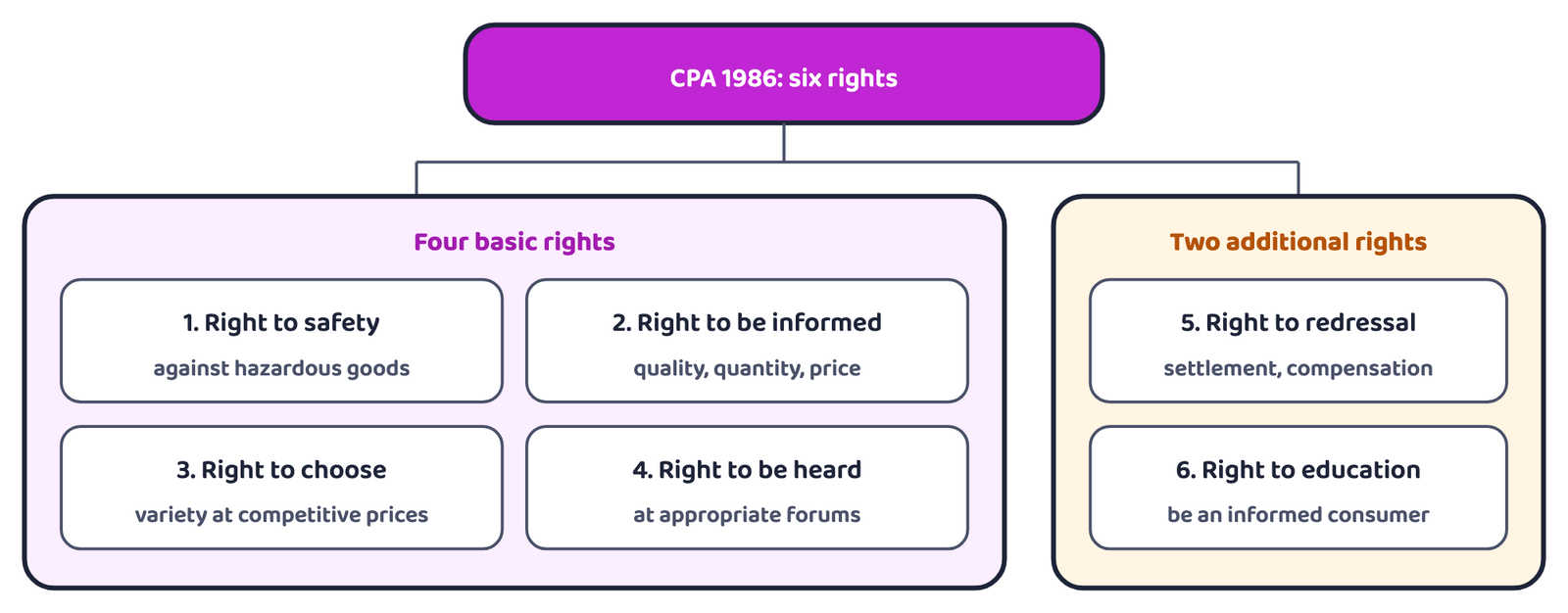
| # | Right | What it means (as in the book) |
|---|---|---|
| 1 | Right to Safety | The right to be protected against hazardous effects on the health/life of a consumer; protection against products, production processes and services hazardous to health or life |
| 2 | Right to be Informed | The right to be informed about the quality, quantity, potency, purity, standard and price of goods and services, to protect against unfair trade practices |
| 3 | Right to Choose | Every buyer has access to products of varying quality, quantity, price, size and design, at competitive prices, and can choose according to his needs and wants |
| 4 | Right to be Heard | Consumers’ interests receive due consideration at appropriate forums; includes the right to be represented in forums working for consumer welfare; the state and voluntary agencies are expected to provide such forums |
| 5 | Right to seek Redressal | Redressal against unfair trade practices or unscrupulous exploitation; fair settlement of genuine grievances; the right to receive compensation for faulty goods and services |
| 6 | Right to Consumer Education | Every person’s right to acquire knowledge and skill to be an informed consumer and make wise decisions while buying goods and hiring services; the consumer should be educated enough to solve the problem himself |
S-I-C-H + R-E
Four basic: Safety, Informed, Choose, Heard. Two additional: Redressal, Education.
Do not call the right to redressal and the right to education “basic” rights. The book has four basic rights; these two are the additional rights.
6 Standardisation Marks
- Another mechanism of consumer protection is through standardisation marks
- Consumers should buy products with a standardisation mark to ensure quality and purity, and should know which products each mark covers
- Standardisation is a prime requisite for attaining quality
| Mark | Given / promulgated by | Products | What it shows |
|---|---|---|---|
| ISI Mark | Certification mark of the Bureau of Indian Standards (BIS), earlier called the Indian Standards Institution (ISI) | Food items (vegetables, fruits and meat products, spices and condiments, processed foods, cereal and soya products, candies, beverages); electrical goods, soaps, detergents, paints, paper | Goods meet the relevant Indian standards; licences are issued to such manufacturers; some items are under mandatory certification |
| AGMARK | Government of India | Agricultural products (food products) | Product reliability; look for the Agmark seal before buying any agricultural product |
| Fruit Product Order (FPO) | Government of India | Fruit and vegetable products | Statutory minimum standards of quality and processing facilities; limits on metallic contaminants and preservatives for fruit products |
| Woolmark | International Wool Secretariat | Wool and woollen garments | The wool is pure; the garment is made only of pure wool, not other fibres |
| Silk Mark | (a quality assurance label) | Silk | Assurance of pure silk; also a brand for generic promotion of pure silk; ensures ‘100% natural silk’ |
| Hallmark | An official Assaying and Hallmarking Centre | Precious metals: platinum, silver and gold articles | The metal conforms to the national/international standard of fineness/purity |
| Ecomark | Scheme operated by BIS | Household consumer products: soaps and detergents, paper, packaging material, plastic products | Logo is an earthen pot; product is environment friendly, produces no hazardous waste, is biodegradable and can be recycled |
| FSSAI | Food Safety and Standards Authority of India, established under the Food Safety and Standards Act 2006 | Articles of food | Lays down science based standards for food; regulates manufacture, storage, distribution and sale so that food is available for human consumption |

Farm → Agmark · Fruit → FPO · Pot → Eco · Jewel → Hall
ISI and Ecomark both belong to BIS; Agmark and FPO are promulgated by the Government of India; Woolmark belongs to the International Wool Secretariat.
When listing “any three standardisation marks”, write each mark with its product, such as “AGMARK: agricultural products”. With FSSAI, always add “Food Safety and Standards Act 2006”.
7 Protection Councils and Consumer Organisations
7.1 Government and statutory bodies
- Statutory, semi-government and non-government bodies look after consumer interests, such as the Bureau of Indian Standards (BIS) and the Directorate of Marketing and Inspection (DMI), Government of India
- The government has also set up Protection Councils at the central and state levels
7.2 Voluntary consumer organisations (NGOs)
- NGOs/voluntary consumer organisations play an important role because of their non-partisan interests (they take no side except the consumer’s)
- They spread information through magazines, booklets, newsletters, buying guides, audio-visual material and research reports
Testing and awareness
Comparative testing of products; awareness about harmful and unsafe products; product recalls
Legal help
Information on new legislative provisions; legal advice and advocacy; handling consumer grievances and complaints
Watch and movement
Act as vigilance groups; hold public meetings; run libraries and documentation centres; important role in consumer awareness, empowerment and the consumer movement
| Consumer organisation | Based in | Publication |
|---|---|---|
| VOICE | Delhi | ‘Consumer Voice’ |
| CERC | Ahmedabad | ‘Insight’ |
| Consumers Union | US | ‘Consumer Reports’ |
| Consumer Association | UK | ‘Which’ |
| Australian Consumers Association | Australia | ‘Choice’ |
8 Consumer Responsibilities
- Every human being has not only rights but also responsibilities; ‘rights and responsibilities’ go hand in hand
- To be able to exercise one’s rights, one must be aware of one’s duties
8.1 The nine responsibilities in the book
| # | Consumer responsibility |
|---|---|
| 1 | Regularly update their knowledge of laws and legislative provisions made by the government |
| 2 | Be honest in all dealings and pay for all purchases |
| 3 | Before buying, do a market survey of brands and features in different shops and markets and compare prices, to make a wise choice |
| 4 | Feel free to choose from the variety available as per needs and requirements |
| 5 | Read all the information on the label/brochure while buying |
| 6 | Buy products with standardisation marks to be assured of quality |
| 7 | Keep receipts and other documents of purchase; they are needed as proof of purchase for filing complaints about defective or malfunctioning products |
| 8 | For services like insurance, credit cards and bank deposits, read and understand all terms and conditions, liabilities and service charges, and get the representative to clarify unclear points |
| 9 | Increase awareness about national and international consumer organisations, their activities, and the benefits of becoming a member |
8.2 Alert consumer and careless consumer
✓ Alert consumer
- Asks for a receipt and keeps it safely
- Reads the label, looks for the mark
- Compares prices
- Pays for every purchase
✗ Careless consumer
- Buys because of “a new pack” or a lucky draw
- Ignores weights without a verification stamp
- Signs insurance or credit card forms without reading the terms
- Takes no action after being cheated
9 Preparing for a Career
9.1 Knowledge and skills required
Knowledge
- Consumer protection mechanisms and redressal agencies
- Quality standards of various kinds of products
- Adulteration and detection of adulterants
- Consumer protection laws, consumer rights and responsibilities
Soft skills
- Good communication and interpersonal skills
- Empathetic and understanding attitude; being a good listener
- Creativity in developing programmes, advertisements and talks for consumer awareness
- Writing skills for educational material and reporting consumer tests; willingness to help fellow consumers and the public
9.2 Courses

- In different institutions the subject may be called Consumer Studies, Consumer Education, Consumer Behaviour or Consumer in the Market
- These programmes create overall awareness and training on Consumer Affairs, with special emphasis on Consumer Protection
- At the postgraduate level, Family Resource Management is also offered; these courses deal with consumer empowerment, protection and consumer behaviour
9.3 Scope
| # | Where | Work |
|---|---|---|
| 1 | Government organisations: Bureau of Indian Standards, Directorate of Marketing and Inspection, Ministry of Consumer Affairs | Decision-making managerial and technical positions |
| 2 | Voluntary consumer organisations | Product testing, consumer awareness, consumer education or empowerment, publishing their magazine |
| 3 | Consumer division of corporate houses | Consumer complaints and suggestions; customer relationship management and customer facilitation (customer databases, one-to-one dealing) |
| 4 | Market research organisations | Consumer behaviour, product reach, acceptance of new products, consumer feedback and suggestions |
| 5 | Your own consumer organisation | Working on the issues discussed in the chapter |
| 6 | National Consumer Helpline | Consumer counselling; helping people get redressal of complaints |
| 7 | Schools and colleges | Consultant to consumer clubs (managing and planning their educative and outreach activities); teaching consumer studies; freelance consultant for redressal guidance through consumer courts and other alternative redressal mechanisms |
| 8 | Department of Audio-visual Publicity | Content developer for consumer awareness advertisements in print and electronic media |
| 9 | Consumer testing laboratories | Analyst for comparative evaluation of products |
| 10 | Consumer Protection Courts | Consumer activist: with legal training, can plead cases |
| 11 | Journalism | People with excellent writing skills can report on consumer affairs |
| 12 | Financial management (with additional training) | First at junior level; later insurance, shares and financial portfolio management |
10 Practical and Activities
From the syllabus (not the book): this is practical 6 (5 marks) in the CBSE 2026-27 practical list, and it is also in the HBSE practicals: preparing a leaflet on consumer education and protection. The book’s Practical 1 gives the full method.
- Topic (any one): (a) Consumer Protection Act (b) Consumer Rights (c) Consumer responsibilities (d) Standardisation marks (e) Consumer problems/redressal. The CBSE list also names “consumer organisation”
- Tasks: collect relevant information; compile it in the limited space of a leaflet; put the concepts simply so the target group understands; give each write-up a crisp introduction, body and conclusion or application
- Purpose: learn the art of preparing a leaflet for an awareness camp; express content simply with heading, sub-heading and salient features; create awareness on consumer education
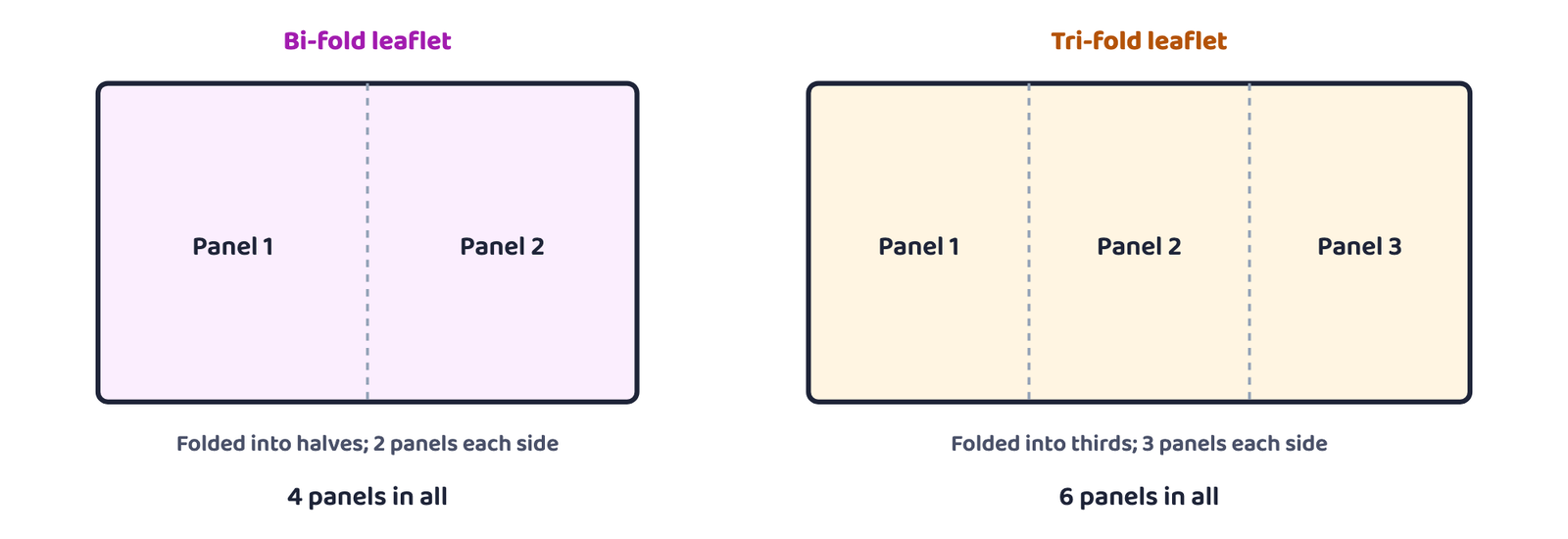
| Part of the leaflet | Point to keep in mind |
|---|---|
| Heading | Normally the most important part, because it first catches the eye; brief, summarising the theme in short, forceful words |
| Subheading | Used when the main heading cannot summarise the text and more explanation is needed; also to introduce separate paragraphs and bridge the gap between headline and text |
| Text | The first one or two sentences carry the substance of the message, then facts and details; simple and to the point; normally only one theme (two or more unrelated themes confuse the reader) |
| Pictures | Preferably photographs; picture and text must complement each other, convey the same idea and expand each other’s ideas |
- Activity 1: interview five people in your locality about consumer problems they faced and actions they took
- Activity 2: Group A surveys knowledge of consumer rights and Group B awareness of consumer responsibilities (three people each)
- Activity No. 4: keep a newspaper cutting of a case reported under the Consumer Protection Act and discuss it
- Activity No. 5: check the labels of ten daily-use commodities (spices, biscuits, bulbs, sugar, sauce, jam) for standardisation marks
- Activity No. 6: list the subjects on offer at undergraduate degree, diploma and certificate programmes on university websites
- Activity No. 7: list postgraduate diploma and degree courses in consumer studies, courses offering it as a subject, and their eligibility
- Every human is a natural consumer; consumer education makes an efficient and alert consumer
- Significance: globalisation, ‘global village’, liberalisation gives more choice but harder choosing; consumer must be a progressive force
- Consumer behaviour = process of purchase decisions; footfalls = customers visiting a store or mall
- Seven expectations: price, information, genuine, quality, purity, ethics, correct weights
- Nine problems: substandard goods, adulteration, high prices, lack of information, inadequate information (labels, ads, buying guides, packaging), incorrect weights, spurious products, sales promotion schemes, services
- CPA 1986: six rights (4 basic + 2 additional), self help, simple-speedy-inexpensive redressal, two implications (complain, compensation)
- CPA 2019: central regulator, strict penalties for misleading ads, e-commerce guidelines
- Marks: ISI (BIS), Agmark (agricultural), FPO (fruit and vegetable products, metallic contaminants, preservatives), Woolmark (International Wool Secretariat), Silk Mark, Hallmark (platinum, silver, gold), Ecomark (earthen pot), FSSAI (Act 2006)
- Protection Councils at central and state levels; VOICE ‘Consumer Voice’, CERC ‘Insight’, ‘Consumer Reports’ (US), ‘Which’ (UK), ‘Choice’ (Australia)
- Nine responsibilities: update knowledge, honesty, market survey, free choice, read labels, standard marks, keep receipts, read terms, know consumer organisations
- Leaflet: bi-fold = 4 panels, tri-fold = 6 panels; heading is the most important part
- Can I define consumer product, consumer behaviour, consumer forum and consumer footfalls?
- Can I write at least five consumer problems with an example each?
- Can I divide the six rights into basic and additional and explain each?
- Can I name the product and the body for all eight standardisation marks?
- Can I write the nine consumer responsibilities and five areas of career scope?