
- define development, development journalism and development communication, and list the four essential features of development communication
- explain why communication and journalism matter for society and democracy
- give the facts, partners and aims of a multi media campaign like the Red Ribbon Express
- explain the four methods of communication (campaign, radio and television, print media, ICTs) with the book’s examples, and tell community radio from All India Radio
- list the knowledge and skills needed for a career in this field, and its scope and career avenues
1 Unit VI Introduction: Communication and Extension
- India is making a concerted effort to reach higher levels of development, so that its benefits reach all, including the vast rural population
- Today’s ‘information society’ uses the discipline of Communication and Extension to create awareness, sensitise, educate and empower the masses
- Communication and Extension Education are crucial ingredients in the country’s efforts to meet the needs of families and communities for their development
- The discipline gives a core curriculum that joins theory and practice in planning development programmes, media and communication; students learn to analyse development programmes, policies and the role of mass media and journalism
- National and international donors and development agencies now share information through websites, publications, videos and interactive multi-media; NGOs have become more sophisticated in using media and communication strategies
- With globalisation, the need to understand international development issues has increased
Advocacy means to be an advocate for a cause. It is not used here in terms of legal provisions but largely to support a cause, such as preventing early marriage of girls, enhancing educational opportunities for children in rural and tribal areas, or preventing deforestation.
- Advocacy is gaining popularity as a way to sensitise society about the needs of the disadvantaged
- It involves lobbying with governments and multilateral bodies to build alliances and networks, and to inform supporters
- So there is an increasing demand for staff with media skills. Graduates can work in the communication and information departments of national and international development agencies, and in extension and advisory services in the public, commercial and not-for-profit sectors, or choose an independent career in development communication
1.1 Sustainable Development Goals and extension programmes
- These goals are commonly known as the Sustainable Development Goals (SDGs)
- The SDGs are global, but each country adapts them to suit its specific local development needs
- They give the whole international community a framework to work together towards a common end: human development reaching everyone, everywhere
| Challenges India faces (in the light of the SDGs) | What extension programmes do |
|---|---|
| Poverty alleviation, enhancing food security, improving health and sanitation, non formal education, environmental conservation and gender equity. These remain the major goals of extension programmes. | Extension educators extend critical information, transfer new technologies and build skills and capacities of different stakeholders (everyone with a part in the programme) working in development programmes, NGOs, education and research institutes, and as entrepreneurs. |
- Over time, extension programmes have evolved new methodologies and strategies to enable behaviour change, so that people adopt healthy practices
Who needs such persons
Government ministries/departments, international agencies, NGOs, voluntary agencies, and even corporate bodies involved in corporate social responsibility activities
What they do
Give direct technical assistance and devise Social and Behaviour Change Communication (SBCC) strategies, interventions, tools and training for programmes of health, nutrition, education, HIV/AIDS, natural resource management and social development
Other names of this domain
Education Extension or Extension Education; Extension and Development Communication; Home-Science and Communication Management; Development Communication and Extension; Extension and Communication. The core stays the same; emphasis and coverage decide the name.
2 Introduction and Significance
2.1 Communication and journalism
- Communication is an integral part of our social and professional life
- Besides news, television, radio and newspapers carry issues of health, environment, consumption, poverty and other topics
- Mass media (means that reach very large numbers of people at once) have the power to investigate and question what is happening, where and why
- Development Journalism is a social activity: through various media, the journalist communicates the feelings of the community to the community
- Journalism is an inseparable part of any democratic system; the Press plays a vital role in democratic society
- People’s participation is the foundation of democracy
- The Press is called the fourth pillar of democracy
- The theory and practice of development communication and journalism keep evolving; it is characterised by conceptual flexibility
2.2 Significance: how communication helps development
Creates awareness
about the technologies that are available
Mobilises people
to use these technologies for the betterment of society
Links
Government agencies, NGOs and people
- As fields of study, development communication and development journalism sensitise students to the process of development and train them to write and/or speak about issues of an equitable and impartial society
- They aim at equipping students, current and prospective journalists, campaigners and media professionals to deepen their knowledge and practical skills on development issues
3 Basic Concepts
3.1 Development
Development means positive changes in the socio-economic and cultural lives of the majority of people on a permanent basis without exploitation or violence.
- In most parts of the world, development calls for intensive efforts to tackle mass illiteracy, population, malnutrition, poor health, hunger and pollution
3.2 Development Journalism
Development Journalism focusses on success stories of people who have adopted new technologies, tried new methods and helped the society. It seeks to describe the people at work in new projects and processes.
Before independence (colonial era)
- Reports on struggles, fights, assassinations, disasters and wars
- Whatever the colonial rulers chose to communicate
Development journalism (after the colonial era)
- A relatively newer concept; came into existence after the colonial era ended
- Newly liberated countries like India saw a lot of expansion in development activities, and journalists had to take notice
- Success stories and people at work in new projects
3.3 Development Communication
Development Communication is utilising the power of communication as a catalyst for social development. It is the practice of systematically applying the processes, strategies and principles of communication to bring about positive social change.
It is the ‘art and science of human communication’ used for facilitating development of a disadvantaged society in a planned manner to ensure equity and achievement of individual potential.
The book’s description of development communication (a catalyst is something that speeds up a change)
Essential features of development communication
Development-oriented
Oriented to socio-economic development and happiness of the people and the community at large
Informs and educates
Aims at giving information and educating the community
Combines channels
Combines suitable mass media and interpersonal (face-to-face) communication channels for greater impact
Audience-based
Based on the audience characteristics and their environment
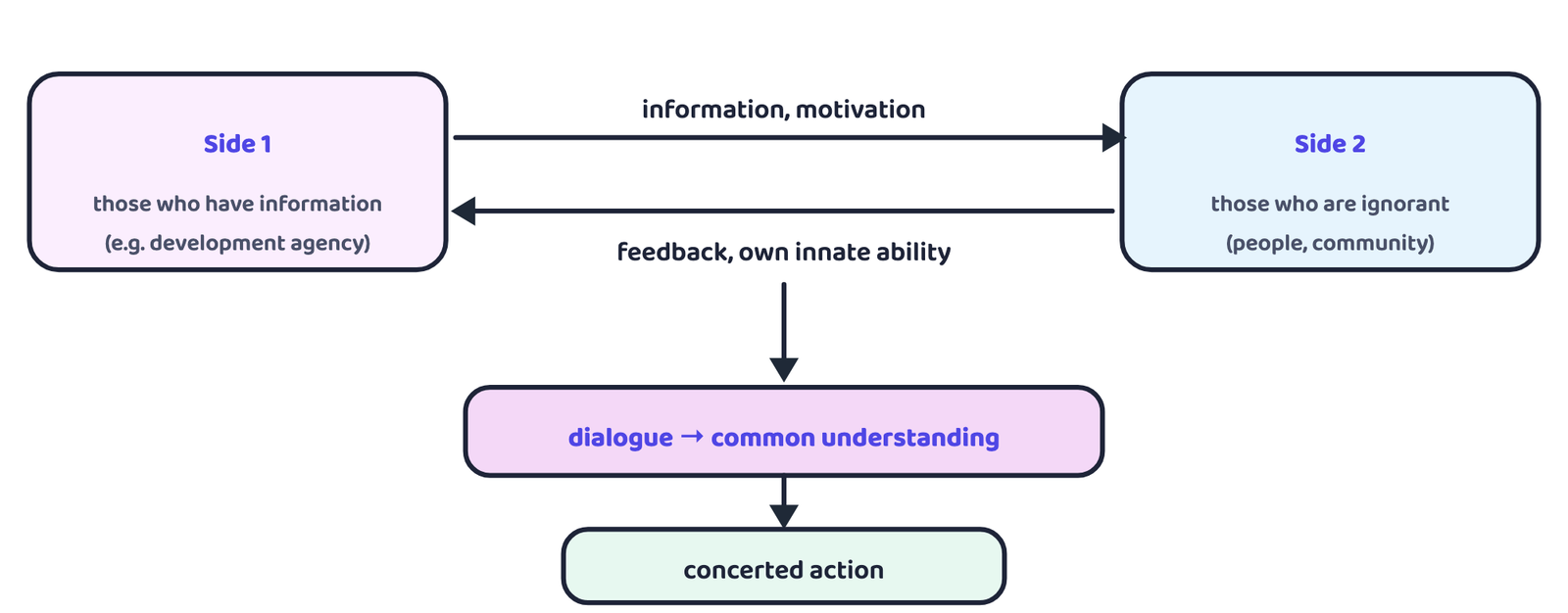
- Development communication is a two way process of communication between those who have information and those who are ignorant
- It assumes that people who face the problem have the innate ability (an inborn ability) to find solutions; they may need help in seeking resources
- It views motivation as the key element
- It tries to build dialogue between people and development agencies
- So it is a social process designed to seek common understanding or consensus among all participants, leading to concerted action (action taken together)
The three definitions are asked separately. Development = positive, permanent change without exploitation or violence. Development journalism = success stories and people at work in new projects. Development communication = using communication systematically as a catalyst for social development (term coined in 1972 by Nora Quebral). The CBSE sample paper asked which option best describes development journalism.
3.4 Development communication initiatives: where and on what
- Such initiatives have been carried out in India and in developing countries like Brazil, Peru, Indonesia and Bangladesh
- They use technologies and mass communication chiefly for development, involving local people and finding sustainable solutions
- Campaigns on mass media channels have been run for prevention of smoking, tuberculosis and HIV/AIDS, and for promotion of sanitation literacy, immunisation, safe child birth and consumer awareness through campaigns like ‘Jago Grahak Jago’
4 Red Ribbon Express (RRE): A Multi Media Campaign
The book’s example of a multi media campaign, run with coordination between all the participants or stakeholders, aimed at breaking silence about HIV/AIDS in rural areas of India.

- RRE was a nationwide communication campaign for generating awareness about HIV/AIDS
- Its seven coaches carried: educational material (mainly on HIV/AIDS), interactive touch screens and 3-D models, services for HIV-TB co-infection, an LCD projector and a platform for folk performances, counselling cabins, and two doctors’ cabins for counselling and treatment
- RRE started its journey from Kanyakumari, followed the ‘parikrama’ style (going round), halted at 180 stations and covered almost all the states of India
- At each halt the performing artists split into groups; each group had orators and performers who went to different villages
- There they held Information Education Communication (IEC) activities: street plays, folk songs, stories and group counselling sessions
- Locally mobilised youth groups joined the team from the train
| Implemented by | It aimed to |
|---|---|
| National AIDS Control Organisation (NACO), Nehru Yuva Kendra Sangathan (NYKS) and international agencies such as UNICEF and UNAIDS, in cooperation with Indian Railways | (1) Spread information regarding primary prevention services (2) Develop an understanding of the disease, to reduce stigma and discrimination against people with AIDS (3) Enhance people’s knowledge about preventive measures, health habits and lifestyle |
The HBSE syllabus lists the Red Ribbon Express as a separate sub-topic. Remember its four numbers (over 9,000 km a year, 180 stations, 43,200 villages, seven coaches), where it started (Kanyakumari) and the partner organisations.
5 Methods of Communication
Many methods are used in this field. The book reviews four selected methods:
5.1 Campaign
A campaign is a combination of the usage of different communication methods and materials, such as meetings, tours, newspaper articles, leaflets and exhibitions, about a theme for a predefined period of time.
- It is a well organised and intensive activity
- It creates public awareness and provides a specific message
- Use of dramatics through different channels ensures attention and interest
- It lasts in the memory of the people and stimulates action
- It creates a conducive environment (a helpful setting) for adoption of practices
- Launched by the Prime Minister of India on 2nd October 2014 to speed up efforts for universal sanitation coverage
- Implemented as a nation wide campaign/Janandolan (people’s movement)
- Aim: eliminating open defecation in rural areas during 2014 to 2019
- How: mass scale behaviour change, construction of household-owned and community-owned toilets, and mechanisms for monitoring toilet construction and usage
A slogan is short, catchy and easy to repeat. On immunisation, for example: “Get the vaccine on time, keep your child disease-free”. The book’s own campaign names, ‘Jago Grahak Jago’ (consumer awareness) and Swachh Bharat (sanitation), work the same way.
5.2 Radio and Television
- Radio and television are the most popular, cheapest and convenient mass media that can be used for development
| Radio compared with | Advantage of radio (as the book gives it) |
|---|---|
| Print media | Reaches more people, particularly those with poor literacy levels |
| Television | Available at a comparatively lower cost |
| All mass media | Radio is the most accessible mass medium; it is a mobile medium, i.e. it can move with the listener at work or rest |
Radio programmes and Public Service Announcements
- Radio programmes come as news, interviews, discussions, documentaries, drama, quiz etc.
- News covers many topics in a short time; interesting facts and stories of current human interest are broadcast at regular intervals
A Public Service Announcement (PSA) is a brief 10-60 second message between programs, generally in the form of jingles. It is basically an advertisement of an idea or a message for public good.
- PSAs provide information or suggestions for action
- They are found quite effective because of their catchy slogan(s) and repeated broadcasts
Community Radio (CR / CRS)
- The earlier limitation of radio was that it did not receive feedback; newer interactive formats, local radio stations and community radio have overcome it
- Because radio is so popular, the Ministry of Information and Broadcasting introduced the concept of a ‘local radio station’ called Community Radio, where local people play an important role
- With a small investment, and training of a few local people by NGOs, a station can be set up, broadcasting in a limited area
- It is run and managed by local people; the contents are for local use in their local dialect
- It supports local development programmes and lets people participate, express their views and display their talents
- Radio thus becomes the voice of the people, a catalyst for people’s development, and encourages youth to prepare for a career in DCJ (Development Communication Journalism)
- NGOs and educational institutions can seek a license to set up a community radio station to broadcast information on development; participation of the local community is encouraged
- It is also used as an information dispenser about government policies, entitlements, programmes, schemes and services
- Participatory content development (the community helps make the programmes)
- Participatory appraisal (the community helps judge them)
- Rapport formation with the community (a relationship of trust)
| Successful community radio examples | Place |
|---|---|
| Vanasthali Vidyapeeth | Rajasthan |
| Self Employed Women’s Association (SEWA) | Gujarat |
| Delhi University (DU) FM | North Delhi |
These stations help communities voice their problems and find solutions.
Community radio and All India Radio: the difference
Community radio (from the book)
- Run and managed by local people
- Broadcasts in a limited area
- Local dialect, local content
- Small investment
- License to NGOs and educational institutions
- Listeners participate and give feedback
All India Radio (general knowledge)
- The government’s public broadcaster (under Prasar Bharati)
- Broadcasts to the whole country or large regions
- Major and regional languages for a wide audience
- Large stations, high cost
- Programmes made by professional staff; listeners mainly listen
This difference is Review Question 4, and the CBSE sample paper asked it for 2 marks. Write the community radio side from the book: run by local people, limited area, local dialect, small investment. The book does not describe All India Radio, so that column is marked general knowledge.
EDUSAT and television
- Television today offers a variety of programmes through channels at international, national and local levels
- Some programmes let people participate: talk shows, reality shows, competitions
- Programmes of immense educational value, like ‘Kyunki Jeena isi Ka Nam hai’ and ‘Main Kuch Bhi Kar Sakti Hun’, can be viewed on private channels
- These show how education and entertainment can be harnessed together for common good
5.3 Print media
- The bulk of news in national and regional dailies is urban in its approach
- Reports on agriculture, problems of rural areas and other development concerns remain low in priority
- Few newspapers and periodicals operate in rural areas covering local themes
- Still, the power of press cannot be denied; though good examples are few, it is a medium of continuous education
Project Village Chhatera: a success story
- A team of enterprising reporters wrote with sensitivity, giving detailed stories of the situation in the village
- The column proved to be a catalyst in bringing various services and benefits; solutions came because local leaders paid attention
- There is a dearth (shortage) of DCJ professionals who write with passion and sensitivity for the rural poor; Communication and Extension students can take this up to show the impact of the Press on development
What a print journalist does
- A story lead is the first piece of information about a newsworthy event from which a full story is built
- For development journalists the internet is a valuable research tool; without a basic level of computer literacy one cannot work satisfactorily
5.4 Information and Communication Technologies (ICTs)
Information and Communication Technologies (ICTs) is an umbrella term that includes computer hardware and software, digital broadcast and telecommunications technologies.
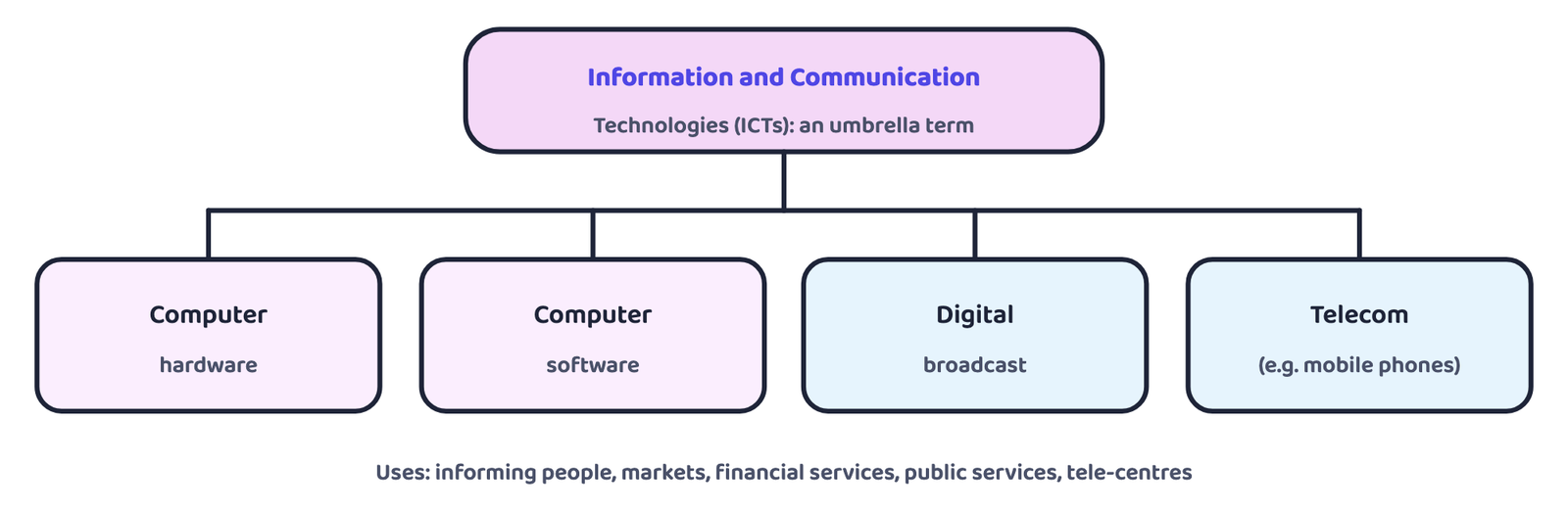
- ICTs have been used for informing people
- In both poor and wealthy countries, mobile phones have enabled the expansion of markets, social business and public services
- Economic services enabled by mobile phones include banking and financial transactions, marketing and distribution, employment and public services
- ICTs are proving to be economically, socially and politically transformative
- A more direct way of using ICTs to better the lives of the poor is setting up tele-centres; many such projects started in India over the last decade or so
SARI project (Tamilnadu)
- Full name: Sustainable Access in Rural India
- Some 80 tele-centre kiosks set up
- Services: basic computer education, e-mail, web browsing, and e-government services including the provision of certificates
Empowering Women at the Grassroots: SEWA and ICTs
- Self Employed Women’s Association (SEWA): a union of several thousand poor women working in the informal sector
- Aim: full employment and self-reliance for women workers
- Support in income, food and social security (health, childcare and shelter)
- Vision: make ICTs a tool for empowering its grassroots members
- SEWA understood the effect of poor access to information on poverty and brought ICTs into its work
- It runs programmes that build women’s abilities in using computers, radio, television, video, telephone, fax machines, mobile phones and satellite communication
- Community Learning Centres (CLCs) in rural areas focus on IT training, including electrical, mechanical and IT engineering
- Besides savings in time and cost, members get quick and easy communication and problem-solving across districts
5.5 The four methods at a glance
| Method | Key strengths (as in the book) | Book’s example |
|---|---|---|
| Campaign | Many methods combined; intensive; specific message; lasts in memory; conducive environment | Swachh Bharat Mission, Red Ribbon Express, Jago Grahak Jago |
| Radio and Television | Popular, cheapest, convenient; radio reaches poor-literacy listeners; mobile medium | PSAs, community radio, EDUSAT |
| Print media | Power of press; medium of continuous education; but rural news low in priority | Project Village Chhatera (1969) |
| ICTs | Umbrella term; economically, socially and politically transformative | SARI tele-centres, SEWA |
For “Why would you choose a campaign instead of print media?” use the book’s points: a campaign combines several methods (meetings, tours, exhibitions, leaflets) and its dramatics ensure attention and interest; it is intensive with one specific message and lasts in memory, stimulating action. In print media the bulk of news is urban, and rural concerns stay low in priority.
6 Knowledge and Skills Required for a Career in this Field
| Skill | What it means and why it is needed |
|---|---|
| Cognitive skills | To be able to comprehend an issue |
| Creative skills | To project issues and concepts in a creative way to attract attention and make an impact |
| Media skills | Media designing, production and technical instrument handling give an advantage in jobs with media houses and advertising agencies |
| Technical skills | A development filmmaker needs camera techniques and video production, apart from content development and implementation; editing skill comes handy for marketing management; operating equipment correctly |
| Laws and regulations | To know what they can and cannot do |
| Presentation and interviewing techniques | To deliver smooth and entertaining programs; also the computers used to operate the station, basic radio production with suitable software, and writing a creative brief that communicates |
| Journalistic + presentation skills | Interest in current affairs and local conditions, hands-on experience in radio, the ability to communicate and knowledge of music are useful |
| Questioning ability | Helps to look into the finer details of any issue; passion for adventure and travel is an added advantage, as travel to remote parts gives unique stories |
| Ability to work with diverse groups | Imperative for a development communication student: being people centric, knowing the principles of social work, leadership skills |
| Good listener and interpersonal skills | Listening helps one write with sensitivity; interacting professionally with staff, partners and consultants is the demand of present day work culture |
| Language and computer skills | Command of any one language (speaking, writing, reading, writing technical reports and documents); Microsoft Office: Word, Excel and PowerPoint |
- As an apprentice (a learner working under guidance), a development communication student gains real experience by writing a radio spot and having it recorded and scheduled for airplay
Helping people help themselves.
The book: the guiding principle for working with diverse groups
“Ability to work with diverse groups is imperative for a development communication student” (CBSE sample paper, 2 marks). Two reasons: (1) being people centric lets the student understand people’s viewpoint on issues affecting their lives; (2) only then can solutions be found that will work for those people.
7 Scope and Career Avenues in Development Communication
7.1 Scope
This field uses a variety of media and communication techniques to address the issues below, so it has a wide scope in terms of content and use:
Information dissemination and education
spreading information and educating people
Behavior change
helping people adopt healthy practices
Social marketing
“selling” a social idea to people
Media advocacy
supporting a cause through the media
Communication for social change
bringing positive change in society
Participatory development communication
development with people’s participation
- Training, advisory and action projects that build the communication capabilities and resources of people in the development process also fall in its scope
- A specialist can take up careers in the social sector: media houses, government and non-government organisations
- Large scale projects are run by Government departments with the help of international agencies, so employment opportunities are satisfying both economically and psychologically

- Development communication offers a vast range of careers and will diversify in the future too
8 Practicals and Activities
- Task: listen to and record a PSA on radio for its content, relevance, impact and technique
- Purpose: gain an insight into how radio as a mass medium creates awareness through PSAs
- Procedure: divide the class into four groups; each group listens to the recorded PSA, analyses it on the given parameters, then scores its quality
- Parameters to describe (8): topic/message, date and time, duration, techniques used (e.g. dialogue with humour/jingle), channel, target group, medium of instruction, objectives
- Parameters to rate (10): suitability of the day/date/time, engaging the listener, creating interest, promoting awareness, motivating the audience, selection of voice over (the speaking voice), clarity of message, clarity of sound recording, appropriateness of sound effects, mention of the source or originator of the PSA
- Scoring: Excellent (3), Good (2), Average (1), Poor (0) for each; Total Score out of 30
- Discussion: the contribution of radio PSAs in creating awareness about social issues like Swachh Bharat Abhiyan for sanitation
Plan any five messages on nutrition, health and life skills, each for a different focal group (e.g. pregnant women, adolescents, the elderly, mothers, school children) and through a different mode of communication (e.g. poster, radio PSA, street play, leaflet, mobile message). For each, write the focal group, the mode, the message text and why that mode suits that group.
- Activity 1: two issues on which campaigns were run, their methods and materials, and your part in them
- Activity 2: plan and list programmes for a campus radio of your school or colony
- Activity 3: a list of awareness programmes/jingles on national and local channels; a quiz
- Activity 4: a local newsletter or small newspaper: its circulation, contributors and editorial board
- Activity 5: your opinion on an issue concerning people in your colony, village or locality
Development communication, mass communication (communication that reaches large numbers of people at once through mass media such as radio, TV and newspapers), campaign, community radio, print media, Information and Communication Technologies (ICTs), questioning.
- SDGs: 17 goals set by world leaders in 2015, adapted locally; extension programmes for India’s challenges; SBCC; advocacy = support a cause
- Journalism: inseparable part of democracy; people’s participation is its foundation; Press = fourth pillar; conceptual flexibility
- Development = positive permanent change without exploitation or violence; development journalism = success stories, after the colonial era
- Development communication = communication as a catalyst; coined in 1972 by Nora Quebral; four features; two way process; motivation the key element
- Red Ribbon Express: HIV/AIDS; seven coaches; over 9,000 km a year; 180 stations; 43,200 villages; Kanyakumari; parikrama; NACO, NYKS, UNICEF, UNAIDS, Indian Railways
- Four methods: campaign · radio and television · print media · ICTs
- Campaign example: Swachh Bharat Mission, 2nd October 2014, open-defecation-free rural India 2014 to 2019
- Radio: cheapest, reaches poor literacy, most accessible, mobile medium; PSA 10-60 seconds, jingles
- Community radio: Ministry of Information and Broadcasting; local people run it; limited area; local dialect; license to NGOs and educational institutions; Vanasthali, SEWA, DU FM
- EDUSAT: September 2004, first education-only satellite; Chhatera: 1969, Hindustan Times, fortnightly column
- ICTs: umbrella term; tele-centres; SARI Tamilnadu some 80 kiosks; SEWA: full employment and self-reliance, CLCs
- Skills: cognitive, creative, technical, questioning, diverse groups, good listener, language and computer
- Careers: development journalist, research scholar, trainer, freelancer and consultant
- Can I write the definitions of development, development journalism and development communication separately?
- Can I list the four essential features of development communication and say who coined the term, and when?
- Can I give the four numbers, the partners and the three aims of the Red Ribbon Express?
- Can I write two or three differences between community radio and All India Radio?
- Can I give the year and main points of Project Village Chhatera, EDUSAT and the Swachh Bharat Mission?
- Can I list the main skills and the four career options in this field?