
- Explain C. Wright Mills’s sociological imagination: how a personal trouble is linked to a public issue
- Show why we belong to more than one “society”, and why societies are plural and unequal
- Tell sociology apart from philosophical and religious reflection and from common sense, with the book’s poverty example
- Describe the intellectual ideas and the material issues (capitalism, industrialisation, the city, clock-time) that gave birth to sociology
- Explain how sociology grew in India under colonialism, and why sociology and social anthropology have no rigid divide here
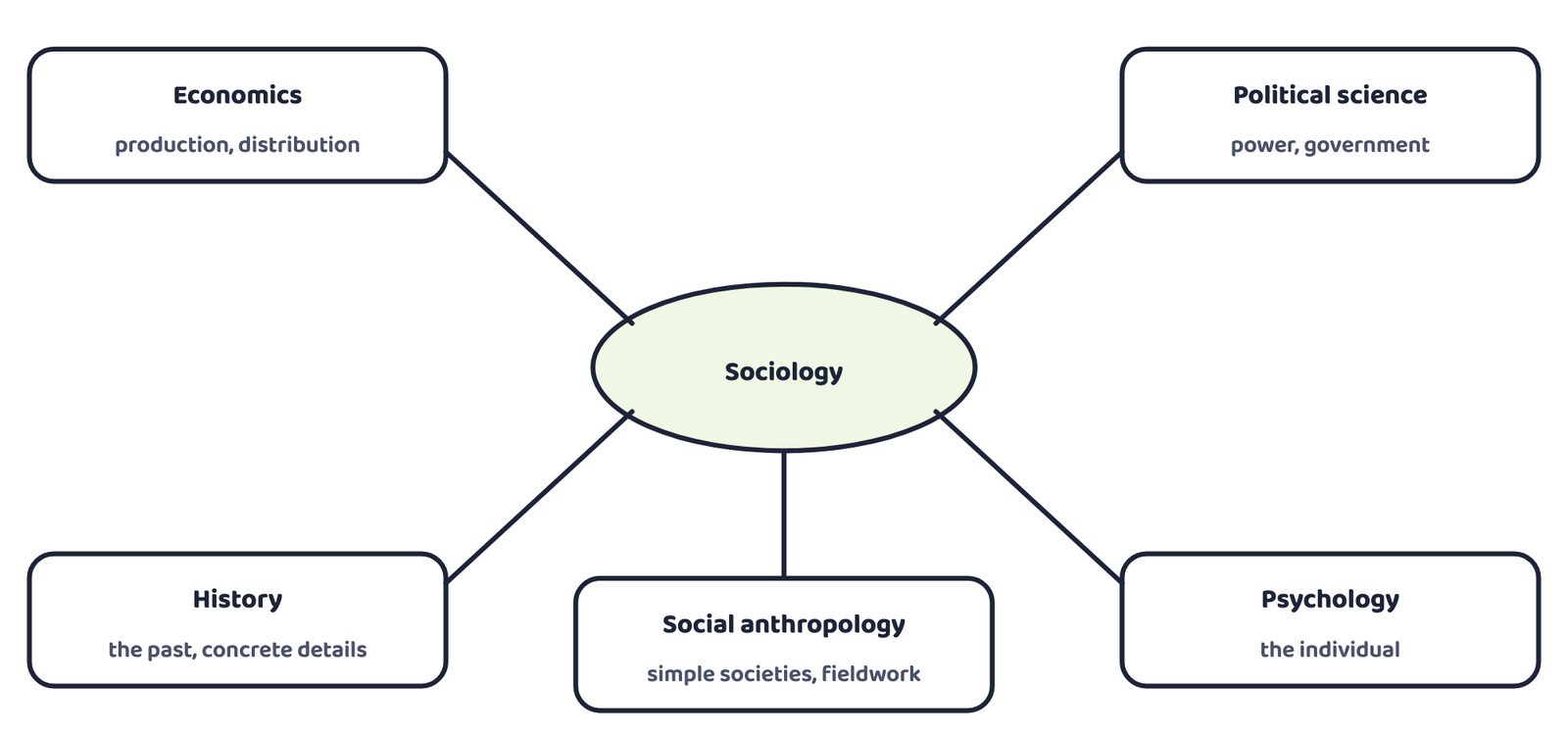
- Compare sociology with economics, political science, history, psychology and social anthropology
| Board (2026-27) | Marks for this chapter | Paper |
|---|---|---|
| CBSE (039) | 10 marks (Unit 1, “Sociology, Society and its Relationship with other Social Sciences”) | Theory 80 + project 20 |
| UP Board | 10 marks | One 100-mark theory paper, no project |
| Rajasthan Board (RBSE) | 10 marks | One 100-mark theory paper |
| MP Board | 8 marks | Theory 80 + project 20 |
Every board above examines the whole chapter. CBSE’s unit lists individuals and collectivities, pluralities and inequalities among societies, the emergence, nature and scope of sociology, and its relationship with other social science disciplines: that is every section of these notes.
1 Introduction: Your Choices Are Not Only Yours
The chapter opens with four pieces of advice that students often hear when they choose subjects:
“Study hard”
Work hard and you will do well. The onus (responsibility) rests on the individual.
“Take this subject”
Some subjects give a better chance of a good job. The job market matters.
“As a boy / as a girl…”
Is this a practical choice for your gender?
“Your family needs you”
Get a job soon, or join the family business. Family and social background matter.
The first advice puts everything on the student. The other three show that outcomes also depend on things outside the student. The book’s point: individual efforts matter a great deal but do not necessarily define outcomes.
Who even decides what a “good job” is? Money, respect, social recognition or personal satisfaction? Different societies answer differently, so culture and social norms play a role too. This gives a first sense of how sociology studies human society as an interconnected whole, and how society and the individual interact.
1.1 The six themes of the chapter
| # | Theme |
|---|---|
| 1 | The connection between a personal problem and a public issue. Choosing subjects worries one student, yet it affects students as a collective entity (all students together, as a group). |
| 2 | The individual in modern times belongs to more than one society, and societies are unequal. Whether a job is respected depends on the culture of the student’s “relevant society”, the society whose opinion counts for her. But which is it: neighbourhood, community, caste or tribe, the parents’ professional circle, the nation? |
| 3 | Sociology is a systematic study of society, distinct from philosophical and religious reflection and from everyday common sense. |
| 4 | The intellectual ideas and material contexts in which sociology was born: mainly western, with global consequences. |
| 5 | How sociology emerged in India. |
| 6 | The scope of sociology and its relationship to other disciplines. |
Just as each of us has a biography, so does a discipline. Understanding the history of a discipline helps us understand the discipline.
This is why the book studies how sociology began.
2 The Sociological Imagination: Personal Problem and Public Issue
The advice in Section 1 showed that the individual and society are dialectically linked: they act on each other, sometimes pulling in opposite directions. “Dialectic” is one of the chapter’s glossary words.
Dialectic: the existence or action of opposing social forces, for instance, social constraint and individual will.
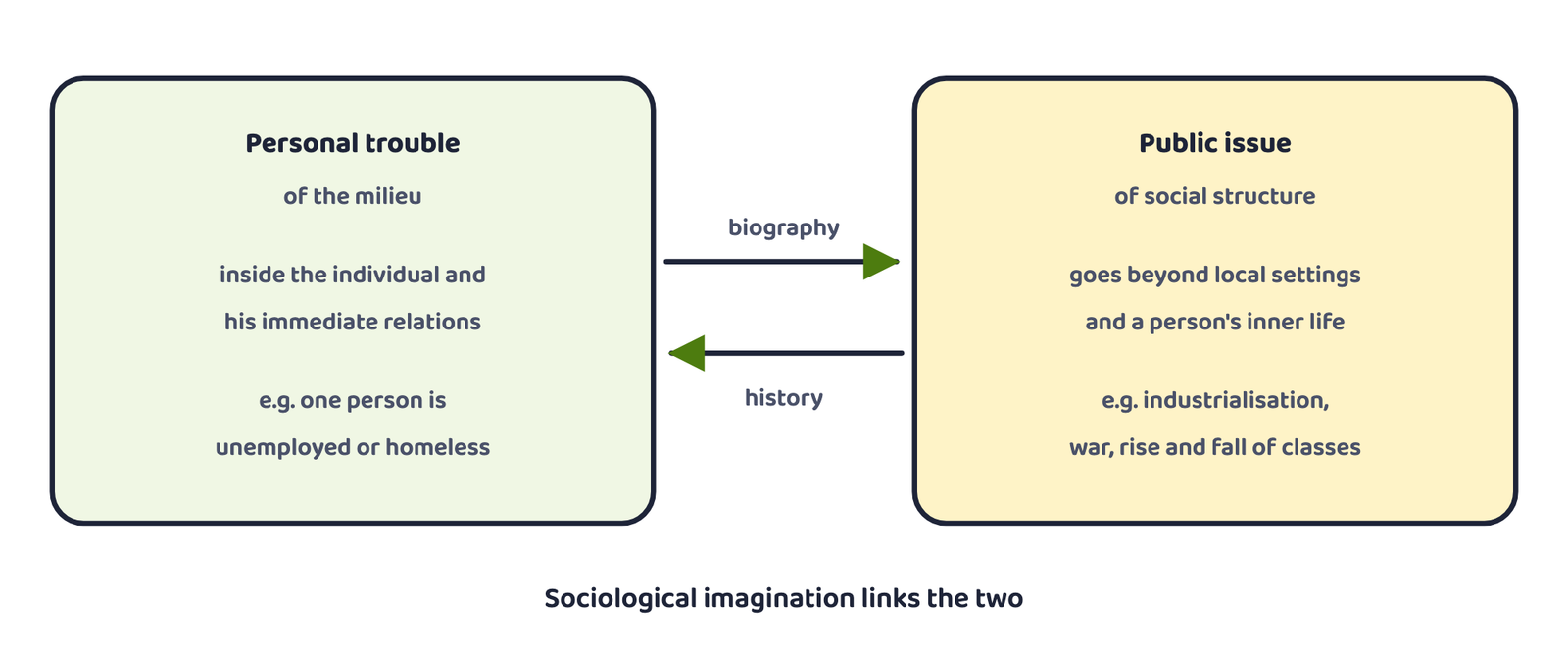
The sociologist C. Wright Mills built his idea of the sociological imagination on exactly this link between the personal and the public.
Sociological imagination (C. Wright Mills, 1959) enables us to grasp history and biography and the relations between the two within society. Mills calls this its “task and promise”.
Mills calls perhaps the most fruitful distinction the one between “the personal troubles of the milieu” and “the public issues of social structure”. A milieu is a person’s immediate surroundings. Social structure means the larger, lasting arrangement of society: its economy, classes, government and institutions, which no single person controls.
| Public change (history) | What happens to individual lives (biography), in Mills’s examples |
|---|---|
| A society is industrialised | A peasant becomes a worker; a feudal lord (a big landlord of the old order) is liquidated (wiped out) or becomes a businessman |
| Classes rise or fall | A man is employed or unemployed |
| The rate of investment (money put into business) goes up or down | A man takes new heart or goes broke |
| Wars happen | An insurance salesman becomes a rocket launcher, a store clerk a radar man; a wife lives alone; a child grows up without a father |
Mills’s conclusion: neither the life of an individual nor the history of a society can be understood without understanding both.
2.1 Homelessness: a personal trouble that is a public issue
Activity 1 in the book shows a photograph of a poor, homeless couple. Their homelessness looks personal, but the sociological imagination explains it as a public issue, with causes such as employment possibilities and rural to urban migration.
The “Pradhan Mantri Awas Yojna–Gramin”, operationalised from 2016, is a major scheme of the Ministry of Rural Development (MORD). It provides financial and labour support to houseless families and to those living in dilapidated kutcha houses, so that they can build pucca houses.
For any “attempt a sociological understanding of a personal problem” question, use Mills’s two terms by name: state the personal trouble, then name the public issue of social structure behind it, then link them (history and biography).
3 Pluralities and Inequalities among Societies
3.1 We belong to more than one “society”
Among foreigners, “our society” may mean Indian society. Among fellow Indians, the same words may mean a linguistic or ethnic community, or a religious, caste or tribal society. This plurality (many societies at once) makes it hard to decide which “society” we are talking about. The book calls this the difficulty of mapping society, that is, drawing its boundaries, and it is not faced by sociologists alone.
The great Indian film maker Satyajit Ray wondered what to put in his films: the village where cows graze and a shepherd plays the flute, the epics where gods and demons fought, or the “monstrous, teeming, bewildering” city of the present? This question of what to focus on in society is central to sociology.
The book then asks whether Ray’s picture of the village is romantic (prettier than real life), and contrasts it with a sociologist’s account of a Dalit in a village (Freeman 1978): Muli, a gaunt forty-year-old, sits on the dusty road outside a tea shop with his glass and saucer placed beside him, a silent signal to the shopkeeper that an Untouchable (a person treated as “untouchable” under the caste system) wants to buy tea. The same village looks very different from where Muli sits.
3.2 Inequality is central to differences among societies
Amartya Sen (2005: 210-11) lists different kinds of inequality among Indians, each needing serious attention:
| Kind of inequality | Some Indians… | Others… |
|---|---|---|
| Wealth | are rich | (most) are not |
| Education | are very well educated | are illiterate |
| Way of life | lead easy lives of luxury | toil hard for little reward |
| Political power | are politically powerful | cannot influence anything |
| Opportunity | have great opportunities for advancement | lack them altogether |
| Treatment by the police | are treated with respect | are treated like dirt |
The recent National Family Health Survey of the Government of India suggests that access to sanitation facilities is more than 60 per cent. Education, health and employment are other indicators of social inequality.
4 Introducing Sociology
The job-market example showed that economic, political, familial, cultural and educational institutions are interconnected, and that the individual is constrained by them and yet can change them to an extent.
Sociology is the study of human social life, groups and societies. Its subject matter is our own behaviour as social beings.
Social constraint: the fact that the groups and societies of which we are a part exert a conditioning influence on our behaviour.
Sociology is not the first subject to think about society. Philosophers, religious teachers and legislators of all civilisations and epochs did so, and all of us carry everyday notions, our common sense, about our own and others’ lives. But sociology’s observations differ from both philosophical reflection and common sense.
4.1 Sociology versus philosophical and religious reflection
Philosophical and religious thinkers
- Ask what is moral or immoral in human behaviour
- Describe the desirable way of living and a good society
- Treat norms and values as they ought to be, as goals to pursue
Sociology
- Also concerned with norms and values
- Studies how norms (accepted rules of behaviour) and values function in actual societies
- Relies on empirical study (study based on observed facts): observes and collects findings even if they are not to the sociologist’s personal liking
Values: ideas held by human individuals or groups about what is desirable, proper, good or bad. Differing values represent key aspects of variations in human culture.
Empirical investigation: a factual enquiry carried out in any given area of sociological study.
The book adds that Chapter 3 will show how the sociology of religion differs from a theological study.
4.2 Peter Berger: the sociologist as a spy
Peter Berger (1963: 16-17) makes an unusual comparison. In a conflict, capturing the enemy’s intelligence is useful only because good intelligence is information free of bias. A spy who reports according to his superiors’ ideology and ambitions produces reports useless to both sides. The sociologist is a spy in much the same way: the job is to report as accurately as possible about a certain terrain.
Does the sociologist then have no social responsibility? The sociologist has such a responsibility, just like any other citizen. But asking about the goals of a study “is not sociological asking”. The book compares this to a biologist, whose knowledge can be used to heal or to kill: the biologist is not free of responsibility, but which use it serves is not a biological question.
4.3 Sociology as a science
- From its beginnings, sociology understood itself as a science.
- Unlike common sense, philosophy or theological commentary, it is bound by scientific canons of procedure, that is, fixed scientific rules of working.
- Its statements must be reached by observing rules of evidence that allow others to check on or repeat the findings and develop them further.
- Sociologists debate natural science versus human science, and quantitative (number-based) versus qualitative (description-based) research; the chapter does not enter that debate (Chapter 5 of this book takes up methods).
5 Sociology and Common Sense Knowledge
Common sense explanations are generally “naturalistic” and/or individualistic. A naturalistic explanation assumes we can identify “natural” reasons for behaviour.
Naturalistic explanation of poverty
- People are afraid of work
- They come from “problem families”
- They are unable to budget properly
- Low intelligence and shiftlessness (laziness)
Sociological explanation of poverty
- Contemporary poverty is caused by the structure of inequality in class society
- It is experienced by those who suffer chronic irregularity of work and low wages
- Source: Jayaram 1987: 3
| Common sense | Sociology |
|---|---|
| Naturalistic or individualistic explanations | Explanations from social structure, found by systematic study |
| Unreflective: does not question its own origins, never asks “Why do I hold this view?” | Ready to ask of any belief, however cherished, “is this really so?” |
| No body of method | Has a body of concepts, methods and data, however loosely coordinated, which common sense cannot replace |
| Quick answers | Rarely spectacular; meaningful and unsuspected connections come from sifting through masses of connections; advances are mostly incremental, only rarely a dramatic breakthrough |
Both the systematic and the questioning approach of sociology come from a broader tradition of scientific investigation, which is why we must look at the context in which sociology emerged (Sections 6 and 7).
In many societies, including many parts of India, descent and inheritance pass from father to son: a patrilineal system (patri = father, lineal = line). Since women tend not to get property rights, the Government of India decided, after the Kargil War, that compensation for the death of Indian soldiers should go to their widows.
The unintended consequence: many widows were forced to marry their brother-in-law (the husband’s brother, dewar), sometimes a young child, so that the compensation stayed with the dead man’s patrilineal family.
Activity 3 asks you to take other issues and explain each in both a naturalistic and a sociological way, as the poverty box does.
The Kargil example is the book’s illustration of how sociology finds unsuspected connections and the unintended consequences of a social action or a state measure. Name both ideas in your answer.
6 The Intellectual Ideas that went into the Making of Sociology
6.1 Evolution and the classification of societies
Influenced by scientific theories of natural evolution (gradual development from simple to complex forms) and by findings about pre-modern societies made by early travellers, colonial administrators, sociologists and social anthropologists tried to sort societies into types and to mark stages of social development. These features reappear in the 19th-century works of the early sociologists Auguste Comte, Karl Marx and Herbert Spencer.
It assumed the west was necessarily the most advanced and civilised, and saw non-western societies as barbaric and less developed. The Indian colonial experience must be seen in this light. Indian sociology reflects this tension, which goes back to British colonialism and the response to it (Singh 2004: 19). Perhaps because of this backdrop, Indian sociology has been particularly thoughtful and reflexive of its practice, that is, it keeps examining its own methods and assumptions (Chaudhuri 2003). The book Understanding Society covers Indian sociological thought in detail.
6.2 Darwin and the organic view of society
- Darwin’s ideas about organic evolution were a dominant influence on early sociological thought.
- Society was often compared to a living organism, and its growth was traced through stages like those of organic life.
- Seeing society as a system of parts, each part playing a given function, shaped the study of institutions like the family or the school and structures such as stratification (the ranking of groups into higher and lower layers).
6.3 The Enlightenment
The Enlightenment: a European intellectual movement of the late 17th and 18th centuries, which emphasised reason and individualism.
- Scientific knowledge advanced, and there was a growing conviction that the methods of the natural sciences should and could be extended to human affairs.
- Poverty, so far seen as a “natural phenomenon”, began to be seen as a “social problem” caused by human ignorance or exploitation, which could therefore be studied and redressed.
- One way to study it was the social survey, based on the belief that human phenomena can be classified and measured (Chapter 5).
- Thinkers of the early modern era believed progress in knowledge promised the solution to all social ills. Auguste Comte, the French scholar considered to be the founder of sociology, believed sociology would contribute to the welfare of humanity.
7 The Material Issues that went into the Making of Sociology
7.1 The Industrial Revolution and capitalism
The Industrial Revolution was based on a new, dynamic form of economic activity: capitalism, the driving force behind the growth of industrial manufacturing.
Capitalism: a system of economic enterprise based on market exchange. “Capital” refers to any asset, including money, property and machines, which can be used to produce commodities for sale or invested in a market with the hope of achieving a profit. The system rests on the private ownership of assets and the means of production.
Profit
Entrepreneurs engaged in the sustained, systematic pursuit of profit.
Markets
Markets became the key instrument of productive life.
Commodities
Goods, services and labour became commodities (things bought and sold), their use decided by rational calculation.
7.2 England before and after industrialisation
England was the centre of the Industrial Revolution.
| Feature | Pre-industrial England | After industrialisation |
|---|---|---|
| Chief occupations | Agriculture and textiles; peasants and landlords, blacksmith and leather worker, weaver and potter, shepherd and brewer | Each of these features changed |
| Where people lived | Most lived in villages | Urban centres expanded and grew |
| Society | Small; hierarchical (status and class positions clearly defined); close interaction | Each of these features changed; new kinds of social interaction |
| Work | Protected by guild (an association of craftsmen of one trade), village and family | Degradation of labour: work wrenched from those protective contexts |
- Degradation of labour: both radical and conservative thinkers were appalled at the fall in status of the common labourer, not to mention the skilled craftsman.
- Cities existed earlier, but industrial cities created a completely new urban world: soot and grime of factories, overcrowded slums of the new industrial working class, bad sanitation and general squalor, and new kinds of social interaction.
- The Hindi film song from C.I.D. (1956), set in Bombay, captures both the material and the experiential sides of city life: buildings, trams, motors and mills everywhere, but no human heart, and the same act given different names (the rich mock the homeless as vagabonds, but call their own cut-throat dealings “business”).
7.3 Britain urbanised fast; India did not follow the same path
Britain
- Seat of the Industrial Revolution
- Became urban from a predominantly rural society very quickly
India (colonial)
- Urban centres did grow
- But with the entry of British manufactured goods, more people moved into agriculture
- Ruined handicraftsmen were not absorbed by indigenous industries and took to agriculture for subsistence (Desai 1975: 70)
7.4 The factory
- The factory and its mechanical division of labour were often seen as a deliberate attempt to destroy the peasant, the artisan, the family and the local community.
- The factory was seen as economic regimentation (strict, uniform control) known until then only in barracks and prisons.
- Karl Marx: the factory was oppressive, yet potentially liberating. Here workers learnt both collective functioning and concerted efforts for better conditions.
7.5 Clock-time
A new indicator of modern society was clock-time as a basis of social organisation. In the 18th and 19th centuries, the tempo of farm and factory labour came to be set by the clock and the calendar.
Before industrial capitalism
- Work-rhythms set by the period of daylight
- Breaks between tasks
- Deadlines and other social duties
Factory production
- Synchronisation of labour (everyone working to the same timing): began punctually, steady pace, set hours, particular days of the week
- The clock injected a new urgency into work
- For employer and employee, “time is now money: it is not passed but spent”
Activities 5 and 6 ask you to find out how work is organised in a traditional village, a factory and a call centre, and how industrial capitalism changed Indian lives in villages and cities.
8 Why Study the Beginning of Sociology in Europe?
- Most issues of sociology date back to the 18th and 19th centuries, when European society was changing with capitalism and industrialisation. Issues raised then, such as urbanisation and factory production, are pertinent to all modern societies, though their features vary.
- Indian society, with its colonial past and incredible diversity, is distinct, and the sociology of India reflects this.
- The answer to “why Europe?”: our past as Indians is closely linked to the history of British capitalism and colonialism. Capitalism in the west meant a world-wide expansion.
R.K. Laxman’s travelogue of Mauritius (2003) shows this colonial and global past. Africans, Chinese, Biharis, Dutch, Persians, Tamils, Arabs, French and English all live together. A Tamil named Radha Krishna Govindan, who is “indeed from Madras”, answers Laxman in mangled English with a heavy French accent: he knows no Tamil at all.
- Enslaved Africans were taken from their homes and cultures, shipped in appalling conditions and put to work in the service of capitalism: a graphic example of people caught up in modernity against their will.
- In the 1800s the British took indentured labour (workers bound by a contract to work for years in a distant land) from India by ship to run their cotton and sugar plantations in distant lands such as Surinam (South America), the West Indies and the Fiji Islands.
- The Nobel prize-winning writer V.S. Naipaul is a descendant of one of these thousands, who never returned home.
9 The Growth of Sociology in India
Colonialism was an essential part of modern capitalism and industrialisation, so western writings on capitalism are relevant for understanding social change in India. Yet the impact of industrialisation in India was not the same as in the west.
India, the great workshop of cotton manufacture for the world, was flooded with English twists and cotton stuffs. Its own produce was kept out of England or admitted on the most cruel terms, while British manufactures were poured into India at a small, nominal duty, ruining the celebrated native cotton fabrics.
9.1 Correcting western ideas about India
- Sociology in India had to deal with western ideas about Indian society that were not always correct, from colonial officials and western scholars who saw Indian society as a contrast to western society.
- Example: the Indian village was portrayed as unchanging. Following Victorian-evolutionary ideas, western writers saw it as a remnant of “the infancy of society“, and saw in 19th-century India the past of European society.
| Standard western view | India | |
|---|---|---|
| Sociology | “The study of human groups and societies, giving particular emphasis to the analysis of the industrialised world” (Giddens 2001: 699) | No rigid divide between the two. Social anthropology moved from “primitive people” to peasants, ethnic groups, social classes, aspects of ancient civilisations and modern industrial societies. |
| Social anthropology | The study of simple societies of non-western, and therefore “other”, cultures |
In a culture and society such as India’s, “the other” can be encountered literally next door.
M.N. Srinivas (1966: 205)
M.N. Srinivas explains why: India’s size and diversity, regional, linguistic, religious, sectarian, ethnic (including caste), and between rural and urban areas, create myriad “others”. The diversity of the modern and traditional, of the village and the metropolitan, perhaps accounts for the absence of a rigid divide.
10 The Scope of Sociology and its Relationship to Other Social Sciences
10.1 Scope
| Level | The book’s examples |
|---|---|
| Interactions between individuals | Shopkeeper and customer; teachers and students; two friends; family members |
| National issues | Unemployment; caste conflict; effect of state policies on forest rights of the tribal population; rural indebtedness |
| Global social processes | New flexible labour regulations and the working class; electronic media and the young; foreign universities and the country’s education system |
What defines sociology is not just what it studies (family, trade unions, villages) but how it studies a chosen field.
Sociology belongs to a group of social sciences that also includes anthropology, economics, political science and history. The divisions among them are not clearcut; they share interests, concepts and methods, and their distinctions are to some extent arbitrary, not a straitjacket. Feminist theories have shown the need for an interdisciplinary approach: a political scientist or economist cannot study gender roles without a sociology of the family or of the gender division of labour.
Feminist theories: a sociological perspective which emphasises the centrality of gender in analysing the social world. Its many strands share the desire to explain gender inequalities in society and to work to overcome them.
10.2 Sociology and Economics
| Economics | Sociology |
|---|---|
| Study of the production and distribution of goods and services | Looks at economic behaviour in the broader context of social norms, values, practices and interests |
| Classical approach: pure economic variables (price, demand and supply, money flows, output and input ratios); traditional focus on the allocation of scarce goods and services | E.g. the large investment in advertising is directly linked to the need to reshape lifestyles and consumption patterns, which corporate managers know well |
| Political economy approach: economic activity in the framework of ownership of and relationship to means of production | Feminist economics draws in gender as a central organising principle, e.g. how work at home is linked to productivity outside |
| Dominant aim: precise laws of economic behaviour; precise terms, exact measures, practical policy suggestions (sociologists envy this) | Studies what economists often neglect: individual behaviour, cultural norms and institutional resistance, which is why economists’ predictions often suffer |
| Provides technical solutions | Usually no technical solutions; a questioning and critical perspective that discusses the social desirability of a goal itself |
A true economic science would look at all the costs of the economy, including crimes and suicides, not only the costs corporations care about. Bourdieu calls for an “economics of happiness” that counts material and symbolic profits and costs, such as the costs of precarious employment (France holds the world record for the use of tranquilisers).
- Recent years have seen a resurgence of economic sociology, perhaps because of sociology’s wider and critical perspective.
- Sociology gives a clearer or more adequate understanding of a social situation, either at the level of factual knowledge or through an improved grasp of why something happens (theoretical understanding).
Activity 7 asks: do advertisements actually influence people’s consumption patterns? Is the idea of a “good life” only economically defined? Are “spending” and “saving” habits culturally formed? Each question points to the social side of economic behaviour.
10.3 Sociology and Political Science
Conventional political science
- Two elements: political theory (ideas about government from Plato to Marx) and government administration (the formal structure of government, not its actual operation)
- Restricted mainly to power as embodied in formal organisation
- Looks at processes within the government
Sociology
- Devoted to the study of all aspects of society
- Stresses the interrelationships between sets of institutions, including government
- Long shared research interests with political science
Max Weber worked in what can be called political sociology, whose focus is increasingly the actual study of political behaviour. Examples from India: studies of voting patterns in recent elections, membership of political organisations, decision-making in organisations, sociological reasons for support of political parties, and the role of gender in politics.
Activity 8 asks you to find out what kinds of studies were conducted during the last general elections: you will probably find features of both political science and sociology in them.
10.4 Sociology and History
| History | Sociology |
|---|---|
| Studies the past, almost as a rule | More interested in the contemporary or recent past |
| Earlier content to delineate (describe) actual events: how things actually happened | Sought to establish causal relationships |
| Studies concrete details | Abstracts from concrete reality, categorises and generalises |
| Conventional history: kings and war | Core interest: less glamorous changes, e.g. in land relations and gender relations within the family |
Today historians also use sociological methods and concepts. History is far more sociological, and social history is the stuff of history: social patterns, gender relations, mores (accepted moral customs), customs and important institutions, beyond the acts of rulers, wars and monarchy.
Activity 9 asks how historians have written the history of art, cricket, clothes and fashion, architecture and housing styles. The book also asks you to discuss how history, sociology, political science and economics would each study fashion and clothes, market places and city streets.
10.5 Sociology and Psychology
Durkheim, who sought to establish a clear scope and method for sociology, left out the individual intentions of those who commit or try to commit suicide in his well-known study of suicide. He used statistics on the social characteristics of these individuals instead.
10.6 Sociology and Social Anthropology
Anthropology in most countries includes archaeology, physical anthropology, cultural history, branches of linguistics and the study of all aspects of life in “simple societies”. The chapter’s concern is social and cultural anthropology, which is close to sociology.
| Point | Social anthropology (traditional) | Sociology |
|---|---|---|
| Societies studied | Simple, non-literate societies | Modern, complex societies |
| How | Studied a society as a whole, in all its aspects; specialised by area: the Andaman Islands, the Nuers, Melanesia | Focuses on parts of society: bureaucracy, religion, caste, or a process such as social mobility |
| Method | Long field work tradition, living in the community, ethnographic methods (detailed first-hand description of a people’s way of life) | Survey method, quantitative data, statistics and the questionnaire |
How the relationship has changed
- An unequal past: western-trained anthropologists studied non-European societies thought exotic, barbaric and uncivilised, and compared them with western modern society as a benchmark while claiming neutrality. Now the erstwhile “natives”, be they Indians or Sudanese, Nagas or Santhals, speak and write about their own societies.
- Global processes: modernity meant even the smallest village was touched by global processes. Under British colonialism, the most remote Indian village saw its land laws, administration and revenue extraction change and its manufacturing industries collapse. Today’s “shrinking of the globe” means a simple society can no longer be assumed to be bounded.
- India is a complex mix of tradition and modernity, village and city, caste and tribe, class and community. Villages nestle in the heart of Delhi; call centres serve European and American clients from different towns.
- Indian sociology is eclectic (picks the best from different sources): it borrows from both traditions, studying societies both part of and not of one’s own culture, complex urban India as well as tribes in a holistic fashion.
- The fear that social anthropology would merge into sociology did not come true: there have been fruitful interchanges. Anthropologists now study the state and globalisation; sociology uses quantitative and qualitative techniques, macro (whole society) and micro (small group, face to face) approaches.
The book’s photograph shows tea pickers in Assam and asks three questions: where in India did the ancestors of the Santhal workers in Assam’s tea plantations come from? When was tea cultivation started in Assam? Did the British drink tea before colonialism?
11 Timeline: How Sociology Came to Be
12 Quick Revision
- Individual effort matters but does not alone define outcomes: job market, family background, gender, culture also count. Sociology sees society as an interconnected whole.
- Mills: sociological imagination links personal troubles of the milieu with public issues of social structure (biography and history).
- We belong to more than one society; societies are plural and unequal (Ray, Freeman’s Muli, Amartya Sen).
- Sociology studies norms and values as they function, not as they ought to be; it is empirical and scientific (Berger’s spy, rules of evidence).
- Common sense is naturalistic, individualistic and unreflective; sociology asks “is this really so?” (Jayaram on poverty; Kargil widows as an unintended consequence).
- Intellectual roots: evolution and classification of societies (Comte, Marx, Spencer), Darwin’s organic view, the Enlightenment (reason, individualism, poverty as a social problem); Comte the founder.
- Material roots: capitalism, Industrial Revolution (England), degradation of labour, industrial cities, factory (Marx: oppressive yet liberating), clock-time.
- India: colonial impact different (handicraftsmen to agriculture, Desai); unchanging-village myth; no rigid divide between sociology and social anthropology (Srinivas: the other next door).
- Scope: interactions, national issues, global processes; defined by how it studies. Distinct from but overlapping with economics, political science, history, psychology and social anthropology.
- Can I give one personal trouble and the public issue behind it, using Mills’s exact terms?
- Can I contrast the naturalistic and sociological explanations of poverty?
- Can I list the intellectual ideas and the material issues behind sociology separately?
- Can I explain why sociology and social anthropology have no rigid divide in India?
- Can I write two differences between sociology and each of the five social sciences?