
- How the sociologist’s idea of culture differs from the everyday use of the word
- Why cultures cannot be ranked (the 2004 tsunami example)
- The definitions of culture by Tylor, Malinowski, Geertz, Leslie White and the Kroeber and Kluckhohn survey
- The cognitive, normative and material dimensions of culture, and culture lag
- Culture and identity, sub-cultures, ethnocentrism versus cosmopolitanism, and cultural change
- What socialisation is, its agencies (family, peer group, school, mass media, work), and how it is linked to individual freedom
| Board (2026-27) | Marks for this chapter | Paper |
|---|---|---|
| CBSE (039) | 12 marks (Unit 4, “Culture and Socialization”) | Theory 80 + project 20 |
| UP Board | 10 marks | One 100-mark theory paper, no project |
| Rajasthan Board (RBSE) | 10 marks | One 100-mark theory paper |
| MP Board | 8 marks | Theory 80 + project 20 |
Every board above examines the whole chapter. CBSE’s unit lists Defining Culture, Dimensions of Culture, Socialisation, and Agencies of Socialisation: that is every section of these notes.
1 Introduction: What Culture Means
‘Culture’, like ‘society’, is a word used often and sometimes vaguely. In everyday talk, culture is limited to the arts, or it refers to the way of life of certain classes or even countries. Sociologists and anthropologists instead study the social contexts in which culture exists. They “take culture apart” to understand how its different aspects are related.
Culture is like a map
You need a map to find your way in unknown territory. In the same way, you need culture to conduct yourself (behave) in society.
A common understanding
Culture is the common understanding that is learnt and developed through social interaction with others. This shared understanding marks a group off from others and gives it an identity.
Never a finished product
Cultures are always changing and evolving. Elements are constantly added, deleted, expanded, shrunk and rearranged. This makes cultures dynamic (always changing) while still working as whole units.
- Signs and symbols: the capacity to develop a common understanding with others and to draw the same meanings from signs and symbols is what distinguishes humans from other animals.
- Creating meaning is a social virtue (a good quality we gain in society): we learn it in the company of others, in families, groups and communities. Through interaction with family, friends and colleagues we learn to use tools and techniques as well as non-material signs and symbols. Much of this knowledge is passed on orally or through books.
A commuter asks an autodriver: “Indiranagar?” The question “Bartheera?” (“Will you come?”) is not spoken; it is carried by the arch of the eyebrow. If the answer is yes, the driver jerks his head towards the back seat. If no (more likely, as every Bangalorean knows), he may drive away, grimace, or shake his head with a smile that says “Sorry”. Words and facial expressions together convey meaning.
This learning prepares us to carry out our roles and responsibilities in society. It begins as primary socialisation in the family and continues as secondary socialisation (Section 8.1).
Think about how you greet different people (friends, older relatives, the other gender, people from other groups). An awkward greeting happens when we do not share a common “culture”; next time we know what to do, so our cultural knowledge expands and rearranges itself.
2 Diverse Settings, Different Cultures
Humans live in many natural settings (mountains and plains, forests and clear lands, deserts and river valleys, islands and mainlands) and in different social set-ups (villages, towns and cities). In each environment people adopt different strategies to cope with natural and social conditions. This leads to diverse ways of life, or cultures.
The tsunami hit parts of the Tamil Nadu and Kerala coast and the Andaman and Nicobar Islands.
- People on the mainland and islands follow a relatively modern way of life. The fisherfolk and service personnel in the islands were caught unaware and suffered large-scale devastation and loss of life.
- The ‘primitive’ tribal communities of the islands, the Onges, Jarawas, Great Andamanese and Shompens, had no access to modern science and technology. Yet they foresaw the calamity from their experiential knowledge and saved themselves by moving to higher ground.
Access to modern science and technology does not make modern cultures superior to tribal cultures. Cultures cannot be ranked, but they can be judged adequate or inadequate in terms of their ability to cope with the strains imposed by nature.
The book asks how the natural environment of another region shapes its food habits, dwellings, clothing and ways of worship, and how natural settings and the visuals in the chapter capture a way of life.
3 Defining Culture
3.1 Everyday meaning versus the sociologist’s meaning
Everyday use
- Culture = acquiring refined taste in classical music, dance or painting
- This taste was thought to distinguish people from the ‘uncultured’ masses, even in something as personal as preferring coffee to tea
- Culture separates individuals
Sociologist’s view
- Culture is a way of life in which all members of society participate
- It does not distinguish individuals from each other
- Every social organisation develops a culture of its own
Find words in Indian languages that mean “culture”, and think about what ideas each word carries with it.
3.2 Definitions by four thinkers (Tylor, Malinowski, Geertz, Leslie White)
Edward Tylor (British scholar), an early anthropological definition: “Culture or civilisation taken in its wide ethnographic sense, is that complex whole which includes knowledge, belief, art, morals, law, custom and any other capabilities and habits acquired by man as a member of society” (Tylor 1871). Ethnographic means describing the ways of life of a people.
Bronislaw Malinowski of Poland (1884-1942), founder of the “functional school” of anthropology, two generations later: “Culture comprises inherited artifacts, goods, technical process, ideas, habits and values” (Malinowski 1931: 621-46). Artifacts are objects made by people.
Clifford Geertz: “… Man is an animal suspended in webs of significance he himself has spun. I take culture to be those webs…” (Geertz 1973: 5). Look at human actions as we look at words in a book, as conveying a message. The search is not for a causal explanation (finding causes) but for an interpretative one (explaining what actions mean), a search for meaning. The “webs” are the meanings people themselves create and live within.
Leslie White placed a similar emphasis on culture as a means of adding meaning to objective reality (things as they physically are). His example: people regarding water from a particular source as holy. The water is the same; culture gives it its meaning.
3.3 What Malinowski adds to Tylor
Tylor
- Apart from art, everything in his list is non-material (knowledge, belief, morals, law, custom)
- Not because he ignored material culture: he was a museum curator, and most of his writing was based on artifacts and tools from societies he had never visited
- His definition tried to capture the intangible and abstract side (what cannot be touched or seen), for a comprehensive understanding
Malinowski
- His definition adds inherited artifacts, goods and technical process: the material side
- He was stranded on an island in the Western Pacific during the First World War
- He discovered the value of staying a long time with the society one studies; this began the tradition of “field work” (Chapter 5)
3.4 Kroeber and Kluckhohn: many definitions
So many definitions existed that Alfred Kroeber and Clyde Kluckhohn (anthropologists from the United States) published a survey, Culture: A Critical Review of Concepts and Definitions, in 1952. A sample:
| # | Culture is… | What it stresses |
|---|---|---|
| (a) | a way of thinking, feeling, believing | mental ways |
| (b) | the total way of life of a people | the total way of life |
| (c) | an abstraction from behaviour | drawn out of behaviour |
| (d) | learned behaviour | what is shared and passed on among a group and down the generations |
| (e) | a storehouse of pooled learning | |
| (f) | the social legacy the individual acquires from his group | |
| (g) | a set of standardised orientations to recurrent problems | the first to treat culture as a means of directing behaviour |
| (h) | a mechanism for the normative regulation of behaviour |
The words that recur are ‘way’, ‘learn’ and ‘behaviour’, but each is used with a different emphasis.
Test the definitions on familiar uses of the word: the culture of eighteenth century Lucknow, the culture of hospitality, or ‘Western culture’. Which definition fits each best? The book also asks you to list phrases with the word ‘culture’ and ask family and friends how they tell cultures apart.
4 Dimensions of Culture
4.1 The three dimensions
Cognitive
How we learn to process what we hear or see so as to give it meaning. Examples: identifying the ring of a cell-phone as ours; recognising the cartoon of a politician.
Normative
Rules of conduct. Examples: not opening other people’s letters; performing rituals at death.
Material
Any activity made possible by means of materials, including tools or machines. Examples: internet ‘chatting’; using rice-flour paste to design kolam on floors.
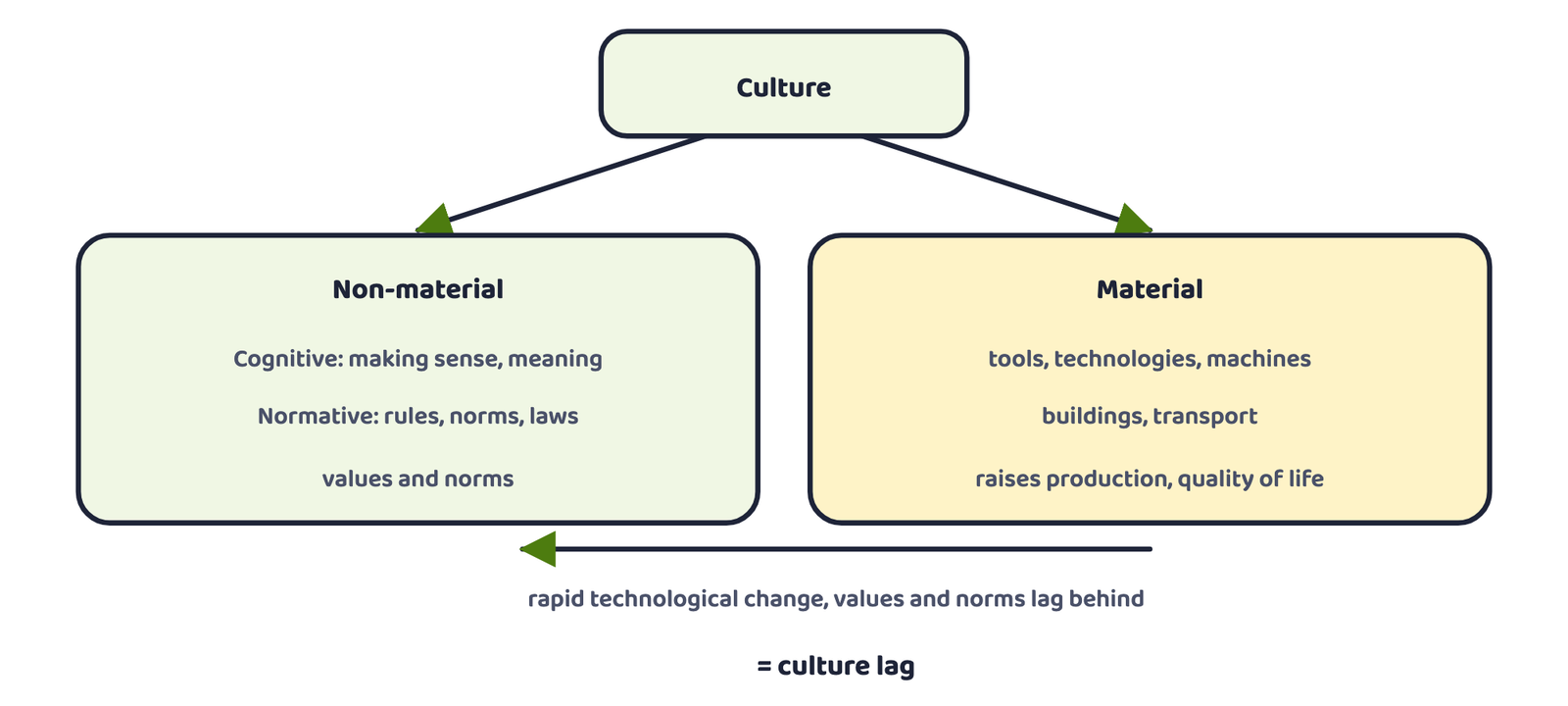
Our understanding of material culture, especially art, is incomplete without knowledge from the cognitive and normative areas. The areas work together. For example, in a community where few people have the cognitive skill of literacy, it becomes the norm for private letters to be read out by a third party. Still, looking at each area separately gives important insights.
4.2 Cognitive aspects of culture
Cognition refers to understanding: how we make sense of all the information coming to us from our environment.
- The cognitive aspects of one’s own culture are harder to recognise than its material aspects (which are tangible, visible or audible) and its normative aspects (which are explicitly stated).
- Literate societies: ideas are written in books and documents and preserved in libraries, institutions or archives.
- Non-literate societies: legend or lore is committed to memory and passed on orally. Specialist practitioners of oral tradition are trained to remember and narrate it on ritual or festive occasions.
Walter Ong, in his influential book Orality and Literacy, cites a study of 1971: only 78 of the approximately 3,000 existing languages possess a literature. Ong suggests that material which is not written down has special features:
Oral (not written down)
- Much repetition of words, to make it easier to remember
- The audience of an oral performance is more receptive and involved
Written
- Texts become more elaborate when written
- Readers of a written text from an unfamiliar culture are less involved
- Literacy and privilege: in societies like ours, literacy was historically available only to the more privileged. Sociological studies ask how literacy can be made relevant to people whose families never went to school. Responses can be unexpected: a vegetable-seller asked why he needed the alphabet when he could mentally calculate what his customers owed him.
- Memory still valued: though we now rely far more on written, audio and visual records, students of Indian classical music are still discouraged from writing down what they learn.
- An open question: we still do not know enough about the impact of electronic media, multiple channels, instant accessing and surfing on our attention span and cognitive culture.
4.3 Normative aspects of culture
The normative dimension consists of folkways, mores, customs, conventions and laws (general knowledge: mores are strongly held customs). These are values or rules that guide social behaviour in different contexts. We usually follow norms because we are used to doing it, as a result of socialisation. All social norms are accompanied by sanctions that promote conformity (behaving as the group expects) (general knowledge: a sanction is a reward or punishment that backs a rule). (Social control was discussed in Chapter 2.)
Law: a formal sanction defined by government as a rule or principle that its citizens must follow. Laws are explicit, apply to the whole society, and their violation attracts penalties and punishment.
| Point | Norms | Laws |
|---|---|---|
| Nature | Implicit rules | Explicit rules |
| Reach | May be specific to a family, school or group | Apply to the whole society, to all who accept the authority of the State |
| Source | Social habit and socialisation | The authority of the State; the most formal definitions of acceptable behaviour |
| Book’s example | Children not allowed outdoors after sundown in your home | Stealing a gold necklace breaks the universally accepted law of private property: jail after trial |
| Status | Can vary according to status | The same for everyone |
Pierre Bourdieu, the French sociologist, reminds us that another culture’s norms carry implicit understandings. If a person wants to show gratitude for a gift, s/he should not offer a return-gift too quickly, or it looks like an attempt to get rid of a debt, not a friendly gesture.
Dominant sections of society apply dominant norms, and these are often discriminating. The book’s examples: norms that did not allow dalits to drink water from the same vessel or even the same source, and norms that kept women from moving freely in the public sphere.
4.4 Material aspects of culture
The material aspect covers tools, technologies, machines, buildings, modes of transportation, and instruments of production and communication.
- Urban areas: mobile phones, music systems, cars and buses, ATMs (automated teller machines), refrigerators and computers in everyday life show our dependence on technology.
- Rural areas: transistor radios, or electric motor pumps lifting water from below the surface for irrigation, show technology adopted to increase production.
4.5 Material and non-material together: culture lag
In sum, culture has two principal dimensions: material and non-material. The cognitive and normative aspects are non-material. The material dimension is crucial to increase production and enhance the quality of life. For a culture to function in an integrated way, the two must work together.
Culture lag: when the material or technological dimensions change rapidly, the non-material aspects (values and norms) can lag behind. Culture lag is the situation in which the non-material dimensions are unable to match the advances of technology.
5 Culture and Identity
- Identities are not inherited; they are fashioned by the individual and the group through their relationships with others.
- For the individual, the social roles s/he plays give identity. Every person in modern society plays multiple roles (for example parent or child in the family), each with particular responsibilities and powers.
- Roles must be recognised and acknowledged, often through a particular language used among role players. Students have their own way of referring to teachers, other students and class performances; this language is also a code that creates their own world of meanings.
- Women also create their own language, and through it their own private space beyond the control of men, for example when they gather at the pond to bathe in rural areas or across washing lines on rooftops in urban areas.
Subculture (glossary): a group of people within a larger culture who borrow from, and often distort, exaggerate or invert, the symbols, values and beliefs of the larger culture to distinguish themselves.
- A culture can contain many sub-cultures, like those of elite and working class youth. Sub-cultures are marked by style, taste and association, and can be identified by speech, dress codes, preferred music, or the way members interact.
- Sub-cultural groups can work as cohesive units that give an identity to all members. There may be leaders and followers, but members are bound by the group’s purpose.
Is there a sub-cultural group in your locality? Notice how you are able to identify it: its speech, dress, music or way of interacting.
6 Ethnocentrism and Cosmopolitanism
Ethnocentrism is the application of one’s own cultural values in evaluating the behaviour and beliefs of people from other cultures. The cultural values projected as the standard or norm are considered superior to the beliefs and values of other cultures.
- Ethnocentrism arises only when cultures come into contact with one another.
- Sociology is an empirical, not a normative, discipline (Chapters 1 and 3): it studies cultures as they are observed, rather than judging what they ought to be.
- A sense of cultural superiority lies under ethnocentric comparisons, and is clearly seen in colonial situations.
We must at present do our best to form a class who may be interpreters between us and the millions whom we govern, a class of persons Indian in blood and colour but English in tastes, in opinions, morals and intellect.
Thomas Babbington Macaulay, Minute on Education (1835) to the East India Company in India; quoted in Mukherji 1948/1979: 87. The book’s example of ethnocentrism.
Cosmopolitanism, the opposite of ethnocentrism, values other cultures for their difference. A cosmopolitan outlook does not evaluate other people’s values and beliefs by one’s own. It celebrates and accommodates different cultural tendencies and promotes cultural exchange and borrowings to enrich one’s own culture.
6.1 Ethnocentrism versus cosmopolitanism
Ethnocentrism
- Judges others by one’s own cultural values
- Own values seen as the standard and superior
- Seen clearly in colonial situations (Macaulay)
Cosmopolitanism
- Values other cultures for their difference
- Accommodates many cultural tendencies, encourages exchange and borrowing
- Linked with modern society (see below)
The English language
A leading vehicle of international communication because it constantly takes in foreign words, yet it does not become a separate language.
Hindi film music
Popular because it borrows from western pop music and from Indian folk and semi-classical forms like bhangra and ghazal, yet it does not lose its character.
A modern society appreciates cultural difference and does not close its doors to influences from abroad. But such influences are always absorbed in a distinctive way, combined with elements of indigenous (native) culture. The absorption of diverse styles, forms, sounds and artifacts gives a cosmopolitan culture its identity. In a global world where modern communication is shrinking distances, a cosmopolitan outlook lets diverse influences enrich one’s own culture.
Hinglish words in vogue include airdash (travel by air), chaddis (underpants), chai (Indian tea), crore (10 million), dacoit (thief), desi (local), dicky (boot), gora (white person), jungli (uncouth), lakh (100,000), lampat (thug), optical (spectacles), prepone (bring forward), stepney (spare tyre) and would-be (fiancé or fiancée). Hinglish contains many words and phrases that Britons or Americans may not easily understand. Some are archaic relics of the Raj, such as ‘pukka’; others are newly coined, such as ‘time-pass’ (an activity that helps kill time). Those whose jobs are outsourced to India are said to have been ‘Bangalored’. This box shows English borrowing from Indian languages: cosmopolitan exchange at work.
7 Cultural Change
Cultural change is the way in which societies change their patterns of culture.
7.1 Where the push for change comes from
Internal impetus
- New methods of farming boost agricultural production
- This transforms food consumption and the quality of life of an agrarian community
External intervention
- Conquest or colonisation
- Can bring deep-seated changes in the cultural practices and behaviour of a society
7.2 How cultural change occurs
When forest-dwelling communities lose access to the forest and its produce, through legal restrictions or because the forest is destroyed, the effect on their way of life can be disastrous. Tribal communities in North East India and middle India have been the worst affected by the loss of forest resources.
7.3 Evolutionary and revolutionary change
Revolutionary change takes place when a culture is transformed rapidly and its values and meaning systems undergo a radical change. It can be started by political intervention, technological innovation or ecological transformation.
Evolutionary change
- The book names it alongside revolutionary change but does not define it
- Our reading (not the book’s words): change that is not rapid or radical, as cultures keep evolving (Section 1)
Revolutionary change
- Rapid; values and meaning systems change radically
- Example: the French Revolution (1789)
It transformed French society by destroying the estate system of ranking, abolishing the monarchy, and inculcating (spreading) the values of liberty, equality and fraternity among its citizens. When a different understanding comes to prevail, culture changes.
Estates System (glossary): a system in feudal Europe of ranking according to occupation. The three estates were the nobility, clergy and the ‘third estate’ (chiefly professional and middle class people). Each estate elected its own representatives; peasants and labourers did not have the vote.
The book asks you to think: has the amazing recent expansion of the media, electronic and print, brought about an evolutionary or a revolutionary change?
8 Socialisation
I believe that a complete life is inclusive of everything around us: plants, cattle, guests, feasts, festivals, quarrels, friendship, companionship, discrimination, scorn. All these and more were present in one single place, my home.
Vaidehi (1945), quoted at the start of the section: the home is where a child first learns the whole of social life.
At birth the human infant knows nothing about society or social behaviour. As the child grows, s/he learns not only about the physical world but also what it means to be a good or bad girl/boy: which behaviour will be applauded and which disapproved.
Socialisation is the process whereby the helpless infant gradually becomes a self-aware, knowledgeable person, skilled in the ways of the culture into which s/he is born. (Glossary: the process by which we learn to become members of society.)
Two small girls were reportedly found in a wolf den in Bengal in 1920. They walked on all fours like animals, preferred raw meat, howled like wolves and had no speech. Such cases have been reported from other parts of the world too. Without socialisation an individual would not behave like a human being.
- It changes the carers too. The birth of a child alters the lives of those who bring it up. Becoming parents and grandparents means new learning; older people remain parents when they become grandparents, which connects generations. A young child’s life changes with the birth of a sibling.
- It is life-long. The most critical learning happens in the early years.
- It is not ‘cultural programming’ (loading fixed lessons into a child like a machine). The child does not passively absorb influences. Even a newborn asserts her/his will: s/he cries when hungry and keeps crying until the carers respond, and the family’s everyday schedule gets reorganised.
Primary socialisation
- In the family
- In the early years: the most critical stage
Secondary socialisation
- In school and other institutions
- Extends over the entire life of a person
8.2 Groups, roles and differences
- The concepts of status/role, social control, groups, social stratification, culture, norms and values all help us understand how socialisation takes place.
- A child is a member of a family (nuclear or extended), and also of a larger kin-group (biradari, khaandaan, a clan) and of a larger society such as a tribe or sub-caste, a religious and a linguistic group.
- Each membership imposes norms and values, and brings roles (son, daughter, grandchild, student). These multiple roles are performed simultaneously. Learning them begins early and continues all through life.
- Norms and values differ within a society by caste, region, social class, religion, village or city, and tribe. Even the language one speaks depends on one’s region; whether it is closer to a spoken dialect or a standard written form depends on the family’s socio-economic and cultural profile.
9 Agencies of Socialisation
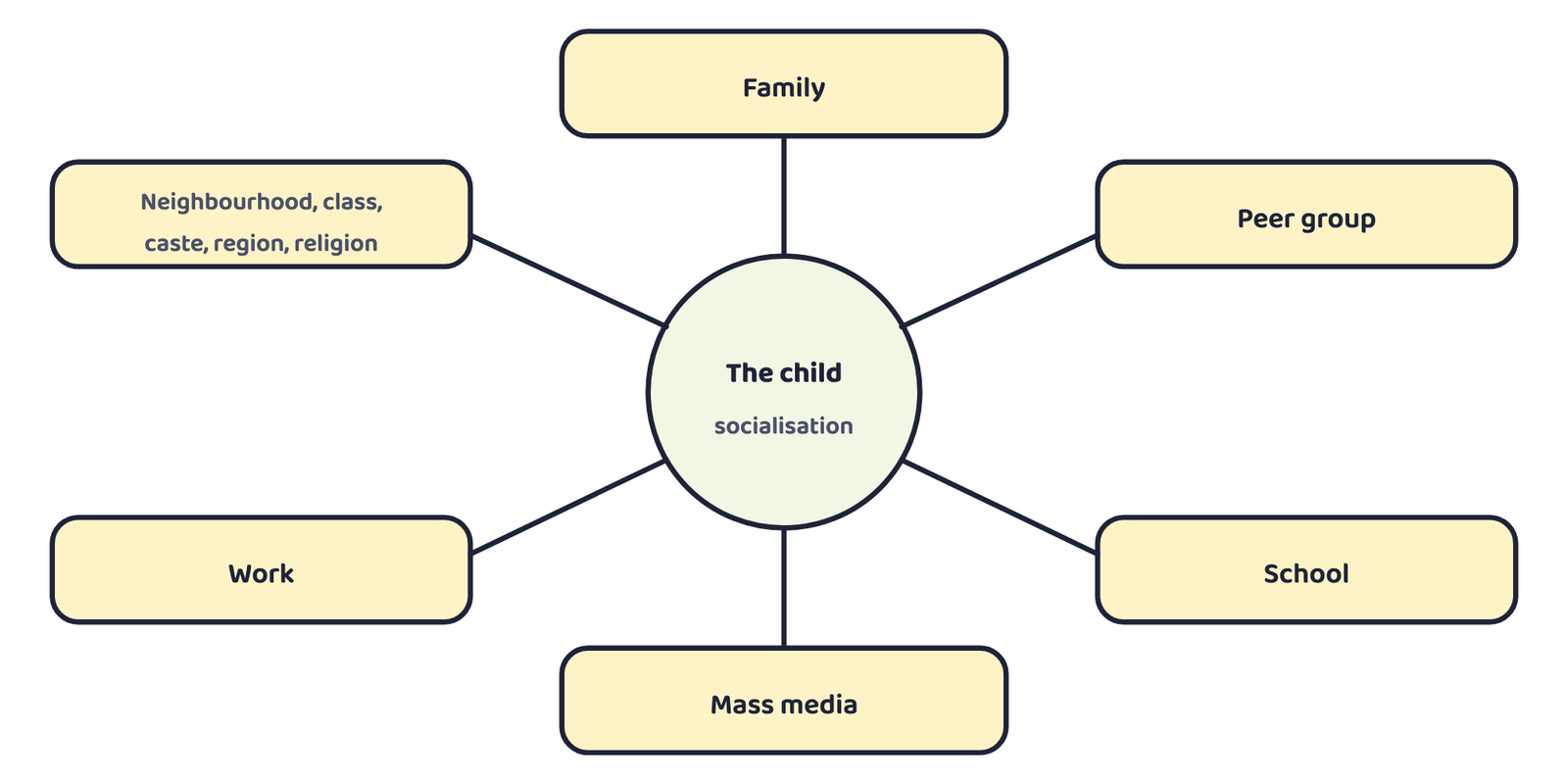
The child is socialised by several agencies and institutions in which s/he takes part: family, school, peer group, neighbourhood, occupational group, and by social class/caste, region and religion.
9.1 Family
- Family systems vary widely, so infants’ experiences are not standard across cultures. In a nuclear family the parents may be the key socialising agents; in an extended family, grandparents, an uncle or a cousin may matter more.
- Families have different ‘locations’ in society. In most traditional societies, the family one is born into largely decides one’s social position for life. Even where position is not inherited, the region and social class of the family affect socialisation sharply. Children pick up the behaviour of their parents, neighbourhood or community.
- Still, few children take over their parents’ outlook without question, especially in today’s fast-changing world. The diversity of socialising agencies creates differences between the outlooks of children, adolescents and parents. The book asks: can you identify an instance where what you learnt from the family was at variance with your peer group, the media or even school?
Activity 6: how would the child of a domestic worker feel different from the child of the family her mother works for (money spent on clothes, more bangles), and what might they share (the same serials, film songs, slang)? Then the harder areas: the sense of security in the family, neighbourhood and street. Activity 7: which would affect you most: possessions (television, music system), space (a room of your own), time (balancing school with household work), opportunities (travel, music classes), or the people around you?
9.2 Peer groups
Peer groups are friendship groups of children of a similar age. The word ‘peer’ means ‘equal’.
- In some cultures, particularly small traditional societies, peer groups are formalised as age-grades.
- Even without age-grades, children over four or five spend much time with friends of the same age.
- Peer relationships often stay important throughout life: informal groups of people of similar age at work shape attitudes and behaviour.
Family
- Dependence is built into the situation
- Because of their power, parents can (in varying degrees) enforce codes of conduct
Peer group
- Relations are reasonably egalitarian (fairly equal): more give and take
- A forceful or physically strong child may try to dominate to some extent
- Rules of behaviour can be tested out and explored
Compare how you interact with friends and with parents and other elders. The ideas of role and status (Chapter 2) explain the difference.
9.3 Schools
- Schooling is a formal organisation with a definite number of subjects.
- But schools also socialise in subtle ways. Alongside the formal curriculum there is what some sociologists call a hidden curriculum (lessons a school teaches without saying so) that shapes children’s learning.
- Example: in some schools in India and other countries, girls rather than boys are expected to sweep the classroom. Some schools counter this by making boys and girls do tasks not normally expected of them. The book asks you to think of examples that reflect both trends.
9.4 Mass media
- Mass media is an essential part of everyday life. Electronic media like television is expanding, but print media is still very important.
- Even in the early print media of nineteenth century India, ‘conduct-books’ instructing women on how to be better house-keepers and more attentive wives were popular in many languages.
- Media can make access to information more democratic: electronic communication can reach a village with no road and no literacy centre.
- A study in Britain: the time children spend watching television equals almost a hundred school days a year, and adults are not far behind.
- Research results are not always conclusive: the link between on-screen violence and aggressive behaviour among children is still debated.
- What is certain is the extent of the influence, in information and in exposure to faraway experiences. Indian serials and films have audiences in Nigeria, Afghanistan and among émigrés from Tibet. The televised Mahabharat was dubbed and aired in Tashkent, and was watched without dubbing in London by children who spoke only English.
- In recent years, non-print digital media through the internet is receiving much attention, particularly in urban areas.
The Shaktimaan serial, telecast a few years ago, had children trying to dive down buildings, resulting in fatal accidents. A clinical psychologist said: “Learning by imitation is a method followed frequently by people and children are no different.” The report shows how mass media influences children.
Explore how people relate to serials set in surroundings unlike their own, and whether children and grandparents disagree about which programmes are worth watching, and whether those differences slowly change.
Work is, in all cultures, an important setting for socialisation. But only in industrial societies do large numbers of people “go out to work”, that is, go each day to places of work separate from the home. In traditional communities, many people tilled land close to where they lived or had workshops in their dwellings.
10 Socialisation and Individual Freedom
- Socialisation, in normal circumstances, can never completely reduce people to conformity. Many factors encourage conflict, for example conflicts between socialising agencies: between school and home, or home and peer group.
- Because our cultural setting influences us so much, it might seem that we are robbed of individuality or free will. The book says this view is fundamentally mistaken.
- Interaction from birth to death certainly conditions our personality, values and behaviour. Yet socialisation is also at the origin of our very individuality and freedom: through it each of us develops a sense of self-identity and the capacity for independent thought and action.
Boys used the street for many things: to stand around watching, run around and play, and try out their bikes. For girls, the street was simply a way to get straight home from school, and they always went in clusters, perhaps because they carried the worst fears of being assaulted. Same street, different socialisation for boys and girls.
10.2 “The Bell” by Gita Krishnakutty (Activity 11)
A young girl announces that she will ring the bell in front of the temple sanctuary. The grown-ups object: Thangam may ring it because she is the daughter of the temple priest. The girl argues that Thangam plays hide-and-seek with them every afternoon and that “we are equal in the eyes of god”. The elders blame “that horrid English school”. Her grandmother oils and ties up her hair, and she is “thankful none of her school friends could see her like this”. She is escorted everywhere, though she walked alone to school in town. Ignoring Kelu Nair, she rings the bell. Her punishment: a “tight-lipped silence” and the conspicuous absence of her favourite tiny pappadams at dinner.
| Theme the book asks you to find | Where it appears |
|---|---|
| Individual versus society | The girl’s rebellion against the grown-ups |
| Normative dimensions differ in town and village | She walked alone to school in town; in the village she is escorted |
| Ascribed status (status given by birth) | Only the priest’s daughter is permitted to touch the bell |
| Conflict between socialising agencies | “Thankful none of her school friends could see her like this”; “that horrid English school” |
| Gendered socialisation | Combing hair + escort + not playing football |
| Punishment (an informal sanction) | “Tight-lipped silence” + absence of pappadams |
11 Other Glossary Terms
The chapter’s glossary also defines these terms. Learn them for one-mark questions.
Cultural Evolutionism
A theory of culture which argues that, just like natural species, culture also evolves through variation and natural selection.
Great Tradition
Cultural traits or traditions which are written and widely accepted by the educated and learned elites of a society.
Little Tradition
Cultural traits or traditions which are oral and operate at the village level.
Self Image
An image of a person as reflected in the eyes of others.
Social Roles
The rights and responsibilities associated with a person’s social position or status.
For a “dimensions of culture” answer, write all three dimensions with the book’s own example for each, then say that cognitive and normative are non-material, and end with culture lag. For “ethnocentrism”, give the definition, Macaulay’s Minute (1835) as the example, and cosmopolitanism as its opposite.
12 Timeline of Dates in the Chapter
13 Quick Revision
- Culture is a common understanding learnt through social interaction; like a map; dynamic, never finished; gives a group its identity.
- Cultures cannot be ranked, only judged adequate or inadequate in coping with nature (tsunami 2004: Onges, Jarawas, Great Andamanese, Shompens).
- Everyday culture = refined taste; sociological culture = way of life of all members. Tylor (1871), Malinowski (1931, functional school, field work), Geertz (1973, webs of significance, interpretative), Leslie White (holy water), Kroeber and Kluckhohn (1952).
- Three dimensions: cognitive (cell-phone ring, cartoon), normative (letters, death rituals), material (chatting, kolam). Cognitive and normative are non-material; rapid material change causes culture lag.
- Ong: 78 of about 3,000 languages have a literature; oral material repeats words. Norms implicit, laws explicit (Bourdieu’s return-gift); dominant norms can discriminate.
- Identity is not inherited; roles need recognition through language; sub-cultures marked by style, taste, association.
- Ethnocentrism (Macaulay 1835) vs cosmopolitanism (English language, Hindi film music, Hinglish).
- Cultural change: internal (farming) or external (conquest); through environment, contact, adaptation; evolutionary or revolutionary (French Revolution 1789).
- Socialisation: helpless infant to self-aware person; wolf-children of Midnapore (1920); life-long; primary (family) and secondary; not cultural programming.
- Agencies: family, peer group (age-grades, give and take), school (hidden curriculum), mass media (conduct-books, hundred school days, Shaktimaan), work. Socialisation is the origin of individuality and freedom.
- Can I contrast the everyday and the sociological meaning of culture?
- Can I write Tylor’s and Malinowski’s definitions and say what Malinowski adds?
- Can I name the three dimensions of culture with one example each, and explain culture lag?
- Can I distinguish norms from laws with the book’s examples?
- Can I define ethnocentrism and cosmopolitanism, with Macaulay as the example?
- Can I explain the two approaches to cultural change (evolutionary and revolutionary)?
- Can I describe four agencies of socialisation and show how socialisation leads to individual freedom?