
- Explain why sociology needs its own terms and concepts, and how functionalists and conflict theorists see society differently
- Tell an aggregate, a quasi group and a social group apart, and list the six features of a social group
- Compare primary and secondary groups, community and association, in-group and out-group, reference and peer groups
- Define social stratification and explain caste and class (Marx, Weber, functionalism)
- Use status and role correctly: status set, status sequence, ascribed and achieved status, prestige, role conflict, role stereotyping
- Explain social control (formal and informal), sanctions and deviance
| Board (2026-27) | Marks for this chapter | Paper |
|---|---|---|
| CBSE (039) | 10 marks (Unit 2, “Terms, Concepts and their use in Sociology”) | Theory 80 + project 20 |
| UP Board | 10 marks | One 100-mark theory paper, no project |
| Rajasthan Board (RBSE) | 10 marks | One 100-mark theory paper |
| MP Board | 8 marks | Theory 80 + project 20 |
Every board above examines the whole chapter. CBSE’s unit lists four topics: Social Groups and Society, Social Stratification, Status and Role, and Society and Social Control. Those are Sections 2 to 5 of these notes; Section 1 is the frame the exercises and glossary rest on.
1 Introduction: Why Sociology Needs Its Own Terms
Chapter 1 showed that individuals do not float freely in society. They are part of collective bodies like the family, tribe, caste, class, clan (a group claiming descent from a common ancestor) and nation. This chapter asks how society itself functions:
Groups
What kinds of groups do individuals form?
Stratification
What unequal orders are individuals and groups placed in?
Social control
How is social control exercised?
Status and role
What status do people occupy and what roles do they play? Are these fixed?
1.1 Why special terms, when we already use these words daily?
Nuclear physics
- Deals with matters unknown to most people
- No word exists for them in common speech
- So it seems obvious that it must develop a terminology
Sociology
- Its subject matter is familiar, and words already exist for it
- That is exactly why terminology is “possibly even more important” here
- We are so well acquainted with the social institutions around us that we cannot see them clearly and precisely (Berger 1976:25)
Example from the book: we live in families, so we may feel we know all about families. That would be conflating (mixing up) sociological knowledge with common sense knowledge or naturalistic explanation (explaining behaviour by “natural” reasons), which Chapter 1 discussed.
1.2 Concepts have a story too
Just as sociology has a history, so do its concepts. Many of them reflect the thinkers’ concern to understand and map the change from pre-modern to modern society:
Other concepts, like stratification, reflect the concern to understand the structured inequalities between groups in society.
1.3 Different thinkers, different key concepts
Concepts arise in society, and just as there are different kinds of individuals and groups, there are different kinds of concepts. Even in its early stage, sociology had contrary and contesting understandings of society:
| Thinker or school | Key concepts / view of society |
|---|---|
| Karl Marx | Class and conflict |
| Emile Durkheim | Social solidarity (what binds members together) and collective conscience (beliefs and feelings shared by the members) |
| Structural functionalists (influential after World War II) | Society is essentially harmonious. They compared society to an organism (a living body) where different parts have a function to play for the maintenance of the whole |
| Conflict theorists (influenced by Marxism) | Society is essentially conflict ridden |
Functionalism: a theoretical perspective based on the notion that social events can best be explained in terms of the function they perform, that is, the contribution they make to the continuity of a society; and on a view of society as a complex system whose various parts work in relationship to each other in a way that needs to be understood.
Conflict theories: a sociological perspective that focuses on the tensions, divisions and competing interests present in human societies. Conflict theorists believe that the scarcity and value of resources in society produces conflict as groups struggle to gain access to and control those resources. Many were strongly influenced by Marx.
1.4 Micro and macro starting points
Start with the individual (micro)
- Understand behaviour through micro interaction
- Concepts such as status and role begin with the individual
Start with structures (macro)
- Begin with macro structures: class, caste, market, state or even community
- Concepts such as social control and stratification begin from a larger context within which individuals are already placed
Microsociology and macrosociology: the study of everyday behaviour in situations of face-to-face interaction is microsociology; analysis is at the level of individuals or small groups. Macrosociology concerns itself with large-scale social systems, like the political system or the economic order. Though they appear distinct, they are closely connected.
1.5 Concepts are keys, not final answers
Classifications and types are keys to open locks to understand society. They are entry points in our understanding, not the final answer.
If the key becomes rusted or bent or does not fit the lock, we change or modify it. Sociology both uses and constantly interrogates its concepts.
Different definitions of the same social entity, for example conflict theory versus functionalist theory, coexist, and this causes unease. This multiplicity of approaches is particularly acute in sociology, and it “cannot but be otherwise for society itself is diverse”. Debate on these differences itself helps us understand society.
Discuss in class: is democracy a help or hindrance to development? Does gender equality make society more harmonious or more divisive? Are punishments or greater discussion the best way to resolve conflicts? The differences that emerge reflect different visions of a good society and different notions of the human being.
2 Social Groups and Society
Sociology is the study of human social life. A defining feature of human life is that humans interact, communicate and construct social collectivities. Sociology’s comparative and historical perspective brings home two “apparently innocuous” (harmless-looking) facts:
- In every society, ancient or feudal or modern, Asian or European or African, human groups and collectivities exist.
- The types of groups and collectivities are different in different societies.
Any gathering of people is not necessarily a social group.
Aggregates are simply collections of people who are in the same place at the same time, but share no definite connection with one another. Examples: passengers waiting at a railway station, airport or bus stop; a cinema audience. Aggregates are often termed quasi groups.
Quasi group: an aggregate or combination which lacks structure or organisation, and whose members may be unaware, or less aware, of the existence of groupings. Examples: social classes, status groups, age and gender groups, crowds.
Quasi groups may become social groups in time and in specific circumstances. Members of a class, caste or community may not yet be organised, or “infused with a sense of ‘we’ feeling”. The book’s examples of this change:
- Class and caste have over time given rise to political parties.
- People of different communities in India, over the long anti-colonial struggle, developed an identity as a nation with a shared past and a common future.
- The women’s movement brought about the idea of women’s groups and organisations.
| # | A social group has at least |
|---|---|
| (i) | Persistent interaction to provide continuity |
| (ii) | A stable pattern of these interactions |
| (iii) | A sense of belonging to identify with other members: each individual is conscious of the group and its own set of rules, rituals and symbols |
| (iv) | Shared interest |
| (v) | Acceptance of common norms and values |
| (vi) | A definable structure |
Social structure refers to patterns of regular and repetitive interaction between individuals or groups.
A social group is a collection of continuously interacting persons who share common interest, culture, values and norms within a given society.
Norms: rules of behaviour which reflect or embody a culture’s values, either prescribing a given type of behaviour, or forbidding it. Norms are always backed by sanctions of one kind or another, varying from informal disapproval to physical punishment or execution.
Activity 2: for caste, class, women, tribes and villagers, find a movement (anti-caste, class based, women’s, tribal, environmental) and an organisation or party. Were they all social groups to start with? At what point does the term “social group” apply? Activity 3: are teenagers a quasi group or a social group? Were ideas about “teenage” as a special phase in life always there? traditional societies marked entry into adulthood in their own ways; marketing and advertisements target teenagers; and teenage means very different experiences for the poor and the rich, the upper and lower class, the discriminated and the privileged caste.
2.3 Types of groups
Sociologists and social anthropologists have classified groups into types, and there is a pattern: most typologies contrast close, intimate, face-to-face interaction in traditional, small-scale societies with impersonal, detached, distant interaction in modern, large-scale societies. The book adds a caution: “a complete contrast is probably not an accurate description of reality.”
2.4 Primary and secondary groups
Primary group: a small group of people connected by intimate and face-to-face association and co-operation. Its members have a sense of belonging. Examples: family, village, groups of friends.
Secondary groups are relatively large in size and maintain formal and impersonal relationships. Examples: schools, government offices, hospitals, students’ associations.
| Point | Primary group | Secondary group |
|---|---|---|
| Size | Small | Relatively large |
| Relationships | Intimate, face-to-face, co-operative | Formal and impersonal |
| Orientation | Person-oriented | Goal oriented |
| Examples | Family, village, groups of friends | Schools, government offices, hospitals, students’ associations |
2.5 Community and society (or association)
Comparing the old traditional, agrarian way of life with the new modern, urban one dates back to the writings of the classical sociologists.
Community
- Human relationships that are highly personal, intimate and enduring
- A person’s involvement is considerable if not total
- As in the family, with real friends or a close-knit group
- Parallel: the primary group
Society or association
- Everything opposite of community
- The apparently impersonal, superficial and transitory relationships of modern urban life
- Commerce and industry need a calculating, rational, self-interested approach: we make contracts or agreements rather than getting to know one another
- Parallel: the secondary group
Collect the memorandum of an association, such as a Residents Welfare Association, a women’s association (Mahila Samiti) or a Sports Club: it states goals, objectives, membership and rules. Contrast it with a large family gathering. Over time, members of a formal group often become close, “just like family and friends”. This shows that concepts are not fixed and frozen: they are keys or tools for understanding society and its changes.
2.6 In-groups and out-groups
In-group: a group marked by a sense of belonging. This feeling separates “us” or “we” from “them” or “they”. Example: children of a particular school form an in-group as against those who do not belong to the school.
Out-group: a group to which the members of an in-group do not belong. Its members can face hostile reactions from the in-group. Migrants are often considered an out-group.
Who belongs and who does not changes with time and social contexts. The well known sociologist M.N. Srinivas noticed this while carrying out a census in Rampura in 1948:
| Villagers’ expression | Meaning | Used for |
|---|---|---|
| nenne monne bandavartu | “came yesterday or the day before” | Recent immigrants, almost contemptuously |
| arsheyinda bandavaru | “came long ago” | Old immigrants |
| khadeem kulagalu | “old lineages” | Old immigrants |
Source: Srinivas 1996:33.
Find out the experience of immigrants in other countries, or from different parts of our own country. Relationships between groups change: people once seen as an out-group become in-group members over time. History has many such processes.
2.7 Reference groups and peer groups
Reference groups: the groups whose lifestyles are emulated (copied). We do not belong to our reference groups, but we do identify ourselves with them. They are important sources of information about culture, lifestyle, aspiration and goal attainment.
In the colonial period many middle class Indians aspired to behave like the proper Englishman, so the English were a reference group for this aspiring section. The process was gendered: it meant different things for men and women. Indian men often wanted to dress and dine like British men but wanted Indian women to remain “Indian”, or to be a bit like the proper English woman but not quite like her.
Peer group: a kind of primary group, usually formed between individuals of similar age or in a common professional group. Peer pressure is the social pressure exerted by one’s peers on what one ought to do or not.
Activity 6 asks whether your friends’ approval or disapproval shapes the way you dress and behave, the music you like or the films you prefer, and whether that is social pressure.
Reference group and peer group are easy to mix up. A reference group is one you do not belong to but copy. A peer group is one you do belong to (a primary group of equals) and which presses you to conform.
3 Social Stratification
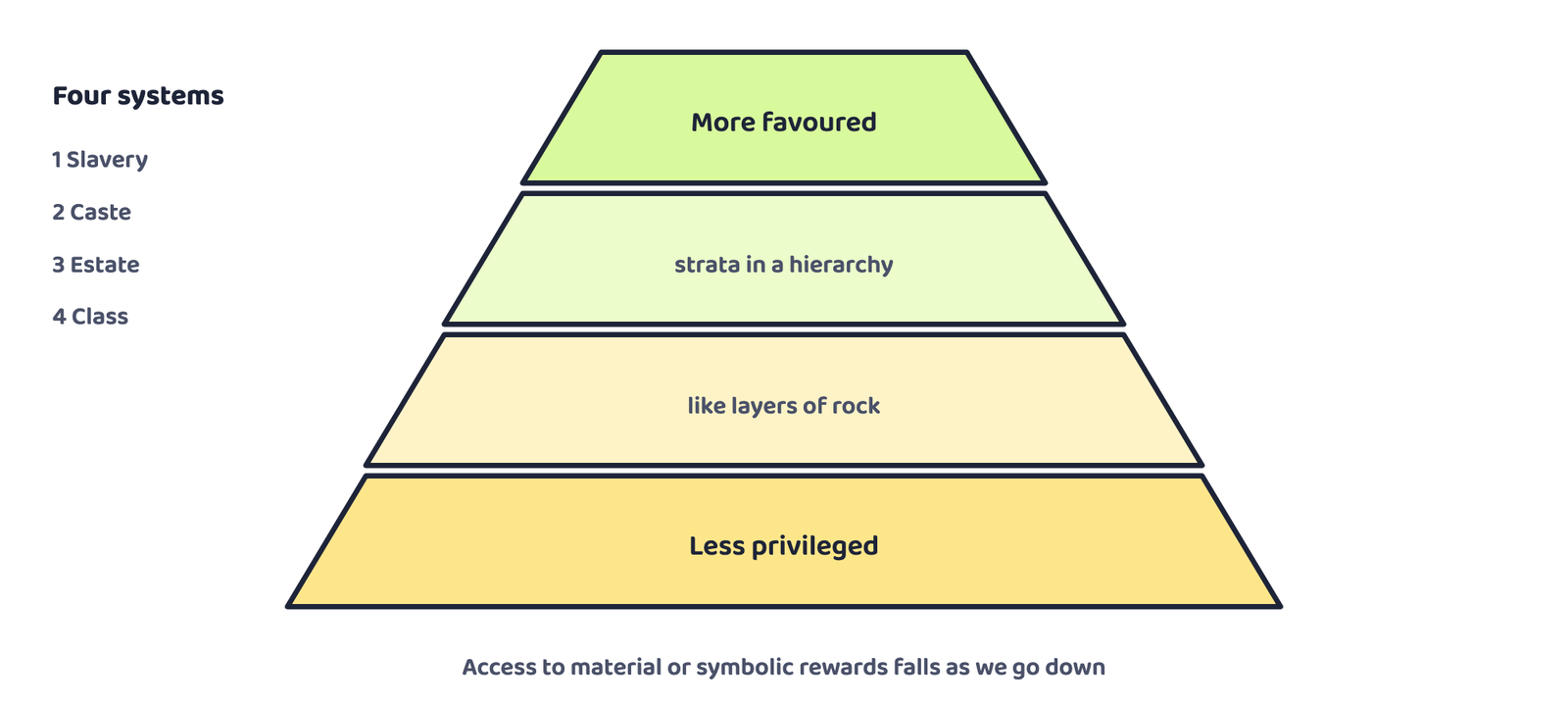
Social stratification refers to the existence of structured inequalities between groups in society, in terms of their access to material or symbolic rewards (symbolic rewards: respect, honour, status). Most simply, it is structural inequalities between different groupings of people.
Stratification is often compared to the geological layering of rock in the earth’s surface. Society is seen as made of “strata” in a hierarchy, with the more favoured at the top and the less privileged near the bottom.
3.1 Why stratification matters
Inequality of power and advantage is central for sociology, because of the crucial place of stratification in the organisation of society. Every aspect of the life of every individual and household is affected. These opportunities are all unequally distributed in systematic ways:
Health
and longevity (length of life)
Security
and educational success
Work
fulfilment in work
Power
political influence
3.2 Four basic systems of stratification
| System | What the book says |
|---|---|
| Slavery | An extreme form of inequality in which some individuals are literally owned by others. Two major examples: ancient Greece and Rome, and the Southern States of the USA in the 18th and 19th centuries. As a formal institution it has gradually been eradicated, but bonded labour (work to repay a debt, without freedom to leave), often even of children, continues. |
| Caste | Position ascribed by birth (see 3.3) |
| Estate | Characterised feudal Europe; not detailed in this chapter |
| Class | Open, achievement-based in principle (see 3.4) |
Class, caste and gender as bases of stratification are dealt with in greater detail in the book Understanding Society.
3.3 Caste
In a caste system, an individual’s position totally depends on status attributes ascribed by birth, not on what is achieved in life. A class society also has systematic constraints on achievement (from race and gender), but in a caste society birth defines a person’s position more completely.
- In traditional India castes formed a hierarchy of social precedence. Each position was defined by its purity or pollution relative to others.
- Belief: the most pure, the Brahmin priestly castes, are superior to all; the Panchamas, sometimes called the “outcastes”, are inferior to all.
- The traditional system is generally conceptualised as the four fold varna: Brahmins, Kshatriyas, Vaishyas and Shudras. In reality there are innumerable occupation-based caste groups called jatis.
- Endogamy (marriage within the group) and ritual avoidance of contact with so-called lower castes were considered critical for maintaining purity by the so-called upper castes. Urbanisation inevitably challenged this.
Modern industries brought into being modern cities honeycombed with cosmopolitan hotels, restaurants, theatres, trams, buses, railways. The modest hotels and restaurants catered for the workers and middle classes became crowded in cities with persons belonging to all castes and even creeds… In trains and buses one occasionally rubbed shoulders with members of the depressed classes… should not, however be supposed that caste had vanished.
A.R. Desai (1975:248), on the social consequences of urbanisation in India
In the mill there may be no open discrimination of the kind in villages, but private interactions tell another story. Parmar observed that “they will not even drink water from our hands” and sometimes use abusive language, because they believe they are superior; no matter how well we dress they will not accept certain things (Franco et. al. 2004:150).
Caste persists
- Even today acute caste discrimination exists
- Those at the lower levels are disadvantaged socially and economically
Democracy changes caste
- Castes as interest groups have gained strength
- Discriminated castes assert their democratic rights
3.4 Class: three views
| View | How it explains class / inequality |
|---|---|
| Marx | Social classes are defined by their relation to the means of production. Are groups owners of means of production such as land or factories, or owners of nothing but their own labour? |
| Weber | Used the term life-chances: the rewards and advantages afforded by market capacity. Inequality might be based on economic relations, but also on prestige or on political power. |
| Functionalism | No society is “classless” or unstratified. Society must place and motivate individuals in the social structure, so stratification is “an unconsciously evolved device” by which societies ensure that the most important positions are deliberately filled by the most qualified persons. The book asks: is this true? |
Means of production: the means whereby the production of material goods is carried on in a society, including not just technology but the social relations between producers.
3.5 Caste and class compared
| Point | Traditional caste system | Modern class system |
|---|---|---|
| Basis of position | Ascribed by birth | Achievement |
| Nature | Fixed, rigid | Open |
| Across generations | Transmitted | Not fixed at birth; open to achievement |
| In practice | Challenged by urbanisation and democracy, but discrimination persists | In democratic societies nothing legally stops a person from the most deprived class and caste reaching the highest position, yet the structure largely persists |
Find out about the life of the late President K. R. Narayanan and discuss ascribed and achieved status, caste and class in this context. Such stories of achievement are sources of immense inspiration. Yet for the most part the structure of the class system persists: studies of social mobility, even in western societies, are far removed from the ideal model of perfect mobility. Sociology has to be sensitive both to the challenges to the caste system and to the persistence of discrimination.
4 Status and Role
“Status” and “role” are often seen as twin concepts.
Status refers to the social position with defined rights and duties assigned to these positions. Example: a mother occupies a status which has many norms of conduct as well as certain responsibilities and prerogatives (special rights).
Role is the dynamic or behavioural aspect of status. Status is occupied, but roles are played.
We may say that a status is an institutionalised role: a role that has become regularised, standardised and formalised in society at large or in any of its specific associations.
4.1 Status set and status sequence
In a modern complex society each individual occupies many kinds of status. The smaller and simpler the society, the fewer the kinds of status an individual can have.
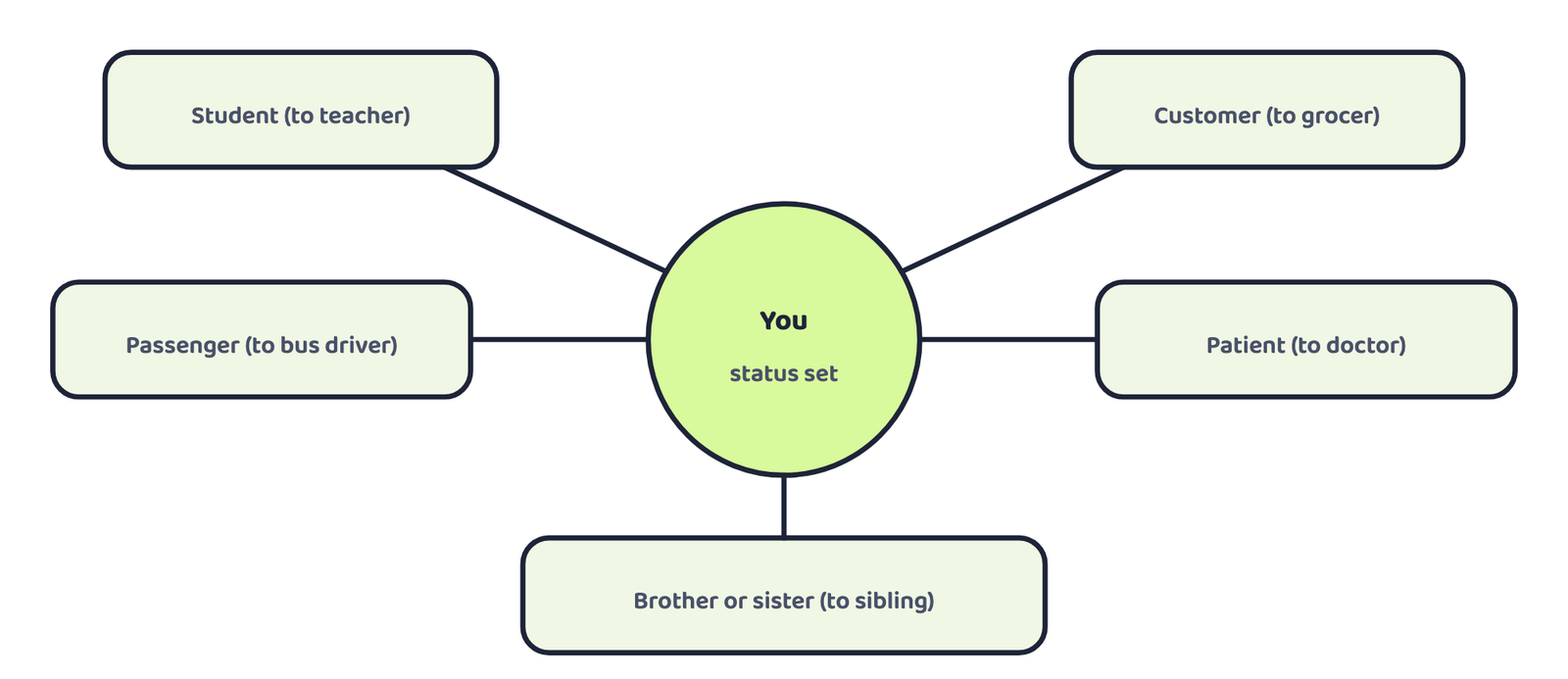
Status set: the multiple status that an individual in a modern society occupies.
Status sequence: the status attained in succession or sequence at various stages of life.
4.2 Ascribed and achieved status
Ascribed status: a social position which a person occupies because of birth, or assumes involuntarily. Achieved status: a social position that a person occupies voluntarily by personal ability, achievements, virtues and choices.
| Point | Ascribed status | Achieved status |
|---|---|---|
| How gained | By birth, or involuntarily | Voluntarily, by ability, achievements, virtues and choices |
| Most common bases | Age, caste, race and kinship (relations by blood or marriage) | Educational qualifications, income and professional expertise |
| Marks which societies | Simple and traditional societies | Modern societies (“you have to prove yourself”) |
Even in modern achievement-based societies, ascribed status matters.
4.3 Prestige
Status and prestige are interconnected. Every status carries certain rights and values, and these values are attached to the social position, not to the person who occupies it or to his/her performance or actions.
Prestige: the kind of value attached to the status or to the office. People rank status in terms of high or low prestige.
The prestige of a doctor may be high in comparison to a shopkeeper, even if the doctor may earn less. Ideas of which occupation is prestigious vary across societies and across periods. (Activity 8: compare which jobs are prestigious in your society with your friends’ views.)
4.4 Role taking, role conflict and role stereotyping
People perform their roles according to social expectations, that is, role taking and role playing. A child learns to behave in accordance with how her behaviour will be seen and judged by others.
Role conflict is the incompatibility among roles corresponding to one or more status. It occurs when contrary expectations arise from two or more roles.
Natal: relating to the place or time of one’s birth. (A Khasi man’s natal house is the house he was born into.)
Common example
- The middle class working woman
- Juggles her role as mother and wife at home and that of a professional at work
- Activity 9: find out how a domestic worker or a construction labourer faces role conflict
Men face it too: Khasi matriliny
- It is a commonplace assumption that men do not face role conflict; sociology, being empirical and comparative, suggests otherwise
- Khasi matriliny (descent and inheritance traced through the mother) generates intense role conflict for men: torn between their natal house and their wife and children
- They lack authority over their children’s loyalty and the freedom to pass on even their self-acquired property to their children after death
- The strain affects Khasi women “in a way more intensely”: a wife can never be fully assured that her husband does not find his sister’s house more congenial (Nongbri 2003:190)
Role stereotyping is a process of reinforcing some specific role for some member of the society. Example: men and women are often socialised (taught by family and society how to behave) in stereotypical roles, as breadwinner and homemaker respectively.
4.5 Are roles and status fixed?
The view the book calls mistaken
- Social roles and status are fixed and unchanging
- Through socialisation (learning the ways of one’s society) individuals simply internalise (absorb as their own) roles and perform them as defined
- It suggests individuals simply take on roles
The book’s view
- Individuals create or negotiate roles
- Socialisation is a process in which humans can exercise agency (act by their own choice); they are not passive subjects waiting to be programmed
- Roles are understood and assumed through an ongoing process of social interaction
Roles and status are not given and fixed. People fight against discriminatory roles and status, for example those based on caste, race or gender, while other sections of society oppose such changes. Individual violations of roles are often punished. So society functions not just with roles and status but also with social control. (Activity 10: collect newspaper reports where dominant sections punish those they think have violated socially prescribed roles.)
Identity: the distinctive characteristic of a person’s character or the character of a group which relate to who they are and what is meaningful to them. Main sources of identity include gender, nationality or ethnicity, and social class.
5 Society and Social Control
Social control refers to the various means used by a society to bring its recalcitrant (stubbornly disobedient) or unruly members back into line. More fully, it is the social process, techniques and strategies by which the behaviour of an individual or a group is regulated.
Social control is one of the most generally used concepts in sociology. Recall: functionalist sociologists understood society as essentially harmonious, and conflict theorists saw it as essentially unequal, unjust and exploitative.
Functionalist perspective
- Social control means (i) the use of force to regulate behaviour of individuals and groups, and (ii) enforcing values and patterns for maintaining order
- It restrains deviant behaviour and mitigates tensions and conflicts
- Maintains social order and cohesion: necessary to stability
Conflict perspective
- Usually would see it more as a mechanism to impose the social control of dominant social classes on the rest of society
- Stability is the writ (command) of one section over the other
- Law is the formal writ of the powerful and their interests on society
The ultimate and, no doubt, the oldest means of social control is physical violence… No state can exist without a police force or its equivalent in armed might.
Peter Berger (84-90). He adds: violence is used economically and as a last resort, the mere threat usually being enough; in primary groups very potent and subtle controls work; and social control is often based on fraudulent claims, like a little boy who controls his peers through a big brother, real or invented (“I will tell my elder brother”).
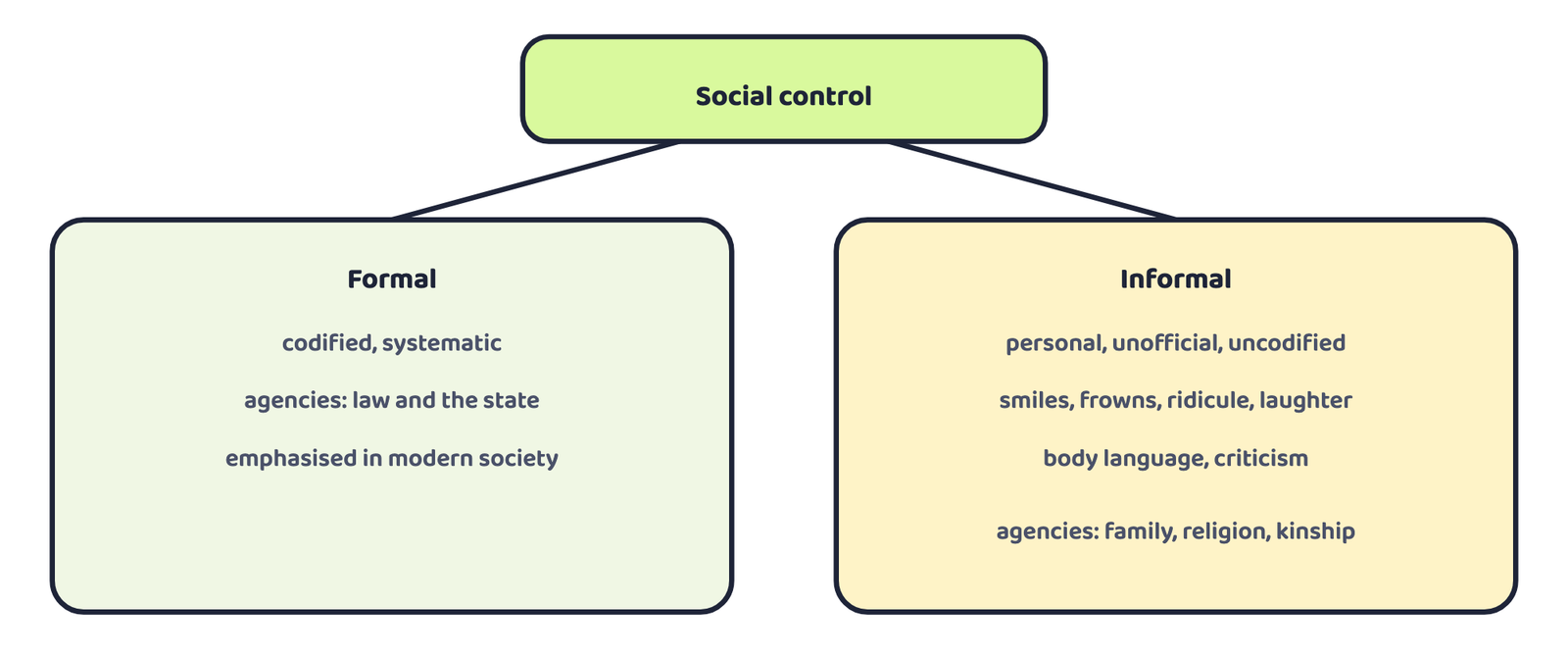
| Point | Formal social control | Informal social control |
|---|---|---|
| Nature | Codified (written down as rules), systematic and other formal mechanisms | Personal, unofficial and uncodified |
| Means | Codified rules: the law | Smiles, making faces, body language, frowns, criticism, ridicule, laughter |
| Agencies | Law and the state | Family, religion, kinship |
| Where stressed | Emphasised in modern society | Found in every society; great variation in use even within one society |
| Effectiveness | Rules are written down and applied through law and the state | Quite effective in day-to-day life, but sometimes not adequate to enforce conformity or obedience |
Think how this “unofficial” social control works in your own life: how is a child who behaves a bit differently treated in class or in the peer group? Have you seen children bullied by their peer group to be more like the other children?
The elder brother of a 19-year-old girl carried out an apparent “honour killing” by allegedly beheading her while she was asleep in a hospital, where she was being treated for stab wounds after he attacked her on December 16 for marrying outside the caste. She and her lover had eloped (run away to marry) on December 10 and returned on December 16 after marrying; her parents opposed the marriage, and the Panchayat (village council) also tried to pressurise the couple.
Model answer to the book’s task of identifying the agencies: the family (parents, elder brother) is an informal agency, and the Panchayat adds community pressure (the book does not classify it); the police named in the report stand for the formal agencies, law and the state.
5.3 Sanctions
Sanction: a mode of reward or punishment that reinforces socially expected forms of behaviour.
Positive sanctions
- Members are rewarded for good and expected behaviour
Negative sanctions
- Used to enforce rules and to restrain deviance
5.4 Deviance
Deviance refers to modes of action which do not conform to the norms or values held by most of the members of a group or society.
- What is regarded as “deviant” is as widely variable as the norms and values that distinguish different cultures and subcultures.
- Ideas of deviance are challenged and change from one period to another. Example: a woman choosing to become an astronaut may be considered deviant at one time and be applauded at another, even in the same society.
The specific terms and concepts of this chapter help you move from common sense towards a sociological understanding of society.
6 Quick Revision
- Sociology needs its own terms because its subject is familiar (Berger 1976). Marx: class and conflict; Durkheim: solidarity and collective conscience; functionalists: harmony; conflict theorists: conflict. Concepts are keys, not final answers.
- Aggregate (no connection) → quasi group (no structure) → social group (six features). Quasi groups become groups: parties, the nation, women’s groups.
- Primary (person-oriented) vs secondary (goal oriented); community vs association; in-group vs out-group (Srinivas, Rampura 1948); reference group (colonial middle class, gendered); peer group.
- Stratification: structured inequality, like rock layers. Four systems: slavery, caste, estate, class.
- Caste: ascribed, purity-pollution, varna and jatis; Desai 1975 (caste had not vanished), Parmar (Franco 2004); democracy made castes interest groups.
- Class: Marx (means of production), Weber (life-chances; economy, prestige, power), functionalism (most qualified fill important positions). K. R. Narayanan; perfect mobility not reached.
- Status occupied, role played. Status set, status sequence, ascribed vs achieved, prestige (doctor vs shopkeeper). Role conflict (working woman, Khasi matriliny, Nongbri 2003), role stereotyping; agency in socialisation.
- Social control: functionalist (order) vs conflict (dominant classes, law as writ); Berger on violence; formal (law, state) vs informal (family, religion, kinship); sanctions positive and negative; deviance varies with culture and time (woman astronaut).
- Can I write the six characteristics of a social group in order?
- Can I give two differences each for primary/secondary, community/association and in-group/out-group?
- Can I explain class in Marx’s, Weber’s and the functionalist way?
- Can I define status set, status sequence and role conflict, with the book’s examples?
- Can I contrast formal and informal social control and name their agencies?