
- How our seven sense organs collect information, and the limits within which they work (absolute and difference threshold)
- What attention is, its properties, and its types: selective, divided and sustained, with three theories of selective attention
- Span of attention and the attention disorder ADHD
- How perception gives meaning to sensations, and how the perceiver’s needs, expectations, style and culture shape it
- Gestalt principles of organisation, depth cues, perceptual constancies, illusions and socio-cultural influences on perception
In the CBSE 2026-27 Class 11 Psychology curriculum, the theory paper carries 70 marks and this chapter, Sensory, Attentional and Perceptual Processes, carries 8 marks. The other 30 marks are practical: a project or small study, experiments and a viva (oral exam). These notes cover the full NCERT theory text of Chapter 4; nothing in it is deleted for 2026-27.
1 Knowing the World
Look around your room: table, chair, books, bag, a watch, pictures on the wall. Step outside and there are trees, animals and buildings. You know all of these without any effort. Ask yourself how you know they exist, and the answer is: through your sense organs (eyes, ears and so on). They collect information from the outside world and from inside our own body, and this information is the base of all our knowledge.
But just registering an object is not enough. The object and its qualities (size, shape, colour) must first draw our attention, and the information must then reach the brain, which makes meaning out of it. So our knowledge of the world rests on three processes.
Sensation, attention and perception are so closely linked that they are treated as parts of one single process, called cognition.
2 Nature and Varieties of Stimulus
Our surroundings contain many kinds of stimuli. Some can be seen (a house), some only heard (music), some smelt (a flower’s fragrance), some tasted (sweets) and some felt by touch (a soft cloth). To deal with them, humans have seven sense organs, also called sensory receptors or information gathering systems, because they gather information from many sources. With these seven organs we register ten different varieties of stimuli, and also their qualities: a light may be bright or dim, yellow or green; a sound may be loud or faint, melodious or distracting.
Note that the skin has separate, specialised receptors for warmth, cold and pain inside it.
3 Sense Modalities
Sensation is the initial experience of a stimulus or an object registered by a particular sense organ. It is the process through which we detect and encode a variety of physical stimuli. It also means the immediate basic experience of a stimulus quality such as “hard”, “warm”, “loud” or “blue”.
Each sense organ is highly specialised for one particular kind of information, so each one is called a sense modality.
3.1 Functional limitations of sense organs
Our sense organs work only within a limited range. Eyes cannot see things that are very dim or very bright; ears cannot hear very faint or very loud sounds. The same is true of every sense. To be noticed, a stimulus must have an optimal intensity or magnitude. The branch that studies how stimuli are related to the sensations they produce is called psychophysics.
Absolute threshold or absolute limen (AL) is the minimum value of a stimulus required to activate a given sensory system.
Put one granule of sugar in a glass of water: no sweetness. Add a second: still none. Keep adding one at a time, and at some point you say “now it is sweet”. That minimum number of granules is the AL of sweetness.
The AL is not a fixed point. It shifts with the person and the situation: how the body is at that moment (organic condition) and how much the person wants something (motivational state) both move it up or down. So it is measured over many trials: the number of granules that produces “sweet” on 50 per cent of occasions is taken as the AL.
Difference threshold or difference limen (DL) is the smallest difference in the value of two stimuli needed to notice them as different. In other words, it is the minimum change in a physical stimulus that produces a difference in sensation on 50 per cent of the trials.
Continuing the sugar test: once the water tastes sweet, keep adding granules. The number of extra granules needed before the water tastes sweeter than before on 50 per cent of occasions is the DL of sweetness.
Absolute threshold (AL)
- Smallest value to notice a stimulus at all
- Plain water to “sweet”
- Measured on 50 per cent of trials
Difference threshold (DL)
- Smallest difference to tell two stimuli apart
- “Sweet” to “sweeter”
- Measured on 50 per cent of trials
Thresholds alone do not explain sensation. A sense organ receives the stimulus and turns it into an electrical impulse, which must reach the higher brain centres. So any structural or functional defect or damage in the receptor organ, its neural pathway or the brain area concerned can cause partial or complete loss of sensation.
Vision and hearing are usually thought to be our two most prized senses. Which sense would be most painful to lose, and why? If you could improve one sense, which would you pick, and could you improve it without magic? Write your answer and discuss it with your teacher.
4 Attentional Processes
Many stimuli hit our senses at the same moment, but we notice only a few. In your classroom there are doors, walls, windows, paintings, desks, students, bags and bottles, yet at one time you focus on just one or two of them.
Attention is the process through which certain stimuli are selected from a group of others.
4.1 Properties of attention
Besides selection, attention has three more properties. All of them need some effort, so attention is also described as “effort allocation”.
Alertness
Readiness to deal with stimuli that appear. Runners on the starting line waiting for the whistle.
Concentration
Focusing awareness on certain objects while shutting out others for the moment. A student listening to the teacher and ignoring school noise.
Search
Looking for a specified subset among many objects. Finding your younger brother and sister among hundreds of children at school gate.
(The chapter Summary lists these three as activation, concentration and search; “activation” there means the same readiness as alertness.)
4.2 Focus and fringe
Focus (focal point)
- The field of awareness is centred on one particular object or event
Fringe
- Objects or events away from the centre of awareness
- We are only vaguely aware of them
4.3 Types of attention
A process-oriented view divides attention into two types: selective and sustained. When we attend to two different things at the same time, it is called divided attention.
4.4 Selective attention
Selective attention is concerned mainly with the selection of a limited number of stimuli or objects from a large number of stimuli.
Our perceptual system has a limited capacity: it can handle only a few stimuli at a moment. Which ones get selected depends on the following factors.
| Type of factor | What it is | Examples from the book |
|---|---|---|
| External (features of the stimulus) | Size, intensity and motion of stimuli | Large, bright, moving stimuli; novel and moderately complex stimuli; human photographs more than photographs of non-living objects; rhythmic sounds more than spoken narration; sudden and intense stimuli |
| Internal: motivational | Our biological or social needs | A hungry person notices even a faint smell of food; a student taking an exam focuses on the teacher’s instructions |
| Internal: cognitive | Interest, attitude and preparatory set | Interesting things are attended to readily; we quickly notice things we feel favourably about |
Preparatory set creates a mental state to act in a certain way, and the readiness of a person to respond to one kind of stimuli and not to others.
4.5 Theories of selective attention
Filter theory: Broadbent (1956)
Think of a narrow bottle neck: lots of stimuli rush into our receptors at once, go through short-term memory and meet a selective filter. The filter passes just one of them on for further processing. The rest are screened out at that moment, so we are aware only of the one that passed.
Filter-attenuation theory: Triesman (1962)
A modification of Broadbent’s theory. Stimuli that do not get through are not completely blocked; the filter only attenuates (weakens) them. So some escape to higher processing: you can catch your own name at a noisy group dinner even when it is said softly.
Multimode theory: Johnston and Heinz (1978)
Attention is a flexible system that can select a stimulus at three stages. The later the selection, the more mental effort it needs.
B-T-J: 1956, 1962, 1978
Broadbent blocks (one gets through), Triesman turns down the volume (weakens), Johnston and Heinz work at three stages.
4.6 Divided attention (Box 4.1)
People drive while talking to a friend, taking a phone call, putting on sunglasses or listening to music. Watch closely and they still give more effort to driving than to the rest. So attention can sometimes go to more than one thing at once, but only when the activities are highly practised. Such activities become almost automatic and need less attention than new or slightly practised ones.
Divided attention is attending to two different things at the same time. It is possible with highly practised tasks, where processing is largely automatic.
Without intention
Automatic processing happens without our meaning to do it.
Unconsciously
It takes place without our awareness.
Very little thought
It involves little or no thinking: reading words or tying shoelaces.
4.7 Sustained attention
Sustained attention is our ability to maintain attention on an object or event for longer durations. It is also known as vigilance.
Selective attention is about selection; sustained attention is about concentration. Air traffic controllers and radar readers must watch screens for hours. Signals appear unpredictably, and a missed signal may be fatal, so they need a great deal of vigilance.
| Factor influencing sustained attention | What helps performance |
|---|---|
| 1. Sensory modality | Performance is better when signals are auditory than when they are visual |
| 2. Clarity of stimuli | Intense and long-lasting stimuli help |
| 3. Temporal uncertainty | Stimuli at regular intervals are attended better than at irregular intervals |
| 4. Spatial uncertainty | Stimuli at a fixed place are attended easily; random locations are hard |
Selective attention
- Concerned with selection of a few stimuli from many
- Depends on external and internal factors
- Example: hearing your name at a noisy dinner
Sustained attention
- Concerned with concentration for a long time (vigilance)
- Depends on modality, clarity, temporal and spatial uncertainty
- Example: a radar reader watching a screen for hours
4.8 Span of attention (Box 4.2)
Span of attention (or perceptual span) is the number of objects one can attend to in a brief exposure (a fraction of a second): the amount of information an observer can grasp from a complex array of stimuli at a single momentary exposure.
The span is measured with an instrument called the tachistoscope. This limited span explains why number plates carry only four digits with a few letters: a traffic policeman can read and note them quickly when a driving rule is broken. Some children do poorly in school simply because of an attention problem, which brings us to ADHD.
4.9 Attention Deficit Hyperactivity Disorder (Box 4.3)
ADHD is a behavioural disorder that is common in children in their primary school years, and boys show it more often than girls. If not managed, the attention problem can continue into adolescence or adulthood.
Three main features
Impulsivity, excessive motor activity, and an inability to attend. The central feature is difficulty in sustaining attention.
Effects
Highly distractible, do not follow instructions, trouble getting along with parents, viewed negatively by peers, poor in school and in reading, though there is no deficit in intelligence.
Causes
Little evidence of a biological basis. Some link with diet (especially food colouring). Social-psychological factors (home environment, family pathology) explain it more reliably. Today it is seen as having multiple causes and effects.
| Treatment | What the book says |
|---|---|
| Drug Ritalin | Reduces over-activity and distractibility, raises attention and concentration. But it does not “cure”, and may suppress normal growth of height and weight. |
| Behavioural management programmes | Positive reinforcement, and learning tasks arranged to keep errors low and give quick feedback and success: found quite useful. |
| Cognitive behavioural training | Rewards for desired behaviour plus training in verbal self-instructions: “stop, think, and then do”. Children learn to shift attention less often and behave reflectively, and this learning stays fairly stable. |
5 Perceptual Processes
A sensation alone (a flash of light, a sound, a smell) tells us nothing about where it came from. To make sense of this raw material, we process it further using our learning, memory, motivation, emotions and other psychological processes.
Perception is the process by which we recognise, interpret or give meaning to the information provided by sense organs.
People often build up stimuli in their own way. So perception is not just reading objects as they exist; it is also a construction of objects and events from one’s own point of view. The sub-processes of meaning-making are shown below (Fig. 4.1 of the book).
5.1 Processing approaches in perception
Do we recognise a dog because we first notice its furry coat, four legs, eyes and ears, or do we notice those parts because we have first recognised a dog? Both routes exist.
Bottom-up processing
- Recognition starts from the parts, which build up to the whole
- Stresses the features of stimuli
- Sees perception as a process of mental construction
Top-down processing
- Recognition starts from the whole, which leads to identifying its parts
- Stresses the perceiver
- Sees perception as recognition or identification of stimuli
Studies show that in perception both processes interact to give us an understanding of the world.
6 The Perceiver
Humans are not machines passively receiving stimuli. They are creative beings who understand the world in their own way. Their motivation, expectations, cultural knowledge, past experience, memories, values, beliefs and attitudes all shape perception. Four of these are described in the book.
6.1 Motivation
Our needs and desires strongly affect what we perceive; one way to satisfy a need is to see objects as things that would satisfy it. In experiments, hungry people shown ambiguous pictures saw them as food more often than satiated (non-hungry) people did.
6.2 Expectations or perceptual sets
What we expect to see in a situation shapes what we see. This tendency to see what we expect, even when it does not match reality, is called perceptual familiarisation or perceptual generalisation. If the milkman comes daily at about 5.30 A.M., any knock at that time is perceived as the milkman, even if it is someone else.
Write 12, 13, 14, 15 on the board and let a friend see it for 5 seconds. Then write A, 13, C, D. Most people now write B in place of 13, because the letters set up an expectation.
6.3 Cognitive styles
Cognitive style is a consistent way of dealing with our environment. It significantly affects how we perceive it.
Field dependent
- See the world as a totality: global or holistic
- Take a long time to find the triangle hidden in Fig. 4.2
Field independent
- Break the world into smaller units: analytic or differentiated
- Find the hidden triangle quickly
6.4 Cultural background and experiences
| Study / group | What was found |
|---|---|
| Hudson: African subjects | People from a pictureless environment could not identify objects in pictures (antelope, spear), failed to see distance in pictures and interpreted them wrongly |
| Eskimos | Make fine distinctions among many kinds of snow that others cannot notice |
| Aboriginal groups of the Siberian region | Tell apart dozens of skin colours of reindeer |
The perceiver plays a key role: people interpret stimuli according to their personal, social and cultural conditions, so their perceptions are both finely tuned and modified.
the main idea of “The Perceiver”
7 Principles of Perceptual Organisation
Our visual field is made of points, lines and colours, yet we see a bicycle as one object, not as a saddle, wheel and handle lying separately.
Form perception is the process of organising the visual field into meaningful wholes.
7.1 The Gestalt view
The most widely accepted answer to how parts become wholes came from the Gestalt psychologists: prominently Köhler, Koffka and Wertheimer.
Gestalt means a regular figure or a form. Gestalt psychologists hold that we perceive stimuli not as separate elements but as an organised “whole” with a definite form, and the whole is different from the sum of its parts.
- Configuration: a flower pot with flowers is one whole; remove the flowers and the pot is still a whole. Only the configuration has changed.
- Pragnanz: our brain processes always lean towards perceiving a good figure, which is why we see everything in an organised form.
- Figure-ground segregation is the most primitive organisation: words on a page, a painting on a wall, birds in the sky stand out as figures; the page, wall and sky stay behind as ground.
In Rubin’s Vase (Fig. 4.3) you see either a white vase or two black faces looking at each other, never both at once: the figure and ground keep switching.
| Figure | Ground (background) |
|---|---|
| 1. Has a definite form | Relatively formless |
| 2. More organised | Less organised |
| 3. Clear contour (outline) | Contourless |
| 4. Stands out | Stays behind the figure |
| 5. Clear, limited, relatively nearer | Unclear, unlimited, away from us |
7.2 Gestalt principles (laws) of organisation

| Principle | What it says | Book’s example |
|---|---|---|
| 1. Proximity | Objects close together in space or time are seen as a group | Dots seen as columns (or rows), not as a square pattern (Fig. 4.4) |
| 2. Similarity | Objects with similar features are seen as a group | Evenly spaced circles and squares seen as alternating columns (Fig. 4.5) |
| 3. Continuity | Objects that seem to form a continuous pattern are seen as belonging together | Two lines a-b and c-d crossing, rather than four lines meeting at centre p (Fig. 4.6) |
| 4. Smallness | Smaller areas tend to be seen as figures against a larger background | A black cross rather than a white cross inside the circle (Fig. 4.7) |
| 5. Symmetry | Symmetrical areas are seen as figures against asymmetrical backgrounds | Black symmetrical areas seen as figures on a white background (Fig. 4.8) |
| 6. Surroundedness | Areas surrounded by others are seen as figures | Five figures on white, rather than the word ‘LIFT’ (Fig. 4.9) |
| 7. Closure | We fill gaps and see objects as wholes, not separate parts | Small angles seen as a triangle (Fig. 4.10) |
“Please Sit Comfortably; Small Students Stay Close”
Proximity, Similarity, Continuity, Smallness, Symmetry, Surroundedness, Closure: the seven principles in book order.
8 Perception of Space, Depth and Distance
Space is the visual field or surface in which things exist, move or can be placed. Our space is organised in three dimensions.
The image an object casts on the retina is flat and two-dimensional (left, right, up, down), yet we see three dimensions. This is because we can turn a two-dimensional retinal image into a three-dimensional perception.
Depth perception (or distance perception) is the process of viewing the world in three dimensions.
We use it daily: judging the distance of an approaching vehicle while driving, or deciding how loudly to call a person walking down the street. Depth is judged from sources of information called cues.
8.1 Monocular cues (psychological cues)
| Cue | How it signals distance |
|---|---|
| Relative size | As an object moves away its retinal image becomes smaller; small-looking objects are seen as farther, bigger-looking ones as closer |
| Interposition or overlapping | The object partly covered is seen as farther; the one covering it as nearer |
| Linear perspective | Distant objects look closer together; parallel rail tracks seem to meet at a vanishing point on the horizon. The more lines converge, the farther they look |
| Aerial perspective | Dust and moisture in the air make distant objects hazy; distant mountains look blue due to scattering of blue light, and seem closer when the air is clear |
| Light and shade | Highlights and shadows on an object give information about its distance |
| Relative height | When we expect two objects to be the same size and they are not, the larger appears closer and the smaller farther |
| Texture gradient | A part of the visual field with greater density of elements is seen as farther (stones look denser further away, Fig. 4.12) |
| Motion parallax | A kinetic monocular cue, so not a pictorial cue. Distant objects seem to move slowly, near ones fast. From a moving bus, near objects move “against” the bus and far objects move “with” it |
8.2 Binocular cues (physiological cues)
Retinal or binocular disparity
The two eyes are about 6.5 centimetres apart, so each retina gets a slightly different image. The brain reads a large disparity as a near object and a small disparity as a distant one.
Convergence
For a near object the eyes turn inward to bring the image onto the fovea of each eye. Muscles report how much the eyes turn; more convergence = nearer object. Try bringing a finger slowly towards your nose.
Accommodation
The ciliary muscle changes the thickness of the eye’s lens to focus the image. For objects beyond about 2 metres the muscle relaxes; as the object comes nearer it contracts and the lens thickens. The brain uses this signal as a distance cue.
Hold a pencil in front of you. Close one eye, then the other, again and again. The pencil seems to jump from side to side, because each eye sees it from a slightly different place: retinal disparity at work.
Monocular cues
- Work with one eye
- Psychological; mostly pictorial
- Relative size, interposition, linear and aerial perspective, light and shade, relative height, texture gradient, motion parallax
Binocular cues
- Need both eyes
- Physiological
- Retinal disparity, convergence, accommodation
9 Perceptual Constancies
As we move around, the information reaching our senses keeps changing, yet we see an object as stable from any position and in any light.
Perceptual constancy is the perception of objects as relatively stable in spite of changes in the stimulation of sensory receptors.
| Constancy | Meaning | Example |
|---|---|---|
| Size constancy | Perceived size stays about the same despite changes in distance and in retinal image size (within limits) | A friend walking towards you does not seem to grow, though the retinal image gets bigger |
| Shape (form) constancy | Familiar objects keep their shape despite changes in retinal image due to orientation | A dinner plate looks round whether its image is a circle, an ellipse or almost a short line (edge view) |
| Brightness constancy | Apparent whiteness, greyness or blackness stays constant under different illumination | White paper looks white in sunlight and room light; coal looks black in both |
10 Illusions
Our perceptions are not always veridical (true to reality). Sometimes the sensory information is misread and the percept does not match the physical stimulus.
Illusions are misperceptions resulting from misinterpretation of information received by our sensory organs.
Illusions come from the external stimulus situation and produce the same experience in everyone, so they are also called “primitive organisations”. They can occur in any sense, but have been studied mostly in vision.
Universal (permanent) illusions
- Found in all individuals
- Do not change with experience or practice
- Rail tracks seem to converge for everyone
Personal illusions
- Vary from individual to individual
10.1 Geometrical illusions
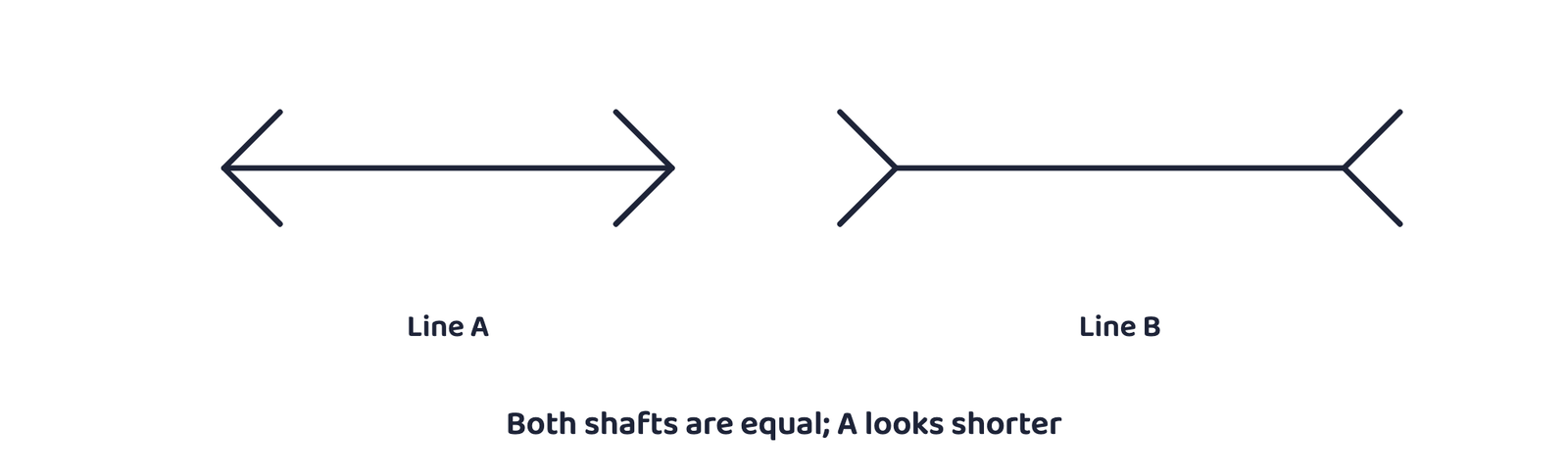
- Muller-Lyer illusion (Fig. 4.13): line A is seen as shorter than line B though both are equal. Even children experience it, and some studies suggest animals do too.
- Vertical-horizontal illusion (Fig. 4.14): two equal lines, but the vertical one looks longer than the horizontal one.
10.2 Apparent movement illusion (phi-phenomenon)
The phi-phenomenon is the illusion of movement experienced when motionless pictures are shown one after another at a suitable rate.
Films in a cinema and a series of flickering electric lights both create it. It can be studied in the lab by presenting two or more lights in succession. According to Wertheimer, four things about the lights must be just right: brightness, size, the gap in space between them, and the gap in time (temporal contiguity); without these the lights look like one point or separate points one after another, with no movement.
Illusions show that we do not perceive the world exactly as it is; we construct it, partly from stimulus features and partly from our experience of the environment.
11 Socio-Cultural Influences on Perception
Do people in different cultures organise what they perceive in the same way? Psychologists tested this with illusion figures and pictures.
| Study | Finding | Explanation |
|---|---|---|
| Segall, Campbell and Herskovits: the most extensive study of illusion susceptibility (remote African villages vs Western urban settings) | The horizontal-vertical illusion fooled the African groups more; the Muller-Lyer illusion fooled the Western groups more | Africans living in dense forests often see verticality (tall trees) and learn to overestimate it; Westerners live among right angles and learn to underestimate lines enclosed by arrowheads. Habits of perception are learnt differently in different cultures |
| Hudson: seminal study in Africa | People who had never seen pictures found it very hard to recognise objects in them and to read depth cues such as superimposition | Informal instruction at home and habitual exposure to pictures are needed to keep the skill of pictorial depth perception |
| Sinha and Mishra: hunters and gatherers in forests, agriculturists in villages, city employees | Interpretation of pictures is strongly linked to cultural experience | Most people recognise familiar objects in pictures, but those less exposed to pictures struggle to interpret actions or events shown in them |
12 Review Questions: Short Answers
- Functional limitations of sense organs? They work within a limited range: we cannot see very dim or very bright things or hear very faint or loud sounds. A stimulus must cross the absolute threshold to be noticed and the difference threshold to be told apart, and damage to receptor, pathway or brain area causes loss of sensation.
- Define attention and its properties. Attention is selecting certain stimuli from many. Its properties: alertness, concentration and search; overall it is “effort allocation”, with a focus and a fringe.
- Determinants of selective attention; how it differs from sustained attention. External factors (size, intensity, motion, novelty, complexity) and internal factors (motivational needs; cognitive interest, attitude, preparatory set). Selective attention is about selecting; sustained attention is about keeping concentration for long (vigilance).
- Main Gestalt proposition. We perceive organised wholes with a definite form, not separate parts; the whole differs from the sum of its parts, and the brain leans towards a good figure (pragnanz).
- How does perception of space take place? The retinal image is 2D, but using monocular and binocular cues we convert it into a 3D perception of depth and distance.
- Monocular cues; role of binocular cues. Monocular: relative size, interposition, linear and aerial perspective, light and shade, relative height, texture gradient, motion parallax. Binocular: retinal disparity, convergence and accommodation tell the brain how near an object is.
- Why do illusions occur? Sensory information is misinterpreted, giving a mismatch between the stimulus and the percept; we construct the world from stimulus features and from our experience.
- How do socio-cultural factors influence perception? They create different familiarity and habits of perceptual inference: Segall, Campbell and Herskovits (illusions), Hudson and Sinha and Mishra (pictures).
- 7 senses: 5 external + 2 deep (kinesthetic, vestibular); 10 varieties of stimuli
- AL = least stimulus noticed; DL = least difference noticed; both on 50 per cent of trials
- Attention = selection; properties alertness, concentration, search; focus vs fringe
- Selective (factors external + internal), sustained (vigilance: modality, clarity, temporal, spatial), divided (automatic, practised)
- Broadbent 1956 filter; Triesman 1962 attenuation; Johnston and Heinz 1978 multimode
- Span of attention 7 ± 2 (Miller), tachistoscope; ADHD: impulsivity, overactivity, inattention
- Perception = giving meaning; bottom-up (parts first) vs top-down (whole first)
- Perceiver: motivation, expectation (perceptual set), cognitive style, culture
- Gestalt: Köhler, Koffka, Wertheimer; figure-ground; 7 principles
- Monocular (pictorial) vs binocular cues; constancies: size, shape, brightness
- Illusions: Muller-Lyer, vertical-horizontal, phi-phenomenon; culture changes susceptibility
- Can I explain AL and DL with the sugar water example?
- Can I name the three theories of selective attention with their proposers and years?
- Can I list the four factors of sustained attention?
- Can I name and explain all seven Gestalt principles?
- Can I sort depth cues into monocular and binocular and explain each binocular cue?