
- What thinking is, and the two building blocks it works with: mental images and concepts
- How we solve problems, what blocks us, and how reasoning, judgment and decision-making work
- What makes thinking creative, the four stages of the creative process, and ways to become more creative
- The three views on how language and thought are related
- How children develop language, and the two big explanations of how language is acquired
The CBSE 2026-27 Class XI Psychology paper is 70 marks of theory plus 30 marks of practical (a project or small study, experiments, and a viva). Chapter 7 Thinking carries 5 marks in the theory paper. The whole chapter is in the syllabus; nothing is excluded. These notes cover the theory text of the NCERT chapter.
1Nature of Thinking
In daily talk we use “think” loosely: to mean remember (“I can’t think of her name”), pay attention (“think about it”) or show uncertainty (“I think my friend will come today”). In psychology, thinking has a meaning of its own: it is the mental activity we use to solve a problem, draw inferences, judge facts, and decide between options.
Thinking is a higher mental process through which we manipulate and analyse the acquired or existing information. (NCERT)
Base of all cognition
Every cognitive activity rests on thinking, and only human beings think in this way. It works on information taken in from the environment.
Goes beyond the given
Looking at a painting, you do not just see colours and strokes: you interpret its meaning and link it to what you already know, so new meaning is created.
Works through many processes
Manipulation and analysis happen by abstracting, reasoning, imagining, problem solving, judging and decision-making.
Organised and goal directed
From cooking to a maths sum, we plan, recall steps used before (familiar task) or infer new strategies (new task).
Internal, but inferred
Thinking cannot be seen. A chess player’s thinking is inferred from his next move, that is, from overt behaviour.
2Building Blocks of Thought
Thinking uses knowledge we already have. This knowledge is stored in two forms: mental images and words (concepts). Finding your way by road to a place you visited long ago, you picture the street: that is thinking in images. Choosing a storybook by what you know about authors and themes is thinking in words or concepts.
2.1 Mental image
An image is a mental representation of a sensory experience; it can be used to think about things, places, and events. (NCERT)
- Imagine a cat sitting on a tree with its tail raised and curved: you “see” the scene with your mind’s eye.
- Imagine yourself in front of the Taj Mahal and describe it: you form a visual image of the scene.
- Drawing a map while giving directions, or locating places on a blank map in an exam, uses mental images.
- Activity 7.1: a friend studies a map with marked places for 2 minutes, then marks them on a blank map (shown upside down). Asked how, s/he usually says s/he formed an image of the whole map.
2.2 Concepts
When we meet any object or event, we pick out its features and match them with a category we already have. If the match fits, we give it that category’s name: an apple is a fruit, a table is furniture. Even a tiny, unfamiliar four-legged animal with a dog-like face that wags its tail and barks at strangers is identified as a dog (maybe of a new breed), and we also expect it to bite strangers.
A concept is a mental representation of a category. It refers to a class of objects, ideas or events that share common properties. (NCERT)
Concepts organise our knowledge, so we can reach it with less time and effort. A tidy student keeps books, pens and the geometry box in fixed places, so nothing is hunted for in the morning rush; a library shelves and labels books by subject. In the same way, forming concepts and categorising objects and events makes thinking quick and efficient.
Our beliefs, values and social practices shape how we think. American and Asian students briefly saw an underwater scene and then described it.
American students: analytical thinking
- Described the biggest, brightest, most outstanding features (“the large fish swimming to the right”)
- Analyse each object separately
Japanese / Asian students: holistic thinking
- Described the background (“the bottom was rocky”, “the water was green”)
- Asians (Japanese, Chinese, Koreans) think more about relationships between objects and backgrounds
3The Processes of Thinking: Problem Solving
Repairing a bicycle can be quick because cues are right in front of you; planning a summer tour or patching up a broken friendship takes more time and effort. A problem need not be a hurdle: making a quick snack for a friend who has just arrived is also a problem, because there is a goal to reach.
Problem solving is thinking that is goal-directed. Every problem has an initial state (the problem) and an end state (the goal), and the two are connected by several steps or mental operations.
3.1 Mental operations in solving a problem (Table 7.1)
Book’s example: you have one week to organise a play in school for Teachers’ Day.
- Anagrams: NAGMARA, BOLMPER, SLEVO, STGNIH, TOLUSONI (answers: ANAGRAM, PROBLEM, SOLVE, INSIGHT, SOLUTION).
- Joining dots: connect nine dots with four straight lines without lifting the pencil.
- Water in three bottles: seven problems. Problems 1 to 5 are solved by the same sequence B – A – 2C (e.g. 127 – 21 – 3 – 3 = 100 ml). Problem 6 (get 20 ml; A = 23, B = 49, C = 3) also works that way, but A – C (23 – 3) is quicker. Problem 7 (get 25 ml; A = 28, B = 76, C = 3) works only by the simple A – C (28 – 3). People who keep using the old sequence show a mental set.
3.2 Obstacles to solving problems
The book names two major obstacles, mental set and lack of motivation, and also explains functional fixedness, which works like mental set.
Mental set is a tendency of a person to solve problems by following already tried mental operations or steps. (NCERT)
- Past success with a strategy can help on a new problem, so mental set can improve speed and quality in some situations.
- But it also creates mental rigidity: the old steps interfere and block new rules or strategies. After a few maths sums of one type you keep using the same steps until one sum refuses to work.
Functional fixedness occurs when people fail to solve a problem because they are fixed on a thing’s usual function. Using a hardbound book to hammer a nail means you have overcome it.
Mental set
Stuck on old steps: keeps using B – A – 2C when A – C is enough.
Functional fixedness
Stuck on an object’s usual use: cannot see a book as a hammer.
Lack of motivation
Skills are of no use without motivation. People who give up after the first step fails need to persist.
4Reasoning
You see a man running desperately on a railway platform. Is he late for his train? Seeing off a friend? Has he left his bag in the train? To find out, you can reason deductively or inductively.
Reasoning is the process of gathering and analysing information to arrive at conclusions. It is also a form of problem solving: the goal is to decide what conclusion follows from given information.
Deductive reasoning
- Begins with an assumption (a general statement you know or believe is true)
- Draws a specific conclusion: general to particular
- “People run on platforms only when late for a train. This man is running. So he is late.”
- Common error: assuming the base statement is true when it may not be. If people also run for other reasons, the conclusion is invalid (Fig. 7.3: the mouse who concludes “I am a cat” because it has four legs)
Inductive reasoning
- Based on specific facts and observation
- Draws a general conclusion: particular to general
- You watch the man enter the compartment and come back with a bag, and conclude he had left his bag in the train
- Common error: jumping to a conclusion without knowing all the facts
- Most scientific reasoning is inductive
Analogy is a form of reasoning with four parts, A is to B as C is to D, where the relation between the first two parts is the same as the relation between the last two.
Examples from the book: water is to fish as air is to human; white is to snow as black is to coal. Analogies help solve problems because they make us notice the important features of an object or event that would otherwise go unnoticed.
5Judgment and Decision-making
In judgment we draw conclusions, form opinions, and evaluate events and objects, based on knowledge and available evidence.
- Example: a man who is talkative, likes mixing with people and convinces others easily is judged most suitable for a salesperson’s job.
- Automatic judgments need no conscious effort and come from habit: braking at a red light.
- Effortful judgments use past knowledge and experience (evaluating a novel) or personal preference (the beauty of a painting). So judgments are not independent of our beliefs and attitudes.
- Judgments change with new information: students first judge a new teacher as very strict; after a few classes they find the teacher extremely student-friendly.
In decision-making the problem is to choose among alternatives by evaluating the cost and benefit associated with each alternative.
- Choosing Psychology or Economics in Class XI: you weigh interest, future prospects, books, teachers; you ask seniors and attend a few classes.
- A friend selected for state-level badminton with final exams near must choose between practice and study by weighing all possible outcomes.
- People’s priorities differ, so their decisions differ. In real life many decisions are quick, so not every situation can be evaluated fully.
| Point | Decision-making | Other problem solving |
|---|---|---|
| Solutions | The choices are already known; one has to be selected | The solution has to be found |
| Basis | Cost and benefit of each alternative, often personal significance | Mental operations from initial state to goal |
Judgment and decision-making are interrelated: you judge each option (form an opinion of it) before you choose one. Inductive and deductive reasoning are what allow us to make judgments.
6Nature and Process of Creative Thinking
Someone, for the first time, thought of planting a seed, making a wheel, or painting cave walls. Music, painting, poetry and scientific progress are all products of creative thinking. Two Indian examples from the book:
A.D. Karve
A botanist who got the UK’s top energy award for a smokeless ‘Chullah’, turning dry, useless sugarcane leaves into clean fuel.
Ashish Panwar
A Class XI student who won a bronze medal for a five feet tall robot at the First International Robotics Olympiad, Glasgow.
Everyday creativity
- In writing, teaching, cooking, role play, storytelling, asking questions, solving daily problems, helping others resolve conflicts
- Reflected in one’s way of perceiving, thinking and problem solving
- Everyone has the potential to be creative
Special talent creativity
- Seen in outstanding creative achievements
- Of scientists, artists, inventors
6.1 Nature of creative thinking
Creative thinking involves the production of novel and original ideas or solutions to problems; it refers to originality and uniqueness of ideas or solutions that did not previously exist.
| Feature | What it means |
|---|---|
| Novelty + originality | New is not enough. Each year’s new car or TV model is not original unless unique features are added. |
| “Effective surprise” (Bruner) | An unusual idea or product makes people feel instantly surprised or startled. |
| Appropriateness | It must fit the context: reality-oriented, appropriate, constructive and socially desirable. Being different without purpose, non-conformist, lost in fantasy or bizarre is not creative thinking. |
6.2 Convergent and divergent thinking (J.P. Guilford)
J.P. Guilford, a pioneer in creativity research, proposed two types of thinking.
Convergent thinking
- Needed for problems with only one correct answer
- The mind converges on the correct solution
- 3, 6, 9, …? Answer: 12
- Picks the most useful or appropriate idea
Divergent thinking
- Open-ended: many possible answers, from one’s own experiences
- Uses of cloth? Improving a chair? What if exams were abolished?
- Produces novel and original ideas
- Generates a wide range of ideas
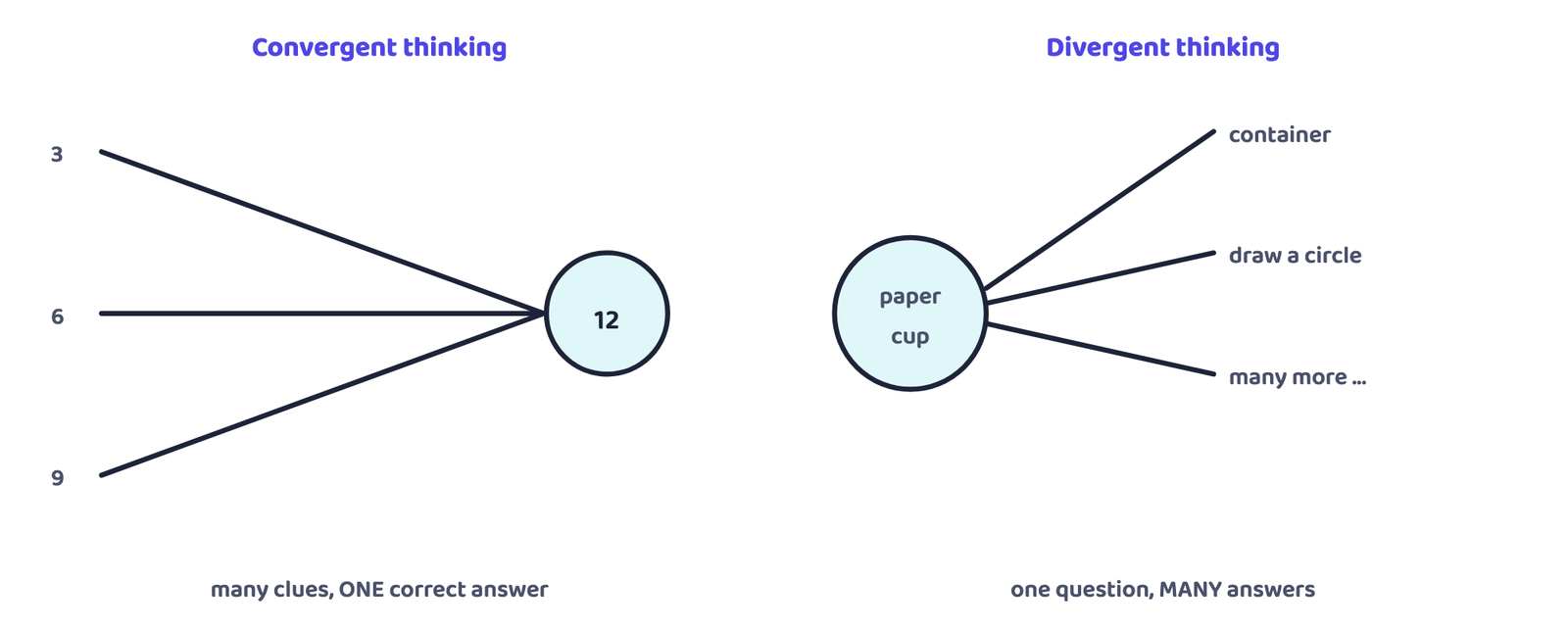
Divergent thinking abilities generally include four abilities:
Fluency
Ability to produce many ideas for a task. More uses of a paper cup = higher fluency.
Flexibility
Variety in thinking: different uses, interpretations or ways of solving. A paper cup as a container, or to draw a circle.
Originality
Producing rare or unusual ideas by seeing new relationships, combining old and new ideas, using new perspectives. Fluency and flexibility are its necessary conditions.
Elaboration
Going into details and working out the implications of new ideas.
Ask for ways to raise food production and most answers are about seeds, fertilizers and irrigation. Someone who suggests farming in the desert to extract protein from weeds has made a remote association, linking ideas we do not normally put together. Letting the mind roam freely over such links produces combinations, of which one or two may be original. Remember: both divergent (many ideas) and convergent (pick the best) thinking are needed for creativity.
Edward de Bono used the term lateral thinking for what Guilford called divergent thinking. Vertical thinking moves in a straight line, back and forth between lower and higher level concepts; lateral thinking looks for alternative ways of defining and interpreting problems. In his words, vertical (logical) thinking “digs the same hole deeper”, while lateral thinking is about digging a hole in another place. Lateral thinking helps the mind make leaps. He developed the Six thinking hats technique, usable alone or in groups; each hat is a different viewpoint you can put on or take off.
| Hat | Kind of thinking |
|---|---|
| White | Gathering information, facts and figures; filling gaps in information |
| Red | Expressing feelings and emotions on the subject |
| Black | Judgment, caution and logic |
| Yellow | What will work and why it will be beneficial |
| Green | Creativity, alternatives and changes |
| Blue | Thinking about the process, not the ideas themselves |
Activity 7.3: frame five divergent-thinking questions on traffic management, pollution, corruption, illiteracy or poverty and discuss them in class.
6.3 Process of creative thinking (Fig. 7.5)
Creative ideas need more than a flash of insight; there are stages before and after the idea comes. It starts with a need to think of or bring out something new, which arises from sensing problems and gaps in information. Not everyone feels this need; some are content with routine work.
6.4 Strategies for creative thinking
- Become aware and sensitive: notice feelings, sights, sounds and textures; spot problems, missing information, gaps and contradictions others miss. Read widely, seek varied information, ask questions.
- Generate many ideas to increase the flow of thoughts (fluency), and deliberately look at a task from many angles (flexibility): rearranging furniture for more space, new ways of dealing with an angry friend.
- Osborn’s Brainstorming: raises fluency and flexibility in open-ended situations.
- Checklists and questions: “What else? In how many ways could it be done? What other uses could this object have?”
Brainstorming (Osborn) works on one rule: first produce ideas freely, and judge their worth only later. Judgment is held back and imagination comes first until no more ideas are left.
7Thought and Language
A child building a sand tower often talks to herself (“not this”, “a little small”, “nice”). So how are language and thought related? The book gives three viewpoints.
Language determines thought
Benjamin Lee Whorf: language determines the contents of thought: the linguistic relativity hypothesis.
Thought determines language
Jean Piaget (Swiss): thought not only determines language but also precedes it.
Different origins
Lev Vygotsky (Russian): thought and language develop separately till about two years, then merge.
7.1 Language as determinant of thought (Whorf)
Hindi and other Indian languages have separate words for mother’s brother, father’s elder brother, father’s younger brother, and so on; English uses one word, uncle. English has dozens of colour words; some tribal languages have only two to four. Does this change how we think?
- Linguistic relativity hypothesis (Whorf): language determines the contents of thought.
- Its strong version, linguistic determinism: what and how a person can think is determined by the language and linguistic categories they use.
- Evidence says otherwise: the same level and quality of thought is possible in all languages, depending on the linguistic categories and structures available. Some thoughts may only be easier in one language than another.
7.2 Thought as determinant of language (Piaget)
- Children form an internal picture of the world through thinking.
- When a child watches someone and later copies it (imitation), thinking takes place without language.
- Language is just one vehicle of thinking; it may widen symbolic thinking but is not necessary for the origins of thought.
- Words can be taught, but understanding them needs the underlying concepts (thinking). So thought is basic, and needed for language to be understood.
7.3 Different origins of language and thought (Vygotsky)
| Vygotsky’s three possibilities | Example |
|---|---|
| Thought without language | When the vehicle of thinking is non-verbal: visual or movement-related |
| Language without thought | Expressing feelings or exchanging pleasantries: “Good morning! How are you?” “Very well, I am fine.” |
| Both together | When the two overlap: verbal thought and rational speech |
8Development of Language and Language Use
8.1 Meaning and nature of language
Without language we could neither share our ideas and feelings nor know what others think and feel. A child’s journey runs from crying and “ma..ma..ma” to the home language (often the mother tongue), then the school’s language of instruction, then other languages.
Language consists of a system of symbols organised by means of certain rules that we use to communicate with each other. (NCERT)
Symbols
Words stand for something else: ‘home’, ‘school’, ‘food’. A word has no meaning in itself until it is linked to an object or event. We use symbols while thinking.
Rules
Words are combined in an accepted order: “I am going to school”, not “school am going I”. (The rules of word order are the syntax of a language.)
Communication
Language carries thoughts, ideas, intentions and feelings to others. Gestures and postures are non-verbal communication; sign language of people with severe hearing and speech problems is also a language.
8.2 Development of language
Language is complex and unique to human beings. Chimpanzees, dolphins and parrots have been taught signs and symbols, but human language is more complex, creative and spontaneous. Children differ in the rate of language development, yet children all over the world follow a predictable pattern of stages.
8.3 How is language acquired? Nature and nurture
Is language inherited (nature) or learnt (nurture)? Most psychologists accept that both are important.
B.F. Skinner (behaviourist): learning
- We learn language the way animals learn to peck keys or press bars
- Association: the sight of a bottle with the word ‘bottle’
- Imitation: copying adults’ use of “bottle”
- Reinforcement: smiles and hugs when the child says it right
- Shaping: successive approximations until the child speaks like an adult
- Explains regional differences in pronunciation, why infants learn the language they hear, and how vocabulary grows
Noam Chomsky (linguist): innate
- Learning principles alone cannot explain how fast children pick up words and grammar without being taught
- Children make sentences they have never heard, so they cannot be imitating
- There is a critical period when language learning must occur to succeed
- Children everywhere pass through the same stages; language “just happens to the child”, like physical maturation
- Children are born with “universal grammar”: a built-in readiness to learn grammar
8.4 Language use
Knowing vocabulary and syntax is not enough. When we speak we have pragmatic intentions: requesting, asking, thanking, demanding. To meet these social goals, language must be pragmatically correct or contextually appropriate, not just grammatical and meaningful. Children often struggle here: a polite request comes out as a demand or command, and they find it hard to take turns in speaking and listening like adults.
- Bilingualism: attaining proficiency in communicating through any two languages.
- Multilingualism: learning more than two languages.
- Mother tongue has been defined as one’s native language, the language from the cradle, the language used at home, or the language spoken by the mother. Generally it is the language one identifies with at the emotional level. A person can have multiple mother tongues.
- India has grass root multilingualism: most Indians use more than one language in daily life, so multilingualism is a way of life in India, at both individual and social levels.
- Studies show bilingualism / multilingualism helps children’s cognitive, linguistic and academic competence.
9NCERT Review Questions: Brief Answers
| Question | Answer in brief |
|---|---|
| 1. Explain the nature of thinking. | A higher mental process of manipulating and analysing information; base of all cognition, unique to humans; organised and goal directed; internal, inferred from overt behaviour; uses images and concepts. |
| 2. What is a concept? Its role in thinking? | A mental representation of a category of things sharing common properties. It organises knowledge so it is reached with less time and effort, making thinking quick and efficient. |
| 3. Obstacles in problem solving? | Mental set (stuck on old steps), functional fixedness (stuck on an object’s usual use) and lack of motivation (giving up without persistence). |
| 4. How does reasoning help in solving problems? | It gathers and analyses information to reach conclusions: deductively (general to particular), inductively (particular to general), or by analogy, which shows features otherwise missed. |
| 5. Are judgment and decision-making interrelated? | Yes. Judgment evaluates options using knowledge, evidence, beliefs and attitudes; decision-making then chooses among those known options by weighing their costs and benefits. |
| 6. Why is divergent thinking important in creativity? | It gives many varied ideas (fluency, flexibility), which are the necessary conditions for original ideas; it drives the preparation stage, while convergent thinking verifies. |
| 7. How can creative thinking be enhanced? | Being aware and sensitive, generating many ideas from many angles, Osborn’s brainstorming, checklists and questions. |
| 8. Does thinking take place without language? | Yes: Piaget shows thinking in imitation without language; Vygotsky says thought is preverbal till about two years and can use visual or movement vehicles. Whorf’s strong view is not supported by evidence. |
| 9. How is language acquired? | Through both nature and nurture: Skinner’s association, imitation, reinforcement and shaping, and Chomsky’s innate universal grammar and critical period. |
Project idea (NCERT): observe 1-, 2- and 3-year-old children for a week; record their speech, how they learn words, and how many words they learn.
- Thinking = higher mental process; base of cognition; goal directed; inferred from overt behaviour; building blocks = images and concepts
- Box 7.1: Americans analytical, Asians holistic thinking
- Problem solving: initial state to end state, 7 steps; obstacles = mental set, functional fixedness, lack of motivation
- Deductive = general to particular; inductive = particular to general (most scientific reasoning); analogy = A:B :: C:D
- Judgment and decision-making are interrelated; decision-making weighs costs and benefits of known options
- Creativity = novelty + originality + appropriateness; Bruner’s “effective surprise”; everyday vs special talent creativity
- Guilford: convergent vs divergent; fluency, flexibility, originality, elaboration; de Bono: lateral thinking, six hats
- Creative process: preparation, incubation, illumination, verification; Osborn’s brainstorming
- Whorf (language decides thought), Piaget (thought precedes language), Vygotsky (separate till 2 years)
- Stages: crying, cooing, babbling (6 m), echolalia (9 m), one-word/holophrase (1 yr), two-word telegraphic (18-20 m); Skinner vs Chomsky
- Can I define a concept and say why we form concepts?
- Can I explain mental set with the water-bottle problems?
- Can I tell deductive from inductive reasoning with the railway platform example?
- Can I name and explain all four divergent thinking abilities and the four stages of the creative process?
- Can I compare Skinner’s and Chomsky’s views of how language is acquired?