
This is the opening chapter of Book 2 (your second Sociology textbook,
Social Change and Development in India). Its own book number is
Chapter 1, but on this site and in your revision plan it is Chapter 8 of
the full year.
| Board | This chapter | Paper shape |
|---|---|---|
| CBSE 2026-27 | 5 marks (Unit 8, Structural Change) | 80 theory + 20 project |
Students of other boards should check their own board’s current
syllabus and marking scheme. The CBSE curriculum gives the unit’s total, not a
per-question split, so the question bank in this chapter’s Important Questions
and MCQ posts is built on the book’s own discussion questions and content.
- Why this chapter treats colonialism as a structure and system, not just a period of history
- How capitalist colonialism differed from earlier empire-building, and what that meant for India’s laws, land and forests
- What capitalism and the nation-state are, and the contradiction between colonial rule and nationalism
- Why British industrialisation caused deindustrialisation in some sectors in India instead of the urban growth it caused in Britain
- How colonial port cities, and the tea plantations, were shaped by colonial interests
- How independent India’s own industrialisation and urbanisation carried this history forward
1 Colonialism as a Structure and System
Understanding India’s present needs some grasp of its past, and the
colonial experience matters most for understanding modern India. This
is not only because many modern ideas and institutions reached India through
colonialism, but because that exposure was contradictory: Indians in
the colonial period read about western liberalism and freedom, yet lived
under a colonial rule that denied them exactly that liberty and freedom.
Contradictions of this kind shaped many of the structural changes this chapter
covers and the cultural changes the next chapter covers: the two are
difficult to fully separate.
Colonialism’s legacy is not just in history books. The book itself lists
everyday examples: a parliamentary, legal, police and educational system
built on the British model; driving on the left side of the road; English
food terms like “cutlets” on roadside menus; a well-known biscuit brand
named after Britain; many school uniforms include neck-ties. The English
language is its own paradox. It gives Indians an edge in the global
market, and has produced a body of Indian literature in English. Yet it
also remains a “mark of privilege”: not knowing English is a real
job-market disadvantage. For groups traditionally denied formal education,
such as Dalits, knowledge of English may open doors of opportunity
that were formerly closed.
Housewives and college students who know English take up assignments as
online scorers in BPOs, evaluating English essays written by non-English-speaking
students in Asia (Japan, Korea, China). Online education is described as a new
wave in the BPO segment: all you need is a flair for English, creative skills and
basic computer knowledge.
The chapter itself narrows its focus to two structural changes that
colonialism brought, industrialisation and urbanisation, mainly in
the colonial period, with a brief look at what happened after independence.
1.1 What Is Colonialism?
Colonialism, at one level, simply means the establishment of
rule by one country over another. In the modern period, western
colonialism has had the greatest impact: its changes were more
far-reaching and deep than those of any earlier rule in India’s history.
Capitalism is an economic system in which the means of
production are privately owned and organised to accumulate profits within
a market system. Its two marks from the very beginning were its
dynamism (the potential to grow, expand, innovate and use
technology and labour for greatest profit) and its global nature.
Western colonialism was inextricably connected to the growth of western
capitalism, and this shaped how capitalism itself developed in a
colonised country like India. Keep this term in mind right away: the
difference between the two kinds of empire-building below turns on it.
History is full of one power annexing another’s territory, but there is a
vital, qualitative difference between pre-capitalist empire-building and
colonialism under capitalism (Alavi and Shanin, 1982):
Pre-capitalist empires
- Apart from outright pillage, profited by exacting a continuous flow of tribute, skimmed off the traditional economic surplus
- On the whole, did not interfere with the subjugated society’s economic base
- Kept traditional economic arrangements largely intact
British (capitalist) colonialism
- Directly interfered to maximise British capitalism’s profit
- Changed land-ownership laws AND decided which crops could or could not be grown
- Altered how goods were produced and distributed
- Entered the forests: cleared trees, started tea plantations, and brought in Forest Acts that prevented pastoralists from entering many forests that had earlier provided valuable forage for their cattle
A question on “how was British colonialism different from earlier
conquests” is really asking for this comparison. Anchor your answer on one
idea: earlier rulers, apart from outright pillage, mostly took a share of the
surplus; British colonialism changed the very structure that produced it.
Some of colonialism’s changes were deliberate, while some took place in an
unintended fashion. Western education was introduced to create Indians who
would manage British colonialism: instead, it led to the growth of a
nationalist and anti-colonial consciousness.
1.2 Movement of People Under Colonialism
Within India
People from present-day Jharkhand moved to Assam to work the new tea
plantations. A new middle class of government employees and
professionals, such as doctors and lawyers, largely from the British
Presidency regions of Bengal and Madras, moved to different parts of
the country in colonial service.
Overseas, as labourers
People were carried by ship to work on other colonised lands in
Asia, Africa and the Americas. Many died on the way; most could never
return. Today many of their descendants are known as people of Indian
origin.
From 1834 to 1920, ships left Indian ports regularly, carrying
people of various religions, genders, classes and castes to work a
minimum of five years on plantations in Mauritius. For many
decades the recruiting ground was centred in Bihar, in particular
in districts such as Patna, Gaya, Arrah, Saran, Tirhoot, Champaran, Munger
(Monghyr), Bhagalpur and Purnea (Pineo, 1984).
1.3 The Nation-State
A nation-state is a particular type of modern state: a
government holds sovereign power within a defined territory, and the
people living there are citizens of a single nation. As capitalism became
the dominant economic system, the nation-state became the dominant
political form. Before the First World War, passports were not
widely used for international travel: societies were not always
organised the way we take for granted today. Nation-states are closely
tied to the rise of nationalism: the principle that a set of
people has a right to be free and to exercise sovereign power, itself
part of the rise of democratic ideas (you will read more in Chapter 3).
Colonial rule meant foreign rule, such as British rule over India.
Nationalism said that the people of India, or of any colonised society,
have an equal right to be sovereign. Indian nationalist leaders grasped
this irony quickly: they declared that swaraj (freedom) was their
birthright, and fought for both political and economic freedom.
2 Industrialisation and Urbanisation: The Colonial Experience
Industrialisation is the emergence of machine production, based
on inanimate power resources such as steam or electricity. In advanced
traditional civilisations, low technology meant most people had to work
the land; in industrial societies, a large majority instead work in
factories, offices or shops. Over 90% of people in the west live in towns
and cities. Industrialisation and urbanisation often occur together, but
not always. In colonial India the pattern differed from Britain’s:
British industrialisation brought deindustrialisation in some sectors and,
at first, more people moving into agriculture, even as new colonial cities
grew.
2.1 Britain’s Experience
Britain was the first society to industrialise, and also the earliest to
turn from a rural into a predominantly urban country (Giddens, 2001: 572):
2.2 India’s Very Different Pattern
In India, the very same British industrialisation led to
deindustrialisation in some sectors and the decline of old urban
centres. Traditional Indian exports of cotton and silk manufactures declined
in the face of “Manchester competition.” From the end of the 19th century,
with the installation of mechanised factory industries, some towns became
much more heavily populated.
| What happened to the city | Cities named by the book | Why |
|---|---|---|
| Declined further | Surat, Masulipatnam | Declined further in the same period in which Bombay and Madras grew; the book lists this as part of the decline of old urban centres |
| Grew | Bombay, Madras | Coastal colonial cities, favoured because primary commodities could be exported and manufactured goods cheaply imported through them |
| Lost their courts | Thanjavur, Dhaka, Murshidabad | When the British took over Indian states, these towns lost their courts and, therefore, some of their artisans and court gentry |
“Urban luxury manufactures like the high quality silks and cottons of
Dacca or Murshidabad must have been hit first by the almost simultaneous
collapse of indigenous court demand and the external market on which
these had largely depended. Village crafts in the interior, and
particularly in regions other than eastern India where British
penetration was earliest and deepest, probably survived much longer,
coming to be seriously affected only with the spread of railways.”
Sarkar, 1983: 29
“The extensive importation of cheap European piecegoods and utensils,
and the establishment in India itself of numerous factories of the
western type, have more or less destroyed many village industries. The
high prices of agricultural produce have also led many village artisans
to abandon their hereditary craft in favour of agriculture … The extent
to which this disintegration of the old village organisation is proceeding
varies considerably in different parts. The change is most noticeable in
the more advanced provinces.”
Do not assume India’s industrialisation pulled people INTO cities the
way it did in Britain. The book is explicit that it was the
opposite: British industrialisation’s initial impact in India
led more people to move into agriculture, as the Census Report shows.
Sociological writings in India have often discussed both the contradictory
and the unintended consequences of colonialism. Box 1.3 below is one such
observation. It also shows that industrialisation is not just about new
machine-based production but also a story of the growth of new social
groups and new social relationships: in other words, of changes in the
Indian social structure.
The substitutes offered by the East India Company and then by the
British government were land ownership and facilities for
education in English. They were not sufficient to create any genuine
middle class: the first remained unconnected with agricultural
productivity, and the second with the mainstream of Indian cultural
traditions. In the book’s own words,
“the zamindars become parasites in land and the graduates job hunters”
(Mukherjee, 1979: 114).
2.3 Colonial Port Cities
Cities had a key role in the economic system of empires. Coastal cities
such as Mumbai, Kolkata and Chennai (the table and timeline below use
their colonial-era names, Bombay, Calcutta and Madras, as the book does
there) were favoured because primary
commodities could easily be exported through them, and manufactured goods
cheaply imported. They were the prime link between the economic core in
Britain and the periphery in colonised India: “the concrete expression of
global capitalism.”
| City | What it exported (Bombay’s figure is for 1900) |
|---|---|
| Bombay | Over three-quarters of India’s raw cotton, shipped through the city |
| Calcutta | Jute, to Dundee |
| Madras | Coffee, sugar, indigo dyes and cotton, to Britain |
Urbanisation in the colonial period saw old urban centres decline while
new colonial cities emerged: Kolkata was one of the first.
The European town
- Spacious bungalows, elegant apartment houses, planned streets
- Trees on both sides of the street, clubs for afternoon and evening get-togethers
- Open space reserved for Western recreational facilities: race and golf courses, soccer, cricket
- Domestic water supply, electric connections and sewage links, where available or technically possible, utilised fully
The native town
- The use of these same civic services was “quite restricted”
Box 1.4, “A model of the South Asian colonial city” (Dutt, 1993: 361).
2.4 The Tea Plantations
Industrialisation and urbanisation did not happen in India the way they
did in Britain. The book says this is not because India began
industrialising late, but because its early industrialisation and
urbanisation were governed by colonial interests. The tea industry is the
book’s own example.
Assam was sparsely populated and the tea plantations were often located
on uninhabited hillsides, so labour had to be brought in from other provinces. Bringing
thousands of people every year needed financial and other incentives,
which the planters were unwilling to offer, so they used
fraud and coercion, backed by penal laws the government passed to
help them: recruitment was carried on for years, mostly by contractors, under the Transport of Native
Labourers Act (No. III) of 1863 of Bengal, amended in 1865, 1870
and 1873. Colonial administrators knew harsh measures were used on
labourers to benefit planters, and knew a colonised country’s own laws
did not have to follow the democratic norms Britain observed at home.
While labourers suffered fraud and coercion, the British planters of
the estates around Parbatpuri (a steamer loading point) lived in huge bungalows on stilts (to keep out wild
animals), served by trained malis, bawarchis and bearers, with household
goods, even cast-iron bathtubs, brought upriver by steamer (Phukun,
2005). Know this contrast as a fact you can cite, not as extra detail to
skip.
3 Structural Change After Independence
3.1 Industrialisation in Independent India
The independent Indian state actively promoted industrialisation, partly
in response to colonialism’s impact on Indian industry (Chapter 5 covers
this in depth, including the shift after 1990’s liberalisation). For Indian
nationalists, economic exploitation under colonial rule had been a central
issue; images of pre-colonial riches contrasted with poverty in British
India. The Swadeshi movement strengthened loyalty to the national
economy, and modern ideas made people see poverty as preventable.
Nationalists saw rapid industrialisation as the path to both growth and
social equity: so the development of heavy and machine-making industries,
the expansion of the public sector, and a large cooperative sector were all
considered important.
Bokaro
New industrial town, post-Independence
Bhilai
New industrial town, post-Independence
Rourkela
New industrial town, post-Independence
Durgapur
New industrial town, post-Independence
3.2 Urbanisation in Independent India
Recent decades of globalisation have brought enormous expansion and
change to Indian cities. The Government of India’s ‘Smart City’
initiative is expected to speed up 21st-century urbanisation further
(Chapter 6 covers this in detail).
Sociologist M.S.A. Rao (1974: 486-490), writing on the first two decades
after independence, described three different situations of urban
impact on villages:
Out-migration for employment
A sizeable number of villagers work in far-off cities while family
stays in the natal village. In Madhopur (north-central India),
77 of 298 households have migrants; a little less than half of all the
migrants work in Bombay or Calcutta; about 75% send money home regularly,
and 83% visit from four to five times a year to once in two years. Some
migrants live in overseas towns, such as those from Gujarat villages in
African and British towns; they have built houses in their natal villages,
invested money in land and industry, and donated to educational
institutions and trusts.
Villages near an industrial town
When a town like Bhilai comes up, some villages are totally
uprooted, others partially acquired. An influx of immigrant workers
raises demand for houses and a market inside the village, but also
creates problems of ordering relationships between native residents and
immigrants.
Growth of metropolitan cities
A few villages are totally absorbed into an expanding metropolis; of
many others, only the land, excluding the inhabited area, is used for
urban development.
3.3 India’s Urban Population, 1951 to 2011
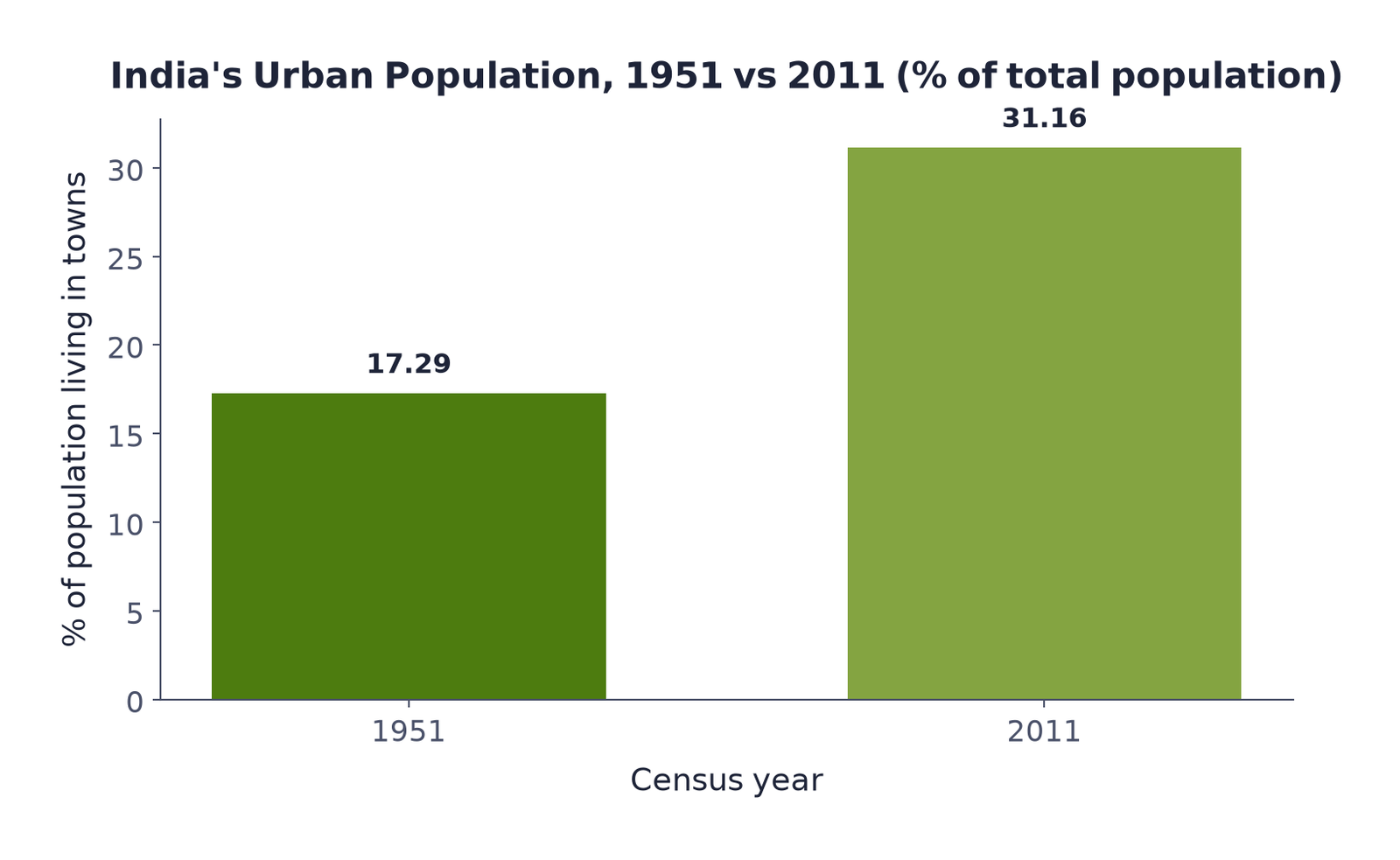
| Year | % of population urban | Urban population | Number of towns |
|---|---|---|---|
| 1951 | 17.29% | 62.44 million | 2,843 |
| 2011 | 31.16% | 377.10 million | 7,935 |
The decennial growth rate of the urban population itself was
41.42% in 1951, showed a declining trend during 1981-2001,
then reversed with a marginal increase to 31.80% in 2011. Do not
confuse this with the % of population that is urban (which only rose,
steadily): the growth rate is a different number and it fell for
decades before recovering slightly. Also remember: for the first time
since independence, the absolute increase in population was
greater in urban than in rural areas, because the rural growth rate fell
sharply while the urban rate stayed about the same.
- Activity 1.1: Find out about the beginnings of Bombay, Madras and Calcutta, the story of their names (Bombay to Mumbai, Madras to Chennai, Calcutta to Kolkata, Bangalore to Bengaluru), and the growth of other colonial urban centres.
- Activity 1.2: Find out how the Amul milk industry emerged.
- Activity 1.3: Find out about towns like Bokaro, Bhilai, Rourkela and Durgapur, whether such industrial towns exist in your region, and about townships built around fertiliser plants and oil wells.
Model answers are in this chapter’s NCERT Solutions post.
4 Conclusion
Colonialism is not just a topic in history: it lives on in complex ways
in daily life even today. Industrialisation and urbanisation are not only
about production systems, technological change and how densely people
settle. They are also, in the book’s own closing words, about
“a way of life” (Wirth, 1938).
- Colonialism = rule of one country over another; British (capitalist) colonialism directly interfered with land, crops, forests and production; pre-capitalist empires, apart from outright pillage, mainly took tribute and on the whole left the economic base alone
- Colonialism moved people both within India (Jharkhand to Assam; Bengal/Madras middle class as officials) and overseas as labourers (Box 1.1: 1834-1920, Mauritius, recruited for many decades mainly from Bihar districts)
- Capitalism = private ownership of production, organised for profit, dynamic and global; nation-state = sovereign government over a defined territory and its citizens
- Colonial rule and nationalism were contradictory: colonial rule meant foreign rule, nationalism claimed equal sovereignty: hence “swaraj as a birthright”
- Britain industrialised AND urbanised together (share living in towns of over 10,000: well under 20% in 1800, 74% by 1900; London about 1.1 million in 1800, over 7 million by 1900)
- India’s pattern differed: deindustrialisation in some sectors, decline of Surat/Masulipatnam, loss of court towns (Thanjavur, Dhaka, Murshidabad), and MORE people pushed into agriculture, not cities
- Colonial port cities (Bombay cotton, Calcutta jute, Madras coffee/sugar/indigo/cotton) linked the British core to the Indian periphery; Job Charnock leased three villages by the Hugli for a trading post (1690), Fort William 1698
- Tea plantations: 1851 start, 1903: 4,79,000 permanent + 93,000 temporary workers, recruited by fraud/coercion, mostly by contractors, under the Transport of Native Labourers Act (No. III) of 1863
- Independent India: Swadeshi-inspired push for heavy industry, public sector, cooperatives (Bokaro, Bhilai, Rourkela, Durgapur); M.S.A. Rao’s three types of urban impact on villages (out-migration, industrial-town-adjacent, metropolitan absorption)
- Urban population: 17.29% (1951, 62.44 million, 2,843 towns) to 31.16% (2011, 377.10 million, 7,935 towns); growth RATE fell 1981-2001 before a marginal 2011 rise
- Can I explain, with one example, how capitalist colonialism differed from pre-capitalist empire-building?
- Can I state why British industrialisation caused deindustrialisation and NOT urbanisation in India, unlike in Britain?
- Can I name the three colonial port cities and what each one exported?
- Can I explain M.S.A. Rao’s three types of urban impact, with the book’s own examples?
- Have I checked how my own board examines this chapter?