
- Why this chapter is different from the other chapters in this book, and what the CBSE curriculum says about it
- How to turn a broad interest into one specific, answerable research question
- The four research methods this book lists, survey, interview, observation, and using archives, with the advantages and disadvantages the book gives for surveys and interviews
- How to pick the right method for a question, instead of picking a favourite method first
- The six project topics the book itself suggests, each with the questions it wants you to ask
- A suggested outline (the notes’ own) for writing up your project
1Read This First: What Kind of Chapter This Is
Every other chapter in this book teaches you sociology as a subject: ideas, thinkers, institutions, and facts you can be asked about directly. This chapter is different. It does not teach a new topic of sociology at all. It teaches you how to do a small piece of sociological research yourself, the project work that sits alongside your board exam. Reading about research and actually doing it are two very different things, and this chapter exists to bridge that gap.
Before going further, the book itself asks you to look back at Chapter 5 of your Class XI textbook, Introducing Sociology, “Doing Sociology: Research Methods.” That chapter explained research methods in general; this one applies them to real project ideas you can actually attempt in school.
The CBSE Class XII Sociology course structure lists Unit 7, “Suggestions for Project Work”, as “Non-evaluative” in the 80-mark theory paper.
The same curriculum gives Project Work a maximum of 20 marks: a project undertaken during the academic year at school level, 15 marks (Introduction 2, Statement of Purpose 2, Research Question 2, Methodology 3, Data Analysis 4, Conclusion 2), and a viva based on the project work, 5 marks.
Other boards: the book does not say how any board assesses this chapter. Check your own board’s current syllabus.
2The One Idea Behind This Whole Chapter
Almost everything in this chapter follows from a single rule. Get this one idea right and the rest becomes common sense.
A research question is the exact, specific thing your project sets out to find an answer to. A research method is the technique you use to collect the evidence needed to answer it: for example, a survey, an interview, or observation.
“Every research question needs an appropriate or suitable research method. A given question may be answered with more than one method, but a given research method is not necessarily appropriate for all questions. In other words, for most research questions one has a choice of possible methods but this choice is usually limited.”
NCERT, Indian Society, Chapter 7
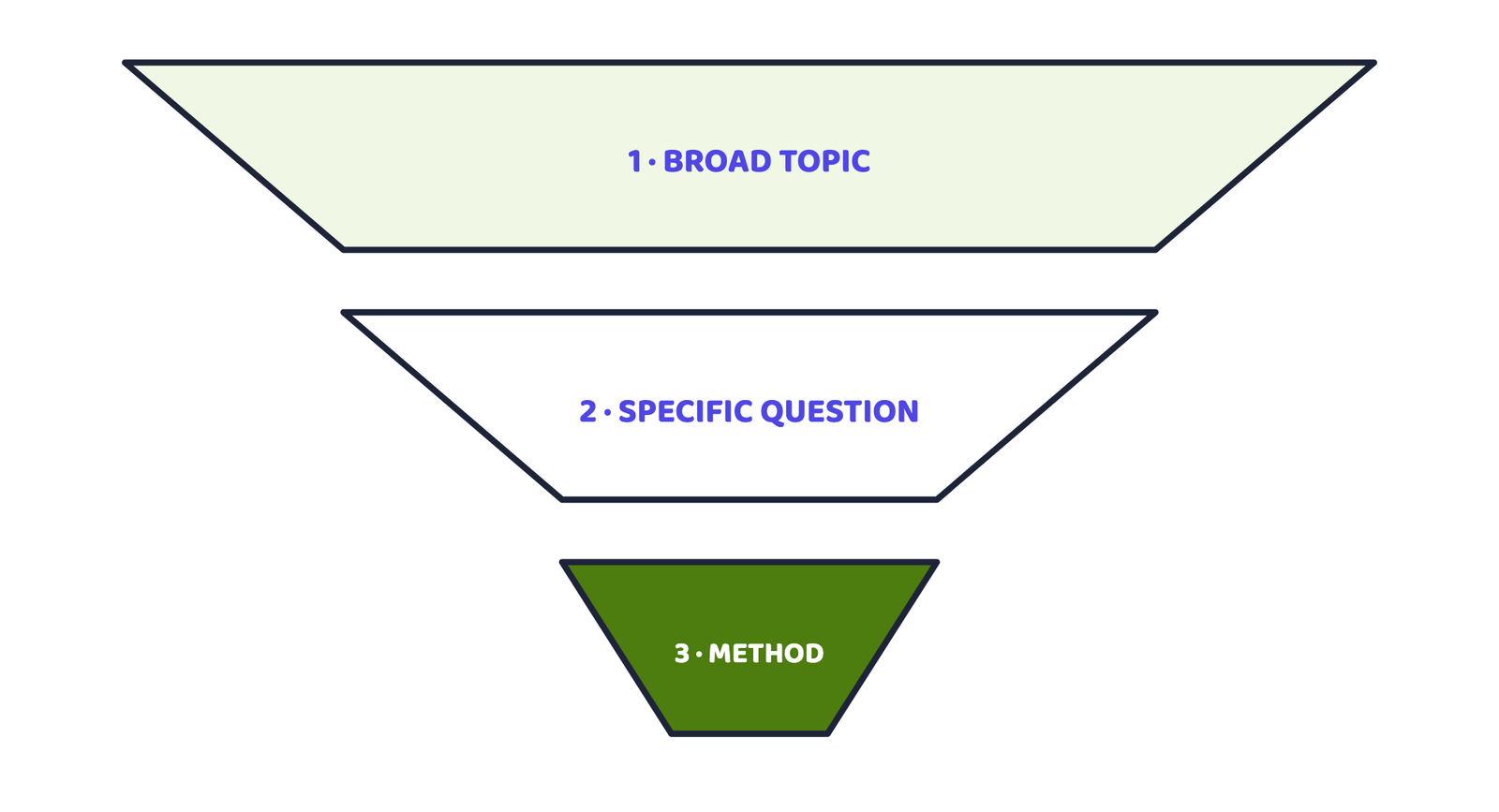
So the book’s order is: start from a broad topic, formulate a specific question, and then, after carefully specifying that question, select a suitable method. The book says this selection must be made according to two things together, not one alone:
2.1 What decides which method you pick
Technical fit
How compatible is this method with this exact question? A question about private feelings needs a method that lets people speak freely; a question about a large population’s opinion needs a method that can reach many people at once.
Practical considerations
How much time do you actually have? What resources, people and materials, are available to you? What are the real circumstances you are working in: the kind of school, the number of students, the season, permissions needed.
3Worked Example From the Book: One Question, Three Methods
The book uses one running example to show this whole process in action: comparing co-educational schools with single-sex (“boys only” or “girls only”) schools.
Two other specific questions the book gives for the same broad topic, so you can see what “narrowing” looks like: “Do students in co-educational schools do better in studies?” and “Are boys-only schools always better than co-educational schools in sports?”
3.1 Two ways to answer the same question
Interview route
- Ask students directly how they feel about their school
- Analyse the answers for differences between school types
Observation route
- Spend time in both kinds of schools watching how students actually behave
- Decide on some criteria by which you could say if students are more or less happy with their school
A third option is a survey: design a questionnaire about how students feel about their school, distribute it to equal numbers of students in each kind of school, then collect and analyse the completed forms.
The book gives these as examples of practical difficulties for the survey route, and similar difficulties can arise in other school-based projects: making enough copies costs time, effort and money; you may need a teacher’s permission to hand out the questionnaire in class, and it may be refused or delayed the first time; after distribution, many students may not return the form, or may leave questions unanswered. You then have to decide how to handle this: go back and ask incomplete respondents to finish it, ignore the incomplete forms and consider only the complete ones, or consider only the completed answers. The book says you must be prepared to deal with such problems.
4The Four Research Methods
These are the tools you choose from once your question is fixed. Learn what each one is good at and, for surveys and interviews, the disadvantages the book states: that is what lets you justify your choice of method in the project write-up.
4.1 Survey method
A survey asks a relatively large number of people (30, 100, 2000, or more, “large” depends on the topic and context) the same fixed set of questions. Either the researcher (the “investigator”) reads the questions aloud and writes down the answers, or the questions are handed over as a printed questionnaire for people to fill in themselves.
✓ Survey, strength
- Can cover a lot of people at once
- Results represent the whole group or population fairly
✗ Survey, weakness
- Questions are fixed in advance, no on-the-spot adjustment
- If a question is misunderstood, wrong or misleading results can be produced
- An interesting answer cannot be followed up further
- Questionnaires are like a snapshot taken at one particular moment: the situation may change later or may have been different before, but the survey would not capture this
4.2 Interviews
An interview is always conducted in person and usually involves far fewer people than a survey, as few as 5, 20 or 40, usually not much more than that. It may be structured (following a pre-decided pattern of questions) or unstructured (only the topics are pre-decided; the actual questions come up naturally in conversation). An interview can also be more or less intensive: one long sitting of 2 to 3 hours, or several repeated visits to build up a detailed account.
✓ Interview, strength
- Flexible, you can go deeper into a promising topic
- Questions can be refined or modified as you go
- You can ask for clarification on the spot
✗ Interview, weakness
- Cannot cover a large number of people
- Limited to presenting the views of a select group of individuals
4.3 Observation
Observation is a method where the researcher systematically watches and records what actually happens in a chosen context, without pre-judging what is relevant and what is not. (This is about observing in general. In the happy-schools example, the book adds that you would have to decide on some criteria for judging how happy students are.)
What does not happen can be just as important as what does. The book’s own example: if you are studying how different classes of people use a public space, it is significant if a particular group, say, poor people, or middle-class people, never enters that space, or is never seen in it. An absence can be as significant as a presence.
4.4 Archival method
The book does not give the archival method a formal definition of its own; it introduces it only through its examples. Putting those together: the archival method means using existing records from the past, such as old newspapers, magazines or television programmes, to find out how something used to be, rather than how it is now.
4.5 Combining more than one method
Methods do not have to be used alone, and combining them is often highly recommended because it lets you approach the same question from different angles.
The book’s own example: researching how the place of mass media (newspapers, television) in social life has changed by combining a survey (what is happening today) with archival research into old newspapers, magazines and television programmes (what it was like before).
5Six Project Topics the Book Suggests
These are topics, not ready-made questions. You still need to narrow each one into a specific question, and pick a method that suits that question, exactly as shown in Section 3. You can always choose other topics in consultation with your teachers. Most methods can be used with most of these topics, but the specific question chosen must be suitable for the method chosen. The book emphasises topics not obviously or directly derived from your textbooks “because it will be easier for you and your teachers to think of your own project related to the texts.”
5.1 Topic by topic
Public Transport
What part does it play in people’s lives? Who needs it, and why? What problems come with it? How has it changed over time? Does unequal access to it cause social problems? Are there groups who do not need public transport, and what is their attitude towards it? You could also trace the history of one specific mode, the tonga, the rickshaw or the train, in your own town or city: the changes it has gone through, its main rivals, whether it is winning or losing that competition and why, its likely future, and whether anyone will miss it. If you live in Delhi, you could write a science-fiction-like account of what the Metro would be like fifty years from now (say 2050 or 2060), giving reasons that link what you imagine to present conditions.
Role of Communication Media in Social Life
Covers mass media (newspapers, television, films, internet) and the media people use to communicate with each other (telephone, letters, mobile phones, email, internet). You could study the changing place of mass media in social life and the shifts within formats like print, radio and television: has TV really reduced the importance of radio and newspapers, or does each format still have its own niche, and why do people prefer one format over another? You could ask about the likes and dislikes of particular groups (classes, age groups, genders) regarding films and books, or how people see new media such as mobile phones and the internet, and their impact. Observation can capture the gap between stated views and actual behaviour, for example how many hours people really watch television compared with how many they feel they watch. Or do a content analysis of how the media treat one theme, such as schools and school education, the environment, caste, religious conflicts, sports events, or local versus national or regional news.
Household Appliances and Domestic Work
Stoves, mixies, grinders, irons, washing machines, ovens, toasters, pressure cookers. How has work within the household changed over time? Has the coming of these devices changed the “intra-household division of labour” (that is, who does which job at home)? Who uses them: mostly men or women, young or old, paid or unpaid workers? How do the users feel about them? Have they really made work easier? Have the age-related jobs done within the household changed? A simpler version: just study how domestic tasks are divided in a household, who does what, and whether that has changed lately.
The Use of Public Space
Open fields, roadsides, empty plots, space outside offices. Some spaces host small businesses; others look empty but are used for functions, meetings, or even become homes for the homeless. What do people from different classes (the poor, the middle classes, affluent people) feel about the use of public space, and what kind of resource does it represent for them? How has the use of a particular open space in your neighbourhood changed over time? Has it generated any conflicts or frictions, and why?
Changing Aspirations of Different Age Groups
Most people change their goals, especially at young ages. What are these changes, and are there patterns across groups? Compare different age groups (say, Classes V, VIII and XI) in different kinds of schools, different genders, or different parental backgrounds. You could also include adults and see what they remember about these changes, and whether changes after school follow a different pattern from changes during the school-going years.
The ‘Biography’ of a Commodity
A “commodity” here just means something you buy or own. Pick one household item, a television, a motorcycle, a carpet, a piece of furniture, and write its life story as if it were an autobiography. What circuits of exchange has it moved through to get to where it is now? Can you trace the social relations through which it was produced, traded and purchased? What is its symbolic significance for its owners (you, your family, the community)? If it could think and talk, what would it say about the people it meets or sees?
6The Book’s Own Topic × Method Table
The book itself lays out, topic by topic, roughly what each of the four methods could look like, and adds a practical caution for each. A table is the clearest way to see all of this at a glance.
| Topic | Observation | Survey | Archival | Interview | Caution |
|---|---|---|---|---|---|
| Public transport (local station) | Behaviour, etiquette, space-sharing | Opinions on change over time, experiences | Newspaper history of change | Regular vs occasional users, men vs women | “Suitable only for biggish cities?” (the book asks this as a question) |
| Household appliances | Patterns of use, division of labour, gender aspects | Attitudes/memories about appliances | Old advertisement patterns | How different people respond to a specific appliance | Boys should be encouraged to take it up too, do not let it become seen as a “girls’ topic” |
| Use of public spaces | How comparable spaces are used across localities | Cross-section of opinions on uses of a space | How a space was used in past years | Do different classes view space-use differently? | Pick places students already know well |
| Changing aspirations | Not suitable for this topic | Boys/girls and adults across generations, from memory | Old school essays on the topic, if available | Talk to one group about its own change, or across age groups | Interviewees should not be from the researcher’s own school |
| Communication media | How people use phones in public, place in their lives | How much TV people watch and what they prefer | Analysis of media coverage on a current issue | Views on the decline of letter-writing | Ask, don’t tell: do not assume decline is automatically a sad thing |
7Writing Up Your Project Report: A Suggested Outline
The book does not give any report format. The seven steps below are the notes’ own suggestion for organising a write-up, not the book’s rule and not a marking scheme. Agree the final shape with your teacher. (The CBSE marks for project work are listed in the box in Section 1.)
If you are asked to describe how you would plan a project, a clear order is: state a specific research question first, name the method(s) you would choose, and justify the choice using both technical fit and practical considerations.
7.1 Do’s and don’ts for your project
✓ Do this
- Narrow every broad topic to one specific, answerable question before choosing a method
- Combine methods when a single one cannot answer your question fully
- Plan for non-response and incomplete answers in a survey
- Choose a public space or a group of people you can realistically access
✗ Never do this
- Pick your favourite method first and then force a question to fit it
- Assume a survey alone captures change over time: the book compares questionnaires to a snapshot taken at one particular moment
- Let a topic become stereotyped as belonging to one gender, as the book warns for household appliances
- Pre-judge your findings before collecting evidence: ask, don’t tell
- Can I state, in one line, why the method is selected after the research question is carefully specified?
- Can I name all four methods, and give the book’s advantage and disadvantage of surveys and of interviews?
- Can I name all six suggested topics without looking?
- Can I explain, with the book’s own public-space example, why an absence can be significant?
- Do I know what my board’s syllabus says about this chapter and about project work?
- Specify the research question carefully first, then select a suitable method for it
- Method choice depends on technical fit AND practical considerations (time, resources, circumstances)
- Survey = many people, fixed questions, representative but rigid and a one-time snapshot
- Interview = few people, in person, flexible but not representative of a large group
- Observation = watching without pre-judging; absence can be as meaningful as presence
- Archival method = using old records to see how something has changed over time
- Combining methods is often highly recommended, for example survey plus archival
- Six suggested topics: public transport, communication media, household appliances, use of public space, changing aspirations, biography of a commodity
- CBSE 2026-27: this unit is “Non-evaluative” in the theory paper; Project Work carries 20 marks (project 15, viva 5)