
In the CBSE 2026-27 Sociology curriculum, the theory paper carries
80 marks and project work 20 marks. This chapter, Unit 6
The Challenges of Cultural Diversity, carries 10 marks within Part A,
Indian Society (40 marks). Other boards set their own syllabus and marks, so
check your own board’s current scheme.
| Board | This chapter | Paper shape |
|---|---|---|
| CBSE | 10 marks | 80 theory + 20 project |
CBSE’s question paper design weights the 80 theory marks by
competency: knowledge and understanding 30 marks, application of knowledge
and concepts 32, and formulate, analyse, evaluate and create 18.
This chapter deals with religion, regionalism and national identity:
subjects where it matters exactly what the textbook says, not what you may
have heard elsewhere. These notes state the book’s own definitions and
examples only. Where the book quotes someone (Max Weber, Tagore, Ambedkar,
Kabir), that is marked as a quotation, not this chapter’s own claim.
- Why “diversity” and “inequality” are different ideas, and why diversity can still turn into conflict
- What community identity is, why it is “ascriptive”, and why people feel so strongly about it
- What a nation, a state and a nation-state are, and why a nation is easy to describe but hard to define
- How states have tried to manage diversity through assimilation or integration, and why both can fail
- How regionalism and language shaped India’s own States, from the 1956 linguistic reorganisation onward
- What a “minority” means in sociology, and why India’s Constitution protects minority rights
- The real difference between communalism and secularism, and the honest tension between secularism and minority protection
- What civil society is, and how it keeps the state accountable to the people
1 Why Cultural Diversity Becomes a Challenge
Different social institutions, from the family to the market, can bring
people together and build strong collective identities. But the very same
institutions can also become sources of inequality and exclusion. This
chapter looks at the tensions that come from cultural diversity.
The word “diversity” emphasises differences, not
inequalities. To say India has great cultural diversity means many
different social groups and communities live here, defined by markers such
as language, religion, sect, race or caste.
Difficulties appear when these diverse communities are also part of a
larger entity, such as a nation: competition or conflict between them can
follow. Cultural identities are very powerful: they can arouse intense
passions and mobilise large numbers of people. When cultural differences are
also tied to economic and social inequality, the situation is more
complicated still, and it gets worse when scarce resources, such as river
waters, jobs or government funds, have to be shared.
2 The Importance of Community Identity
Every human being needs a stable sense of identity to operate in the
world: who am I, how am I different from others, what should my goals be?
Many of these questions are answered through socialisation: the way
our family and community teach us to live in society. Our community gives
us our mother tongue and the cultural values through which we understand the
world; it anchors our own sense of self.
Community identity is based on birth and “belonging”, not on
acquired qualification or “accomplishment”. It is what we are,
not what we have become. Such identities are called
ascriptive: determined by birth, with no choice involved.
Unlike a profession or a sports team, where you must pass an exam or
demonstrate skill to belong, membership in a family, religious or regional
community has no precondition, and yet it is total. Most ascriptive
identities are very hard to shake off, even if a person tries to disown
them, because others may keep identifying them by those same markers.
2.1 Two features of ascriptive identity
Emotionally powerful
Because belonging is accidental yet almost inescapable, expanding and overlapping circles of ties (family, kinship [ties through blood or marriage], caste,
ethnicity [common descent, in addition to shared language or culture], language, region,
religion) give people a strong sense of who they are, so a perceived threat to community identity can provoke an emotional or even violent reaction.
Universal
Everyone has a motherland, a mother tongue, a family, a faith. This is not strictly true of every single individual, but it is true in a general sense, and we are all more or less equally loyal to our own identities.
Because ascriptive identities are universal and deeply felt, each side
in a conflict tends to see the other as a hated enemy, exaggerating its
own virtues and the other side’s faults. For example: when two nations go
to war, patriots on each side see the other as the aggressor, and each
believes God and truth are on its side. In the heat of the moment, it is
very hard for people on either side to see that they are constructing
matching but reversed mirror images of each other.
3 Communities, Nations and Nation-States
At the simplest level, a nation is a large-scale community: “a
community of communities”. Members of a nation share the desire to be part
of the same political collectivity (a group bound together by a shared
sense of belonging), which usually expresses itself as the
aspiration to form a state.
A state, in its most general sense, is an abstract entity: a set
of political-legal institutions claiming control over a particular
geographical territory and the people living in it.
In Max Weber’s well-known definition, a state is a “body that
successfully claims a monopoly of legitimate force in a particular
territory.”
Max Weber’s well-known definition (Weber 1970:78)
In plain terms (our own gloss, not the book’s words): a “monopoly of legitimate force” means only the
state is allowed to use force (police, army, courts) that people accept as
rightful: a private group using the same kind of force is called something
else (a militia, a criminal gang), never a state.
3.1 When one nation does not equal one state
A nation is easy to describe but hard to define. Many nations share a
common religion, language, ethnicity or regional culture, but for every
possible defining criterion, there are exceptions: many nations share no
single common language or religion, and many languages or religions are
shared across several nations without those nations merging into one.
So how do we tell a nation apart from an ethnic group, a religious
community, or a regionally-defined community? Conceptually, there is no
hard distinction: any of these could become a nation one day, and none is
guaranteed to. The criterion that comes closest is the state: unlike
other communities, nations are communities that have a state of their own, which is why the two words are joined with a hyphen: nation-state.
A nation-state is a nation that has succeeded in acquiring a
state of its own. In recent times there is usually a one-to-one bond
between nation and state (one nation, one state), but this is a
new development, not a historical or logical necessity.
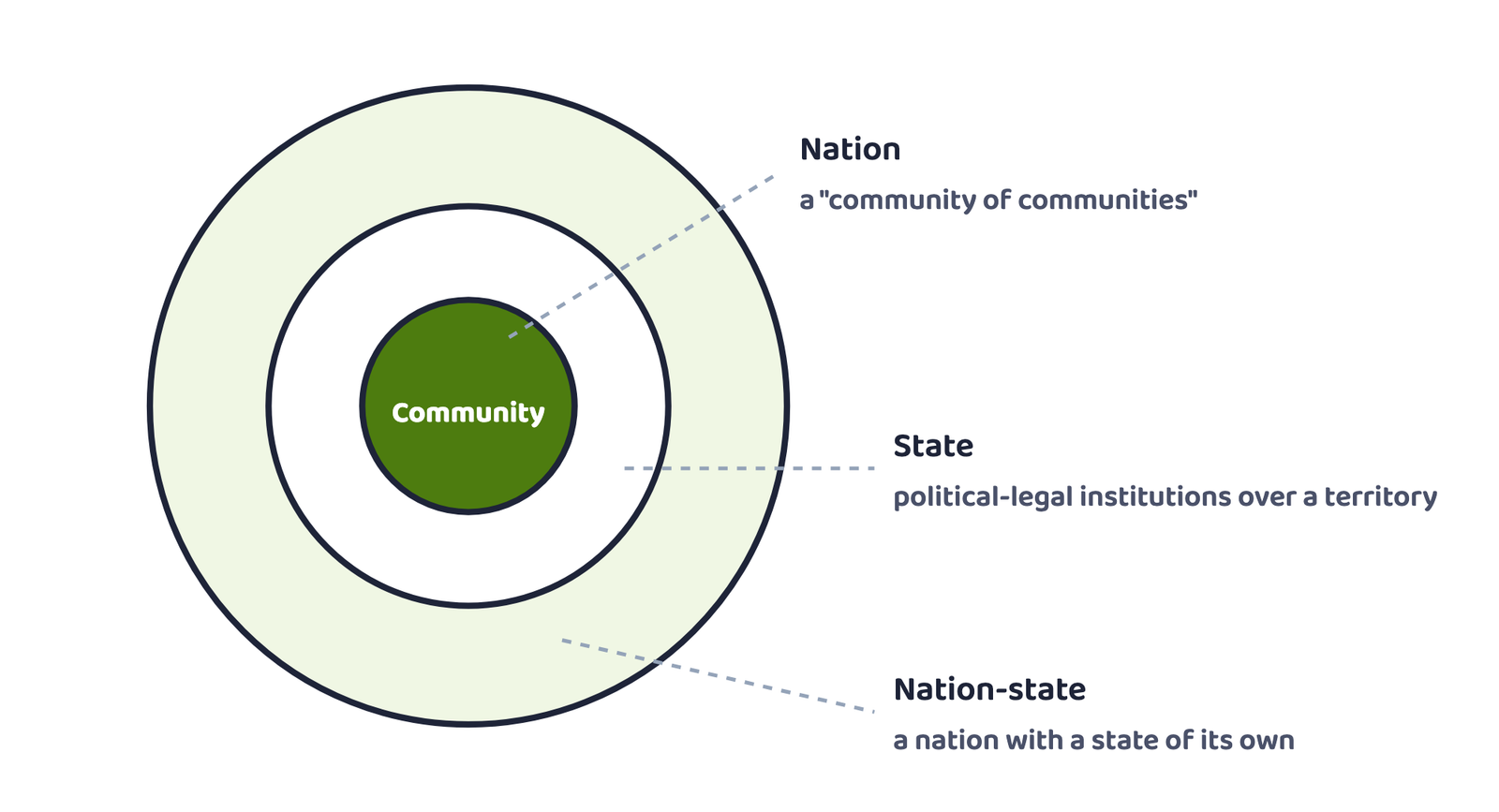
“community of communities” that aspires to political unity; a state is the
set of institutions that control a territory. A nation that succeeds in
acquiring a state of its own is a “nation-state”.
Soviet Union
While it existed, the Soviet Union explicitly recognised that the peoples it governed belonged to different “nations”: more than one hundred internal nationalities were recognised within one state.
Jamaicans abroad
More Jamaicans live outside Jamaica than inside it: the “non-resident” Jamaican population exceeds the “resident” one, showing a nation’s people need not all live inside one state’s territory.
Dual citizenship
Some states allow their citizens to also be citizens of another state at the same time. Jewish Americans, for example, may be citizens of Israel as well as the USA, and can even serve in one country’s armed forces without losing the other’s citizenship.
Today it is easiest to define a nation simply as a community that has
succeeded in acquiring its own state. The opposite is also increasingly
true: aspiring nationalities work to form states, and existing states find
it more and more necessary to claim they represent a nation. A defining
feature of the modern era is the rise of democracy and nationalism as the
main sources of political legitimacy: “the nation” is now the most
accepted justification for a state, while “the people” are the ultimate
source of the nation’s legitimacy. In other words, states need the nation
just as much as, or even more than, nations need states.
Because there is no historically fixed or logically necessary
relationship between a nation-state and the community forms it may be
based on, there is no pre-determined answer to the question: how
should the “state” part of a nation-state treat the different communities
that make up its “nation” part?
3.2 How states have tried to answer that question
Historically, states have tried to secure their citizens’ loyalty and
obedience through nation-building strategies: policies of
assimilation or integration, because most states feared
that recognising community differences would fragment society and prevent
a harmonious nation. Both sets of policies assume a single national
identity.
Assimilation
- Persuades, encourages or forces all citizens to adopt one uniform set of cultural values and norms
- These values and norms are usually entirely or largely those of the dominant social group; other groups are expected or required to give up their own culture and adopt them
- Often involves outright suppression of the identities of ethnic, religious or linguistic groups, trying to erode the cultural differences between groups (Box 6.1)
Integration
- Different in style but not in overall objective: restricts the PUBLIC culture to one common national pattern
- “Non-national” cultures are relegated to the private sphere and allowed to survive there
- Still risks treating the dominant group’s culture as “the” national culture
The book (adapting a 2004 UNDP Human Development Report on Culture and
Democracy) lists the interventions such strategies typically use:
Centralise power
Power is centralised in forums where the dominant group is a majority, and the autonomy of local or minority groups is eliminated.
One legal system
A unified legal and judicial system based on the dominant group’s traditions is imposed, and alternative systems used by other groups are abolished.
One official language
The dominant group’s language becomes the sole official “national” language, made mandatory in all public institutions.
State-run promotion
The dominant group’s language and culture are promoted through state-controlled media and educational institutions.
National symbols
State symbols celebrate the dominant group’s history and heroes: choice of national holidays, naming of streets, and similar decisions.
Seizing resources
Lands, forests and fisheries are seized from minority and indigenous groups and declared “national resources”.
Why would an existing state see community identity as dangerous? Because
any basis of community identity, language, religion, ethnicity, could one
day become the basis of a rival nation. But suppressing cultural diversity
is costly: it alienates the communities whose culture is treated as
“non-national”, and suppression itself can intensify the very identity it
targets. The book’s own conclusion: encouraging, or at least allowing,
cultural diversity is good policy, both practically and on principle.
4 Cultural Diversity and India as a Nation-State
India is one of the most socially and culturally diverse countries in
the world. These are the book’s 2011 Census figures; quote them with the
year:
| Religious community | Share of population (2011 Census) |
|---|---|
| Hindus | ~80% |
| Muslims | 14.2%: the book’s own phrase for this is “the world’s second largest Muslim country after Indonesia and Pakistan” (quoted exactly as printed, even though it names two countries ahead of “second”) |
| Christians | 2.3% |
| Sikhs | 1.7% |
| Buddhists | 0.7% |
| Jains | 0.4% |
Hindus themselves are not one homogenous group: they are
regionally specific, plural in belief and practice, and divided by caste
and language. Because India’s total population is so large, even these
small percentages add up to large absolute numbers.
India’s own relationship with its diversity fits neither the
assimilationist nor the integrationist model above. Independent India ruled
out assimilation from the start (though some sections of the dominant Hindu
community have demanded it). “National integration” is a constant theme in
state policy, but India has not been integrationist in the sense described
above: the Constitution declares India a secular state, yet religion,
language and similar factors are not banished from the public sphere: they
are explicitly recognised by the state, with very strong constitutional
protection for minority religions by international standards.
In the book’s words, “in general”, India’s problems have been more in
the sphere of implementation and practice than laws or principles.
On the whole, India “can be considered” a good example of a “state-nation”,
though it is not entirely free from the problems common to nation-states.
An alternative to the nation-state is the “state-nation”: various
“nations” (ethnic, religious, linguistic or indigenous identities) can
co-exist peacefully and cooperatively in a single state polity. This
needs explicit efforts to end cultural exclusion and to build multiple,
complementary identities. Such responsive policies provide
incentives to build a feeling of unity in diversity, a “we” feeling, so
citizens can identify with both their country and their other cultural
identities. India’s
Constitution incorporates this notion, and comparative surveys show India
has been very cohesive despite its diversity. The box also names a real
challenge: the rise of groups seeking to impose a singular Hindu identity
on the country, which undermines inclusion and minority rights, and notes
that recent communal violence raises concerns for social harmony. Even so,
it credits India’s constitutional design with holding the country together
across enormous regional, linguistic and cultural diversity: on
indicators of identification, trust and support, India’s performance is
“particularly impressive” when compared with other long-standing, and
wealthier, democracies. National
cohesion, the box concludes, does not require imposing a single identity
and denouncing diversity.
5 Regionalism in the Indian Context
Regionalism is rooted in India’s diversity of languages,
cultures, tribes and religions. It is encouraged by the geographical
concentration of these identity markers in particular regions, and
fuelled by a sense of regional deprivation. Indian federalism
(power divided between the Centre and the States, instead of held only by
the Centre) has been a means of accommodating these regional sentiments.
After Independence, India initially kept the British-era arrangement of
large multi-ethnic, multilingual provinces (“presidencies”: Madras,
Bombay and Calcutta were the three major ones; all three cities have since
been renamed). These provinces were the major political-administrative
units of a semi-federal state called the Union of India. Soon after
the Constitution was adopted, strong popular
agitations forced these units to be reorganised into ethno-linguistic
States.
In the 1920s, the Indian National Congress reorganised its own
provincial units along linguistic lines, and Gandhi and other leaders
promised that independent India would be reorganised into linguistic
provinces too. But freedom in 1947 came with Partition, and top Congress
leaders, Nehru, Patel and Rajaji, hesitated on that promise,
fearing that if religion had caused one partition, language might cause
many more.
Many had feared, including Prime Minister Nehru, that states based on
language would hasten India’s subdivision. The opposite happened:
linguistic states have strengthened Indian unity, not weakened it: it has proved entirely consistent to be, in the book’s own words,
“Kannadiga and Indian, Bengali and Indian, Tamil and Indian, Gujarati and
Indian.”
5.1 Two neighbours that chose differently
Sri Lanka (Ceylon), 1956
- In the very same year as India’s SRC, Ceylon’s Parliament declared Sinhala the sole official language, despite Tamil protests
- A left-wing Sinhala MP’s warning: “One language, two nations” … “Two languages, one nation”
- Civil war has raged in Sri Lanka since 1983, partly rooted in the majority’s denial of minority-language rights
Pakistan, 1971
- Pakistan was divided in 1971 because the Punjabi and Urdu speakers of its western wing would not respect the sentiments of the Bengalis in the east
Had India ignored its language communities, it might instead have had:
“One language, fourteen or fifteen nations.”
Adapted from Ramachandra Guha, The Times of India, 1 November 2006 (Box 6.3)
Language, together with regional and tribal identity, not
religion, has been the most powerful instrument of ethno-national
identity formation in India. But not every linguistic community got its
own State: when Chhattisgarh, Uttaranchal and Jharkhand were created
in 2000, language did not play a prominent role: a combination of
ethnicity based on tribal identity, language, regional deprivation and
ecology together provided the basis for statehood.
The book itself notes this style rule: a capital “State” means a
federal unit within the Indian nation-state; a lowercase “state”
means the broader conceptual category (as in “nation-state”). Keep the
two apart in your own answers.
Respecting regional sentiment is not just about creating States: it
needs an institutional structure that gives them real autonomy inside a
larger federal structure. In India, the Constitution defines this through a
State List and a Union (Centre) List of subjects, plus a
Concurrent List where both may act; State legislatures determine
the composition of the Rajya Sabha; periodic bodies decide
Centre-State relations: for example, the Finance Commission, set up
every five years to decide how tax revenue is shared between the Centre and
the States; up to 2017, each Five Year Plan also involved detailed State
Plans prepared by the State Planning Commissions of each state; and the
GST Council includes State members.
Perhaps the most contentious aspect of cultural diversity is religion.
The book divides these issues into two related groups:
Secularism-communalism
About the state’s relationship to religion, and to political groupings that treat religion as their primary identity.
Minority-majority
About how the state treats religious, ethnic or other communities that are unequal in numbers and/or power (social, economic or political).
6.2 Minority rights and nation-building
The dominant trend in Indian nationalism was inclusive (it recognised
diversity and plurality) and democratic (it opposed discrimination and
exclusion, seeking a just and equitable society). The term “people” has
not been seen in exclusive terms, as referring to any specific group defined
by religion, ethnicity, race or caste. Humanist ideas
influenced Indian nationalists, and the uglier side of exclusive
nationalism was criticised at length by Mahatma Gandhi and
Rabindranath Tagore.
“…where the spirit of the Western nationalism prevails, the whole
people is being taught from boyhood to foster hatred and ambitions by
all kinds of means — by the manufacture of half-truths and untruths in
history, by persistent misrepresentation of other races… To imbue the
minds of a whole people with an abnormal vanity of its own superiority
… is imitating the West where she has a festering sore…”
Rabindranath Tagore, On Nationalism, 1917 (Box 6.4)
To be effective, ideas of inclusive nationalism had to be built into the
Constitution, because, as already seen, a dominant group tends to assume
its own culture, language or religion is synonymous with the nation-state.
A strong, democratic nation needs special constitutional provisions to
guarantee the rights of all groups, minority groups in particular.
In sociology, “minority” is more than a numerical distinction:
it usually implies relative disadvantage, and it implies that members
form a collectivity: a strong sense of group solidarity and
belonging. A group that is a numerical minority but has no such
collectivity, such as left-handed people, is NOT a sociological
minority.
Privileged minorities (like extremely wealthy people) are not usually
referred to as minorities; if they are, the term is qualified, as in
“privileged minority”. It is also possible for a
minority to be disadvantaged in one sense but not another: Parsis or
Sikhs, for example, may be relatively well-off economically, yet still
culturally disadvantaged because of their small numbers next to India’s
Hindu majority. Religious or cultural minorities need special protection
because of the demographic dominance of the majority.
Hindus number about 966 million (80%) and are not a homogenous group:
they are divided by caste, as (to varying degrees) are all the other
major religions. The book gives two ratios: the Hindu population is
four times larger than the combined population of all other
minority religions, and about six times larger than
the largest minority group, the Muslims.
| Community | Population share | Where concentrated |
|---|---|---|
| Muslims | 172 million, 14.2% (largest minority) | Majority in Jammu & Kashmir; sizeable in West Bengal, UP, Kerala, Andhra Pradesh, Karnataka, Rajasthan |
| Christians | 27.8 million, 2.3% | Majority in three North-Eastern States: Nagaland (88%), Mizoram (87%), Meghalaya (74%); also Goa (25%), Kerala (18.4%) |
| Sikhs | 21 million, 1.7% | Majority in Punjab (58%) |
| Buddhists | 8 million, 0.7% | Highest share in Sikkim (27%) and Arunachal Pradesh (12%); Maharashtra highest among larger states (6%) |
| Other Religions and Persuasions | under 8 million, 0.7% | the book gives no state-wise breakdown for this group |
| Jains | 4.5 million, 0.4% | Highest in Maharashtra (1.3%), Delhi and Gujarat (~1% each) |
During the long struggle against British colonialism, Indian
nationalists understood the need to recognise and respect India’s
diversity, and “unity in diversity” became the shorthand for this.
Minority and cultural rights were debated across many sessions of the
Indian National Congress, and finally found expression in the Constitution
(Zaidi 1984).
Dr B.R. Ambedkar (1891-1956), the chief architect of the
Constitution, a Buddhist revivalist, jurist, scholar and political
leader born in a poor untouchable community, who spent his life fighting
untouchability and the caste system, made this point in the Constituent
Assembly:
The quote below cites an exchange from the negotiations
for preventing the partition of Ireland, which Ambedkar uses as a contrast
case: there, the Protestant minority’s leader (Carson) rejected the
safeguards offered by the Catholic majority leader (Redmond) for a united
Ireland. Ambedkar’s point is that no minority in India has taken that
stand.
“Minorities are an explosive force which, if it erupts, can blow up the
whole fabric of the state… the minorities in India have agreed to
place their existence in the hands of the majority… [Redmond, the
Catholic majority leader, told Carson, the Protestant minority leader in
Ireland:] ‘Ask for any safeguard you like for the Protestant minority but
let us have a United Ireland.’ Carson’s reply was ‘Damn your safeguards,
we don’t want to be ruled by you.’ No minority in India has taken this
stand.”
Dr B.R. Ambedkar, Constituent Assembly Debates 1950: 310-311, cited in Narang 2002:63 (Box 6.6)
The book gives two real examples of what happens when a country fails to
recognise the rights of a group within it:
Bangladesh
- One of the key issues behind Bangladesh’s formation was the Pakistani state’s unwillingness to recognise the cultural and linguistic rights of the people of Bangladesh
Sri Lanka
- One of the contentious issues behind the ethnic conflict in Sri Lanka was the imposition of Sinhalese as the national language
The book’s general principle: any forcible imposition of a language or
religion on any group in India weakens national unity, which is itself
based on recognising differences. Indian nationalism recognises this, and
the Constitution affirms it. Minorities, the book also notes, exist in
every nation-state, not just India: nowhere in the world is there a
nation-state made up of a single, homogenous cultural group. Even countries
once closest to this, such as Iceland, Sweden or South Korea, have
gained a plurality of groups through modern capitalism, colonialism and
large-scale migration.
Article 29(1): “Any section of the citizens residing in the
territory of India or any part there of having a distinct language,
script or culture of its own shall have the right to conserve the
same.”
Article 29(2): “No citizen shall be denied admission into any
educational institution maintained by the State or received out of State
funds on grounds only of religion, race, caste, language or any of
them.”
Article 30(1): “All minorities, whether based on religion or
language, shall have the right to establish and administer educational
institutions of their choice.”
Article 30(2): “The State shall not, in granting aid to
educational institutions, discriminate against any educational
institution on the ground that it is under the management of a minority,
whether based on religion or language.”
In plain words: any section of citizens with its own
language, script or culture may conserve it; no citizen may be refused
admission to a State-maintained or State-aided institution only on grounds
of religion, race, caste or language; minorities, based on religion or
language, may establish and run their own educational institutions; and
the State may not discriminate in aid against an institution because a
minority manages it.
6.3 Communalism, Secularism and the Nation-state
In everyday South Asian usage, communalism means an aggressive
political ideology, linked to religion, that treats one’s own religious
group as the only legitimate one and other groups as inferior or opposed.
This is a peculiarly Indian, or perhaps South Asian, meaning: the ordinary English
word “communal” is neutral, simply meaning related to a community rather
than to an individual.
Communalism is about politics, not religion: there is no necessary
link between personal faith and communalism. A communalist may or may not
be devout, and a devout person may or may not be communalist. What matters
is the attitude toward people who hold other kinds of identities.
Communalists build an aggressive political identity and are ready to
condemn or attack anyone outside it, and claim that religious identity
overrides everything else: whether rich or poor, whatever one’s
occupation, caste or political belief, religion is treated as all that
counts, homogenising diverse groups (“all Hindus”, “all Muslims”) into one.
Communalism has been a recurrent source of tension and violence in India,
including riots from before Independence, often (though not only) a
consequence of the colonial “divide and rule” policy: the book is explicit
that colonialism did not invent inter-community conflict, and cannot be
blamed for riots after Independence. But India also has a long tradition of
religious pluralism, from peaceful co-existence to real syncretism, visible
in the devotional songs and poetry of the Bhakti and Sufi movements. In
short, as the book puts it, history provides us with both good and bad
examples; what we wish to learn from it is up to us.
“Moko Kahan Dhundhe re Bande / Mein To Tere Paas Mein… / Na Mandir
Mein, Na Masjid Mein / Na Kabe Kailas Mein”: “Where do you search for me?
I am with you… Not in temples, nor in mosques, neither in Kaaba nor in
Kailash.”
Kabir Das, a lasting symbol of syncretic Hindu-Muslim traditions (Box 6.8)
Secularism, in the Western sense, means the separation of church
and state, tied to secularisation: religion’s progressive retreat
from public life as it turns from a mandatory obligation into a voluntary
personal practice.
Indian meanings of secular/secularism include the Western sense, but add
another: in everyday language, “secular” is most commonly used as the
opposite of “communal”. A secular person or state does not favour one
religion over others: this opposes religious chauvinism, but does not
necessarily mean hostility to religion. In terms of state-religion
relations, this Indian sense implies equal respect for all religions,
not separation or distance: for example, the secular Indian state declares
public holidays for the festivals of every religion.
The Indian state is committed to secularism AND to protecting
minorities at the same time, and this creates a genuine tension. Minority
protection means giving special consideration where the normal working of
politics puts minorities at a disadvantage, but this immediately invites
the charge of “favouritism” or “appeasement” (treating a group
specially just to keep it happy, at the cost of fairness to everyone
else). Opponents argue this
kind of secularism is just an excuse to win minority votes; supporters
argue that without such protection, secularism can become an excuse to
impose the majority’s values on minorities. The book presents both sides:
do not present only one as “the answer”.
7 State and Civil Society
The state is a crucial institution for managing cultural diversity, but
it can also become independent of the very nation and people it claims to
represent. When the state’s own structures, legislature, bureaucracy,
judiciary, armed forces, police, become insulated from the people, the
state risks turning authoritarian.
An authoritarian state is the opposite of a democratic state:
people have no voice, and those in power are accountable to no one. Such
states often limit or abolish civil liberties: freedom of speech, freedom
of the press, freedom of political activity, protection from the wrongful
use of authority, and the due process of law.
Apart from authoritarianism, a state’s own institutions can also become
unable or unwilling to respond to people’s needs because of corruption,
inefficiency, or a lack of resources. This is exactly where
non-state actors become important: they can watch the state,
protest its injustices, or supplement its efforts.
Civil society is the broad arena that lies beyond the private
domain of the family, but outside both the state and the market. It is
the sphere of active citizenship, where individuals voluntarily create
institutions and organisations, take up social issues, and try to
influence or make demands on the state.
Civil society includes political parties, media institutions, trade
unions, NGOs, religious organisations and other collective entities. The
book’s own test for what counts: an organisation must NOT be state-controlled,
and must NOT be a purely commercial, profit-making entity.
Today, civil society’s activities range from advocacy and lobbying with
national and international agencies to active participation in movements
on many different issues:
7.1 What civil society organisations work on
Land and livelihood
Tribal struggles for land rights; fishermen’s struggles against mechanised fishing; rehabilitation of the dam-displaced; land distribution to Dalits.
Urban life
Devolution in urban governance; rehabilitation of hawkers and pavement dwellers; campaigns against slum demolitions and for housing rights.
Rights and reform
Campaigns against rape and violence against women; primary education reform; civil liberties organisations keeping watch on the state.
The media, especially its visual and electronic segments, has also taken
an increasingly active role.
The Right to Information Act, 2005 (Act No. 22/2005) began as an
agitation in rural Rajasthan for the release of information on government
funds spent on village development, and grew into a nationwide campaign.
Despite bureaucratic resistance, the government was forced to pass a new
law formally acknowledging citizens’ right to information.
| Detail | What the book says |
|---|---|
| Passed by Parliament | 15 June 2005 |
| Came into force | 13 October 2005 |
| Overrides | The Official Secrets Act, 1923, and other restrictive laws |
| Reply expected from a public authority | Expeditiously, or within thirty days (the book says the authority “is expected to” reply) |
| Citizen rights under the Act | Request information; take copies of documents; inspect documents, works and records; take certified samples of work; obtain information as printouts, diskettes, tapes, video cassettes or other electronic modes |
Examples of this sort, the book says, illustrate the crucial importance
of civil society in ensuring that the state is accountable to the nation and
its people.
- Activity 6.1: find out the origins of your own State: when it was formed, and whether language, ethnic/tribal identity, regional deprivation, ecology or another criterion defined it; classify the States by these criteria, and find the criteria used by movements demanding a new State (the book’s hint: the Vidarbha movement).
- Activity 6.2: collect poems, songs and short stories from your elders that highlight religious pluralism, syncretism or communal harmony, and present them in class.
- Activity 6.3: find out about civil society organisations or NGOs in your neighbourhood: the issues they take up, who works in them, and how they differ from government and commercial organisations.
All three are answered in this chapter’s NCERT Solutions post.
8 In Summary
Cultural diversity can present tough challenges, because cultural
identities are very powerful and the “state” part of a nation-state has no
pre-determined answer to how it should treat the communities that make up
its “nation” part. The Indian case fits neither the assimilationist nor the
integrationist model: the state is secular, yet religion, language and
other such factors are not banished from the public sphere. Linguistic
states have helped strengthen, not undermine, Indian unity. The
Constitution protects minority rights, and civil society is crucial in
ensuring that the state is accountable to the nation and its people.
- Diversity ≠ inequality; diversity becomes a challenge when tied to competition, inequality or scarce resources
- Community identity is ascriptive: born into it, not earned, yet total and hard to shake off
- Nation = community of communities; state = Weber’s “monopoly of legitimate force”; nation-state = a nation with its own state (a recent, not universal, pairing)
- States manage diversity through assimilation (a uniform culture for all citizens, eroding group differences) or integration (uniform public culture only, other cultures allowed in the private domain); both risk making the dominant culture “the” national culture
- India: 1.21 billion people (2011), about 1,632 languages, 22 in the 8th Schedule, 80% Hindu / 14.2% Muslim / 2.3% Christian / 1.7% Sikh / 0.7% Buddhist / 0.4% Jain
- India is neither assimilationist nor integrationist: secular, but recognises religion/language publicly; can be considered a good example of a “state-nation”
- Linguistic states (SRC, 1 November 1956; Potti Sriramulu’s fast, October 1952, and death, December 1952, led to Andhra Pradesh) strengthened, not weakened, Indian unity, unlike Sri Lanka (1956 Sinhala-only, civil war since 1983) or Pakistan (split 1971)
- Chhattisgarh, Uttaranchal, Jharkhand (2000): a combination of tribal identity, language, regional deprivation and ecology, with language not playing a prominent role; 28 States, 8 UTs
- Minority = (usually) relative disadvantage + collectivity, not just small numbers; Ambedkar’s Constituent Assembly speech and Articles 29-30 protect minority rights
- Communalism = politics using religion as an aggressive identity, not religion itself; secularism (Indian sense) = equal respect, not separation, and it sits in real tension with minority protection (“appeasement” debate)
- Civil society (NGOs, unions, media, parties, not state, not for-profit) keeps the state accountable: the RTI Act, 2005 (in force 13 October 2005) is the book’s own example
- Can I explain the difference between “diversity” and “inequality” in the book’s own terms?
- Can I state Weber’s definition of the state, and explain why a nation is hard to define?
- Can I explain assimilation and integration, with one intervention each side uses?
- Can I narrate the linguistic-states story (Potti Sriramulu → Andhra Pradesh → SRC 1956) in order?
- Can I define “minority” the sociological way, not just as a small number?
- Can I explain why communalism is about politics, and what “secularism” means in the Indian sense?
- Can I define civil society and give three issues it works on, with the RTI Act as one example?
- Do I know my own board’s marks for this chapter?