
Complete solutions to all 13 in-text questions and all 15 end-of-chapter exercise questions from NCERT Science, Chapter 4 “Carbon and its Compounds”, in the English edition’s own wording. Try working out the answer yourself first, then check it against this one.
A In-text Questions
The question boxes printed inside the chapter, after the sections they test, answered first in book order. The end-of-chapter exercises follow below.
Questions after Section 4.1
Q. What would be the electron dot structure of carbon dioxide which has the formula CO₂?
Answer: Carbon has 4 valence electrons and each oxygen atom has 6. Carbon shares two of its electrons with each oxygen atom, and each oxygen shares two electrons with carbon, so carbon is joined to each oxygen by a double bond (two shared pairs): O=C=O. In the electron dot structure, carbon sits in the middle with two shared pairs on its left and two on its right; each oxygen also carries two lone (unshared) pairs. Every atom then has 8 electrons in its outermost shell: carbon from its four shared pairs, and each oxygen from two shared pairs plus two lone pairs.

Q. What would be the electron dot structure of a molecule of sulphur which is made up of eight atoms of sulphur? (Hint – The eight atoms of sulphur are joined together in the form of a ring.)
Answer: The sulphur molecule is S₈: eight sulphur atoms joined in a ring. Each sulphur atom has 6 valence electrons. In the ring, every sulphur atom shares one electron with the sulphur atom on its left and one with the sulphur atom on its right, forming two single covalent bonds, and keeps its remaining four electrons as two lone pairs. So each sulphur atom has 2 shared pairs + 2 lone pairs = 8 electrons, a complete octet, and the ring as a whole has eight S-S single bonds.
Questions after Section 4.2
Q. How many structural isomers can you draw for pentane?
Answer: Three. Pentane (C₅H₁₂) can have: (i) a straight chain of five carbons, CH₃-CH₂-CH₂-CH₂-CH₃ (n-pentane); (ii) a chain of four carbons with one CH₃ branch on the second carbon, CH₃-CH(CH₃)-CH₂-CH₃ (isopentane, 2-methylbutane); (iii) a central carbon joined to four CH₃ groups, C(CH₃)₄ (neopentane, 2,2-dimethylpropane). All three have the same molecular formula C₅H₁₂ but different structures.

Q. What are the two properties of carbon which lead to the huge number of carbon compounds we see around us?
Answer: (i) Catenation: carbon can form bonds with other carbon atoms, giving long chains, branched chains and rings, and the C-C bond is strong and stable. (ii) Tetravalency: carbon has a valency of four, so each carbon atom can bond with four other atoms of carbon or of other elements such as hydrogen, oxygen, nitrogen, sulphur and chlorine.
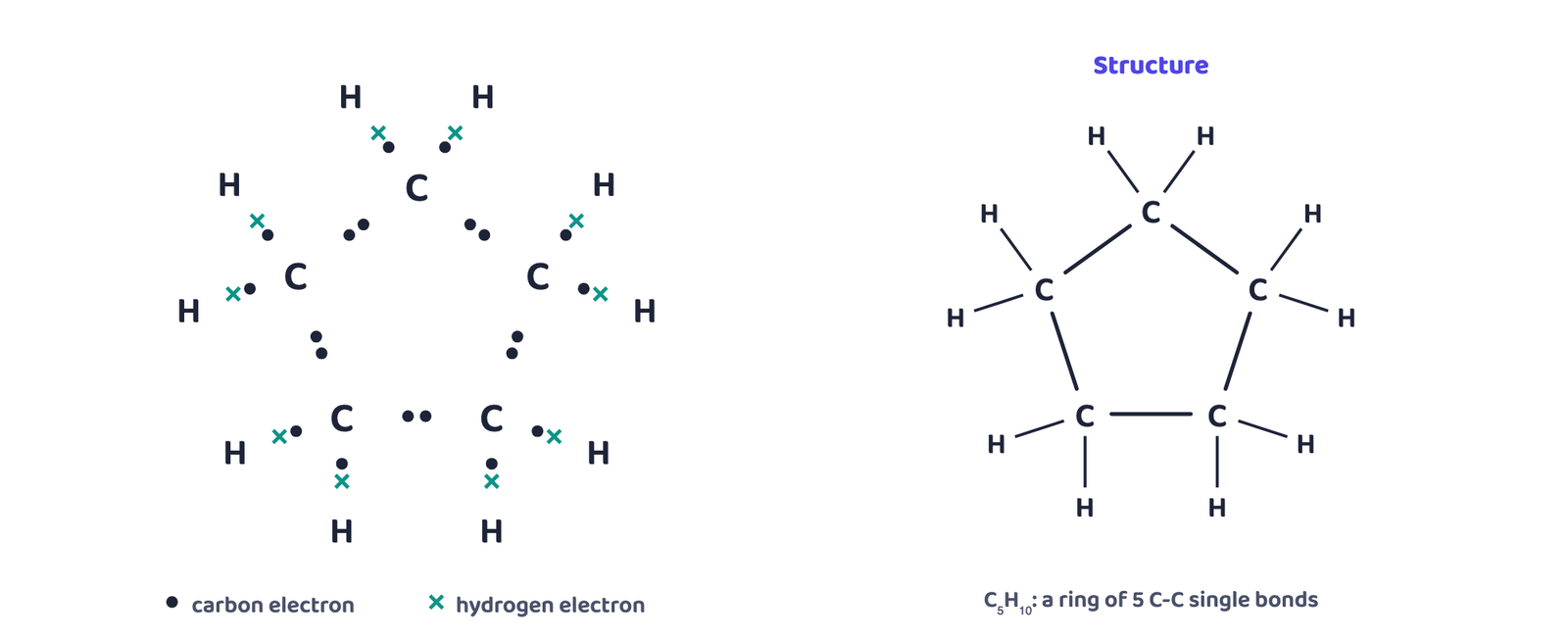
Q. What will be the formula and electron dot structure of cyclopentane?
Answer: The formula of cyclopentane is C₅H₁₀. Its five carbon atoms are joined by single bonds in a ring (a pentagon). Each carbon shares one electron pair with each of its two neighbouring carbons and one pair with each of two hydrogen atoms. So the electron dot structure shows 5 C-C shared pairs around the ring and 10 C-H shared pairs, every carbon having 8 electrons and every hydrogen 2.
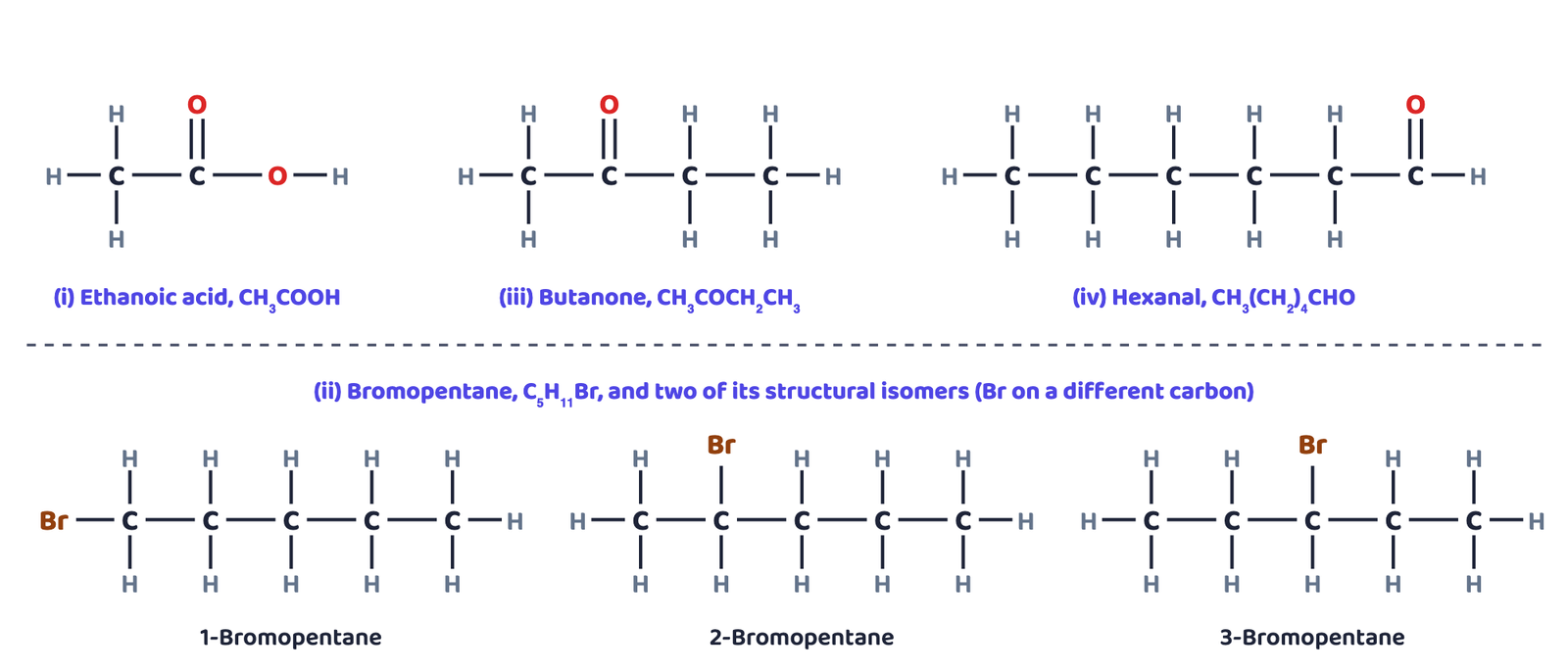
Q. Draw the structures for the following compounds. (i) Ethanoic acid (ii) Bromopentane* (iii) Butanone (iv) Hexanal. *Are structural isomers possible for bromopentane?
Answer: (i) Ethanoic acid: CH₃-COOH, that is, H₃C-C(=O)-O-H (the -COOH carbon has a double bond to one oxygen and a single bond to an -OH group). (ii) Bromopentane: CH₃-CH₂-CH₂-CH₂-CH₂-Br. (iii) Butanone: CH₃-CO-CH₂-CH₃ (the C=O is on the second carbon). (iv) Hexanal: CH₃-CH₂-CH₂-CH₂-CH₂-CHO. Yes, structural isomers are possible for bromopentane (C₅H₁₁Br): the bromine atom can be placed on different carbon atoms of the chain (1-bromopentane, 2-bromopentane, 3-bromopentane), and the carbon chain itself can also be branched.
Q. How would you name the following compounds? (i) CH₃-CH₂-Br (ii) H-CHO (a carbon joined to one H and to an =O, with the second H shown above it) (iii) CH₃-CH₂-CH₂-CH₂-C≡C-H (a six-carbon chain ending in a triple bond)
Answer: (i) Bromoethane (two carbons, bromine shown by the prefix bromo-). (ii) Methanal (one carbon with the aldehyde group -CHO; also called formaldehyde). (iii) Hexyne (six carbons with a triple bond, so the ending -ane changes to -yne; more precisely 1-hexyne).
Questions after Section 4.3
Q. Why is the conversion of ethanol to ethanoic acid an oxidation reaction?
Answer: Because oxygen is added to ethanol in this conversion. When ethanol (CH₃CH₂OH) is heated with an oxidising agent such as alkaline potassium permanganate or acidified potassium dichromate, its -CH₂OH group becomes -COOH: the molecule gains an oxygen atom (and loses two hydrogen atoms) to give ethanoic acid (CH₃COOH). Addition of oxygen to a substance is oxidation.
Q. A mixture of oxygen and ethyne is burnt for welding. Can you tell why a mixture of ethyne and air is not used?
Answer: Welding needs a flame hot enough to melt metals. When ethyne burns in pure oxygen, combustion is complete and a very hot, clean flame is produced. Air contains only about one-fifth oxygen, so with air the supply of oxygen is limited: ethyne then burns incompletely with a sooty, yellow flame that does not give out enough heat for welding.
Questions after Section 4.4
Q. How would you distinguish experimentally between an alcohol and a carboxylic acid?
Answer: Add a little sodium hydrogencarbonate (or sodium carbonate) to each liquid in a test tube. The carboxylic acid reacts with brisk effervescence, giving carbon dioxide gas, which turns lime water milky; the alcohol shows no reaction. (Litmus also helps: the carboxylic acid turns blue litmus red, while the alcohol has no effect on litmus.)
Q. What are oxidising agents?
Answer: Oxidising agents are substances that are capable of adding oxygen to other substances. For example, alkaline potassium permanganate and acidified potassium dichromate oxidise alcohols to acids.
Questions after Section 4.5
Q. Would you be able to check if water is hard by using a detergent?
Answer: No. Detergents lather well in both hard water and soft water, because the charged ends of detergent molecules do not form insoluble precipitates with the calcium and magnesium ions of hard water. So a detergent gives the same foam in both and cannot show whether water is hard. Soap is used for this test: it forms a curdy scum and little foam in hard water.
Q. People use a variety of methods to wash clothes. Usually after adding the soap, they ‘beat’ the clothes on a stone, or beat it with a paddle, scrub with a brush or the mixture is agitated in a washing machine. Why is agitation necessary to get clean clothes?
Answer: Soap molecules surround the oily dirt and form micelles, with their hydrocarbon tails in the oil and their ionic ends facing the water. But the dirt is still held in the fibres of the cloth. Beating, scrubbing or agitating pulls these micelles, with the dirt trapped in them, out of the fabric and into the water, from where they are rinsed away. Without agitation much of the dirt would stay on the cloth.
B End-of-chapter Exercises
1. Ethane, with the molecular formula C₂H₆ has
(a) 6 covalent bonds. (b) 7 covalent bonds. (c) 8 covalent bonds. (d) 9 covalent bonds.
Answer: (b) 7 covalent bonds. Ethane, , has one C-C bond and six C-H bonds (three hydrogens on each carbon), giving 1 + 6 = 7 covalent bonds in total.
2. Butanone is a four-carbon compound with the functional group
(a) carboxylic acid. (b) aldehyde. (c) ketone. (d) alcohol.
Answer: (c) ketone. Butanone has four carbon atoms and carries the ketone functional group (-CO-), which is why its name ends in the suffix “-one”.
3. While cooking, if the bottom of the vessel is getting blackened on the outside, it means that
(a) the food is not cooked completely. (b) the fuel is not burning completely. (c) the fuel is wet. (d) the fuel is burning completely.
Answer: (b) the fuel is not burning completely. This is incomplete combustion, usually because the stove’s air holes are blocked; it deposits soot (unburnt carbon) on the vessel’s outer surface, blackening it and wasting fuel.
4. Explain the nature of the covalent bond using the bond formation in CH₃Cl.
Answer: In (chloromethane), carbon has four valence electrons and shares one electron each with three hydrogen atoms and with one chlorine atom, forming four single covalent bonds in total. Each shared pair of electrons “belongs” to both atoms of that bond, so carbon ends up with a complete octet (8 electrons) and each hydrogen atom, and the chlorine atom, also attains a stable, filled outer shell. Because these bonds form by sharing electrons rather than by one atom transferring electrons to another, they are covalent, not ionic.
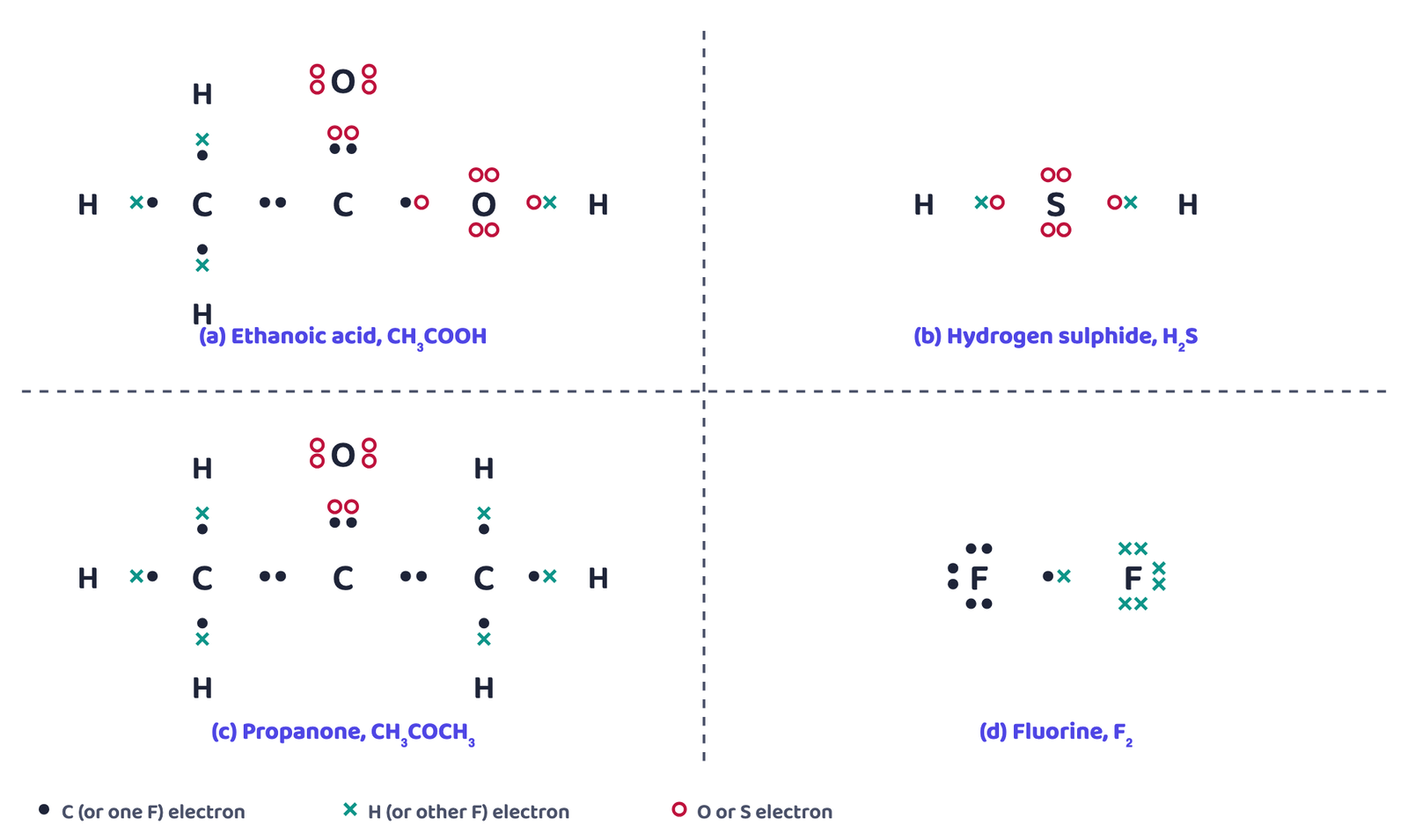
5. Draw the electron dot structures for (a) ethanoic acid (b) H₂S (c) propanone (d) F₂.
Answer:
(a) Ethanoic acid (): the carbon of the -COOH group forms a double bond with one oxygen atom and a single bond with a second oxygen atom (which carries the acidic hydrogen), and is singly bonded to the carbon; each C-H bond is one shared electron pair.
(b) : sulphur has six valence electrons and needs two more to complete its octet, so it shares one electron with each of two hydrogen atoms, forming two single S-H bonds; two lone pairs remain on the sulphur atom.
(c) Propanone (): the central carbon atom forms a double bond with an oxygen atom and single bonds with the two groups on either side.
(d) : each fluorine atom has seven valence electrons; the two atoms share one electron each to complete their octets, forming a single F-F bond, with three lone pairs remaining on each fluorine atom.
6. What is an homologous series? Explain with an example.
Answer: A homologous series is a series of compounds in which the same functional group substitutes for hydrogen in a carbon chain, with each successive member differing from the one before it by a unit, a difference of 14 u in molecular mass. Example: the alcohol series carrying the -OH functional group: methanol (), ethanol (), propanol () and butanol (). Each member differs from the next by one unit, and because they all share the same -OH functional group, their chemical properties are all very similar even though their chain lengths differ.
7. How can ethanol and ethanoic acid be differentiated on the basis of their physical and chemical properties?
Answer: Physical properties: ethanol is a liquid at room temperature with a melting point of 156 K and boiling point of 351 K; ethanoic acid has a much higher melting point of 290 K, so pure ethanoic acid freezes into ice-like crystals in a cold winter, which is why it is called glacial acetic acid. Chemical properties: ethanol is neutral to litmus paper, while ethanoic acid turns blue litmus paper red, since it is acidic. The clearest chemical test: ethanoic acid reacts with sodium carbonate or sodium hydrogencarbonate with brisk effervescence, releasing carbon dioxide gas (confirmed by turning lime water milky); ethanol does not react with sodium hydrogencarbonate at all. This reaction is the standard experimental test used to tell the two apart.
8. Why does micelle formation take place when soap is added to water? Will a micelle be formed in other solvents such as ethanol also?
Answer: A soap molecule has a hydrophilic (water-loving, ionic) end and a hydrophobic (water-fearing, hydrocarbon) tail. In water, the soap molecules arrange themselves into clusters, called micelles, with their hydrophobic tails pointing inward, away from the water, and their hydrophilic ionic ends facing outward into the water. A micelle would not form if soap were dissolved in ethanol instead, because ethanol can dissolve both the hydrocarbon tail and the ionic end of the soap molecule, so there is no part of the molecule that needs to hide away from the solvent, and no cluster needs to form.
9. Why are carbon and its compounds used as fuels for most applications?
Answer: Carbon and its compounds release a large amount of heat and light energy on burning completely in oxygen, and this combustion is easy to start and control. Carbon-based fuels such as coal, petroleum, natural gas and wood are also abundant and can be stored, transported and burned conveniently, which together makes carbon and its compounds efficient and practical energy sources for most everyday and industrial uses.
10. Explain the formation of scum when hard water is treated with soap.
Answer: Hard water contains dissolved calcium and magnesium salts. When soap (a sodium or potassium salt of a long-chain carboxylic acid) is added to hard water, these calcium and magnesium ions react with the soap to form an insoluble calcium/magnesium salt of the fatty acid. This insoluble, curdy precipitate is called scum. Because some of the soap is used up forming this scum instead of lathering, more soap has to be used before any foam appears.
11. What change will you observe if you test soap with litmus paper (red and blue)?
Answer: Soap is mildly alkaline (it is the salt of a strong base, sodium or potassium hydroxide, and a weak carboxylic acid), so it turns red litmus paper blue, while blue litmus paper stays blue and shows no change.
12. What is hydrogenation? What is its industrial application?
Answer: Hydrogenation is an addition reaction in which an unsaturated hydrocarbon adds hydrogen gas, in the presence of a catalyst such as palladium or nickel, to become a saturated hydrocarbon. Its main industrial application is converting vegetable oils, which have long unsaturated carbon chains, into solid vegetable fat (vegetable ghee), which has saturated carbon chains, using a nickel catalyst.
13. Which of the following hydrocarbons undergo addition reactions: C₂H₆, C₃H₈, C₃H₆, C₂H₂ and CH₄.
Answer: (propene) and (ethyne) undergo addition reactions, because both are unsaturated: propene has a double bond and ethyne has a triple bond, and an addition reaction adds hydrogen across such a multiple bond. (ethane), (propane) and (methane) are all saturated hydrocarbons with only single bonds, so they do not undergo addition reactions.
14. Give a test that can be used to differentiate between saturated and unsaturated hydrocarbons.
Answer: Burn a small sample of the hydrocarbon and observe the flame. A saturated hydrocarbon burns with a clean flame, while an unsaturated hydrocarbon burns with a yellow flame accompanied by a lot of black smoke, and leaves a sooty deposit on a metal plate held above the flame. This difference in the flame and the soot produced is the test the chapter itself describes for telling a saturated hydrocarbon from an unsaturated one.
15. Explain the mechanism of the cleaning action of soaps.
Answer: A soap molecule has an ionic (hydrophilic) end that mixes with water and a hydrocarbon (hydrophobic) tail that mixes with oil. When soap is added to water containing oily dirt, many soap molecules arrange themselves around each droplet of oily dirt with their hydrocarbon tails buried in the oil and their ionic ends facing outward into the water; this cluster is called a micelle. Because the outward-facing ionic ends repel one another, the micelles stay suspended in the water as a colloid instead of clumping together and separating out. Agitation, such as rubbing, shaking or the motion of a washing machine, then physically pulls the whole micelle, with the trapped dirt inside it, away from the cloth and into the water, from where it is rinsed away.