
- How the human eye focuses light onto the retina, and what each part of the eye does
- What accommodation is, and why the eye lens cannot keep focusing below a certain minimum distance
- The three common defects of vision, myopia, hypermetropia and presbyopia, and which lens corrects each one
- How to calculate the power of a corrective lens from a person’s far point or near point
- How a prism splits white light into a spectrum, and why the colours separate out
- Why stars twinkle, why the Sun is seen about 2 minutes before actual sunrise and after actual
sunset, and why the clear sky is blue
myopiahypermetropiapresbyopiapower of a lens
dispersionVIBGYORspectrumatmospheric refraction
twinklingTyndall effectscattering of light
1The Human Eye
Of all our sense organs, the eye is the most important: without it, we experience the world
completely differently. Close your eyes, and you can still recognise a friend by smell, touch or the
sound of their voice, but you cannot tell red from green. The human eye is what lets us see the
shapes and colours of everything around us.
The eye works very much like a camera. A system of lenses forms an image on a light-sensitive
screen at the back, called the retina. Light first enters the eye through a thin, transparent
membrane called the cornea, which bulges outward at the front of the eyeball. The eyeball
itself is roughly spherical, with a diameter of about 2.3 cm. Most of the actual bending
(refraction) of the incoming light happens at the outer surface of the cornea, not inside the eye
lens. The eye lens only does the fine adjustment needed to bring objects at different distances into
sharp focus.

Cornea
Transparent front bulge. Does most of the light bending (refraction) as light enters the eye.
Iris
Dark muscular diaphragm (a ring that controls how much light gets through, like a camera’s aperture) behind the cornea. Controls the size of the pupil.
Pupil
The opening in the iris. Regulates how much light enters the eye.
Eye lens
Fibrous, jelly-like lens. Fine tunes the focal length so a sharp image lands on the retina.
Ciliary muscles
Change the curvature, and so the focal length, of the eye lens.
Retina
Delicate membrane at the back, with an enormous number of light sensitive cells. The eye lens forms an inverted, real image (defined just below) on it, and its cells generate electrical signals.
Optic nerve
Carries the electrical signals from the retina to the brain, which interprets them as what we see.
A real image forms where light rays actually meet after passing through a lens, so it
can be caught on a screen, which is exactly what the retina does. A virtual image forms
where the rays only appear to meet if traced backward, so it cannot be caught on a screen. The lens
formula used to correct myopia and hypermetropia works out exactly where this real or virtual image
forms.
1.1 Power of Accommodation
The eye lens is made of a fibrous, jelly-like material, and its curvature can be changed by the
ciliary muscles. Changing the curvature changes the focal length of the lens (the distance
from the lens at which it brings light to a sharp focus). When the ciliary
muscles relax, the lens becomes thin and its focal length increases, which lets us see distant
objects clearly. When the muscles contract, the lens becomes thicker, its focal length decreases,
and nearby objects come into focus.
Accommodation is the ability of the eye lens to adjust its focal length so that objects
at different distances can all be brought into sharp focus on the retina.
The focal length of the eye lens cannot be decreased below a certain minimum limit. Try holding a
printed page very close to your eyes and the image blurs, or your eyes feel strain. To see an
object comfortably, you must hold it at least about 25 cm away.
The near point (or the least distance of distinct vision) is the closest distance at
which an object can be seen clearly and comfortably, without strain. For a young adult with normal
vision, it is about 25 cm.
The far point is the farthest distance up to which the eye can see objects clearly. For a
normal eye, the far point is at infinity.
So a normal eye can see everything clearly that lies between 25 cm and infinity from it.
At old age, the crystalline lens of the eye (the same eye lens already described above) can
become milky and cloudy. This condition is called
cataract, and it causes partial or complete loss of vision. Vision can usually be restored
through a cataract surgery, in which the cloudy lens is replaced.
About 35 million people in the developing world are blind, and most of them can be cured. About
4.5 million of these have corneal blindness, which can be cured through corneal transplantation
using donated eyes.
| Fact | Figure |
|---|---|
| Of the 4.5 million correctable by corneal transplant, share who are children below 12 | 60% |
| Time window to remove donated eyes after death | 4 to 6 hours |
| Time taken to remove the eyes (simple, no disfigurement) | 10 to 15 minutes |
| People helped by one donated pair of eyes | up to 4 corneal blind people |
Any person, of any age or sex, can donate eyes, including those who wore spectacles or had
cataract surgery, and diabetic, hypertensive or asthmatic people without a communicable disease.
People who died of or were infected with AIDS, Hepatitis B or C, rabies, acute leukaemia, tetanus,
cholera, meningitis or encephalitis cannot donate. An eye bank collects, evaluates and distributes
donated eyes; unsuitable ones go to research and medical education, and donor and recipient
identities always stay confidential.
2Defects of Vision and their Correction
The eye can develop defects that blur vision to varying degrees. These are called
refractive defects of the eye, and there are three common ones: myopia, hypermetropia and
presbyopia. Myopia and hypermetropia can occur at any age, usually because of the shape of the
eyeball or the curvature of the eye lens; only presbyopia is caused specifically by ageing, through a
gradual loss of the power of accommodation. Each defect is corrected with a suitable
spherical lens (a lens whose surfaces are uniformly curved, either concave or convex).
2.1 Myopia (near sightedness)
Myopia is a defect in which a person can see nearby objects clearly but cannot see
distant objects distinctly. The far point is nearer than infinity.
In a myopic eye, the image of a distant object forms in front of the retina instead of on
it. This can happen because of (i) excessive curvature of the eye lens, or (ii) elongation of the
eyeball. It is corrected by using a concave (diverging) lens of suitable power, which pushes
the image back onto the retina.

2.2 Hypermetropia (far sightedness)
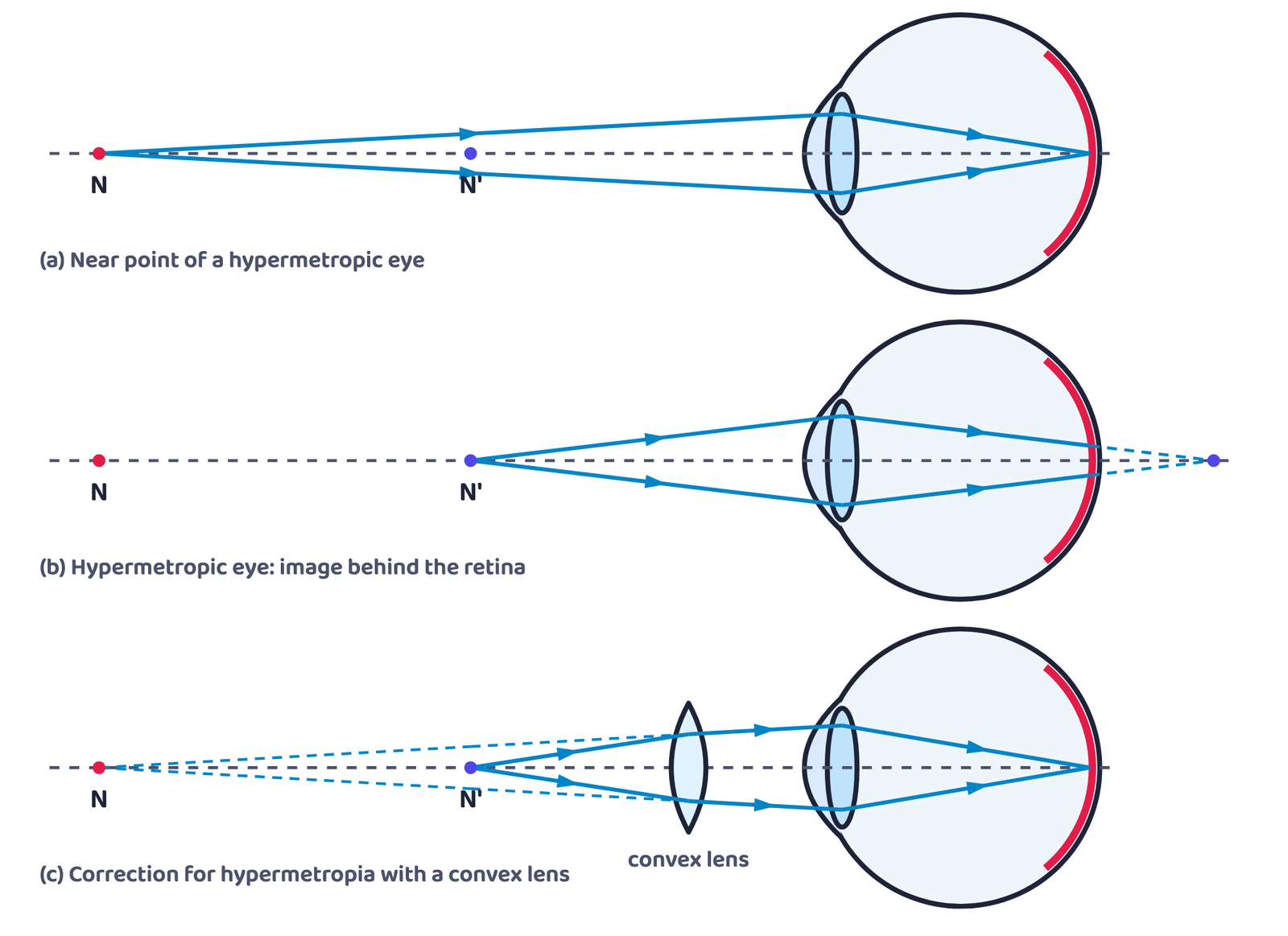
Hypermetropia is a defect in which a person can see distant objects clearly but cannot
see nearby objects distinctly. The near point is farther away than the normal 25 cm.
Light rays from a nearby object focus behind the retina. This can happen because (i) the
focal length of the eye lens is too long, or (ii) the eyeball has become too small. It is corrected
by using a convex (converging) lens of suitable power, which adds the extra focusing power
needed to bring the image onto the retina.
2.3 Presbyopia
Presbyopia is the gradual loss of the eye’s power of accommodation with age, caused by
weakening of the ciliary muscles and reduced flexibility of the eye lens. The near point recedes
away from the person.
Presbyopia itself is corrected with ordinary corrective eye-glasses: a convex lens for near
work, since the ciliary muscles have weakened and the eye can no longer accommodate on its own.
Sometimes, though, a person may suffer from both myopia and hypermetropia together. Such people
often need bi-focal lenses instead. A common type of bifocal lens has both a concave and a
convex lens ground into one spectacle: the upper portion is a concave lens, for distant vision, and
the lower portion is a convex lens, for near vision. Contact lenses and surgery can also correct
these refractive defects today.
Myopia
- Distant objects blurred, near objects clear
- Image forms in front of the retina
- Corrected with a concave lens
Hypermetropia
- Near objects blurred, distant objects clear
- Image forms behind the retina
- Corrected with a convex lens
Students often swap the two. Remember it through the lens itself: a concave lens is
thinner in the middle and pushes light apart (diverges it), which is exactly what a myopic eye,
which over-converges light, needs. A convex lens is thicker in the middle and pulls light
together (converges it), which is what a hypermetropic eye, which under-converges light, needs.
accommodation described earlier: here it means how strongly a lens converges or diverges light.
= power of the lens, in dioptres (D). = focal length, in metres. A convex (converging)
lens has positive power; a concave (diverging) lens has negative power.
The most common mark lost in these numericals is a units slip. Always convert the focal length
or the given distance to metres before using . A far point of “80 cm” must become
first.
= focal length, all measured from the optical centre of the lens (the point at its exact
centre through which light passes without bending), in metres, and all following the
sign convention (the rule for which distances count as positive and which as negative):
distances measured against the direction of incident light are negative. This formula connects an
object’s position, its image’s position and the lens power needed to relate them.
To find the power needed to correct myopia, imagine an object at infinity: the corrective lens
must form its image at the person’s own far point, so that the eye can then see it. To correct
hypermetropia, an object at the normal near point (25 cm) must appear to come from the person’s own
(farther) near point.
Given
A student’s far point is 2 m (myopic eye).
Find
The type and power of the corrective lens.
An object at infinity must form its image at the far point, so and
(the image is virtual, on the same side as the object).
: a concave lens.
Given
A person’s near point is 50 cm (hypermetropic eye); assume the normal near point is 25 cm.
Find
The power of the corrective lens.
An object placed at the normal near point must appear to be at the person’s own near point, so
and .
, so (a convex lens)
3Refraction of Light through a Prism
You already know that in a rectangular glass slab, the two refracting surfaces are parallel, so
the emergent ray comes out parallel to the incident ray, only shifted sideways. A prism is
different: it has two triangular bases and three rectangular lateral surfaces that are inclined to
each other. The angle between its two refracting (lateral) faces is called the angle of the
prism ().

Three more angles are marked on this diagram, each measured from the normal at the point where a
ray meets a surface: ∠i, the angle of incidence, between the incident ray PE and the
normal at E; ∠r, the angle of refraction, between the refracted ray EF and the normal at
E; and ∠e, the angle of emergence, between the emergent ray FS and the normal at F.
The normal is an imaginary line drawn perpendicular (at 90°) to a surface at the
point where a ray of light strikes it. Every angle of incidence, refraction, emergence or
deviation is measured from this line, never from the surface itself.
At the first surface, light travels from air into glass, and it bends towards the normal.
At the second surface, it travels from glass back into air, and it bends away from the
normal. Because the two refracting surfaces of a prism are not parallel (unlike a slab), the
emergent ray FS comes out at an angle to the original incident ray PE. This angle is called the
angle of deviation ().
4Dispersion of White Light by a Glass Prism
Dispersion is the splitting of white light into its component colours as it passes
through a prism. The band of colours produced is called the spectrum.
When sunlight passes through a narrow slit and then through a glass prism, it splits into a
beautiful band of seven colours on a screen: violet, indigo, blue, green, yellow, orange and red,
remembered by the acronym VIBGYOR.

VIBGYOR
Violet, Indigo, Blue, Green, Yellow, Orange, Red, in that order. Red bends the least
through a prism, violet bends the most, which is why they end up spread apart into a band.
Isaac Newton was the first to use a glass prism to obtain the spectrum of sunlight. When he
tried to split the spectrum further with a second, similarly placed prism, no new colours appeared.
But when he placed the second prism inverted with respect to the first, all the separated
colours recombined into a beam of white light. This recombination is what convinced Newton that
sunlight itself is made up of seven colours.
White light is light, such as sunlight, that is really a mixture of all the colours of the
visible spectrum travelling together; that is exactly why passing it through a prism splits it back
into that same band of colours.
A rainbow is a natural spectrum that appears in the sky after a rain shower. It is caused by
the dispersion of sunlight by tiny water droplets suspended in the atmosphere, and it always forms
in the direction opposite to the Sun. Each water droplet acts like a tiny prism: it refracts
and disperses the incident sunlight, reflects it internally once (bounces it off the inside surface
of the droplet rather than letting it pass straight through), and refracts it again on the way
out, so different colours reach the observer’s eye. A similar rainbow effect can also be seen on a
sunny day by looking at a waterfall or a water fountain with the Sun behind you.

5Atmospheric Refraction
You may have noticed objects seeming to waver when viewed through the turbulent (constantly
moving and unevenly mixing) hot air rising above a fire or a radiator. The air just above the fire is hotter, and so less dense, than the
cooler air further up, and it bends light slightly differently. Since these conditions keep
changing, the apparent position of the object keeps fluctuating. This is atmospheric
refraction on a small, local scale.
5.1 Twinkling of Stars
The twinkling of a star is the same effect on a much larger scale. Starlight is refracted
continuously as it travels down through the Earth’s atmosphere, a medium whose refractive
index (a number that measures how strongly a medium bends light passing through it) keeps
changing gradually. Because the atmosphere bends starlight towards the normal, the star’s
apparent position is slightly different (higher) than its actual position, especially near the
horizon. The atmosphere’s physical conditions are never perfectly stationary, so this apparent
position keeps changing slightly. Stars are also so distant that they behave as point sized
sources of light. As the path of light from a star varies, both its apparent position and the
amount of light reaching the eye fluctuate, so the star appears sometimes brighter and sometimes
fainter. This fluctuation is what we see as twinkling.

Stars twinkle
- Extremely distant, so act as point sized sources
- Light from a single point keeps fluctuating
- Brightness visibly flickers
Planets don’t twinkle
- Much closer, so seen as extended sources
- Made of many point sized sources together
- Individual fluctuations average out to zero
5.2 Advance Sunrise and Delayed Sunset
Because of atmospheric refraction, the Sun becomes visible to us about 2 minutes before it
actually crosses the horizon at sunrise, and remains visible for about 2 minutes after it has
actually crossed the horizon at sunset. The apparent flattening of the Sun’s disc that you can see
right at sunrise and sunset is caused by this same phenomenon.
6Scattering of Light
The blue colour of the sky and the colour of water in the deep sea are everyday results of light
interacting with the particles around us. As you learnt in
Class IX, the path of a light beam is invisible through a true solution, because its
particles are too small to scatter light, but becomes visible through a colloidal solution,
where the particles are relatively larger and do scatter light.
6.1 Tyndall Effect
The Tyndall effect is the scattering of light by colloidal sized particles, which makes
the path of a light beam visible.
The Earth’s atmosphere is a mixture of fine particles: smoke, tiny water droplets, suspended dust
and air molecules. When a beam of light strikes such particles, its path becomes visible because
light is diffusely reflected off them towards our eyes (scattered back out in many directions,
instead of as one sharp beam).
You can see the Tyndall effect when a narrow beam of sunlight enters a smoke-filled room through
a small hole, or when sunlight filters down through the canopy of a dense forest and tiny water
droplets in the mist scatter it into visible shafts of light.
The colour of the scattered light depends on the size of the particles doing the scattering. A
light wave’s wavelength is the distance between one crest of the wave and the next; violet
light has the shortest wavelength in the visible spectrum and red the longest. Very fine particles
scatter mainly blue light, which has a short wavelength; larger particles scatter light of longer
wavelengths; and if the particles are large enough, the scattered light can even appear white.
6.2 Why is the Colour of the Clear Sky Blue?
Scattering of light is the redirection of light in many directions when it strikes fine
particles, such as those in the atmosphere.
Air molecules and other fine atmospheric particles are smaller than the wavelength of visible
light, and they scatter shorter wavelengths, at the blue end, far more strongly than longer
wavelengths, at the red end. Red light’s wavelength is about 1.8 times greater than blue
light’s. So as sunlight passes through the atmosphere, its blue component gets scattered again and
again in all directions. This scattered blue light is what reaches our eyes when we look up, which
is why the clear sky looks blue.
The book also lists the colour of water in the deep sea among the phenomena that come from the
scattering of light.
If the Earth had no atmosphere at all, there would be no scattering, and the sky would look dark.
This is exactly why the sky looks dark to passengers and astronauts flying at very high altitudes:
scattering is not prominent where the atmosphere is too thin.
‘Danger’ signal lights are red because red light is scattered the least by fog or smoke,
so it stays visible in the same colour even from a distance.
Light reaching your eye rarely comes straight from its source. It bends through your own eye
lens, splits inside a prism, and gets scattered all across the sky. Each of these effects (bending
in the eye, splitting in a prism, and scattering in the sky) is what lets you see colour and the
world around you clearly, and what paints the sky blue in the first place.
This chapter in one line
- Can I label a diagram of the eye with all seven parts and say what each one does?
- Can I state where the image forms in myopia and in hypermetropia, and which lens corrects each?
- Can I calculate the power of a corrective lens from a given far point or near point?
- Can I name the rays and angles in a prism ray diagram (PE, EF, FS, ∠i, ∠r, ∠e, ∠A, ∠D)?
- Can I explain why the clear sky is blue, and why danger signal lights are red?
- Can I explain why stars twinkle but planets do not?
- Eye: cornea does most of the refraction, iris/pupil control light entry, eye lens fine tunes focus via the ciliary muscles and forms an inverted real image on the retina, whose light sensitive cells send signals through the optic nerve to the brain
- Accommodation: near point 25 cm, far point infinity, for a normal eye
- Myopia: image before retina, corrected with concave lens (negative power)
- Hypermetropia: image behind retina, corrected with convex lens (positive power)
- Presbyopia: ageing weakens ciliary muscles; corrected with convex corrective eye-glasses. Bifocal lenses (concave upper for distance, convex lower for near) are for someone who has both myopia and hypermetropia together, not for presbyopia alone
- Power formula: , with always in metres
- Prism: PE incident, EF refracted, FS emergent; bends towards normal entering glass, away from normal leaving it; is the deviation
- Dispersion splits white light into VIBGYOR; red bends least, violet most; Newton’s inverted second prism recombined the colours, proving sunlight is made of seven colours
- Rainbow: dispersion + internal reflection in water droplets, always opposite the Sun
- Twinkling: atmosphere bends starlight towards the normal; stars are point sources so brightness fluctuates; planets are extended sources so the fluctuations cancel out
- Sunrise/sunset shift by about 2 minutes due to atmospheric refraction
- Sky is blue because fine particles in air scatter blue (shorter wavelength) more strongly than red; no atmosphere means no scattering and a dark sky (as seen by passengers at very high altitudes); danger signal lights are red because red is scattered least by fog or smoke