
Exam-useful questions from this chapter, grouped by marks, each with a full model answer. Try writing the answer yourself first, then check it against this one.
1 1-Mark Questions
Q. What is meant by the power of accommodation of the eye?
Answer: It is the ability of the eye lens to adjust its focal length so that objects at different distances can be focussed clearly on the retina.
Q. What is the near point of the normal human eye?
Answer: About 25 cm from the eye, for a young adult with normal vision.
Q. What is the far point of the normal human eye?
Answer: Infinity.
Q. Name the part of the eye that controls the amount of light entering it.
Answer: The pupil, whose size is controlled by the iris.
Q. Define dispersion of light.
Answer: Dispersion is the splitting of white light into its component colours (VIBGYOR) as it passes through a prism.
Q. What is a spectrum?
Answer: The band of the coloured components of a light beam, produced when white light is dispersed, is called its spectrum.
Q. Name the phenomenon responsible for the twinkling of stars.
Answer: Atmospheric refraction of starlight.
Q. What is the Tyndall effect?
Answer: The scattering of light by colloidal sized particles, which makes the path of a light beam visible.
Q. Why are danger signal lights red in colour?
Answer: Because red light is scattered the least by fog or smoke, so it stays visible in the same colour even from a distance.
Q. Name the defect of vision in which a person cannot see distant objects clearly.
Answer: Myopia (near sightedness).
Q. What is a cataract, and how is it corrected?
Answer: In old age, the crystalline lens of the eye can become milky and cloudy, causing partial or complete loss of vision. This is called a cataract, and vision can usually be restored through a cataract surgery, in which the cloudy lens is replaced.
Q. What is the function of the optic nerve?
Answer: The optic nerve carries the electrical signals generated by the retina to the brain, which interprets them as the images we see.
2 2-Mark Questions
Q. A person with a myopic eye cannot see objects beyond 1.2 m distinctly. What type of corrective lens should be used to restore proper vision?
Answer: A concave lens should be used. Its focal length must equal (in magnitude) the person’s far point, 1.2 m, so that an object at infinity forms its image at the far point, which the eye can then see clearly.
Q. What is the far point and the near point of the human eye with normal vision?
Answer: Near point: about 25 cm from the eye. Far point: infinity.
Q. A student has difficulty reading the blackboard while sitting in the last row of the class. What could be the defect the student is suffering from, and how can it be corrected?
Answer: The student most likely has myopia (near sightedness), since distant objects like the blackboard appear blurred. It can be corrected by using a concave lens of suitable power, prescribed after an eye check up.
Q. Why is a normal eye not able to see clearly objects placed closer than 25 cm?
Answer: Below 25 cm, the ciliary muscles would need to make the eye lens curve more than its maximum possible curvature to focus the object on the retina. Since the focal length of the eye lens cannot be decreased below a certain minimum limit, such close objects cannot be focussed and appear blurred, or cause eye strain.
Q. What happens to the image distance in the eye when we increase the distance of an object from the eye?
Answer: The eye’s own image distance (the distance from the eye lens to the retina) stays fixed, since the eyeball does not change shape. Instead, the ciliary muscles change the focal length of the eye lens (through accommodation) so that the image continues to form exactly on the retina as the object distance changes.
Q. Why do stars twinkle but planets do not?
Answer: Stars are extremely distant and behave as point sized sources of light; as starlight passes through the atmosphere’s continuously changing refractive index, its apparent position and brightness fluctuate, seen as twinkling. Planets are much closer and are seen as extended sources made of many point sized sources together; the individual fluctuations from all these points average out to zero, so planets do not twinkle.
Q. Explain why the Sun is visible a little before actual sunrise and a little after actual sunset.
Answer: Atmospheric refraction bends the Sun’s rays as they pass through the atmosphere’s changing density, so the Sun’s apparent position appears above its actual position near the horizon. This makes the Sun visible about 2 minutes before it actually crosses the horizon at sunrise, and for about 2 minutes after it has actually crossed the horizon at sunset.
Q. Why does the sky appear dark instead of blue to an astronaut?
Answer: The blue colour of the sky is caused by the scattering of sunlight by fine particles in the atmosphere. At the very high altitudes where astronauts travel, there is almost no atmosphere left to scatter light, so there is no scattered blue light reaching the eye, and the sky appears dark.
Q. State two causes each of myopia and hypermetropia.
Answer: Myopia: (i) excessive curvature of the eye lens, (ii) elongation of the eyeball. Hypermetropia: (i) the focal length of the eye lens becomes too long, (ii) the eyeball becomes too small.
Q. What is meant by the angle of deviation produced by a prism?
Answer: It is the angle between the direction of the original incident ray and the direction of the emergent ray, caused by the prism’s two non-parallel refracting surfaces bending the ray twice.
3 4-Mark Questions
Q. A person needs a lens of power -5.5 dioptres for correcting his distant vision. For correcting his near vision he needs a lens of power +1.5 dioptre. What is the focal length of the lens required for correcting (i) distant vision, and (ii) near vision?
Answer: (i) Distant vision: f = 1/P = 1/(-5.5) = -0.182 m, approximately -18.2 cm (a concave lens).
(ii) Near vision: f = 1/P = 1/(1.5) = 0.667 m, approximately +66.7 cm (a convex lens).
Q. The far point of a myopic person is 80 cm in front of the eye. What is the nature and power of the lens required to correct the problem?
Answer: A concave lens is needed. To form the image of a distant object (u = infinity) at the far point, v = -0.8 m, so f = -0.8 m.
P = 1/f = 1/(-0.8) = -1.25 D. The lens is concave, of power -1.25 D.
Q. The near point of a hypermetropic eye is 1 m. What is the power of the lens required to correct this defect? Assume the near point of the normal eye is 25 cm.
Answer: For a convex lens, an object at the normal near point (u = -0.25 m) must appear to be at the person’s own near point (v = -1 m).
1/f = 1/v – 1/u = 1/(-1) – 1/(-0.25) = -1 + 4 = 3
f = 1/3 m = 0.33 m
P = 1/f = +3 D. The lens is convex, of power +3 D.
Q. With the help of a labelled diagram, describe how a triangular glass prism refracts a ray of light passing through it, naming the incident, refracted and emergent rays.
Answer: A prism has two triangular bases and three rectangular lateral faces inclined to each other, the angle between two lateral faces being the angle of the prism (angle A). An incident ray PE strikes the first face; it bends towards the normal on entering the denser glass and travels through the prism as the refracted ray EF. At the second face, it bends away from the normal as it leaves the glass, emerging as the ray FS.

Because the two faces are not parallel, FS is not parallel to PE; the angle between their directions is the angle of deviation, angle D.
Q. Explain, step by step, how a rainbow is formed in the sky.
Answer: A rainbow is a natural spectrum seen in the sky after a rain shower, caused by the dispersion of sunlight inside countless tiny water droplets suspended in the atmosphere. Sunlight entering a droplet first refracts (bends) and starts to disperse into its component colours; the dispersed light then reflects internally once off the back of the droplet; finally, it refracts again as it leaves the droplet, spreading the colours further apart. Different colours reach the observer’s eye from different droplets at slightly different angles, producing the familiar band of colours. Because of this geometry, a rainbow always forms in the direction opposite to the Sun.
Q. Describe the process of dispersion of white light through a prism, and explain how Newton concluded that sunlight is made up of seven colours.
Answer: When a narrow beam of sunlight is passed through a glass prism, it splits into a band of seven colours, violet, indigo, blue, green, yellow, orange and red (VIBGYOR), because each colour bends through a different angle inside the prism, red the least and violet the most. Isaac Newton first obtained this spectrum using a prism. When he passed the spectrum through a second, similarly oriented prism, no further colours appeared. But when he placed the second prism inverted with respect to the first, the separated colours recombined into a single beam of white light. This recombination convinced Newton that ordinary sunlight is itself made up of seven colours, not a single colour.
Q. Explain why the colour of the clear sky is blue.
Answer: Air molecules and other fine particles in the atmosphere are smaller than the wavelength of visible light. Such small particles scatter shorter wavelengths (the blue end of the spectrum) far more effectively than longer wavelengths (the red end); in fact red light’s wavelength is about 1.8 times greater than blue light’s. As sunlight passes through the atmosphere, its blue component is scattered again and again in all directions by these particles, and this scattered blue light is what reaches our eyes when we look up at the sky, making it appear blue. If the Earth had no atmosphere, there would be no scattering at all and the sky would look dark, as it does to passengers or astronauts flying at very high altitudes.
4 6-Mark Questions
Q. Explain, with a labelled ray diagram, what myopia is, its causes, and how it is corrected. Include a numerical example.
Answer: Myopia (near sightedness) is a defect in which a person can see nearby objects clearly but cannot see distant objects distinctly, because the far point is nearer than infinity. A myopic eye focuses a distant object too early, so its image lands short of the retina rather than exactly on it. This can be caused by (i) excessive curvature of the eye lens, or (ii) elongation of the eyeball.
Myopia is corrected using a concave (diverging) lens of suitable power, which diverges the incoming rays just enough that the eye’s own lens forms the image exactly on the retina, as the labelled ray diagram shows.

Numerical example: if a myopic person’s far point is 2 m, the corrective lens must form the image of a distant object (u = infinity) at v = -2 m, giving f = -2 m and P = 1/f = -0.5 D: a concave lens of power -0.5 D.
Q. Explain, with a labelled ray diagram, what hypermetropia is, its causes, and how it is corrected. Include a numerical example.
Answer: Hypermetropia (far sightedness) is a defect in which a person can see distant objects clearly but cannot see nearby objects distinctly, because the near point is farther away than the normal 25 cm. Light rays from a close object focus behind the retina instead of on it. This can be caused by (i) the focal length of the eye lens becoming too long, or (ii) the eyeball becoming too small.
Hypermetropia is corrected using a convex (converging) lens of suitable power, which provides the extra converging power needed to bring the image exactly onto the retina, as the labelled ray diagram shows.
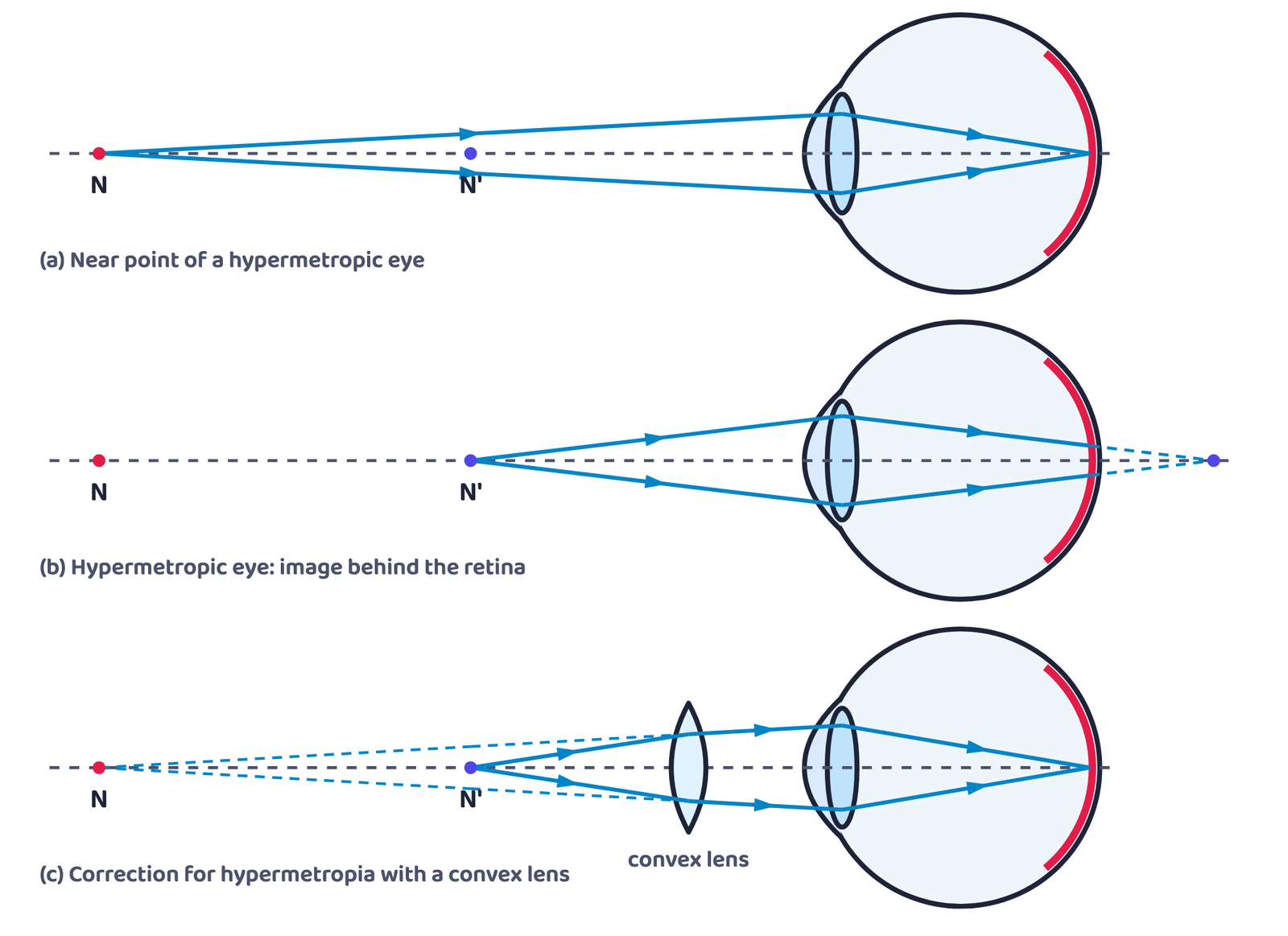
Numerical example: if a hypermetropic person’s near point is 50 cm, then for an object placed at the normal near point (u = -0.25 m) to appear at the person’s own near point (v = -0.5 m): 1/f = 1/v – 1/u = 1/(-0.5) – 1/(-0.25) = -2 + 4 = 2, so f = 0.5 m and P = +2 D: a convex lens of power +2 D.
Q. Describe the phenomenon of atmospheric refraction, and use it to explain (i) the twinkling of stars, (ii) why planets do not twinkle, and (iii) advance sunrise and delayed sunset.
Answer: Atmospheric refraction is the bending of light as it passes through the Earth’s atmosphere, whose refractive index changes continuously and is never perfectly stationary.
(i) Twinkling of stars: starlight is refracted continuously on its way down through the atmosphere, and because stars are extremely distant, they act as point sized sources. As the atmosphere’s changing conditions vary the path of light slightly, both the star’s apparent position and the amount of light reaching the eye fluctuate, seen as twinkling.
(ii) Planets do not twinkle: planets are much closer to the Earth and are seen as extended sources, effectively a large number of point sized sources bundled together. The individual brightness fluctuations from all these points average out to nearly zero, so the twinkling effect is not seen.
(iii) Advance sunrise and delayed sunset: atmospheric refraction bends the Sun’s rays near the horizon so that the Sun’s apparent position is higher than its actual position. This makes the Sun visible about 2 minutes before it actually crosses the horizon at sunrise, and for about 2 minutes after it has actually crossed the horizon at sunset; the same bending also causes the apparent flattening of the Sun’s disc at these times.
5 Case Studies
(A) 1 mark Name the defect of vision this man is most likely developing.
Answer: Presbyopia.
(B) 2 marks What causes this defect?
Answer: It is caused by the gradual weakening of the ciliary muscles and the diminishing flexibility of the eye lens with age, which reduces the eye’s power of accommodation.
(C) 2 marks What kind of corrective lens would help him read comfortably, and what should he use if he also develops difficulty seeing distant objects later?
Answer: A convex lens would help him read comfortably. If he later also develops difficulty with distant vision, he would need bifocal lenses: a concave lens in the upper part for distant vision and a convex lens in the lower part for near vision.
(A) 1 mark Name the phenomenon that produced the band of seven colours on the screen.
Answer: Dispersion of white light.
(B) 1 mark Name the sequence of colours seen on the screen, in order.
Answer: Violet, Indigo, Blue, Green, Yellow, Orange, Red (VIBGYOR).
(C) 2 marks Why did the band of colours disappear and turn back into a single spot of white light when the second, inverted prism was added?
Answer: The second prism, being inverted with respect to the first, bent each colour back by an equal and opposite amount, recombining all seven colours of the spectrum into a single beam of white light. This is the same experiment through which Newton concluded that sunlight itself is made up of seven colours.