1 · Square identities(x±y)², (x+y+z)² and x²−y², visualised with area models
2 · Factoring quadraticsSplitting the middle term, matching perfect-square patterns
Exploring Algebraic Identities
3 · Cube identities(x±y)³, x³±y³, and the three-variable identity x³+y³+z³−3xyz
4 · ApplicationsFast squaring/cubing, area word problems, simplifying rational expressions
What you will learn in this chapter
The difference between an equation and an identity
All the standard square and cube identities, and how to visualise them geometrically
How to factor a quadratic by splitting the middle term
How to simplify a rational expression by factoring and cancelling common factors
identityexpansionfactorisationsplitting the middle termperfect squarerational expression
1What Is an Identity?
Learn by heartDefinition 1
An identity is an equation that is true for every value of the variables in it. An equation that is only true for particular values is not an identity. E.g. x2−1=24 is true only for x=±5 (an equation), but (x+y)2=x2+2xy+y2 is true for all x,y (an identity).
Take any three consecutive square numbers, say 1,4,9. Add the smallest and largest, subtract twice the middle: (1+9)−2(4)=2. Try 25,36,49: (25+49)−2(36)=2 again. This always gives 2, and algebra explains why: writing the numbers as (n−1)2,n2,(n+1)2, we get (n−1)2+(n+1)2−2n2=2n2+2−2n2=2 for every n.
2Square Identities
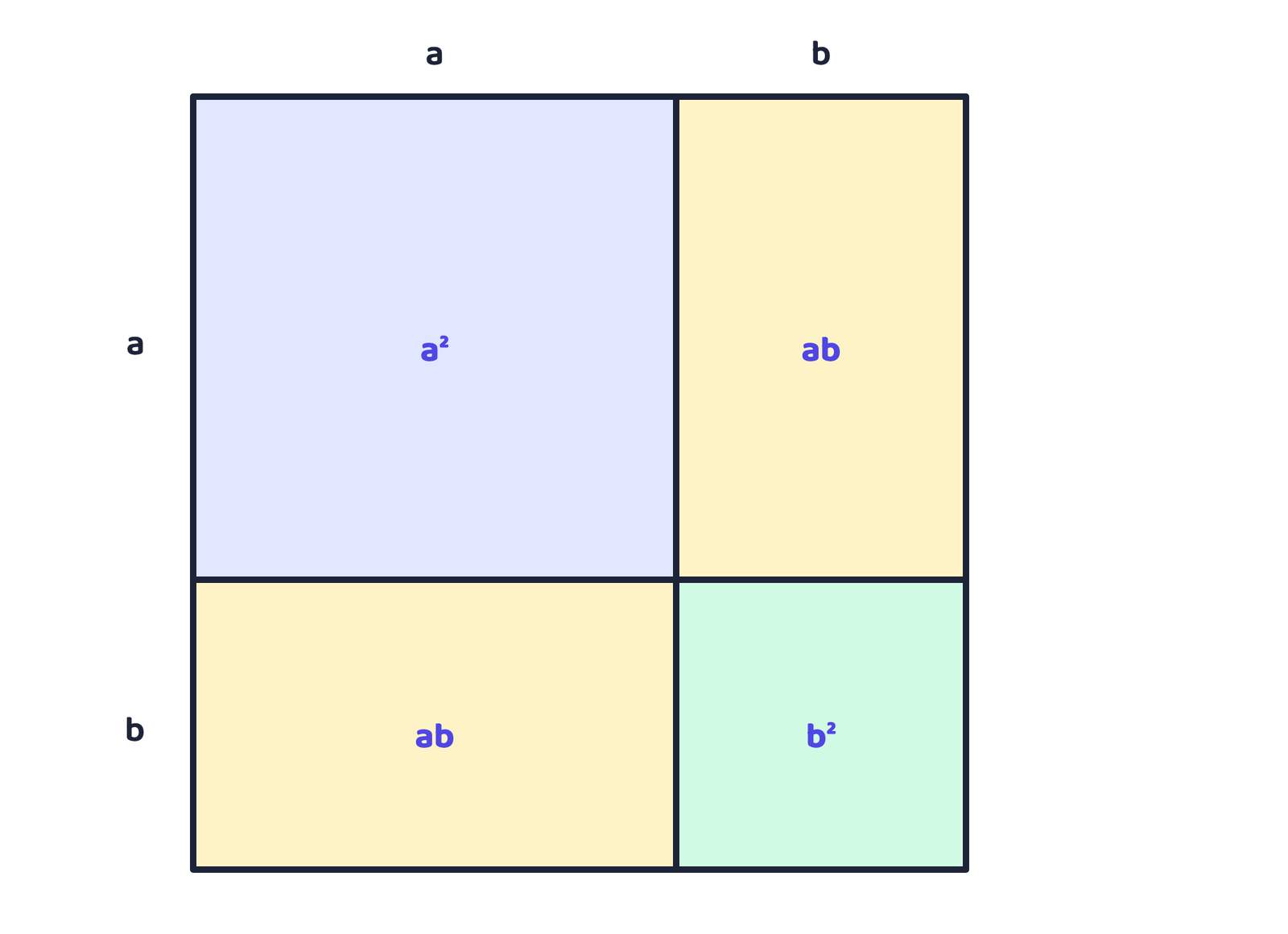
Figure 1: A square of side (a+b) splits into an a×a square, a b×b square, and two ab rectangles, giving (a+b)² = a² + 2ab + b².
Formula
(x+y)2=x2+2xy+y2
Also true for negative and rational x,y, proved generally using the distributive property: (x+y)(x+y)=x(x+y)+y(x+y)
The identities above run in reverse too: they factor expressions, not just expand them.
Solved Example
Q. Factor 9x2+30x+25.
9x2=(3x)2, 25=52, 30x=2(3x)(5), matching a2+2ab+b2 with a=3x,b=5. So 9x2+30x+25=(3x+5)2
Splitting the middle term
To factor x2+(a+b)x+ab as (x+a)(x+b): find two numbers a,b whose sum is the coefficient of x and whose product is the constant term.
Solved Example
Q. Factor x2−5x−24.
Need two numbers with sum −5 and product −24: these are −8 and 3.
x2−5x−24=x2−8x+3x−24=x(x−8)+3(x−8)=(x−8)(x+3)
Formula (general quadratic)
(ax+b)(cx+d)=acx2+(ad+bc)x+bd
Common Mistake
When the constant term is negative, the two numbers a and b must have opposite signs; when it is positive, they must have the same sign as the middle-term coefficient’s sign. Getting this backwards is the single most common factoring error.
4Cube Identities
Identity
Expression
Sum cubed
(x+y)3=x3+3x2y+3xy2+y3
Difference cubed
(x−y)3=x3−3x2y+3xy2−y3
Difference of cubes
x3−y3=(x−y)(x2+xy+y2)
Sum of cubes
x3+y3=(x+y)(x2−xy+y2)
Three-variable cube identity
x3+y3+z3−3xyz=(x+y+z)(x2+y2+z2−xy−yz−zx)
Where the cube identities come from
(x+y)3=(x+y)(x+y)2=(x+y)(x2+2xy+y2), expanded by distributivity, gives x3+3x2y+3xy2+y3. Replacing y with −y gives the difference-cubed identity, with signs alternating +,−,+,−.
Rewrite as (2n)3−3(2n)2(5m)+3(2n)(5m)2−(5m)3, matching x3−3x2y+3xy2−y3 with x=2n,y=5m. So it equals (2n−5m)3
Special case worth remembering
If x+y+z=0, then x3+y3+z3=3xyz
Because the first factor (x+y+z) in the identity becomes zero, leaving x3+y3+z3−3xyz=0.
Given
x+y+z=10, xyz=25, x2+y2+z2=38
Find
x3+y3+z3
Solution
From (x+y+z)2=x2+y2+z2+2(xy+yz+zx): 100=38+2(xy+yz+zx)⇒xy+yz+zx=31
From the cube identity: x3+y3+z3−3(25)=10(38−31)⇒x3+y3+z3=70+75=145
5Simplifying Rational Expressions
Factor the numerator and denominator fully, then cancel any factor common to both (assuming the denominator is never zero).
Given
5x2+5x−100x2−7x+12, denominator =0
Simplify
Solution
Numerator: need sum −7, product 12: these are −3,−4. So x2−7x+12=(x−3)(x−4)
Denominator: 5x2+5x−100=5(x2+x−20); need sum 1, product −20: these are 5,−4. So =5(x−4)(x+5)
5(x−4)(x+5)(x−3)(x−4)=5(x+5)x−3 (cancelling x−4, valid since x=4)
Solved Example: area word problem
Q. A rectangular pool’s breadth is 4 m less than its length, and its area is 96 sq. m. Find its dimensions.
Let length =x m, breadth =x−4 m. Then x(x−4)=96⇒x2−4x−96=0
Need sum −4, product −96: these are −12,8. So (x−12)(x+8)=0⇒x=12 (rejecting x=−8, a length can’t be negative)
Length =12 m, breadth =8 m
Every identity in this chapter comes from expanding a product with the distributive property, just applied to squares, cubes, and sums of several variables.
the single idea to carry out of this chapter
All identities in one place
(x+y)2x2+2xy+y2
(x−y)2x2−2xy+y2
(x+y+z)2x2+y2+z2+2xy+2yz+2zx
x2−y2(x+y)(x−y)
x2+(a+b)x+ab(x+a)(x+b)
(ax+b)(cx+d)acx2+(ad+bc)x+bd
x3−y3(x−y)(x2+xy+y2)
x3+y3(x+y)(x2−xy+y2)
(x+y)3x3+3x2y+3xy2+y3
(x−y)3x3−3x2y+3xy2−y3
x3+y3+z3−3xyz(x+y+z)(x2+y2+z2−xy−yz−zx)
Check yourself before the exam
Can I state and apply all 11 identities without looking them up?
Can I factor a quadratic by splitting the middle term, choosing the correct signs?
Can I use Śhrīdharāchārya’s method or the (x+y+z)² identity to square a number mentally?
Can I simplify a rational expression and state the value that must be excluded?
Quick Revision: read this the night before the exam
Identity = true for all values; equation = true only for specific values
(x±y)2=x2±2xy+y2; (x+y+z)2 adds all three squares plus three cross terms
x2−y2=(x+y)(x−y); use it for fast squaring: a2=(a+b)(a−b)+b2
Splitting the middle term: find two numbers with the given sum and product
(x±y)3=x3±3x2y+3xy2±y3 (signs alternate for the minus case)
x3+y3+z3−3xyz=(x+y+z)(x2+y2+z2−xy−yz−zx); equals 0 when x+y+z=0
Simplify rational expressions by factoring both parts and cancelling, noting what can’t equal zero
Practice Questions
1 markExpand (3x−5)2 using an identity.
1 markEvaluate 9982 using a suitable identity.
2 marksFactor 25x2+70xy+49y2.
2 marksFactor x2+2x−63 by splitting the middle term.
2 marksEvaluate 52×48 using x2−y2=(x+y)(x−y).
3 marksExpand (2p−3q+r)2 using the three-term identity.
3 marksFind a if x3+12x2q+48xq2+64q3=(x+a)3.
2 marksSimplify 3s2+2st−5t29s2−25t2, assuming the denominator is never 0.
3 marksIf x+y+z=0, show that x3+y3+z3=3xyz, and use it to find 23+(−5)3+33.
4 marksA square garden of side 30 m has a path of uniform width s m built around it. Find an expression for the area of the path in terms of s.
3 marksA number plus its reciprocal equals 613. Find the number(s).
1 markWhich is an identity, not just an equation? (a) x2=16(b) 2x+3=11(c) (x+1)2=x2+2x+1(d) x2−x=6
1 markTo factor x2−9x+20, the two numbers needed are: (a) 4 and 5(b) −4 and −5(c) 2 and 10(d) −2 and −10
Assertion (A):(a+b)2 is always greater than or equal to a2+b2 when a,b>0. Reason (R):(a+b)2−(a2+b2)=2ab, which is non-negative when a,b>0.
Case Study
Saira arranges one square tile of side x units, 8 rectangular strips of size x by 1 units, and 15 unit squares to build one large rectangle, with total area x² + 8x + 15 square units.
1 markWhich two numbers have sum 8 and product 15?
1 markFactor x² + 8x + 15 into two linear factors.
2 marksState the length and breadth of Saira’s rectangle in terms of x.
Answer Key
Q19x2−30x+25
Q29982=(1000−2)2=1000000−4000+4=996004
Q3(5x+7y)2
Q4Sum 2, product −63: numbers 9, −7. (x+9)(x−7)
Q552×48=(50+2)(50−2)=2500−4=2496
Q64p2+9q2+r2−12pq+4pr−6qr
Q7a=4q (since 64q3=(4q)3 and the pattern matches x3+3x2(4q)+3x(4q)2+(4q)3)
Q8(3s+5t)(s−t)(3s−5t)(3s+5t)=s−t3s−5t
Q9Proof follows from the factored identity; 2+(−5)+3=0, so sum of cubes =3(2)(−5)(3)=−90
Q10Outer square (30+2s)2 minus garden 302: path area =120s+4s2 sq. m
Q11x+x1=613⇒6x2−13x+6=0⇒(3x−2)(2x−3)=0⇒x=32 or 23
MCQ 1–3(a) · (c) · (b)
A/RBoth A and R are true, and R is the correct explanation of A
Case Study3 and 5 · (x+3)(x+5) · length =x+5, breadth =x+3