the Mughal Empire
c. sixteenth-seventeenth century
Roughly 85 per cent of India’s population lived in villages during the sixteenth and seventeenth centuries. Peasants and landed elites both worked the land and both claimed a share of what it produced, a relationship of cooperation, competition and conflict that made up rural society. The Mughal state, whose revenue came overwhelmingly from agriculture, entered this world through assessors, collectors and record keepers, while trade, money and markets tied villages to towns.
1 Peasants and Agricultural Production
The village was agrarian society’s basic unit, its peasants performing every seasonal task, tilling, sowing, harvesting, and producing agro-based goods such as sugar and oil. Not all rural land was settled farmland, though: large dry or hilly tracts and substantial forest areas sat alongside the cultivated expanses.
1.1 Looking for sources
Peasants left no accounts of themselves, so the main sources are Mughal court chronicles and documents. The most important is the Ain-i Akbari (“the Ain”), by Akbar’s court historian Abu’l Fazl, meticulously recording the state’s arrangements for cultivation, revenue collection, and its relationship with the zamindars. Its central purpose was to present Akbar’s empire as one held together by social harmony under a strong ruling class, so any revolt is treated as predestined to fail. In short, the Ain gives a view from the top.
Regional records supplement it: detailed seventeenth- and eighteenth-century revenue documents from Gujarat, Maharashtra and Rajasthan, and extensive East India Company records for eastern India, all documenting conflicts between peasants, zamindars and the state, and revealing what peasants themselves expected of fair treatment.
1.2 Peasants and their lands
Indo-Persian sources called a peasant raiyat (plural riaya) or muzarian, also kisan or asami. Khud-kashta peasants held land in their own village; pahi-kashta cultivated land elsewhere on contract, either by choice (better terms) or compulsion (famine).
Most north Indian peasants owned little: rarely more than a pair of bullocks and two ploughs. In Gujarat, six acres counted as affluent; in Bengal, five acres was the average farm’s upper limit and ten acres made a rich asami. Land itself was individually owned and bought and sold like any other property.
Babur, the first Mughal emperor, in his memoirs: “In Hindustan hamlets and villages, towns indeed, are depopulated and set up in a moment! If the people of a large town… flee from it, they do it in such a way that not a sign or trace of them remains in a day and a half. On the other hand, if they fix their eyes on a place to settle, they need not dig water-courses because their crops are all rain-grown… They make a tank or a well; they need not build houses or set up walls… khas-grass abounds, wood is unlimited, huts are made, and straightaway there is a village or a town!”
1.3 Irrigation and technology
Abundant land, available labour and peasant mobility drove constant agricultural expansion. Rainfall determined the crop: 40+ inches meant rice zones, then wheat, then millets as rainfall fell. Monsoons remained the backbone of farming, but some crops needed artificial irrigation.
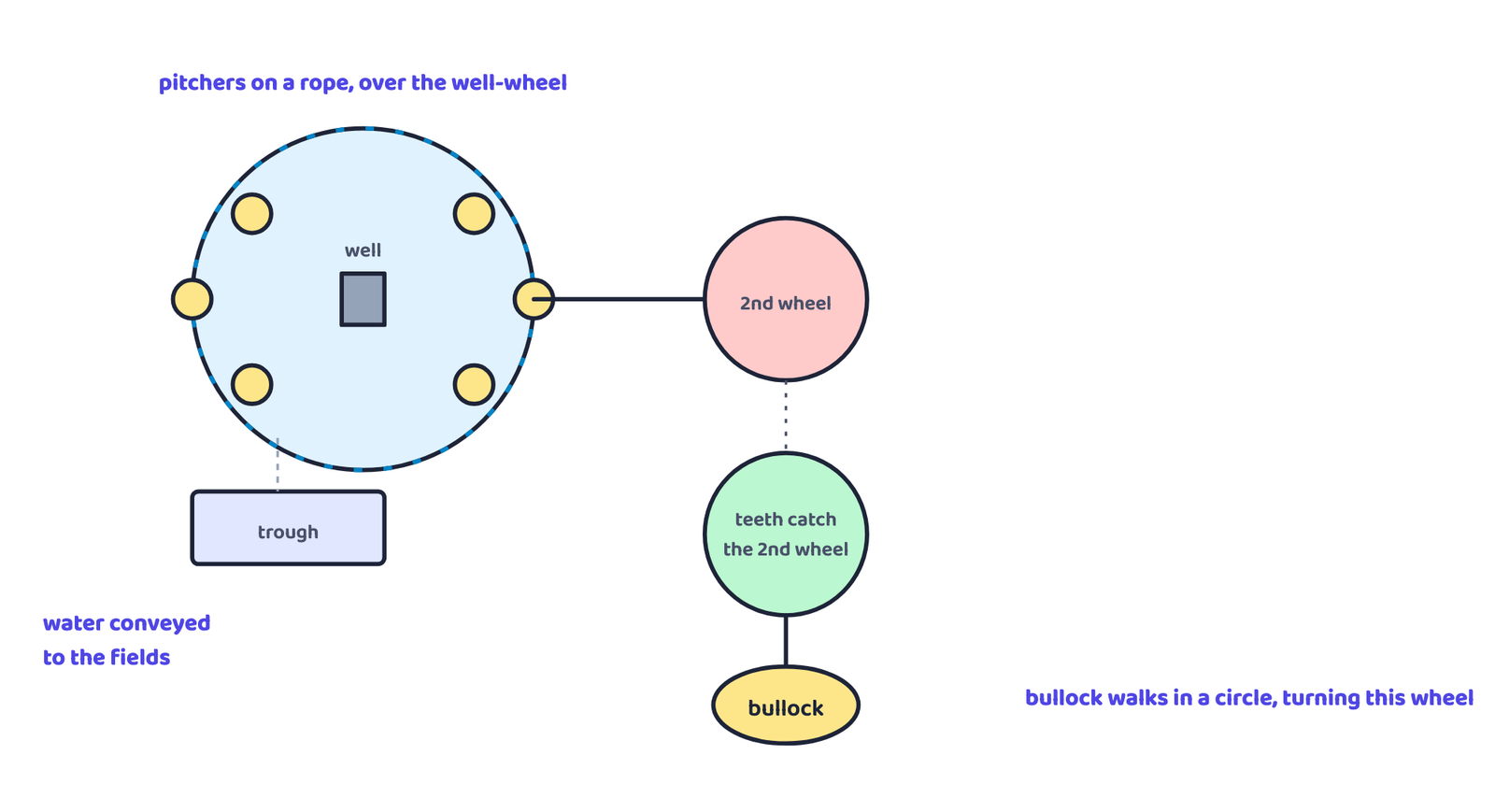
Babur, on the devices he saw: “In Lahore, Dipalpur… and those other parts, people water by means of a wheel. They make two circles of rope long enough to suit the depths of the well, fix strips of wood between them, and on these fasten pitchers… In Agra, Chandwar, Bayana… people water with a bucket… tie a rope to a large bucket, put the rope over a roller, and tie its other end to the bullock. One person must drive the bullock, another empty the bucket.”
The state also supported irrigation directly, digging new canals (nahr, nala) and repairing old ones, such as the shahnahr in Punjab under Shah Jahan. Cattle-powered technology included the light wooden plough with an iron coulter (shallow furrows preserved moisture in hot months), seed-drills pulled by oxen (though broadcasting seed by hand was more common), and a narrow iron blade for hoeing and weeding.
1.4 An abundance of crops
Two seasonal cycles, kharif (autumn) and rabi (spring), meant most regions grew at least two crops a year (do-fasla), some with assured water even three. The Ain records 39 crop varieties in Agra, 43 in Delhi, and 50 varieties of rice alone in Bengal.
Jins-i kamil (“perfect crops”) were cash crops the Mughal state actively encouraged for their higher revenue: cotton (central India, the Deccan) and sugarcane (Bengal) above all, alongside oilseeds like mustard and lentils. Subsistence and commercial farming were closely intertwined on an average peasant’s own holding.
New World and African crops arrived through the seventeenth century: maize (via Africa and Spain, a major western Indian crop by then), tomatoes, potatoes, chillies, pineapple and papaya. Tobacco, reaching the Deccan first then the north, was unknown to Akbar and his nobles until 1604; despite Jahangir’s ban, smoking and cultivation only grew, and tobacco was a major crop by the century’s end.
Economic historians estimate India’s population grew by about 50 million between 1600 and 1800, roughly 33 per cent over two centuries, despite periodic famine and epidemic, a result of this varied and flexible agricultural base.
2 The Village Community
Peasants owned land individually but belonged to a collective village community with three parts: cultivators, the panchayat, and the headman (muqaddam or mandal).
2.1 Caste and the rural milieu
Caste made the peasantry deeply unequal. A significant share worked as landless menials or agricultural labourers (majur), assigned menial tasks and kept poor regardless of how much cultivable land existed, comparable, the chapter notes, to Dalits in modern India. Similar hierarchies reached non-Hindu communities too: Muslim halalkhoran (scavengers) lived outside village boundaries, and Bihar’s mallahzadas (“sons of boatmen”) were treated much like slaves.
At intermediate levels, caste and status correlated far less neatly. A seventeenth-century Marwar manual lists Rajputs as peasants sharing space with lower-status Jats. The Gauravas around Vrindavan sought Rajput status; Ahirs, Gujars and Malis rose through profitable cattle-rearing and horticulture; in the east, Sadgops and Kaivartas, pastoral and fishing castes, acquired peasant status.
2.2 Panchayats and headmen
The village panchayat, an assembly of elders with hereditary property rights, was usually caste-mixed in mixed-caste villages, though menial labourers were unlikely to sit on it; its decisions bound members. The headman, chosen by elder consensus and ratified by the zamindar, held office only as long as elders trusted him, and could be dismissed. His chief job was supervising village accounts, helped by the patwari (accountant).
Do not idealise the panchayat system. Mandals often defrauded village accounts in league with the patwari and underassessed their own land’s revenue to shift the burden onto smaller cultivators.
Panchayat funds, pooled from members, paid for entertaining visiting revenue officials, community relief after calamities like floods, and infrastructure (a bund, a canal) individual peasants could not afford alone. A key panchayat function was policing caste boundaries: in eastern India every marriage required the mandal’s presence, “chiefly to prevent any offence against their caste”. Panchayats could levy fines or, as a drastic, usually temporary measure, expel someone from the community, making them an outcaste who lost the right to practise their profession, a strong deterrent to breaking caste norms.
Each caste additionally had its own jati panchayat, which in Rajasthan arbitrated civil disputes across castes, mediated land claims, judged marriage propriety and ritual precedence; the state generally respected jati panchayat rulings except in criminal matters. Petitions from western India (Rajasthan, Maharashtra), often from the lowest rungs of rural society, complained of extortionate taxation or unpaid forced labour (begar) by “superior” castes or state officials, treating the panchayat as a moral court of appeal guaranteeing a customary right to subsistence, especially during drought. Panchayat rulings varied case by case; when compromise failed, peasants often simply deserted the village, an effective weapon given how easily uncultivated land was available elsewhere.
2.3 Village artisans
Marathi documents and early British-era village surveys found artisans made up as much as 25 per cent of village households. The line between peasant and artisan was often blurred: cultivating families dyed, printed textiles, baked, fired pottery and repaired tools in the gaps between sowing, weeding and harvesting. Specialist artisans, potters, blacksmiths, carpenters, barbers, even goldsmiths, were paid in a harvest share or land allotment (often cultivable waste, panchayat-assigned), which in Maharashtra became a hereditary holding called miras or watan.
Another model paired individual artisans with individual peasant households in negotiated goods-for-services exchange; eighteenth-century Bengal zamindars, for instance, paid blacksmiths, carpenters and goldsmiths “a small daily allowance and diet money”, a pattern later labelled the jajmani system (a term not actually used at the time). Cash payment existed too, alongside these barter-style arrangements.
2.4 A “little republic”?
Some nineteenth-century British officials romanticised the village as a “little republic” of fraternal, equal partners. It was not: individual ownership and deep caste and gender inequality meant a small group of powerful individuals actually ran village affairs, exploiting weaker sections while dispensing justice. A cash economy had also already developed through village-town trade; even in the Mughal heartland, revenue was assessed and collected in cash, and export-oriented artisans (weavers, and producers of cotton, silk, indigo) were paid cash advances and wages.
The seventeenth-century French traveller Jean-Baptiste Tavernier found it remarkable “that in India a village must be very small indeed if it has not a money-changer called a Shroff”, who acted as a banker for remittances.
3 Women in Agrarian Society
Men and women worked the fields together: men tilled and ploughed, women sowed, weeded, threshed and winnowed. With nucleated villages and individuated peasant farming, the whole household’s labour and resources were the basis of production, so a clean home/field, woman/man split was never really possible. Biological taboos still persisted regardless: menstruating women could not touch the plough or potter’s wheel in western India, or enter Bengal’s betel-leaf (paan) groves.
Spinning yarn, sifting and kneading clay for pottery and embroidery all depended heavily on female labour, and the more commercialised a product, the greater the demand for women’s work, which took them into employers’ homes and to markets, not only the fields. Women mattered doubly as a labour force and as child bearers, but high female mortality (malnutrition, frequent pregnancy, childbirth deaths) created a real shortage of wives, which shaped distinct rural customs: bride-price rather than dowry, and legitimate remarriage for both divorced and widowed women.
Do not read these customs as evidence of greater freedom for women. The household stayed male-headed by norm, women were kept under strict control precisely because their reproductive role made them so valuable, and suspected infidelity could bring draconian punishment.
Panchayat petitions from Rajasthan, Gujarat and Maharashtra show wives protesting a husband’s infidelity or a household head’s (grihasthi) neglect. Male infidelity was not always punished, though the state and higher castes did intervene to ensure family maintenance; when women petitioned, their own names were dropped from the record, they appear only as “mother”, “sister” or “wife” of the male household head.
Among landed elites, women had real inheritance rights: Punjab records show women, widows included, actively selling inherited property in the land market; both Hindu and Muslim women inherited zamindaris, freely sold or mortgaged them, and women zamindars appear in eighteenth-century Bengal, including at the head of the huge Rajshahi zamindari, one of the era’s largest.
4 Forests and Tribes
4.1 Beyond settled villages
Beyond intensively farmed regions, dense forest (jangal) or scrubland (kharbandi) covered huge swathes of eastern, central and northern India (including the Terai), Jharkhand, and peninsular India down the Western Ghats and Deccan; contemporary estimates put average forest cover at about 40 per cent.
Jangli, applied to forest dwellers, did not mean “uncivilised” in its contemporary sense; it described those living by gathering forest produce, hunting and shifting agriculture, activities that were highly season-specific. Among the Bhils: spring for gathering, summer for fishing, monsoon for cultivation, autumn-winter for hunting, a cycle that required and reinforced mobility.
For the state, forests were politically dangerous: a refuge (mawas) for troublemakers. Babur wrote that jungles gave cover “behind which the people of the pargana become stubbornly rebellious and pay no taxes.”
4.2 Inroads into forests
The state needed war elephants, so peshkash (tribute) from forest peoples often took the form of elephants. Hunting itself carried Mughal political meaning: court historians described royal hunts as a way for the emperor to travel the empire and personally hear his subjects’ grievances, and court painters often inserted small symbolic scenes into hunt paintings signalling a harmonious reign.
Mukundaram Chakrabarti’s sixteenth-century Bengali poem Chandimangala: hero Kalaketu clears forest and founds a kingdom. “Hearing the news, outsiders came from various lands. Kalaketu then bought and distributed among them / Heavy knives, axes, battle-axes and pikes… Having cleared the forest / They established markets… Hearing the sound of the axe, / Tigers became apprehensive and ran away, roaring.”
Source 4 · hill-plains trade, c. 1595. Abu’l Fazl on the suba of Awadh: hill tribes carried down “gold, copper, lead, musk, tails of the kutas cow (the yak), honey, chuk… pomegranate seed, ginger, long pepper… hawks, falcons… and other articles”, trading them for “white and coloured cloths, amber, salt, asafoetida, ornaments, glass and earthen ware” from the plains.
Commercial agriculture reached into forests too: honey, beeswax and gum lac were in high demand, gum lac becoming a major seventeenth-century export; elephants were captured and sold; barter persisted alongside cash trade, and tribes like the Lohanis in Punjab ran overland trade with Afghanistan and within Punjab itself.
Social change followed: tribal chieftains, like village “big men”, built armies from lineage groups, and many became zamindars, some even kings. Sind tribes fielded 6,000 cavalry and 7,000 infantry; Assam’s Ahom kings had paiks, men obliged to military service in exchange for land, and declared wild-elephant capture a royal monopoly. This tribal-to-monarchical shift, though older, only fully matured by the sixteenth century, evident in the Ain’s record of north-eastern tribal kingdoms and, for instance, the Koch kings’ long sequence of wars subjugating neighbouring tribes. Sufi pirs are thought to have played a real role in the slow spread of Islam into these newly settled agricultural frontiers.
5 The Zamindars
Zamindars lived off agriculture without farming directly: landed proprietors with elevated social and economic status, drawn partly from caste, partly from the services (khidmat) they performed for the state.
Zamindars’ personal lands, milkiyat (“property”), were worked with hired or servile labour for their private use, and could be freely sold, bequeathed or mortgaged. Zamindars also earned by collecting revenue for the state (for a fee) and by controlling military resources: most kept fortresses (qilachas) and armed contingents of cavalry, artillery and infantry.
The Ain records the zamindars’ combined military strength across Mughal India at 384,558 cavalry, 4,277,057 infantry, 1,863 elephants, 4,260 cannons and 4,500 boats, a force rivalling the imperial army itself.
Picture rural society as a pyramid: zamindars formed its very narrow apex. Abu’l Fazl’s account shows a dominant upper-caste Brahmana-Rajput combine, alongside intermediate castes and a real presence of Muslim zamindaris. Some zamindaris clearly began through conquest, a powerful chief dispossessing weaker rivals, though the state was unlikely to tolerate this without confirming the new zamindar by imperial order (sanad). More common were slower processes: colonising new land, transfer of rights, state order, or straightforward purchase, the last of which let people from relatively “lower” castes buy their way into zamindar status, since zamindaris were traded quite briskly. Clan or lineage-based consolidation mattered too: Rajputs and Jats in the north, peasant-pastoralist Sadgops in central and south-western Bengal.
Zamindars actively drove agricultural colonisation, helping settle cultivators with cash loans and tools, sold produce from their own milkiyat lands, and often set up markets (haats) where peasants also sold their own crops, accelerating monetisation of the countryside.
Do not write zamindars off as simply oppressors. Their relationship with peasants carried real reciprocity, paternalism and patronage: bhakti saints, sharp critics of caste oppression elsewhere, rarely portrayed zamindars (or moneylenders) as exploiters, usually blaming state revenue officials instead; and in many seventeenth-century agrarian uprisings, zamindars actually fought alongside the peasantry against the state, not against them.
6 The Land Revenue System
Land revenue was the Mughal Empire’s economic backbone, requiring an administrative apparatus led by the diwan’s office (daftar), supervising the empire’s whole fiscal system.
Revenue assessment happened in two stages: jama, the amount assessed, and hasil, the amount actually collected, which could fall short of the assessment for local reasons. Akbar directed the amil-guzar (revenue collector) to prefer cash payment but keep payment in kind available too.
Both cultivated and cultivable land was measured province by province; the Ain compiled these totals under Akbar, and measurement continued under later emperors, Aurangzeb in 1665 ordering annual village-level cultivator counts. Forests, being unmeasured, remained largely outside this system.
The Ain: “Polaj is land which is annually cultivated for each crop in succession and is never allowed to lie fallow. Parauti is land left out of cultivation for a time that it may recover its strength. Chachar is land that has lain fallow for three or four years. Banjar is land uncultivated for five years and more.” Polaj and parauti were each further split into good, middling and bad; the average of the three gave the medium produce, of which one-third was claimed as royal revenue.
The Ain again, on assessment methods: kankut, estimating standing crops (cut and classed good/middling/inferior if disputed); batai/bhaoli, reaping and dividing the harvest by agreement in the parties’ presence (needing careful inspectors, “otherwise the evil-minded and false are given to deception”); khet-batai, dividing the sown field itself before harvest; lang batai, dividing the cut grain into heaps.
Source 7 · the jama, 1665. Aurangzeb’s order to his revenue officials: discover the actual state of cultivation, “village by village, peasant-wise”, after minute scrutiny, and assess the jama “keeping in view the financial interests of the government, and the welfare of the peasantry.”
7 The Flow of Silver
The Mughal Empire, alongside the Ming (China), Safavid (Iran) and Ottoman (Turkey) empires, achieved political stability that supported vibrant overland trade from China to the Mediterranean. Voyages of discovery and the opening of the New World then hugely expanded Asia’s, and especially India’s, trade with Europe, both geographically and in the range of goods traded. This trade brought enormous quantities of silver bullion into Asia, much of it flowing on into India, which had no natural silver of its own. The result was remarkable currency stability, particularly the silver rupya, between the sixteenth and eighteenth centuries, expanding coin minting and cash circulation and strengthening the Mughal state’s ability to tax and collect revenue in cash.
Italian traveller Giovanni Careri, c. 1690: “all the Gold and Silver, which circulates throughout the World at last Centres here… the Turks not being able to abstain from Coffee… nor Persia, Arabia, and the Turks themselves to go without the commodities of India, send vast quantities of Mony to Moka on the Red Sea… Bassora at the bottom of the Persian Gulf… which is afterwards sent over in Ships to Indostan… All that the Dutch fetch from the Mines in Japan, sooner or later, goes to Indostan; and the goods carry’d hence into Europe… are all purchas’d for ready Mony, which remains there.”
8 The Ain-i Akbari of Abu’l Fazl
Completed in 1598, Akbar’s 42nd regnal year, after five revisions, the Ain was the third book of a larger history project, the Akbar Nama (the first two books were historical narrative, covered in Theme 9). The Ain itself functioned as a compendium of imperial regulations and a gazetteer, covering court, administration, army, revenue sources and provincial layout, plus the empire’s literary, cultural and religious traditions.
| Book (daftar) | Name | Content |
|---|---|---|
| 1 | Manzil-abadi | The imperial household and its maintenance |
| 2 | Sipah-abadi | Military and civil administration, plus sketches of mansabdars, scholars, poets and artists |
| 3 | Mulk-abadi | Fiscal administration: revenue rates and the “Account of the Twelve Provinces” (subas), with detailed sarkar-level tables |
| 4-5 | — | Religious, literary and cultural traditions, and a collection of Akbar’s “auspicious sayings” |
The mulk-abadi’s sarkar-level tables ran eight columns: pargana/mahal, forts (qila), measured area (arazi and zamin-i paimuda), cash-assessed revenue (naqdi), charitable revenue grants (suyurghal), zamindars, their castes, and their troop strength (horsemen/sawar, foot-soldiers/piyada, elephants/fil), giving an extraordinarily detailed view of north Indian agrarian society.
Abu’l Fazl on his method: Akbar ordered him to write “with the pen of sincerity”, so he spent “much labour and research”, interrogating “the servants of the State and the old members of the illustrious family”, examining both “truth-speaking old men” and “active-minded” younger officials, and had provincial records and memoranda sent to court, “recited in the royal hearing” before final inclusion. He drew on the Record Office established from the emperor’s 19th regnal year, on original orders sent to the provinces, and on reports submitted by ministers and officials.
Henry Blochmann edited and, with the Asiatic Society of Bengal, published the Ain in its Bibliotheca Indica series; the standard English translation of Volume 1 is Blochmann’s (Calcutta, 1873), Volumes 2 and 3 by H.S. Jarrett (Calcutta, 1891 and 1894).
Its five revisions show real caution: oral testimony was cross-checked before being written up as fact, and all numeric data was spelled out in words to prevent transcription errors. Still, the Ain has real limits: numerous totalling errors, mostly minor arithmetic or transcription slips by assistants; and skewed regional coverage, caste data on zamindars is missing for Bengal and Orissa, and the detailed price and wage data comes mainly from around Agra, limiting its relevance elsewhere.
The Ain’s real achievement, worth stating directly in any essay question on it, was breaking from the medieval chronicle tradition of writing almost exclusively about wars, conquests and dynastic politics. It made the country, its people, professions and products the actual subject, not decoration around a political narrative, which is exactly why its quantitative evidence on agrarian relations remains uncontested even with its flaws.
9 Timeline and Revision
| Landmarks in the history of the Mughal Empire | |
|---|---|
| 1526 | Babur defeats Ibrahim Lodi at Panipat, becomes first Mughal emperor |
| 1530-40 | First phase of Humayun’s reign |
| 1540-55 | Humayun defeated by Sher Shah, in exile at the Safavid court |
| 1555-56 | Humayun regains lost territories |
| 1556-1605 | Reign of Akbar |
| 1605-27 | Reign of Jahangir |
| 1628-58 | Reign of Shah Jahan |
| 1658-1707 | Reign of Aurangzeb |
| 1739 | Nadir Shah invades India, sacks Delhi |
| 1761 | Ahmad Shah Abdali defeats the Marathas, third battle of Panipat |
| 1765 | Diwani of Bengal transferred to the East India Company |
| 1857 | Last Mughal ruler, Bahadur Shah II, deposed, exiled to Rangoon |
- The Ain-i Akbari is the chapter’s central source: rich and quantitative, but a “view from the top”, skewed in coverage, needing regional records to balance it.
- Peasants (raiyat/kisan/asami) held small, individually owned plots; khud-kashta farmed their own village, pahi-kashta farmed elsewhere on contract.
- Jins-i kamil cash crops (cotton, sugarcane) were interwoven with subsistence staples, not opposed to them.
- Village society ran on caste hierarchy, panchayat and headman governance, and artisan exchange networks (miras/watan land, later called jajmani), not egalitarian “little republics”.
- Women shared field labour fully but faced ritual restriction and tight male control, even as elite women held real, exercised inheritance rights over zamindaris.
- Forests covered roughly 40 per cent of the land; “jangli” meant a livelihood, not an absence of civilisation, and tribal chiefs often became zamindars or kings.
- Zamindars formed the narrow apex of rural society, powerful and often exploitative, yet in practice more often allied with peasants against the state than against them.
- Revenue assessment (jama) and collection (hasil) used land classification (polaj, parauti, chachar, banjar) and multiple measurement methods (kankut, batai, khet-batai, lang batai).
- A global silver influx, driven by New World bullion and Asian trade networks, stabilised Mughal currency and strengthened cash-based revenue collection.
- 1 markWho authored the Ain-i Akbari, and in what year was it completed?
- 1 markDistinguish between khud-kashta and pahi-kashta peasants.
- 1 markWhat is jins-i kamil? Give two examples.
- 1 markWhat were milkiyat lands?
- 1 markDistinguish between jama and hasil.
- 2 marksWhat were the three constituents of the village community?
- 2 marksWhat is begar, and who complained about it in panchayat petitions?
- 2 marksWhat does “jangli” mean in contemporary sixteenth-seventeenth century usage?
- 2 marksName the four categories of land under Akbar’s classification system.
- 3 marksWhat problems arise in using the Ain as a source for agrarian history, and how do historians deal with them?
- 3 marksDescribe the role played by women in agricultural production.
- 3 marksHow did caste status and economic status correlate at the lower and intermediate levels of rural society?
- 3 marksDescribe the four methods of revenue assessment listed in Source 6 (kankut, batai, khet-batai, lang batai).
- 3 marksWhat evidence suggests zamindars and peasants sometimes made common cause against the state?
- 3 marksDiscuss, with examples, the significance of monetary transactions in this period.
- 3 marksHow did tribal chieftains sometimes transform into zamindars or kings?
- 5 marksTo what extent can agricultural production in the sixteenth-seventeenth centuries be characterised as subsistence agriculture? Give reasons.
- 5 marksTo what extent was caste a factor in agrarian social and economic relations?
- 5 marksHow were the lives of forest dwellers transformed in the sixteenth and seventeenth centuries?
- 5 marksExamine the role played by zamindars in Mughal India.
- 5 marksDiscuss the ways in which panchayats and village headmen regulated rural society.
- 5 marksExamine the evidence that suggests land revenue was central to the Mughal fiscal system.
- 5 marksDiscuss how global flows of silver bullion connected the Mughal economy to the wider world.
- 1 markThe Ain-i Akbari is the third book of a larger history known as:
(a) Baburnama(b) Akbar Nama(c) Tuzuk-i-Jahangiri(d) Shah Jahan Nama - 1 markThe village headman was known as:
(a) patwari(b) diwan(c) muqaddam or mandal(d) amil-guzar - 1 markLand uncultivated for five years or more was classified as:
(a) polaj(b) parauti(c) chachar(d) banjar - 1 markSufi saints who spread Islam among newly settled agricultural communities were called:
(a) qazis(b) pirs(c) ulama(d) shaikhs - 1 markThe Ahom kings’ subjects obliged to render military service in exchange for land were called:
(a) paiks(b) sawars(c) piyadas(d) mansabdars - 1 markAccording to Careri, silver reaching India ultimately originated largely from:
(a) China(b) America(c) Africa(d) Persia
Choose: (a) both A and R are true and R explains A; (b) both true but R does not explain A; (c) A true, R false; (d) A false, R true.
Reason (R): Village society was genuinely egalitarian, with resources and labour shared equally among all residents.
Reason (R): Zamindars and peasants often stood together against state revenue demands, and it was usually state officials who drew the saints’ criticism.