
- The complete poem, exactly as the book prints it, and who wrote it
- What happens in each stanza, explained in simple words
- Why Frost picked a crow and a hemlock tree, and what the snow stands for
- The central idea: a tiny moment can carry a large meaning
- Every poetic device the poem really uses, with the exact words that prove it
- Short answers to the book’s “Thinking about the Poem” questions
1Meet the Poet
The book prints only the poet’s name, Robert Frost, under the poem. The facts below are general knowledge, given so that you can place him.
Frost’s poems use plain, everyday scenes (woods, snow, farms, birds) and quietly turn them into thoughts about life. “Dust of Snow” is a clear example: a bird, a tree and a little snow, and the whole poem is about how a person’s day can turn around.
2The Poem, in Full
The poem has two stanzas of four lines each, eight short lines in all. Here it is exactly as the book prints it. Notice that there is no comma or full stop until the very last word.
The way a crow
Shook down on me
The dust of snow
From a hemlock tree
Has given my heart
A change of mood
And saved some part
Of a day I had rued.
The book’s glossary: hemlock is “A poisonous plant (tree) with small white flowers”.
The book’s glossary: rued means “held in regret”. So “a day I had rued” is a day the poet was sorry about, a day that had been going badly.
3Stanza-by-Stanza Meaning
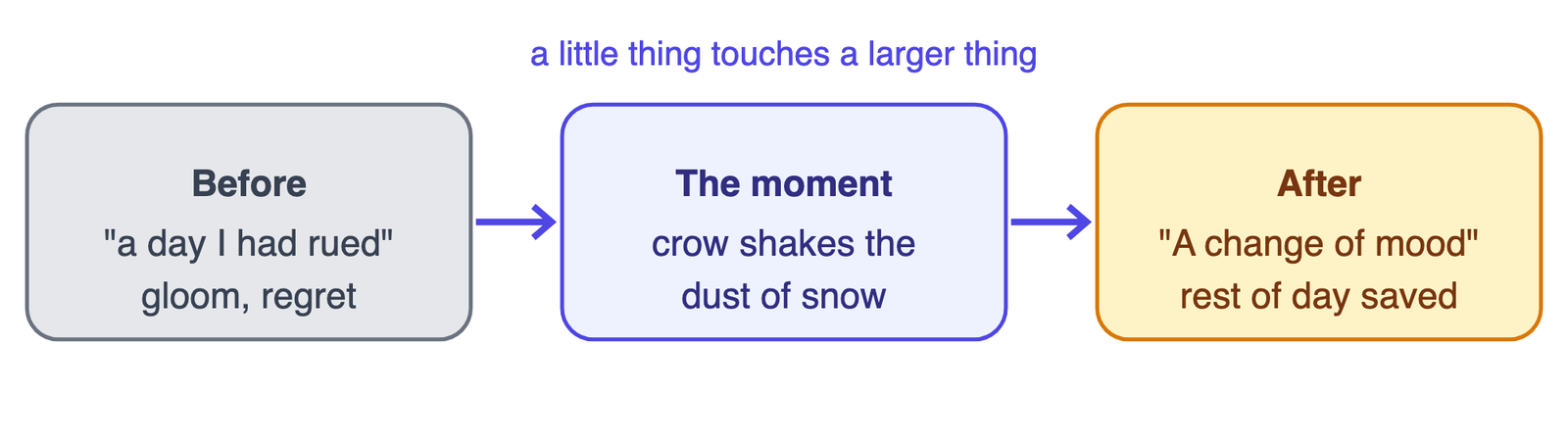
3.1 Read it as one sentence
The whole poem is a single sentence. Put in prose order, it says:
The way a crow shook down on me the dust of snow from a hemlock tree has given my heart a change of mood and saved some part of a day I had rued.
the poem’s eight lines read as one sentence
Stanza 1 is the subject (what happened) and stanza 2 is the result (what it did). Because the sentence runs straight on from the first stanza into the second, the reader feels the cause flow into the effect, just as the poet felt it.
If asked “What changed the poet’s mood?”, the precise answer is the way the crow shook the dust of snow on him from the hemlock tree, not just “snow”. The poem’s own subject is “The way a crow / Shook down on me / The dust of snow”.
4Central Idea and Message
A very small, ordinary moment in nature can change a person’s mood and rescue a bad day. The book itself says the poem “presents a moment that seems simple, but has a larger significance”, and links it to Frost’s words: “A little thing touches a larger thing.”
The message for the reader follows from this:
- Do not let one bad part of the day spoil all of it; a change of mood is always possible.
- Joy can come from unexpected, even unlikely, sources.
- Nature can heal and refresh the mind.
5How Frost Presents Nature: Crow, Hemlock and Snow
Poets usually pick pleasant birds such as the nightingale, cuckoo, skylark or peacock, and beautiful trees. Frost does the opposite. The book itself asks why he did not choose “a more ‘beautiful’ tree such as a maple, or an oak, or a pine”.
| Image | What it usually suggests | What it does in this poem |
|---|---|---|
| Crow | A black bird with a harsh caw; in Indian and many other traditions, a sign of bad luck (an ill omen) | Stands for gloom and sorrow, yet it is the crow that brings the poet relief |
| Hemlock tree | A poisonous plant (the book’s glossary) | Stands for sadness, sickness of mind, and the poet’s dark mood |
| Dust of snow | Fresh, cold, clean, light | Stands for joy, freshness and a new start; it wakes the poet out of his gloom |
Symbolism is using an object to stand for an idea. Here the crow and the hemlock are symbols of sorrow, and the dust of snow is a symbol of joy and renewal. The point of the contrast: happiness can come even out of things we think of as dark or unlucky.
6Poetic Devices Used
Only devices that the poem really uses are listed. Learn each one with its quoted words.
| Device | Exact words | What it does |
|---|---|---|
| Rhyme scheme abab cdcd | crow / snow, me / tree; heart / part, mood / rued | Alternate rhyme in each stanza gives the poem a light, song-like movement |
| Symbolism | “a crow”, “a hemlock tree”, “The dust of snow” | Crow and hemlock stand for sorrow; snow stands for joy and renewal |
| Metaphor | “The dust of snow” | Fine, powdery snow is described as dust, showing how light and small the snowfall is |
| Imagery (visual) | “Shook down on me / The dust of snow / From a hemlock tree” | Lets the reader see the white snow falling from a dark tree onto the poet |
| Enjambment | Every line runs on into the next; the only punctuation is the final full stop | The single unbroken sentence carries the cause straight into its effect |
| Alliteration | “saved some” | Repeated ‘s’ sound at the start of nearby words adds music |
| Contrast | dark crow and poisonous hemlock vs white, fresh snow; “a day I had rued” vs “A change of mood” | Sets gloom against joy, which is the whole point of the poem |
The rhyme scheme is the pattern of rhyming end-words, marked with letters. In “Dust of Snow” it is abab cdcd: crow (a), me (b), snow (a), tree (b); heart (c), mood (d), part (c), rued (d).
Enjambment is when a sentence runs on from one line to the next with no pause at the line end. In this poem all eight lines are one sentence, so the poem is enjambed from start to finish.
Do not call “dust of snow” a simile. There is no “like” or “as”: snow is spoken of directly as dust, so it is a metaphor. And the poem has no personification of the crow; the crow simply shakes the branch.
7Tone and Title
Tone
Reflective and quiet. It moves from regret and gloom (“a day I had rued”) to relief and hope (“A change of mood”). The poem ends in thankfulness for a small gift.
Title
“Dust of Snow” names the small thing at the heart of the poem. Calling it dust stresses how tiny and light it is, which makes its large effect on the poet’s mood more striking.
8Thinking about the Poem: Short Answers
What is a “dust of snow”? What changed the poet’s mood, and how?
A “dust of snow” is a light shower of fine, powdery snowflakes. The way a crow shook it down on him from a hemlock tree changed his mood: from sorrow and regret to cheer and hope, so the rest of his day was saved.
Which birds are usually named in poems? Is a crow? What does a crow bring to mind?
Poems usually name the nightingale, cuckoo, skylark or peacock. A crow is rarely mentioned. A crow brings to mind a black, noisy bird and, in common belief, bad luck or gloom.
What is a hemlock tree? Why not a maple, an oak or a pine?
A hemlock is a poisonous plant (tree) with small white flowers. Frost picks it, not a “beautiful” tree, because it matches the poet’s dark mood and makes the contrast sharper: even something poisonous can be the source of joy.
What do the crow and hemlock stand for, and what does the dust of snow stand for?
The crow and the hemlock stand for sorrow and gloom. The dust of snow stands for joy, freshness and renewal, the small good thing that lifts the poet’s spirits.
Have you had a similar moment that changed your mood?
Personal answer. Example: on a bad day after a poor test, a little child’s laugh in the park made me smile, and I went home cheerful. Like the poet, a small thing changed my whole day.
9The Poem at a Glance
| Point | Detail |
|---|---|
| Poet | Robert Frost |
| Form | 2 stanzas x 4 lines; one sentence; short lines |
| Rhyme scheme | abab cdcd |
| Speaker | The poet himself (first person: “me”, “my heart”, “I”) |
| Event | A crow shakes snow from a hemlock tree onto the poet |
| Effect | His mood changes and the rest of a regretted day is saved |
| Key symbols | Crow, hemlock (sorrow); dust of snow (joy, renewal) |
| Tone | Reflective; gloom turning to hope |
- Poet: Robert Frost; 2 stanzas, 8 lines, one sentence, rhyme scheme abab cdcd
- Event: a crow shakes the “dust of snow” from a hemlock tree onto the poet
- Effect: “A change of mood”; it “saved some part / Of a day I had rued”
- Glossary: hemlock = poisonous plant (tree) with small white flowers; rued = held in regret
- Symbols: crow and hemlock = sorrow; snow = joy and renewal
- Book’s framing: a simple moment with “a larger significance”; “A little thing touches a larger thing.”
- Devices: symbolism, metaphor (“dust of snow”), imagery, enjambment, alliteration (“saved some”), contrast
- Can I write out all eight lines correctly, with the single full stop at the end?
- Can I explain what happens in stanza 1 and what it causes in stanza 2?
- Can I say why Frost chose a crow and a hemlock instead of a pleasant bird and tree?
- Can I mark the rhyme scheme and name at least four devices with their words?
- Can I state the central idea in two lines?