
- The complete poem, exactly as the book prints it, and who wrote it
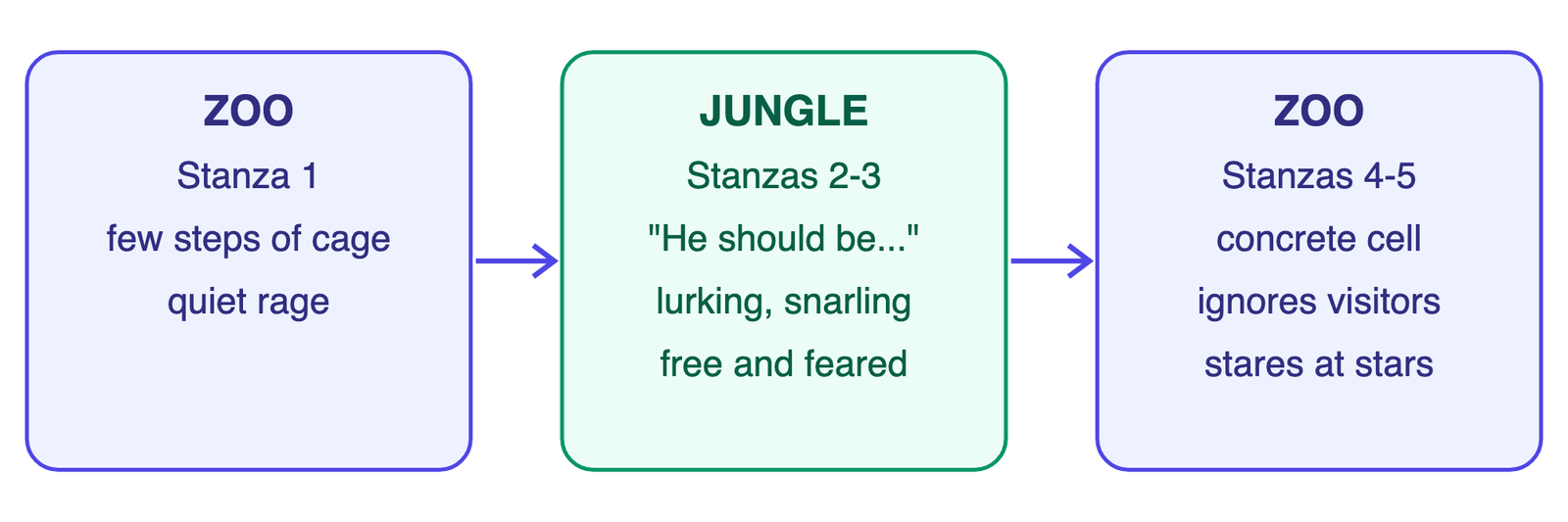
- How the poem travels from the zoo to the jungle and back to the zoo
- What each of the five stanzas says, in simple English
- The central idea: a wild animal loses its true life in a cage
- The devices the poem really uses, with the exact words
- Short answers to the book’s “Thinking about the Poem” questions
1Meet the Poet and the Poem
The book prints the poet’s name, Leslie Norris, below the last stanza. As general knowledge: he was a Welsh poet and short-story writer (1921-2006) who often wrote about animals and the countryside.
The poem places a tiger in a zoo beside a tiger in its natural habitat (its home in the wild). It goes from the zoo to the jungle, and then back to the zoo. The book asks you to spot which stanzas show the zoo and which show the jungle.
2The Poem, in Full
Here is the poem exactly as the book prints it. Notice that the third stanza ends with an exclamation mark.
He stalks in his vivid stripes
The few steps of his cage,
On pads of velvet quiet,
In his quiet rage.
He should be lurking in shadow,
Sliding through long grass
Near the water hole
Where plump deer pass.
He should be snarling around houses
At the jungle’s edge,
Baring his white fangs, his claws,
Terrorising the village!
But he’s locked in a concrete cell,
His strength behind bars,
Stalking the length of his cage,
Ignoring visitors.
He hears the last voice at night,
The patrolling cars,
And stares with his brilliant eyes
At the brilliant stars.
The book’s glossary: snarls means “makes an angry, warning sound”. In stanza 3 the tiger “should be snarling around houses”.
Other words to know
| Word | Meaning here |
|---|---|
| stalks | walks slowly and stiffly, in a proud or angry way |
| vivid | bright and sharp in colour |
| pads | the soft cushions under an animal’s paws |
| lurking | waiting out of sight, ready to spring |
| plump | well-fed, fleshy |
| baring | showing, uncovering |
| fangs | long, pointed teeth |
| terrorising | filling with fear |
| patrolling | going round to guard a place |
3Stanza-by-Stanza Meaning
4Cage and Wild: the Two Columns (book question 1)
Movements and actions
In the cage
- stalks (the few steps of his cage)
- on pads of velvet quiet
- in his quiet rage
- locked
- stalking the length of his cage
- ignoring visitors
- hears; stares
In the wild
- lurking in shadow
- sliding through long grass
- snarling around houses
- baring his white fangs, his claws
- terrorising the village
Words for the two places
The zoo
- cage
- concrete cell
- bars
- visitors
- patrolling cars
The jungle
- shadow
- long grass
- water hole
- plump deer
- houses at the jungle’s edge, the village
The cage words are hard, small and man-made; the jungle words are open, natural and full of life. Setting them side by side is how the poet makes us feel the tiger’s loss.
5Central Idea and Message
A tiger is meant to roam, hunt and rule the jungle. Shut inside a zoo, its power is wasted and its anger has nowhere to go. By contrasting the caged tiger with the free one, the poet shows the pain of captivity and suggests that wild animals belong in their natural habitat.
- Freedom vs captivity: the jungle stanzas are full of movement; the zoo stanzas are full of walls and bars.
- Lost strength: “His strength behind bars” shows power that cannot be used.
- Longing: the closing look at the stars suggests a wish for the open world he has lost.
6Poetic Devices Used
Only devices the poem really uses are listed. Learn each with its quoted words.
| Device | Exact words | What it does |
|---|---|---|
| Contrast | stanzas 1, 4, 5 (zoo) vs stanzas 2, 3 (jungle) | The whole poem is built on the gap between the caged life and the free one |
| Oxymoron | “quiet rage” | Two opposite ideas joined: anger that cannot be shown |
| Metaphor | “pads of velvet quiet” | His paws are soft and silent, as if made of velvet |
| Repetition | “quiet … quiet”; “brilliant eyes / … brilliant stars” | Stresses his silent anger, and links his eyes with the free stars |
| Anaphora | “He should be lurking” / “He should be snarling” | Two stanzas open the same way, building the picture of the life he ought to have |
| Alliteration | “stalks in his vivid stripes”; “plump deer pass” | Repeated sounds give the lines rhythm |
| Imagery | “vivid stripes”, “white fangs”, “plump deer”, “brilliant stars” | Clear pictures the reader can see |
| Enjambment | “He stalks in his vivid stripes / The few steps of his cage,” | A sentence runs on into the next line without a pause |
| Rhyme | cage/rage, grass/pass, cars/stars | The second and fourth lines rhyme (abcb) in most stanzas; stanzas 3 and 4 have only near-rhymes (edge/village, bars/visitors) |
An oxymoron puts two words with opposite meanings side by side. In “quiet rage”, rage is loud by nature, yet the caged tiger’s rage is silent because he can do nothing with it.
Contrast is placing two very different things next to each other so each looks sharper. Here the cramped, concrete zoo is set against the shady, grassy, open jungle.
“velvet quiet” / “quiet rage”: the first “quiet” is about his silent steps, the second is about his silent anger. Repeating the word shows that both his body and his feelings have been forced into silence.
“brilliant eyes” / “brilliant stars”: the same word ties the tiger to the stars. His eyes still shine with wild life, and the bright, distant stars stand for the freedom he cannot reach.
Stanzas 2 and 3 do not describe what the tiger is doing now. They use “He should be”: they are the poet’s picture of the life the tiger ought to have. Only stanzas 1, 4 and 5 show the real tiger in the zoo.
7Tone and Title
Tone
Sympathetic and sad. The poet feels for the tiger and quietly criticises the practice of locking wild animals away.
Title
“A Tiger in the Zoo” names the problem itself: a creature of the jungle placed where it does not belong. The title already hints at the mismatch the poem explores.
8Thinking about the Poem: Short Answers
Which words show the tiger’s movements and the two places, and how do they create a contrast?
See the two-column tables in section 4. In the cage he can only pace, stay silent and ignore people; in the wild he hides, glides, growls and hunts. The cage is concrete and barred, while the jungle has shade, grass, water and prey. Hard, shut-in words against open, living words make the cruelty of the cage clear.
What is the effect of repeating “quiet” and “brilliant”?
“Quiet” twice shows that his steps and his fury are both muffled by captivity. “Brilliant” twice connects his shining eyes with the shining stars, so his gaze becomes a silent wish for the freedom of the open sky.
Are zoos needed for conservation and for educating people? Are there alternatives?
For: zoos can breed species that are close to dying out and let people, especially children, see animals and learn to care for them. Against: as this poem and the two printed with it (“The Tiger” by Peter Niblett, “The Panther” by Rainer Maria Rilke) show, a cage makes an animal restless and unhappy. Alternatives: wildlife sanctuaries, national parks and reserves, where animals live in a natural setting and people watch them from a distance.
Take a point of view for or against zoos.
A balanced answer: zoos should exist only to protect animals that cannot survive in the wild and to teach the public, with large, natural enclosures. Wherever possible, animals should be protected in their own habitat instead. (Write a couple of paragraphs in your own words.)
The book also prints a short poem, “The Greater Cats” by Victoria Sackville-West, on the same idea of caged big cats staring out between the bars.
9The Poem at a Glance
| Point | Detail |
|---|---|
| Poet | Leslie Norris |
| Form | 5 stanzas of 4 lines (20 lines) |
| Movement | Zoo (1) → jungle (2, 3) → zoo (4, 5) |
| Glossary | snarls = makes an angry, warning sound |
| Theme | Captivity vs freedom; wild animals belong in the wild |
| Key devices | Contrast, oxymoron, metaphor, repetition, anaphora, imagery |
| Tone | Sympathetic, sad, critical of captivity |
- Poet: Leslie Norris; 5 stanzas of 4 lines
- Zoo in stanzas 1, 4, 5; the jungle he should have in stanzas 2, 3
- Caged: few steps, quiet rage, concrete cell, strength behind bars, ignores visitors
- Wild: lurking in shadow, long grass, water hole, plump deer, snarling at the jungle’s edge, terrorising the village
- Night: last voice, patrolling cars; stares with brilliant eyes at brilliant stars
- Devices: contrast, oxymoron (“quiet rage”), metaphor (“velvet quiet”), repetition, anaphora (“He should be”)
- Tone: sympathetic and sad; message: wild animals belong in their natural habitat
- Can I say which stanzas are set in the zoo and which in the jungle?
- Can I list the tiger’s caged actions and his wild actions in two columns?
- Can I explain “quiet rage” and the repeated “brilliant”?
- Can I name four devices with their exact words?
- Can I give one point for and one against zoos?