
- The complete poem, line for line as the book prints it, and who wrote it
- The seven animals and the “rule” the poet gives for spotting each one
- Why every rule is a joke: it works only when it is already too late
- The poet’s games with spelling and grammar (poetic licence)
- The devices the poem really uses, with the exact words
- Short answers to the book’s “Thinking about the Poem” questions
1Meet the Poet and the Poem
The name printed under the last stanza is Carolyn Wells. As general knowledge: she was an American writer (1862-1942) known for light, comic verse and for mystery novels.
The book calls this a humorous poem. It offers some dangerous ways to identify (to “tell”) wild animals. The book also asks you to read it aloud with a strong and regular rhythm, because the beat is part of the fun.
In the title, tell does not mean “say”. It means identify or tell apart: to know one animal from another. So the title promises a guide to recognising wild animals.
2The Poem, in Full
The lines below follow the book’s own line breaks, capitals and apostrophes. Notice the shortened words (dyin’, ’Twill, ’Tis) and the odd spellings (lept, lep): the poet chose them on purpose.
If ever you should go by chance
To jungles in the east;
And if there should to you advance
A large and tawny beast,
If he roars at you as you’re dyin’
You’ll know it is the Asian Lion…
Or if some time when roaming round,
A noble wild beast greets you,
With black stripes on a yellow ground,
Just notice if he eats you.
This simple rule may help you learn
The Bengal Tiger to discern.
If strolling forth, a beast you view,
Whose hide with spots is peppered,
As soon as he has lept on you,
You’ll know it is the Leopard.
’Twill do no good to roar with pain,
He’ll only lep and lep again.
If when you’re walking round your yard
You meet a creature there,
Who hugs you very, very hard,
Be sure it is a Bear.
If you have any doubts, I guess
He’ll give you just one more caress.
Though to distinguish beasts of prey
A novice might nonplus,
The Crocodile you always may
Tell from the Hyena thus:
Hyenas come with merry smiles;
But if they weep they’re Crocodiles.
The true Chameleon is small,
A lizard sort of thing;
He hasn’t any ears at all,
And not a single wing.
If there is nothing on the tree,
’Tis the chameleon you see.
Words to know (the book’s glossary)
| Word | Meaning given in the book |
|---|---|
| ground | background |
| discern | make out; identify |
| hide | animal skin |
| peppered | here, covered with spots |
| caress | a gentle, loving touch |
| novice | someone new to a job |
| (be) nonplus(sed) | (be) puzzled, confused, surprised; usually used only in the passive |
A few more words
| Word | Meaning here |
|---|---|
| tawny | brownish-yellow, the colour of a lion’s coat |
| advance | come forward, move towards you |
| noble | grand, fine-looking |
| strolling forth | walking out in a relaxed way |
| ’Twill / ’Tis | old short forms of “It will” and “It is” |
| beasts of prey | animals that hunt and eat other animals |
3Stanza-by-Stanza Meaning
Every stanza follows the same plan: it sets up a meeting with a beast, gives one “clue” for naming it, and the clue turns out to be the attack itself.
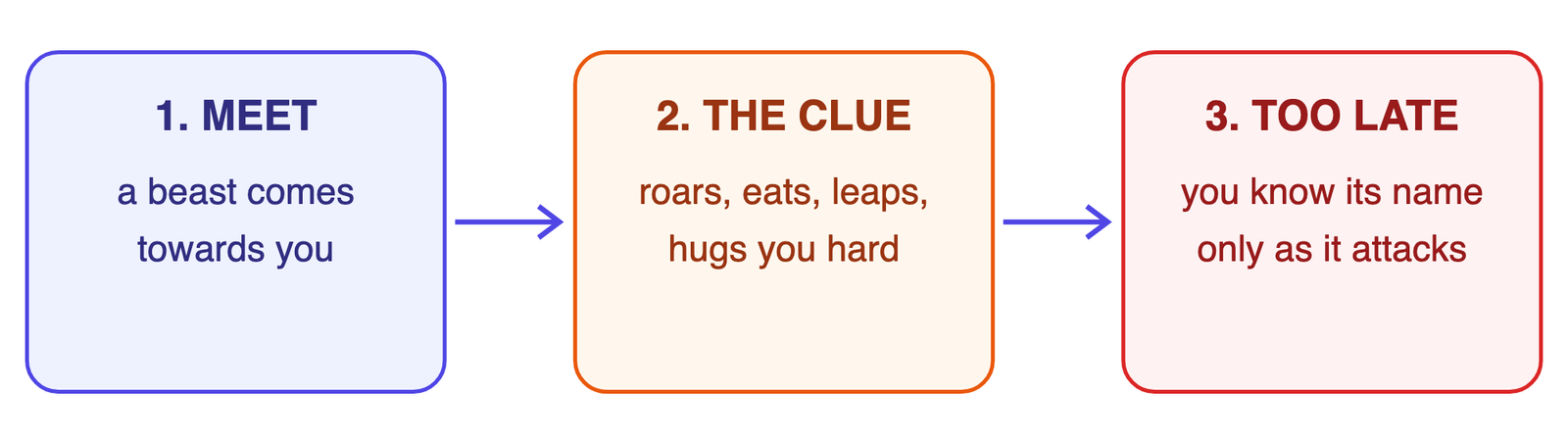
Not every meeting happens in the jungle. The lion appears in “jungles in the east”, but the bear is met while “walking round your yard”. The chameleon is on a tree. Quote the place the poem gives for each animal.
4The Seven Animals and Their “Rules”
| Animal | What it looks like | The “rule” for knowing it | Why it is a joke |
|---|---|---|---|
| Asian Lion | large and tawny | it roars as you die | you learn its name only at your death |
| Bengal Tiger | black stripes on a yellow ground | see if it eats you | “greets you” and “simple rule” sound polite and easy |
| Leopard | hide peppered with spots | it leaps on you, again and again | shouting in pain is useless |
| Bear | (no looks given) | it hugs you very, very hard | a killing squeeze is called a “caress” |
| Hyena | comes with merry smiles | it seems to laugh | a cheerful face on a beast of prey |
| Crocodile | (no looks given) | it weeps | plays on the idea of “crocodile tears” |
| Chameleon | small, lizard-like, no ears, no wing | you see nothing on the tree | the proof that it is there is that you cannot see it |
The poem pretends to be a practical guide for identifying wild animals. Each “rule” is really a description of the animal attacking you, so you can name it only when it is too late. Through this mock advice and playful language the poet makes fun of how dangerous these beasts are, and gives us a few true facts (stripes, spots, the chameleon’s colour-changing skill) along the way.
- Humour from ideas: deadly attacks are described as greetings, hugs and caresses.
- Humour from language: bent spellings and grammar (dyin’, lept, lep, nonplus) that fit the rhyme.
- Popular beliefs: the laughing hyena and the weeping crocodile come from common sayings, not from science.
5Poetic Devices Used
Only devices the poem really uses are listed. Learn each with its quoted words.
| Device | Exact words | What it does |
|---|---|---|
| Irony | “A noble wild beast greets you”; “one more caress” | Friendly words describe a deadly attack; the gap between them makes us laugh |
| Poetic licence | “dyin’”, “lept”, “lep”, “A novice might nonplus” | The poet bends spelling and grammar to keep the rhyme and the beat |
| Inversion | “If strolling forth, a beast you view”; “The Bengal Tiger to discern” | Normal word order is reversed so the line ends on a rhyming word |
| Repetition | “very, very hard”; “lep and lep again” | Stresses how tight the hug is and how often the leopard pounces |
| Alliteration | “roaming round”; “Be sure it is a Bear” | Repeated opening sounds add to the bouncy rhythm |
| Personification | “Hyenas come with merry smiles”; “if they weep” | Animals are given human feelings, smiling and crying |
| Metaphor | “hide with spots is peppered” | The leopard’s spots are pictured as pepper sprinkled over its skin |
| Imagery | “black stripes on a yellow ground” | A clear colour picture of the tiger |
| Rhyme | chance/advance, east/beast, dyin’/Lion | Every stanza rhymes ababcc and closes on a rhyming couplet that delivers the joke |
Poetic licence is the freedom a poet takes to break normal rules of spelling, grammar or pronunciation for the sake of rhyme, rhythm or effect. In this poem: dyin’ (for dying) to match “Lion”, lept and lep (for leapt and leap), and “A novice might nonplus” (for “might be nonplussed”) to rhyme with “thus”.
Irony is saying one thing while the real situation is the opposite. A tiger that “greets” you is about to eat you; a bear’s “caress” (a gentle, loving touch) is a crushing hug.
6Tone and Title
Tone
Humorous and mock-serious. The poet speaks like a calm teacher handing out useful tips, while the tips are absurd and deadly. That straight face is what makes the reader laugh.
Title
“How to Tell Wild Animals” sounds like the heading of a real handbook. The reader expects facts; the poem gives jokes. The title sets up the trick the whole poem plays.
7Thinking about the Poem: Short Answers
Does “dyin’” rhyme with “lion”? Can you say it so that it does?
Not exactly: “lion” is said LY-un, “dying” is said DY-ing. If we drop the final g and read “dyin’” as DY-un, it chimes with “Lion”. The poet cuts the word on purpose to make the rhyme.
How does the poet suggest you identify the lion and the tiger, and when?
The lion is the large, tawny beast that roars over you as you lie dying. The tiger is the striped animal (black on yellow) that eats you. So you can name them only at the very end, during the attack, which is exactly the joke.
Are “lept” and “lep” spelt correctly? Why are they spelt so?
No. The standard forms are “leapt” and “leap”. The poet writes them to sound like the first part of “Leopard” (Lep-ard), which ties the action to the animal’s name, keeps the beat and adds to the fun.
A bearhug, the laughing hyena and crocodile tears: are there similar sayings in your language?
A bearhug is a very tight embrace. Hindi has many animal sayings too, for example bheegi billi banna (to act meek like a wet cat), kuen ka mendhak (a frog in a well, someone with narrow knowledge) and magarmachh ke aansoo (false tears, the Hindi form of crocodile tears).
How would you write “A novice might nonplus” correctly? Why is the poet’s line better?
Correct form: “A novice might be nonplussed” (a beginner might be puzzled). The poet’s shorter version keeps the line’s beat and gives “nonplus”, which rhymes with “thus” two lines later. The odd grammar also adds a touch of comedy.
Other examples of poets taking liberties, and humorous poems in your language?
In this same book, Ogden Nash’s “The Tale of Custard the Dragon” invents words like “realio, trulio” for rhyme and fun. In Hindi, the comic verse of Kaka Hathrasi (general knowledge) plays with words in a similar way. Answers may vary.
Which lines do you find funny, and why?
Sample choices: “Just notice if he eats you”, which treats being eaten as a simple test; “He’ll give you just one more caress”, where a deadly squeeze is called a loving touch; and the last couplet, where seeing nothing proves the chameleon is there. Each joke comes from calm words used for a terrible event.
The book closes the page with a small box, “English is funny, because…”, giving two everyday puzzles of the language: noses that “run” and feet that “smell”. Like the poem, it shows how English words can mean two things at once.
8The Poem at a Glance
| Point | Detail |
|---|---|
| Poet | Carolyn Wells |
| Form | 6 stanzas of 6 lines (36 lines), rhyme ababcc |
| Animals | Asian Lion, Bengal Tiger, Leopard, Bear, Crocodile, Hyena, Chameleon |
| Glossary | ground, discern, hide, peppered, caress, novice, nonplus |
| Theme | A mock guide: each animal is “identified” only by its attack |
| Key devices | Irony, poetic licence, inversion, repetition, alliteration, personification |
| Tone | Humorous, playful, mock-serious |
- Poet: Carolyn Wells; 6 stanzas of 6 lines; rhyme ababcc
- Lion: tawny, roars as you die; Tiger: black stripes on yellow, eats you
- Leopard: spotted hide, leaps again and again; Bear: very hard hug in your yard, one more caress
- Hyenas smile, Crocodiles weep; Chameleon: nothing seen on the tree
- Poetic licence: dyin’, lept, lep, “A novice might nonplus”
- Devices: irony, inversion, repetition, alliteration, personification, metaphor “peppered”
- Tone: humorous and mock-serious; “tell” means identify
- Can I name all seven animals in order, with each one’s clue?
- Can I explain why every rule comes too late?
- Can I give four examples of poetic licence and say why each was used?
- Can I find irony in two lines?
- Can I give the meanings of the seven glossary words?