
- The complete poem, line for line as the book prints it, and who wrote it
- What happens to the ball and how the boy reacts
- Why the speaker does not step in or offer money
- The big idea: learning what loss means, and learning to stand up after it
- The devices the poem really uses, with the exact words
- Short answers to the book’s own questions on the poem
1Meet the Poet and the Poem
The name printed under the last line is John Berryman. As general knowledge: he was an American poet (1914-1972) whose poems often deal with grief and inner struggle.
A boy has lost a ball and is badly upset. A ball is cheap, and buying a new one is easy, so the book asks: why is he so upset? Read the poem to find out what the poet thinks has really been lost, and what the boy must learn from losing something.
The speaker is the “I” of the poem: a grown-up onlooker who sees the ball roll away (“I saw it go”) and then thinks about what the boy is going through. He never talks to the boy aloud; he only watches and reflects.
2The Poem, in Full
The lines below follow the book’s own line breaks, capitals and punctuation. The book prints the poem as a single block, so we study it in four groups of lines rather than “stanzas”.
What is the boy now, who has lost his ball,
What, what is he to do? I saw it go
Merrily bouncing, down the street, and then
Merrily over — there it is in the water!
No use to say ‘O there are other balls’:
An ultimate shaking grief fixes the boy
As he stands rigid, trembling, staring down
All his young days into the harbour where
His ball went. I would not intrude on him;
A dime, another ball, is worthless. Now
He senses first responsibility
In a world of possessions. People will take
Balls, balls will be lost always, little boy.
And no one buys a ball back. Money is external.
He is learning, well behind his desperate eyes,
The epistemology of loss, how to stand up
Knowing what every man must one day know
And most know many days, how to stand up.
Words to know (the book’s glossary)
| Word or phrase | Meaning, as the book’s glossary explains it |
|---|---|
| O there are other balls | suggests the loss is not important enough to worry about |
| shaking grief | sadness which greatly affects the boy |
| rigid | stiff |
| (to) intrude on | here, to enter a situation where one is not welcome |
| a dime | ten cents (U.S.) |
| desperate | hopeless |
| epistemology of loss | understanding the nature of loss, that is, what it means to lose something |
| epistemology | the study of the nature of knowledge itself; from the Greek episteme, “knowledge” |
A few more words
| Word | Meaning here |
|---|---|
| merrily | happily, cheerfully |
| ultimate | deepest, the greatest possible |
| fixes | holds him still, as if pinned to the spot |
| harbour | a stretch of sheltered water by the shore where boats stay |
| possessions | the things a person owns |
| external | outside; here, money stays outside the real feeling of loss and cannot reach it |
3Line-by-Line Meaning
The poem moves from a small event (a ball rolls into water) to a large idea (every person must learn to live with loss).
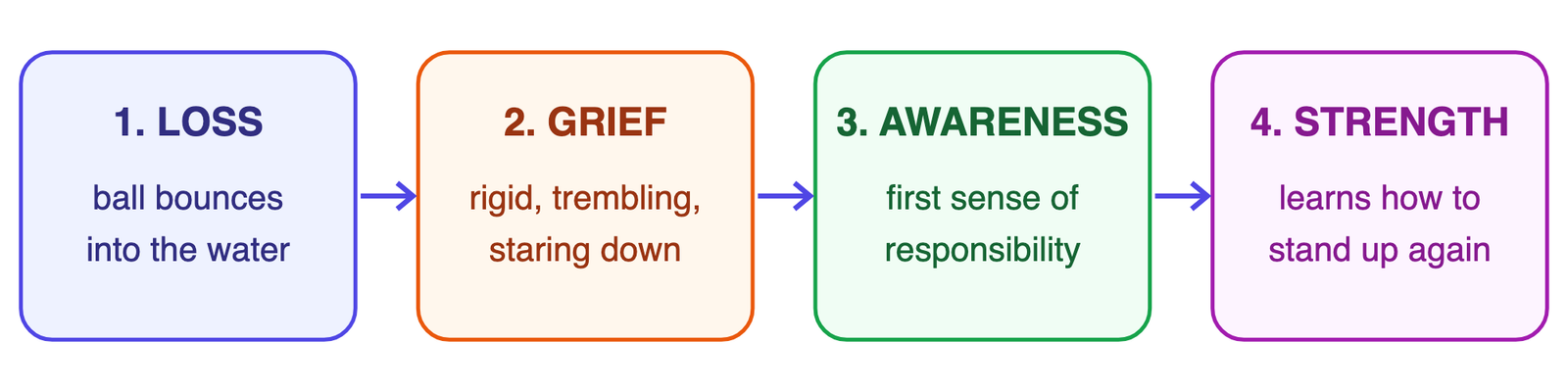
The speaker does not comfort the boy, buy him a ball or explain anything to him. The poem says “I would not intrude on him”. The boy learns on his own; the speaker only watches and thinks.
4Why Is the Boy So Upset? Why Doesn’t the Speaker Help?
A cheap toy, a deep loss
What the world sees
- A cheap toy has rolled into the water
- A dime would buy a new one
- “O there are other balls”
What the boy feels
- He has lost his ball, tied to “All his young days”
- No new ball can bring this one back
- For the first time, he meets real loss
- Not intruding: the boy has to go through this feeling himself. Stepping in would take away the lesson he is quietly learning.
- No money offered: “A dime, another ball, is worthless.” A replacement cannot fill the gap, because what is gone is not just an object.
- “Money is external”: money can buy things from outside, but it cannot touch the sorrow inside a person.
Through a boy who loses his ball, the poet shows that loss is a part of life. Things we own will be taken or lost, and money cannot buy them back. The boy’s grief is his first lesson in responsibility and in what losing means. Like every grown-up, he must learn to accept the loss and stand up again.
In the book’s words, epistemology is the study of the nature of knowledge (from the Greek episteme, knowledge). So the epistemology of loss means understanding the nature of loss: knowing from experience what it means to lose something.
5Poetic Devices Used
Only devices the poem really uses are listed. Learn each with its quoted words.
| Device | Exact words | What it does |
|---|---|---|
| Repetition | “What, what is he to do?”; “Merrily bouncing … Merrily over”; “Balls, balls”; “how to stand up” (twice) | Stresses the boy’s helplessness, the ball’s carefree motion, the certainty of loss and the final lesson |
| Rhetorical question | “What, what is he to do?” | No answer is expected; it shows there is nothing the boy can do |
| Enjambment (run-on lines) | “staring down / All his young days into the harbour where / His ball went.” | The sentence spills over line ends, like a slow, heavy thought |
| Symbolism | the ball | Stands for the boy’s childhood and the things we love and lose |
| Transferred epithet | “his desperate eyes” | The hopelessness belongs to the boy, but the word is placed on his eyes |
| Imagery | “stands rigid, trembling, staring down” | A clear picture of a child frozen by sorrow |
| Alliteration | “Balls, balls will be lost” | The repeated b sound makes the warning ring |
| Direct address | “little boy” | The speaker turns to the boy in thought, gently, as an older person would |
| Contrast | “Merrily bouncing” against “rigid, trembling” | The happy ball and the frozen boy sharpen the sense of loss |
| Free verse | end words such as ball / go / then / water | No fixed rhyme scheme; the poem sounds like someone thinking aloud |
A transferred epithet is a describing word moved from the person it really describes to something linked with that person. In “his desperate eyes”, it is the boy who feels hopeless, yet “desperate” is attached to his eyes.
Enjambment means a sentence continues from one line into the next without a pause at the line’s end. “into the harbour where / His ball went” is a clear example.
6Tone and Title
Tone
Sympathetic and thoughtful. The speaker feels for the boy, yet keeps a calm distance and turns a child’s small sorrow into a serious reflection on life.
Title
“The Ball Poem” sounds plain, almost childish. That is the point: a simple object, a ball, opens up a deep truth about loss and growing up.
7The Book’s Questions: Short Answers
Why does the poet say, “I would not intrude on him”? Why doesn’t he offer money for another ball?
The boy is facing his first real loss, and the speaker feels this is a private moment the boy must live through himself. Money is no answer either: a new ball would not be the same ball, so a dime “is worthless” here.
Has the boy had the ball for a long time? Is it linked to memories of playing with it?
Yes. The phrase “All his young days” suggests the ball has been with him through his childhood. Looking into the harbour, he seems to see those happy playing days sinking with it.
What does “in a world of possessions” mean?
It means a world where people own things and value what they own. In such a world, things will be taken or lost, and each person has to learn to look after what is theirs and to bear it when something goes. (The poem’s line reads “In a world of possessions”.)
Has the boy lost anything earlier? Which words suggest the answer?
No, this seems to be his first loss. The words “He senses first responsibility” show that the feeling is new to him.
What does the poet say the boy is learning from losing the ball?
He is learning what it truly means to lose something, that a lost thing cannot be bought back, and how to pick himself up and carry on. Every adult must learn this once, and most must learn it many times.
Have you ever lost something you liked very much? How did you feel, and did you get over it?
Personal answer. A sample idea: losing a gift from a grandparent, feeling sad for days, then slowly accepting it and keeping the memory instead of the object. Answers will vary.
8The Poem at a Glance
| Point | Detail |
|---|---|
| Poet | John Berryman |
| Form | 18 lines in one block; free verse, no fixed rhyme |
| Characters | The boy; the speaker who watches |
| Places | the street, the water, the harbour |
| Glossary | O there are other balls, shaking grief, rigid, intrude on, a dime, desperate, epistemology of loss, epistemology |
| Theme | Loss is part of life; money cannot undo it; we must learn to stand up |
| Key devices | Repetition, rhetorical question, enjambment, symbolism, transferred epithet |
| Tone | Sympathetic, thoughtful, reflective |
- Poet: John Berryman; 18 lines, one block, free verse
- Ball bounces merrily down the street and over into the water (the harbour)
- Boy: ultimate shaking grief; rigid, trembling, staring down all his young days
- Speaker would not intrude; a dime, another ball, is worthless
- First responsibility in a world of possessions; no one buys a ball back; money is external
- He learns the epistemology of loss and how to stand up, as every man must
- Devices: repetition, rhetorical question, enjambment, symbol (ball), transferred epithet (desperate eyes)
- Can I say why another ball would not help the boy?
- Can I explain why the speaker does not intrude?
- Can I explain “Money is external” and “epistemology of loss”?
- Can I quote the words that show this is the boy’s first loss?
- Can I give the eight glossary items with meanings?