
- The complete poem, line for line as the book prints it, and who wrote it
- The two voices: the adult giving orders, and Amanda in her own head
- Amanda’s three dream worlds: mermaid, orphan and Rapunzel
- The big idea: a child’s need for freedom and quiet space
- The devices the poem really uses, with the exact words
- Short answers to the book’s nine questions on the poem
1Meet the Poet and the Poem
The name printed under the last stanza is Robin Klein. As general knowledge: Robin Klein (1936-2021) was an Australian writer best known for books for children and young readers.
Most children feel that grown-ups keep telling them what to do and what not to do, so their freedom seems cut down. The book asks you to list things you would like to do that elders do not allow. Then it suggests reading the poem aloud in pairs, one stanza each, and promises a surprise. The surprise: the two readers are not having a conversation at all. One voice keeps giving orders; the other is somewhere else entirely.
Parenthesis means words placed inside round brackets ( ). In this poem, stanzas 2, 4 and 6 sit inside brackets because they are Amanda’s private thoughts, not words spoken aloud. The brackets keep her inner world apart from the adult’s spoken orders.
2The Poem, in Full
The lines below follow the book’s own line breaks, capitals and punctuation.
Don’t bite your nails, Amanda!
Don’t hunch your shoulders, Amanda!
Stop that slouching and sit up straight,
Amanda!
(There is a languid, emerald sea,
where the sole inhabitant is me—
a mermaid, drifting blissfully.)
Did you finish your homework, Amanda?
Did you tidy your room, Amanda?
I thought I told you to clean your shoes,
Amanda!
(I am an orphan, roaming the street.
I pattern soft dust with my hushed, bare feet.
The silence is golden, the freedom is sweet.)
Don’t eat that chocolate, Amanda!
Remember your acne, Amanda!
Will you please look at me when I’m speaking to you,
Amanda!
(I am Rapunzel, I have not a care;
life in a tower is tranquil and rare;
I’ll certainly never let down my bright hair!)
Stop that sulking at once, Amanda!
You’re always so moody, Amanda!
Anyone would think that I nagged at you,
Amanda!
Words to know (the book’s glossary)
| Word | Meaning, as the book’s glossary gives it |
|---|---|
| languid | relaxed |
| drifting | moving slowly |
| pattern | make patterns |
| tranquil | calm |
A few more words
| Word | Meaning here |
|---|---|
| hunch | to bend the shoulders forward and round the back |
| slouching | sitting or standing in a lazy, drooping way |
| emerald | bright green, the colour of the emerald stone |
| sole inhabitant | the only one who lives there |
| blissfully | with perfect happiness |
| hushed | making no sound |
| acne | pimples on the face, common in the early teens |
| sulking | staying silent and cross because one is unhappy |
| nagged | found fault or gave orders again and again |
3Stanza-by-Stanza Meaning
The stanzas take turns: an adult’s order, then Amanda’s escape, then another order, and so on.
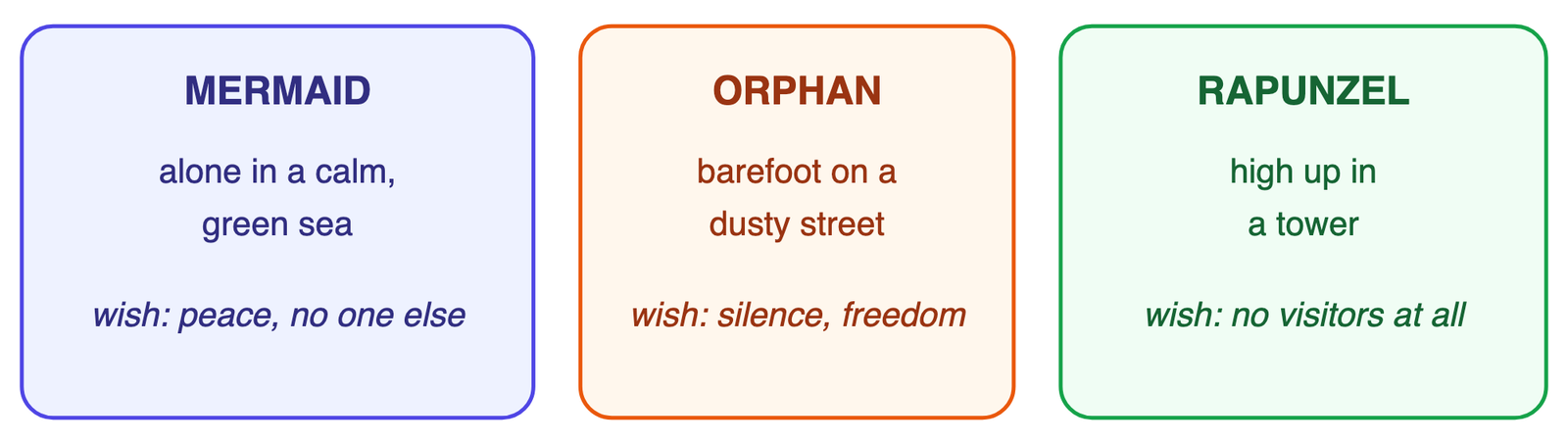
Amanda is not really an orphan, a mermaid or Rapunzel, and she never answers the adult aloud. The bracketed stanzas happen only in her imagination. She is sitting right there while the orders keep coming.
4The Two Voices
Who speaks, and how
The adult (stanzas 1, 3, 5, 7)
- Most likely a parent, probably her mother; the poem never names the speaker
- Speaks in orders and checking questions
- Every stanza ends on a sharp “Amanda!”
- Cares about manners, posture, duties and looks
Amanda (stanzas 2, 4, 6)
- Thinks silently, inside brackets
- Is not listening to the adult at all
- Each dream is three rhyming lines
- Cares about calm, silence and being left alone
The poem shows a young girl who is corrected and ordered about all day by an adult. Instead of answering back, Amanda slips into daydreams where she is free, calm and alone. The poet suggests that too much control pushes a child away: children need some space and freedom, and constant instructions only make them shut off.
Irony is when words say one thing while the situation shows the opposite. The adult says “Anyone would think that I nagged at you”, as if nagging were unthinkable, yet the whole poem is a string of nagging.
5Poetic Devices Used
Only devices the poem really uses are listed. Learn each with its quoted words.
| Device | Exact words | What it does |
|---|---|---|
| Repetition (refrain) | “Amanda!” at the end of every line or stanza of the adult’s part | Shows how often she is called and corrected; builds the adult’s irritation |
| Alliteration | “Stop that slouching and sit up straight” | The hissing s sounds make the scolding sound sharp |
| Metaphor | “The silence is golden, the freedom is sweet.” | Silence is treated as gold and freedom as something sweet to taste: both are precious to her |
| Imagery | “a languid, emerald sea” | A picture of a calm, bright green sea |
| Transferred epithet | “my hushed, bare feet” | It is her walking that is silent, but the word “hushed” is placed on her feet |
| Allusion | “I am Rapunzel” | Points to a well-known fairy tale of a girl in a tower |
| Irony | “Anyone would think that I nagged at you” | The adult denies nagging while doing nothing else |
| Contrast | orders of stanzas 1, 3, 5, 7 against the dreams of 2, 4, 6 | Real, noisy control set against calm, imagined freedom |
| Rhyme scheme | sea / me / blissfully; street / feet / sweet; care / rare / hair | Each dream stanza is a triplet rhyming aaa (“blissfully” rhymes on its final sound); the adult’s stanzas have no fixed rhyme and end on the refrain |
An allusion is a short reference to a well-known story, person or event that the reader is expected to know. “I am Rapunzel” alludes to the fairy tale of a girl kept in a high tower whose long hair is let down for visitors to climb.
A refrain is a word or line repeated at regular places in a poem. Here the name “Amanda!” closes every one of the adult’s stanzas.
6Tone and Title
Tone
The adult’s tone is impatient, bossy and irritated. Amanda’s tone is dreamy, calm and longing. The poet’s own tone is light and gently humorous, with sympathy for the child.
Title
“Amanda!” is her name called out the way the adult calls it, with an exclamation mark. The title itself sounds like a scolding, which is exactly what the poem is about.
7The Book’s Questions: Short Answers
How old do you think Amanda is? How do you know this?
She seems to be in her early teens, roughly 12 or 13. The clue is “Remember your acne”, since pimples usually appear at that age; homework and fairy-tale dreams fit a young student too. The book gives no exact age.
Who do you think is speaking to her?
An adult who looks after her at home, most likely her mother. The orders are about posture, homework, her room, her shoes and her diet, the kind of things a parent keeps checking.
Why are Stanzas 2, 4 and 6 given in parenthesis?
They are Amanda’s unspoken thoughts. The brackets separate what goes on inside her mind from the adult’s words said out loud.
Who speaks in Stanzas 2, 4 and 6? Is she listening to the other speaker?
Amanda herself. She is not listening: while the orders go on, her mind is in a sea, on a street or in a tower. That is why the adult asks her to look up when spoken to.
What could Amanda do if she were a mermaid?
She could float slowly and happily through a calm green sea, with no one else there to watch or correct her.
Is Amanda an orphan? Why does she say so?
No, she has at least one parent, who is speaking to her. She only imagines being an orphan because then nobody would be ordering her about; she could wander barefoot and enjoy silence and freedom.
Do you know the story of Rapunzel? Why does Amanda want to be Rapunzel?
(General knowledge) Rapunzel is a fairy-tale girl shut away in a tall tower, whose long hair is let down so that others can climb up to her. Amanda likes the calm of the tower; by never letting her hair down, she would keep everyone, including the scolding adult, away.
What does the girl yearn for? What does the poem tell you about Amanda?
She longs for freedom, quiet and time to herself. The poem shows her as a sensitive, imaginative girl who answers constant correction by retreating into calm pictures she makes up for herself.
Read the last stanza. Is Amanda sulking and moody?
Not really. Her silence comes from dreaming, not from anger. The adult reads her silence as sulking, but she has simply tuned out the endless orders.
8The Poem at a Glance
| Point | Detail |
|---|---|
| Poet | Robin Klein |
| Form | 7 stanzas: adult’s 4-line stanzas alternate with Amanda’s 3-line bracketed stanzas |
| Characters | Amanda; the adult (most likely her mother) |
| Dream worlds | a mermaid in an emerald sea; an orphan on a dusty street; Rapunzel in a tower |
| Glossary | languid, drifting, pattern, tranquil |
| Theme | A child’s need for freedom; too much control drives a child into her own world |
| Key devices | Refrain, alliteration, metaphor, allusion, irony, transferred epithet |
| Tone | Adult: bossy, irritated; Amanda: dreamy, longing |
- Poet: Robin Klein; 7 stanzas; two voices in turn
- Orders: nails, shoulders, slouching; homework, room, shoes; chocolate, acne, look at me; sulking, moody
- Dreams (in brackets): mermaid in a languid, emerald sea; orphan with hushed, bare feet; Rapunzel in a tranquil tower
- Amanda is not listening and is not an orphan; she only imagines it
- Last line is ironic: the adult denies the nagging the poem is full of
- Devices: refrain “Amanda!”, alliteration (s), metaphor (silence golden), allusion (Rapunzel), transferred epithet (hushed feet)
- Can I say who speaks in each stanza and why three are in brackets?
- Can I describe all three dream worlds and what each one gives Amanda?
- Can I name the clue to Amanda’s age?
- Can I explain the irony of the last stanza?
- Can I give the four glossary words with meanings?