
- The complete poem, line for line as the book prints it, and who wrote it
- What the trees do in each of the three stanzas
- Why the forest outside is empty, and why the house ends up empty instead
- How the moon changes from whole to broken, and why
- The two big readings: nature breaking free, and people breaking free
- The devices the poem really uses, with the exact words, and short answers to the book’s questions
1Meet the Poet and the Poem
The name printed under the last line is Adrienne Rich. The book’s note on her says three things: she was born in Baltimore, Maryland, U.S.A. in 1929; she wrote nearly twenty volumes of poetry; and she has been called a feminist and a radical poet.
Before the poem, the book asks two puzzling questions: can a forest exist with no trees in it? And in this poem, where are the trees, and where are they going? Keep both in mind: the answers are “inside a house” and “out into the empty forest”.
The speaker is the “I” of the poem: a woman (the book’s questions say “her letters”) sitting inside the house at night, writing letters, while the trees that were kept indoors break their way out to the forest. She notices everything but says almost nothing about it in her letters.
2The Poem, in Full
The lines below follow the book’s own line breaks, capitals and punctuation. The third stanza starts on page 77 and finishes on page 78 of the book.
The trees inside are moving out into the forest,
the forest that was empty all these days
where no bird could sit
no insect hide
no sun bury its feet in shadow
the forest that was empty all these nights
will be full of trees by morning.
All night the roots work
to disengage themselves from the cracks
in the veranda floor.
The leaves strain toward the glass
small twigs stiff with exertion
long-cramped boughs shuffling under the roof
like newly discharged patients
half-dazed, moving
to the clinic doors.
I sit inside, doors open to the veranda
writing long letters
in which I scarcely mention the departure
of the forest from the house.
The night is fresh, the whole moon shines
in a sky still open
the smell of leaves and lichen
still reaches like a voice into the rooms.
My head is full of whispers
which tomorrow will be silent.
Listen. The glass is breaking.
The trees are stumbling forward
into the night. Winds rush to meet them.
The moon is broken like a mirror,
its pieces flash now in the crown
of the tallest oak.
Words to know (the book’s glossary)
| Word or phrase | Meaning, as the book’s glossary explains it |
|---|---|
| to disengage themselves | to separate themselves |
| strain | make efforts to move |
| bough | branch |
| shuffling | moving repeatedly from one position to another |
| lichen | crusty patches or bushy growth on tree trunks/bare ground formed by association of fungus and alga |
A few more words
| Word | Meaning here |
|---|---|
| veranda | a roofed, open area along the side of a house |
| exertion | hard physical effort |
| long-cramped | squeezed into too small a space for a long time |
| discharged | allowed to leave a hospital after treatment |
| half-dazed | not fully alert, a little confused |
| scarcely | hardly, almost not at all |
| departure | the act of leaving |
| stumbling | moving unsteadily, almost tripping |
| crown | the topmost leafy part of a tree |
3Stanza-by-Stanza Meaning
The poem follows one night. The trees start inside a house, struggle all night, and by the end are out under the moon.
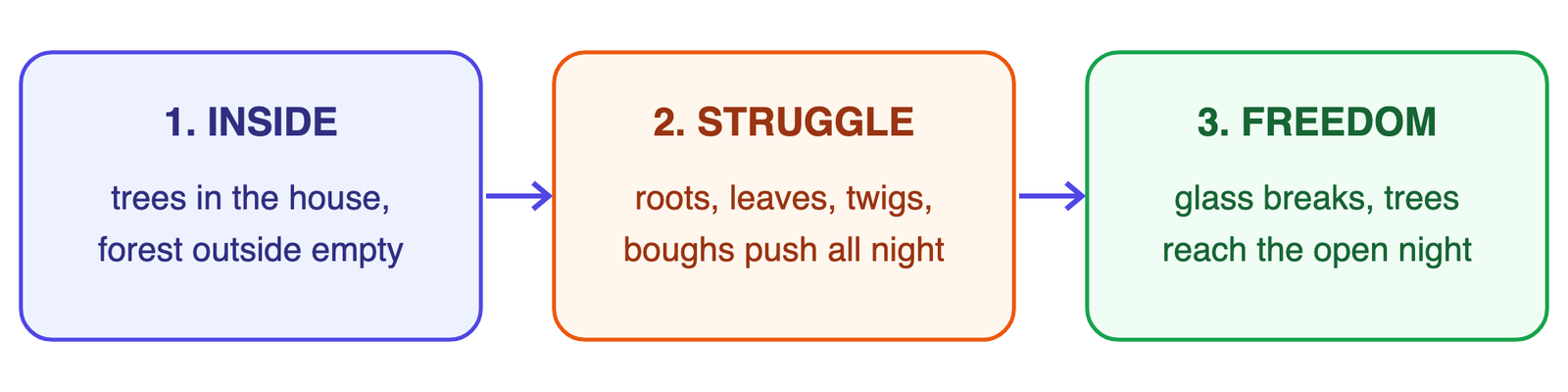
Trees cannot really walk. The poet imagines them moving in order to make a point about nature being shut away indoors. Write “the poet imagines” or “the poet pictures”, never as if this happened literally.
4Key Ideas, Explained
Two kinds of emptiness
At the start
- Trees shut up inside a house
- The forest outside is empty
- No bird, no insect, no shade
- The moon is whole in an open sky
At the end
- The house has lost its trees; its glass is broken
- The forest will be full by morning
- Winds come out to welcome the trees
- The moon looks broken among the oak’s top branches
- The sun’s “feet”: the sun is pictured as a person whose feet are its rays touching the ground. In a forest with trees, those rays sink into cool shade; in a bare forest there is no shade at all, so the sun has nowhere to “bury its feet”.
- Why the patients comparison works: people leaving hospital after a long stay are weak, unsteady and blinking at the outside world. The boughs, kept cramped under a roof, move out in the same shaky, half-awake way.
- Why the moon changes: at first nothing stands between the speaker and the sky, so the moon is whole. When the freed trees rise up outside, their leafy tops come between her eyes and the moon, splitting its light into many shining fragments.
- Why the letters stay silent: the speaker barely writes about the trees leaving. Huge, strange events are often the hardest to put into words, and people sometimes keep quiet about what surprises or embarrasses them.
The poet pictures trees kept indoors as decoration breaking out, during one night, to fill an empty forest. The poem shows the conflict between man and nature: people cut forests down and then shut plants up in houses, but nature longs to be free and will return to where it belongs. Read another way, the trees stand for human beings (especially women) who break out of the walls that confine them.
- Nature reading: trees used for “interior decoration” in cities are, in effect, imprisoned while real forests are cleared. The poem shows them breaking out to restore the forest.
- Human reading: the book notes that Adrienne Rich often uses trees as a metaphor for human beings. Since she is called a feminist poet, the trees can stand for women held inside the home, who struggle, break the “glass” and step into a wider world.
5Poetic Devices Used
Only devices the poem really uses are listed. Learn each with its quoted words.
| Device | Exact words | What it does |
|---|---|---|
| Personification | “All night the roots work”; “no sun bury its feet in shadow”; “Winds rush to meet them” | Trees, sun and winds act like living people, making the night’s events feel alive |
| Simile | “like newly discharged patients” | The cramped boughs move as shakily as patients just out of hospital |
| Simile | “still reaches like a voice into the rooms” | The smell of leaves seems to call to the speaker |
| Simile | “The moon is broken like a mirror” | The moon, seen through branches, looks shattered into bright pieces |
| Repetition | “the forest that was empty all these days” / “the forest that was empty all these nights” | Stresses how long the forest has stood bare |
| Anaphora | “no bird could sit / no insect hide / no sun bury its feet” | Each line starts with “no”, piling up what a treeless forest lacks |
| Alliteration | “small twigs stiff”; “leaves and lichen” | Repeated first sounds give the lines music |
| Metaphor | “the crown / of the tallest oak” | The top of the tree is called a crown, as if the oak were a king |
| Imagery | “The glass is breaking. / The trees are stumbling forward / into the night.” | A vivid sight and sound picture of the escape |
| Symbolism | the trees; the glass | Trees stand for nature (or for confined people); glass stands for the barrier that holds them |
| Enjambment | “the departure / of the forest from the house” | The sentence runs on across lines, like a long, slow thought |
| Free verse | end words such as forest / days / sit / hide | No fixed rhyme scheme; the poem moves like natural speech |
Personification gives human actions or feelings to something that is not human. In “All night the roots work”, roots are shown labouring like workers.
A simile compares two unlike things using “like” or “as”. The poem has three, all with “like”: the boughs and the patients, the smell and a voice, the moon and a mirror.
6Tone and Title
Tone
Calm and dreamlike at the start, then tense and urgent at the breakout (“Listen. The glass is breaking.”). Underneath runs quiet sympathy for the trees and a gentle warning to people.
Title
“The Trees” is simple and fitting: the trees are the main actors from the first line to the last, and their escape is the whole story of the poem.
7The Book’s Questions: Short Answers
(i) Three things that cannot happen in a treeless forest? (ii) What does “sun bury its feet in shadow” suggest, and what are the sun’s “feet”?
(i) A bird cannot perch, an insect cannot hide, and the sun cannot sink its feet into shade. (ii) It paints sunbeams slipping down into the cool, dark spaces under thick trees. The “feet” are the sun’s rays that reach the ground.
(i) Where are the trees? What do their roots, leaves and twigs do? (ii) What are the branches compared to?
(i) They are kept indoors, in the speaker’s house. Every part of them labours through the night: roots tug loose from the gaps in the floor, leaves push hard at the windows, and the little twigs harden as they try to move. (ii) To newly discharged patients, half-dazed, making their way to the clinic doors.
(i) How is the moon described at the start and at the end of the third stanza, and why does it change? (ii) What happens to the house? (iii) Why are the letters silent about it?
(i) First the whole moon shines in a sky still open; at the end it is broken like a mirror, its pieces flashing in the crown of the tallest oak. The trees now stand between the speaker and the sky, so their branches split its light. (ii) The house is left without its trees, its glass broken, its rooms empty of the green life they held. (iii) The event is so strange and so big that she cannot find words for it, or feels others would not believe it; we often keep quiet about things that shock us.
(i) Is there a conflict between man and nature? Compare with A Tiger in the Zoo. (ii) What if the trees stand for human beings?
(i) Yes. Just as the tiger is caged in a zoo, the trees are shut in a house as decoration while forests are cleared. Both poems show nature longing for its true home and breaking (or dreaming of breaking) out. (ii) The trees can then stand for people, especially women, kept inside narrow walls. Their night-long effort and the breaking glass show the struggle to step out into freedom.
Compare with “On Killing a Tree” by Gieve Patel.
Both poems are about people’s harm to trees. In Patel’s poem, people try to destroy a tree; in Rich’s poem, trees escape from human control and win back their forest. One shows how hard a tree is to kill, the other how strongly nature wants to be free.
The book’s pages also carry a Homophones activity (refuse/refuse, dove/dove, invalid/invalid): words spelt the same but with different meanings and, sometimes, different pronunciation.
8The Poem at a Glance
| Point | Detail |
|---|---|
| Poet | Adrienne Rich (born Baltimore, Maryland, U.S.A., 1929) |
| Form | 3 stanzas (7, 11, 16 lines); free verse |
| Setting | One night: a house with a veranda, the empty forest, a moonlit sky |
| Glossary | to disengage themselves, strain, bough, shuffling, lichen |
| Theme | Nature confined by man breaks free; trees may also stand for confined people |
| Key devices | Personification, three similes, anaphora, repetition, imagery, symbolism |
| Tone | Calm, dreamlike, then urgent; sympathetic to the trees |
- Poet: Adrienne Rich; 3 stanzas; free verse
- Stanza 1: indoor trees moving out to an empty forest (no bird, no insect, no shade); full by morning
- Stanza 2: roots, leaves, twigs and long-cramped boughs struggle; boughs like newly discharged patients
- Stanza 3: speaker writes long letters, scarcely mentions it; whole moon, open sky; smell of lichen like a voice
- Breakout: glass breaks, trees stumble into the night, winds rush to meet them; moon broken like a mirror in the tallest oak
- Themes: man versus nature; trees as a metaphor for people seeking freedom
- Can I name the three things a treeless forest lacks?
- Can I say what each part of the trees does in stanza 2?
- Can I explain why the moon looks whole first and broken later?
- Can I quote all three similes?
- Can I give both readings of the poem?