
- The whole poem, exactly as First Flight prints it, and who wrote it
- What the fog does in each of the six lines: arrive, settle, watch, leave
- How a single picture (a cat) carries the entire poem
- What a metaphor is, and why this poem is a metaphor and not a simile
- Why the poem is called free verse
- Short answers to the book’s “Thinking about the Poem” questions
1Meet the Poet and the Poem
The name printed under the poem is Carl Sandburg. The book gives no note on him, so here is a little general knowledge (not from the book): he was an American poet who lived from 1878 to 1967, and “Fog” first came out in his collection Chicago Poems (1916).
The poem is tiny: six short lines, about twenty words in all. In that space it paints one picture. A thick fog drifts in over a port town, stays for a while, and drifts away, and the poet sees all of this as the movements of a cat.
Fog is a thick cloud of tiny water droplets that hangs close to the ground or the sea. It makes things hard to see, it makes no sound, and it lifts or drifts away after some time.
2The Poem, in Full
The lines below keep the book’s own line breaks, capitals and punctuation (First Flight, page 93).
The fog comes
on little cat feet.
It sits looking
over harbour and city
on silent haunches
and then moves on.
Words to know
| Word or phrase | Meaning |
|---|---|
| on haunches | sitting with knees bent (the book’s glossary) |
| harbour | a sheltered stretch of water near the coast where ships and boats stay safely |
| silent | making no sound at all |
| moves on | goes away to some other place |
3Line-by-Line Meaning
Read the six lines as three small moments in the fog’s visit: it arrives, it stays, it leaves.
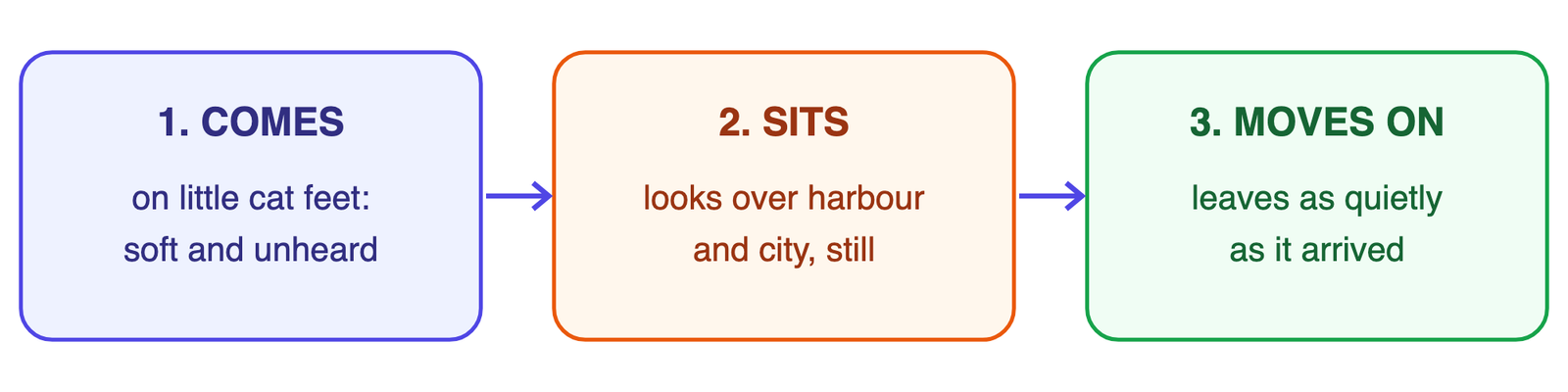
In line 3, “It sits looking”, the word “It” means the fog. Students sometimes answer “the cat”, but there is no real cat in the poem. The cat is only the picture the poet uses for the fog.
4The Central Idea
The poem shows fog as a quiet, passing visitor. Like a cat, it arrives without a sound, sits calmly watching the harbour and the city for a while, and then leaves on its own. The poet invites us to notice the gentle, mysterious ways of nature, and reminds us that such moments do not last.
Ways the fog is like a cat
Moves silently
Both come in without a sound: “on little cat feet”.
Sits and watches
Both settle down and gaze around them: “It sits looking”.
Rests with legs folded
The fog sits “on silent haunches”, the pose of a resting cat.
Leaves when it likes
A cat wanders off on its own; the fog “moves on” too.
5Poetic Devices
A metaphor compares two different things by giving one of them a quality of the other, without using “like” or “as”. The book puts it this way: a metaphor “compares two things by transferring a feature of one thing to the other”.
Free verse is poetry with no fixed rhyme and no regular rhythm. The lines simply follow the natural flow of speech and thought.
| Device | Exact words | What it does |
|---|---|---|
| Extended metaphor | the whole poem; “on little cat feet”, “It sits looking”, “on silent haunches” | The fog is treated as a cat from the first line to the last, though the poem never says “like a cat”. |
| Personification | “It sits looking / over harbour and city” | Fog cannot sit or look; giving it a living creature’s actions makes it feel alive. |
| Imagery | “over harbour and city / on silent haunches” | Creates a picture of a misty port town lying hushed and covered. |
| Enjambment | “The fog comes / on little cat feet.” | A sentence runs on past the line end, so the poem flows smoothly, like the drifting fog. |
| Free verse (no rhyme) | line ends: comes, feet, looking, city, haunches, on | No two line endings rhyme and there is no set beat, so the rhyme scheme is none. |
A simile would say “the fog is like a cat”. Sandburg never says this. He simply lets the fog do what a cat does (“little cat feet”, “haunches”). That is why the comparison is a metaphor, and because it runs through the whole poem it is called an extended metaphor.
Tone and title
The tone is calm, quiet and gently mysterious. Nothing dramatic happens; the poet simply watches and describes. The title “Fog” is just one word, as short as the poem itself, and it names the only “character” in it. The cat is never named in the title, which leaves the reader to discover the comparison.
6Thinking about the Poem: Short Answers
(i) What does Sandburg think the fog is like?
He sees the fog as a cat.
(ii) How does the fog come?
It arrives softly and without a sound, on “little cat feet”.
(iii) What does ‘it’ in the third line refer to?
“It” stands for the fog.
(iv) Does the poet actually say that the fog is like a cat? Find three things that tell us that the fog is like a cat.
No, he never says so directly; he shows it through a metaphor. Three clues: the fog comes on “little cat feet”; it “sits looking” over the harbour and city; it rests “on silent haunches” and later “moves on” on its own.
| Word | Metaphor | How they are alike |
|---|---|---|
| Storm | tiger | pounces over the fields, growls (given in the book) |
| Train | a long iron caterpillar | a long, jointed body that crawls along a fixed path |
| Fire | a hungry beast | it devours everything in its way and keeps wanting more |
| School | a garden | young minds are tended there and grow |
| Home | a nest | a warm, safe place to rest and come back to |
These are sample answers; any metaphor that shares a clear feature with the word is acceptable.
The storm, a wild bull,
charges down the valley,
bellowing, tossing the trees aside.
Then, worn out,
it lies down in the meadow
and the evening is still.
Notice how the poem shows the storm’s force and noise, then the sudden calm, all through one animal picture.
Does this poem have a rhyme scheme?
No. None of the six line endings (comes, feet, looking, city, haunches, on) rhyme, and the lines have no fixed rhythm. The poem is written in free verse.
7The Poem at a Glance
| Point | Detail |
|---|---|
| Poet | Carl Sandburg |
| Form | One block of 6 lines; free verse, no rhyme scheme |
| Setting | A harbour and a city covered by fog |
| Glossary | on haunches: sitting with knees bent |
| Main device | Extended metaphor: fog as a cat |
| Other devices | Personification, imagery, enjambment |
| Tone | Calm, quiet, gently mysterious |
| Theme | Nature’s quiet beauty; the fog’s visit is brief |
- Poet: Carl Sandburg; 6 lines; free verse
- Lines 1-2: fog comes “on little cat feet”, softly and unheard
- Lines 3-5: it sits looking over harbour and city “on silent haunches” (knees bent)
- Line 6: “and then moves on”, it leaves on its own
- “It” in line 3 = the fog
- Main device: extended metaphor (fog = cat), not a simile; also personification
- Can I write all six lines from memory, with the right line breaks?
- Can I give three clues that the fog is like a cat?
- Can I explain why this is a metaphor and not a simile?
- Can I say what “on haunches” means?
- Can I explain why the poem is free verse?