
- How Richard Ebright went from a boy collecting butterflies to a young scientist with a new theory about cells
- The part played by his mother, by a children’s book and by Dr Frederick A. Urquhart
- Every science fair project in order, from the lost frog-tissue display to the hormone from the gold spots
- The three qualities the writer says go into the making of a scientist
- Characters, themes, key lines and short answers to every “Read and find out”, “Think about it” and “Talk about it” question
1The Author and the Opening Note
The chapter ends with the name ROBERT W. PETERSON, the writer of this true account. It is not a made-up story: it traces the early life of a real American scientist, Richard H. Ebright.
The note at the top of the chapter tells us two things before the story starts:
- Ebright went on to receive the Searle Scholar Award and the Schering Plough Award for Biochemistry and Molecular Biology.
- His love of butterflies was the door through which he entered science.
2The Story, Step by Step
2.1 A Record at Twenty-two
The chapter opens at the high point. At just twenty-two, Ebright, who had once been a ‘scout of the year’, set the scientific world talking with a new theory on how cells work. He and his college room-mate explained it in an article in a major journal, the Proceedings of the National Academy of Science.
Never before had this journal printed work by college students. The writer compares it to a baseball player reaching the big leagues at fifteen and scoring a home run on his very first turn at bat. (The book’s footnote explains that a home run is when the batter runs round all the bases back to home plate without stopping; a ball hit right out of the field also counts.) The point: a huge success at a very young age, and only the first of many.
2.2 A Boy Who Collected Everything
- Richard was an only child and grew up north of Reading, Pennsylvania (in the USA).
- With nobody to make up a team, he could not play football or baseball, so he turned to the one thing a single child can do well: he collected things.
- From kindergarten onwards he collected butterflies, and also rocks, fossils and coins.
- He was a keen astronomer as well, sometimes watching the stars the whole night.
- By the second grade he had collected all twenty-five species of butterflies found around his hometown.
The book prints a box of these butterflies under six groups: Gossamer-Winged (hairstreaks, coppers, blues), Wood Nymphs and Satyrs, Monarchs, Whites and Sulphurs, Brush-footed (fritillary, checkerspot, painted lady, viceroy and others) and the Snout Butterfly. A graph beside it shows how many of each kind were collected in the six-week season.
2.3 His Mother: First Teacher and Companion
Richard had a quick mind and a strong urge to find things out. His mother fed that urge in every way she could.
Result: Richard earned top grades, yet in ordinary matters his mother says he was like any other child.
2.4 The Turning Point: a Children’s Book
After collecting every local species, Richard might have stopped. Then his mother got him a children’s book, The Travels of Monarch X, about how monarch butterflies migrate to Central America. This book “opened the world of science” to him.
- At its end, readers were asked to help study butterfly migration by tagging butterflies for Dr Frederick A. Urquhart of the University of Toronto, Canada.
- His mother wrote to Dr Urquhart, and Richard began sticking light adhesive tags on the wings of monarchs.
- Whoever found a tagged butterfly was to post the tag to Dr Urquhart.
Migration is the regular long journey of animals from one region to another, usually with the seasons. Monarch butterflies make such a journey to Central America, and tagging helps scientists track the route.
2.5 Raising a Flock of Monarchs
Around Reading the butterfly season lasts only six weeks in late summer, and catching butterflies one at a time gives very few. So Richard decided to breed his own.
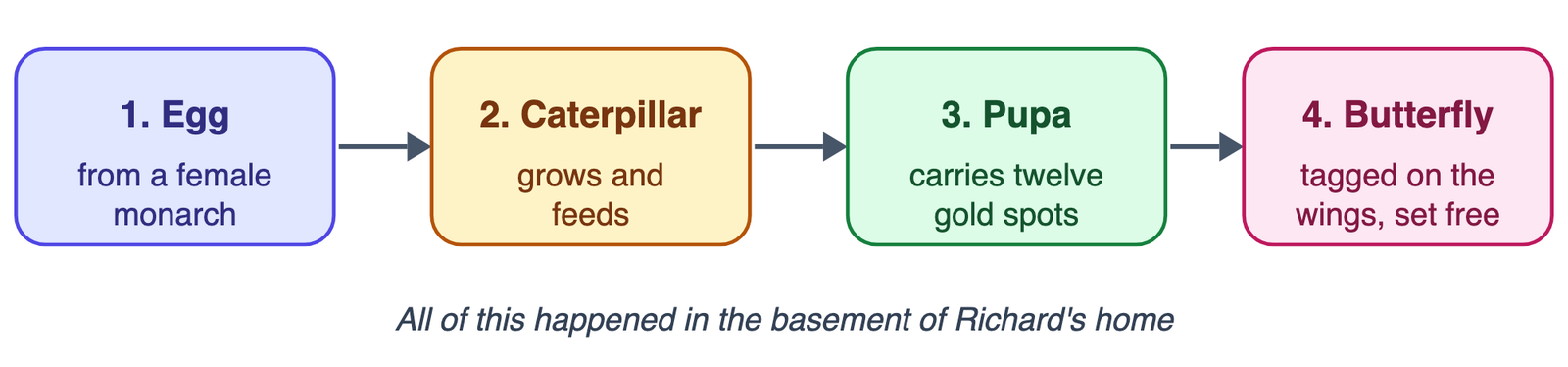
A pupa is the resting stage of an insect between caterpillar and adult, when the body is changing inside a case. The monarch pupa is where Richard later found his big research question.
For several years his basement held thousands of monarchs at different stages. In the end, though, he grew tired of tagging. It was “tedious” and gave little feedback: in all those years only two of his tagged butterflies were caught again, and neither had gone more than seventy-five miles from his home.
2.6 A Lost Science Fair, a Lasting Lesson
In the seventh grade Richard entered a county science fair and won nothing. He showed slides of frog tissues under a microscope. Sitting empty-handed while everyone around him had won something hurt. But he understood why: the winners had attempted real experiments, while he had only set out a tidy exhibit.
Science means doing a real experiment, not just putting things on display. His competitive spirit showed here: he resolved that next year he would do a real experiment, on the insects he knew best.
He wrote to Dr Urquhart for ideas and received a stack of suggestions. These kept him busy right through high school and led to prize-winning projects at county and international science fairs.
2.7 The Projects, Year by Year
2.8 The Viceroy and the Monarch
| The theory being tested | What Richard did and found |
|---|---|
| Viceroy butterflies look like monarchs because birds find monarchs unpleasant to eat, while viceroys taste good. Looking like a monarch keeps a viceroy safer. | He checked whether birds really would eat monarchs. His starling refused ordinary bird food but ate every monarch it could get. |
| So does the copying really protect the viceroy? | This suggested that birds do eat monarchs. The book adds that later research by other people showed viceroys probably do copy monarchs. |
2.9 The Twelve Gold Spots
In his second year of high school Richard began the research that led to his biggest early discovery. The question was simple: what are the twelve tiny gold spots on a monarch pupa for? People took them to be mere decoration (“just ornamental”), but Dr Urquhart doubted it.
- With another excellent science student, Richard first had to build a device. It showed that the spots produce a hormone the butterfly needs to develop fully.
- In his senior year he grew cells from a monarch’s wing in a culture. The cells divided and formed normal wing scales only if they were fed the hormone from the gold spots.
- After his first (freshman) year at Harvard University, using the Department of Agriculture laboratory’s sophisticated instruments, he identified the hormone’s chemical structure.
A hormone is a chemical made inside a living body that controls growth or some other process. Richard showed that the gold spots make a hormone without which the monarch cannot develop fully. (General science meaning; the book uses the word without defining it.)
2.10 From a Hormone to a Theory of Cell Life
About a year-and-a-half later, in his junior year at Harvard, the big idea came while he was looking at X-ray photos of the chemical structure of a hormone. He did not cry “Eureka!” or “I’ve got it!”, but he believed those photos, together with his hormone work, answered one of biology’s puzzles: how a cell can ‘read’ the blueprint of its DNA.
In the book’s words, DNA is “the substance in the nucleus of a cell that controls heredity”. It decides the form and the work of the cell, which is why it is called the blueprint for life.
- He and his room-mate James R. Wong worked through the night, drawing pictures and building plastic models of molecules to show how it could happen. Later they wrote the paper together.
- He graduated from Harvard with highest honours, second in a class of 1,510.
- As a graduate student researcher at Harvard Medical School he began experiments to test the theory.
- If the theory is proved right, it will help us understand the processes of life and might lead to new ideas for preventing some kinds of cancer and other diseases.
Write that Ebright proposed a theory and began testing it. The book says “if the theory proves correct”; it never says the theory was proved.
3More Than a Scientist
3.1 His Other Interests
Speaker
Champion debater and public speaker; active in the Debating and Model United Nations clubs.
Outdoors
A good canoeist and an all-round outdoors person.
Photographer
An expert at photographing nature and scientific exhibits.
Student
Straight-A in high school; studies came easily, so he had energy for clubs.
3.2 Mr Weiherer’s View
Richard A. Weiherer, his social studies teacher, guided both clubs. Richard admired him and said Mr Weiherer “opened my mind to new ideas”. The teacher, in turn, noticed how hard Richard worked: three or four hours at night on debate research, on top of his butterfly research and other interests.
Most importantly, Mr Weiherer said Richard was “competitive, but not in a bad sense”. He did not want to win just for the sake of winning or for a prize; he wanted to do the best job he possibly could.
4Characters
| Person | Who they are | Role in Richard’s growth |
|---|---|---|
| Richard H. Ebright | The young scientist; an only child from near Reading, Pennsylvania | Curious, determined, competitive in the right way, many-sided |
| His mother | A widow from his third-grade year; his first companion | Bought equipment and the key book, wrote to Dr Urquhart, filled evenings with learning |
| Dr Frederick A. Urquhart | Butterfly researcher, University of Toronto, Canada | Tagging work, a stack of experiment ideas, doubted the gold spots were just ornament |
| Richard A. Weiherer | Social studies teacher; adviser to the Debating and Model UN clubs | Opened his mind to new ideas; praised his extra effort |
| James R. Wong | His college room-mate | Built models with him overnight and co-wrote the paper |
5Themes and Message
5.1 The Recipe for a Scientist
The writer ends with a recipe. Begin with a first-rate mind, add curiosity, and mix in the will to win for the right reasons. Richard has all three.
5.2 The Big Ideas
Curiosity drives science
A boy’s hobby of collecting grew, question by question, into a theory about life itself.
Failure can teach
Losing one fair showed him the difference between a display and a real experiment.
Guidance matters
His mother, Dr Urquhart and Mr Weiherer each opened a door at the right time.
Healthy competition
He competed to do his best work, not to collect prizes.
“The Making of a Scientist” means that a scientist is not born ready-made. Richard was shaped step by step: by his own curiosity and hard work, by the people who encouraged him, and by learning from a loss.
5.3 Key Lines and What They Mean
| Line from the chapter | Meaning |
|---|---|
| “And it all started with butterflies.” | His whole career grew out of a childhood hobby. |
| “I certainly couldn’t play football or baseball with a team of one.” | As an only child he had no team, so he took up collecting. |
| “He liked it. He wanted to learn.” | His mother’s extra lessons never felt like a burden to him. |
| “It’s tedious and there’s not much feedback” | Why he gave up tagging: dull work with almost no results. |
| “I knew that for the next year’s fair I would have to do a real experiment” | The lesson he drew from losing the county fair. |
| “Everyone assumed the spots were just ornamental” | The common belief his gold-spot research challenged. |
| “Thus DNA is the blueprint for life.” | DNA holds the plan for the form and work of every cell. |
| “For the right reasons, he wants to be the best.” | Mr Weiherer’s praise: winning by doing the best job, not for prizes. |
6Answers to the Book’s Questions
6.1 Read and Find Out
- How did a book become a turning point? The Travels of Monarch X, about monarchs migrating to Central America, made him curious about real science and linked him to Dr Urquhart’s tagging research, which led to all his later projects.
- How did his mother help him? She gave him company, trips and equipment (telescopes, microscopes, cameras, mounting materials), found learning tasks for him in the evenings, bought him the key book and wrote to Dr Urquhart.
- What lesson did he learn from losing a fair? That judges reward real experiments, not neat displays; next time he would have to do a real experiment.
- What experiments did he then undertake? The beetle and the caterpillar disease; whether birds eat monarchs (the viceroy theory); the purpose of the gold spots and their hormone; wing cells grown in a culture; the hormone’s chemical structure; then the theory of how cells read DNA.
- What qualities make a scientist? A first-rate mind, curiosity, and the will to win for the right reasons.
6.2 Think About It
- Q1. Is reading many books enough to become a scientist, an economist or a historian? No. Books build the base, but real expertise comes from observing closely, asking questions, thinking things through and testing ideas, as Richard learnt when a display lost to real experiments.
- Q2. Richard’s work in the light of your science books; which field would you choose? Cells are the units of life and DNA in the nucleus carries the instructions for heredity. Richard’s theory tried to explain how a cell reads those instructions. Your choice of field (for example plants, space or medicine) should be backed by one reason, such as a question you keep wondering about.
6.3 Talk About It
The book takes these questions from Discovered Questions (NCERT, 2006) by Professor Yash Pal and Dr Rahul Pal. The short answers below are general knowledge, not from the chapter.
- DNA fingerprinting: comparing patterns in a person’s DNA, which differ from person to person; used to identify criminals, settle questions of parentage and identify bodies.
- Honeybees and their own comb: bees recognise their hive mainly by its smell and by landmarks and the sun’s position they learn on their flights.
- Rain in drops: water vapour condenses on tiny dust particles; surface tension pulls the water into round drops, which grow until they are heavy enough to fall.
- Q2: share your own “why” questions with the class; asking them is where scientific inquiry begins.
7Words to Know
Suggested reading in the book: ‘Journey by Night’ by Norah Burke, Children Who Made It Big by Thangamani, and School Days by Tom Brown.
- Author Robert W. Peterson; true account of Richard H. Ebright; awards: Searle Scholar, Schering Plough
- At 22, with his room-mate, a theory on how cells work in the Proceedings of the National Academy of Science
- Only child, north of Reading, Pennsylvania; collected butterflies, rocks, fossils, coins; star-gazing
- Mother: trips, telescopes, microscopes, cameras; father died in grade 3; evenings of learning
- All 25 local butterfly species by grade 2; The Travels of Monarch X; tagging for Dr Urquhart, Toronto
- Raised monarchs in the basement; tagging tedious: only 2 recaptured, within 75 miles
- Grade 7 loss with frog-tissue slides; lesson: do a real experiment
- Beetle project won; viceroy project (starling) first in zoology, third overall
- Twelve gold spots make a hormone; wing cells need it; structure identified; Walter Reed and Agriculture labs
- X-ray photos: how a cell reads its DNA; James R. Wong; Harvard second of 1,510; Harvard Medical School
- Mr Weiherer: competitive but not in a bad sense; recipe: first-rate mind, curiosity, will to win for the right reasons
- Can I list four ways his mother helped him?
- Can I explain why The Travels of Monarch X was a turning point?
- Can I give his projects in order from grade 7 to Harvard?
- Can I explain the gold spots research in three steps?
- Can I state the three qualities in the writer’s recipe for a scientist?