
- Why Matilda Loisel was never happy with her life, and what kind of man her husband was
- How one invitation, one dress and one borrowed necklace changed the couple’s life for ten years
- Every money figure in the story (400, 18,000, 36,000, 40,000 and 500 francs) and what each one stands for
- The twist at the end, and why it makes the story ironic
- Characters, themes, key lines and short answers to every “Read and find out”, “Think about it” and “Talk about it” question
1The Author and the Opening Note
The story ends with the name GUY DE MAUPASSANT. The book prints no note on his life. As general knowledge: he was a nineteenth-century French writer, famous for short stories with a sudden turn at the end. “The Necklace” is one of his best known.
The short note at the top of the chapter sums up the set-up in three moves: Matilda is invited to a grand party; she has a beautiful dress but no jewellery; she borrows a necklace from a friend and loses it. The story is about what follows.
2The Story, Step by Step
2.1 A Pretty Woman in a Clerk’s Home
Matilda was young and pretty, but she felt she had been born into a family of clerks by a mistake of fate. The narrator calls it birth “as if through an error of destiny”. She had no dowry and no way of being noticed by a rich or important man, so she let herself marry a petty clerk in the office of the Board of Education.
The narrator sums her up in one short line: “She was simple, but she was unhappy.” She felt made for every delicacy and luxury, so the plain flat hurt her: the shabby walls, the worn chairs. These things tortured and angered her.
| What she actually had | What she kept dreaming of |
|---|---|
| A husband who lifts the lid of the soup dish and cheers for “the good potpie” | Elegant dinners, shining silver, fine food in marvellous dishes |
| A small flat with shabby walls and worn chairs | A grand home full of luxury |
| No frocks and no jewels | Frocks and jewels, the only things she loved |
| A rich friend from her convent school days | That friend’s lifestyle; after each visit she came back so miserable that she avoided going |
She would weep for whole days out of despair and disappointment. Her unhappiness did not come from real hardship; it came from comparing her life with the lives of the rich.
2.2 The Invitation
One evening her husband came home delighted, holding a large envelope. Inside was a printed card: The Minister of Public Instruction and Madame George Ramponneau invited M. and Mme Loisel to an evening at the Minister’s residence on Monday, January 18.
He expected joy. Instead she threw the card on the table “spitefully” and asked what she would want with that. He explained why it was a prize: she never went out; the event was very select; few such cards went to employees; she would see “the whole official world” there.
Her real worry came out next: she had nothing to wear. He suggested the dress she wore to the theatre, then saw her crying and was stunned. She calmed herself and told him to pass the card to a colleague whose wife had better clothes.
2.3 Four Hundred Francs
Hurt by her tears, he asked how much a suitable, simple dress would cost. She thought hard about a figure he would not refuse in fright, and named four hundred francs.
He went a little pale. He had saved exactly that sum to buy a gun, so that he could join friends on hunting parties the next summer, shooting larks on Sundays. He still agreed and gave her the money, only asking her to get a pretty dress. This is the first of his many sacrifices.
2.4 A New Problem: No Jewel
As the ball came closer, the dress was nearly ready, yet Matilda looked sad and anxious. Her husband asked why she had been acting strangely for two or three days. She said she was upset at having no jewel to wear; she would look “poverty-stricken” and would rather not go.
2.5 The Night of the Ball
At the ball Matilda was a great success. The book calls her “the prettiest of all”. Every man noticed her, asked her name and wanted to be introduced. She danced with enthusiasm, drunk with pleasure, thinking only of the admiration around her, a victory that felt complete and sweet.
Matilda
Dances till about four o’clock in the morning, lost in her triumph.
M. Loisel
Half asleep in one of the little salons since midnight, with three other men whose wives were having a wonderful time.
When they left, he put around her shoulders the modest wraps they had brought. Their poverty clashed with her ball dress, and she hurried off so that the other women in their rich furs would not see. He asked her to wait while he called a cab, but she ran down the steps.
Outside there was no carriage. They walked toward the river, cold and hopeless, until they found one of the shabby old carriages seen in Paris only at night. It took them to their door. For her the glory was over, and he remembered he had to be at the office by ten o’clock.
2.6 The Necklace Is Lost
In front of the mirror she took off the wraps for one last look at herself in her glory, and screamed: the necklace was no longer around her neck.
2.7 Replacing the Necklace
In a shop at the Palais-Royal they found a chaplet of diamonds that looked just like the lost one.
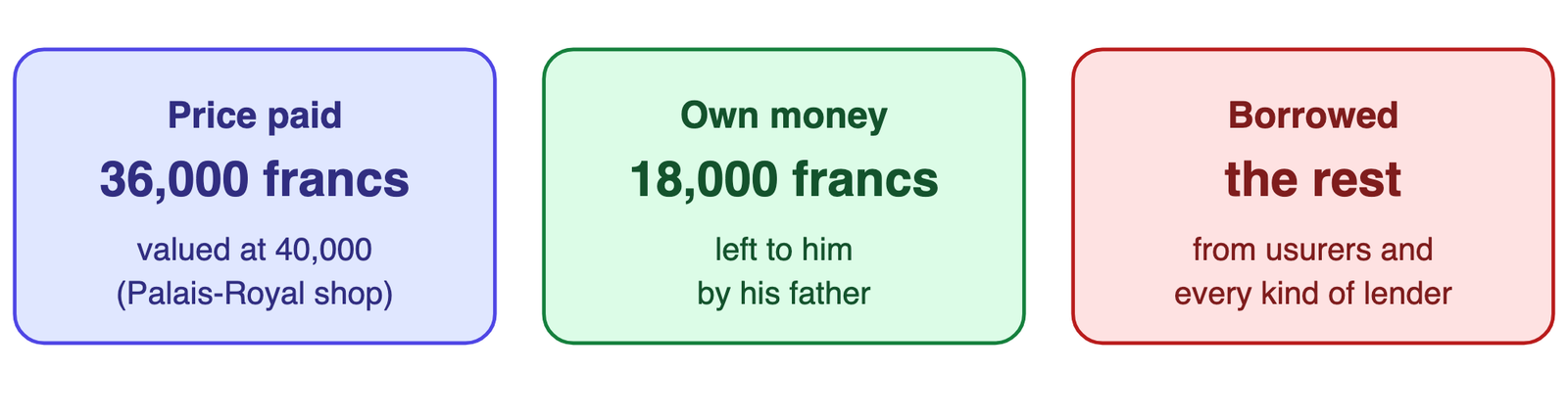
To raise the balance Loisel made “ruinous promises” and took money from usurers, people who lent at steep interest. Then he laid the 36,000 francs on the jeweller’s counter and took the new necklace.
When Matilda returned it, Mme Forestier spoke in a frigid (icy) tone: “You should have returned them to me sooner, for I might have needed them.” She did not open the box. Matilda had dreaded that she would: if her friend noticed the swap, what would she think? Would she call her a robber?
2.8 Ten Years of Hard Labour
Now Matilda learnt “the horrible life of necessity”. To her credit, she did her share fully and bravely. The debt had to be paid, and she would pay it.
| Matilda’s part | M. Loisel’s part |
|---|---|
| Sent away the maid; moved to rooms in an attic | Kept on his office job by day |
| Did the hated kitchen work: washing dishes, linen, clothes and dishcloths | In the evenings, kept the account books of some merchants in order |
| Carried the rubbish down every morning and the water up, resting on each landing | At night, often did copying at five sous a page |
| Shopped dressed like a working woman, basket on arm, bargaining over every last sou | Together, after ten years, they had paid back everything |
The cost to Matilda showed on her body. She now looked old: a strong, hard, rough woman of a poor home, hair carelessly done, skirts crooked, hands red, voice loud, scrubbing floors with big pails of water. Yet when her husband was at work she would sometimes sit by the window and remember the ball where she had been so beautiful and so admired.
Here the narrator asks what would have happened if she had not lost the necklace, and adds: “How singular is life, and how full of changes! How small a thing will ruin or save one!” One small object decided ten years of two lives.
2.9 The Twist at the End
One Sunday, out for a walk in the Champs-Elysees to forget the week’s worries, Matilda saw Mme Forestier with a child. Her friend was still young, pretty and attractive. Since the debt was paid, Matilda decided to tell her everything and greeted her: “Good morning, Jeanne.”
Jeanne did not know this plain-looking woman and was taken aback at being spoken to so familiarly. When Matilda gave her name, she cried out, “Oh! my poor Matilda! How you have changed!”
Matilda explained: the hard years were because of the necklace; she had lost it, returned another exactly like it, and it had taken ten years to pay for. Now it was over, and she was “decently content”. She smiled with “proud and simple joy”.
Deeply moved, Mme Forestier took both her hands and said: “Oh! My poor Matilda! Mine were false. They were not worth over five hundred francs!” The necklace that cost the Loisels 36,000 francs and ten years was only an imitation.
3Characters
| Character | Traits, with proof from the story |
|---|---|
| Matilda (Mme Loisel) | Pretty and discontented: feels born for luxury, tortured by worn chairs. Vain and proud: refuses flowers, hides her cheap wraps from women in furs. Self-centred at first: takes her husband’s gun money. Brave and hard-working later: she pays back the debt rather than run from it, doing her part “completely, heroically” over ten years. |
| M. Loisel | Content and simple: enjoys a potpie. Loving and generous: brings the card to please her; gives up his gun money. Practical: suggests the friend’s jewels; searches the street, police and cab offices. Self-sacrificing: spends his father’s 18,000 francs, borrows the rest, works evenings and nights. His one fault: the clasp lie was his idea. |
| Mme Forestier (Jeanne) | Rich and generous: opens her jewel-case and says “Choose, my dear”. A little cold when the necklace comes back late. Honest and kind-hearted: at once tells Matilda the necklace was false and is touched by her story. |
4Themes and Message
4.1 The Big Ideas
Vanity and false pride
Matilda’s wish to look rich, not her need, drives every step: the dress, the necklace, the hurry to escape the women in furs.
Honesty
One honest sentence to her friend would have saved ten years. The lie about the clasp buys time but costs everything.
Contentment
Her husband is happy with little; she is miserable with enough. Ironically she calls herself “decently content” only after losing everything.
Appearance and reality
The necklace looked priceless but was false; Matilda looked grand at the ball but was a clerk’s wife. Things are not what they seem.
Irony of fate is when events turn out the opposite of what a person expected, often in a cruel way. Matilda borrowed the necklace to look rich for one night and ended up poor for ten years, all to replace a necklace worth only five hundred francs.
4.2 Key Lines and What They Mean
| Line from the book | What it shows |
|---|---|
| “She was simple, but she was unhappy.” | Her sadness comes from inside her, from desire, not from want. |
| “There is nothing more humiliating than to have a shabby air in the midst of rich women.” | Her pride: what others think matters more to her than anything. |
| “Could you lend me this? Only this?” | Her heart is set on the costliest-looking piece. |
| “You should have returned them to me sooner, for I might have needed them.” | Mme Forestier’s cool tone; Matilda fears being called a thief. |
| “How small a thing will ruin or save one!” | The narrator’s comment on chance: one object shaped two lives. |
| “Mine were false. They were not worth over five hundred francs!” | The twist that makes all their suffering pointless. |
5Answers to the Book’s Questions
5.1 Read and Find Out
- What kind of a person is Mme Loisel, and why is she always unhappy? Pretty, vain and dissatisfied. She thinks she was meant for luxury, so her plain home, plain food and lack of dresses and jewels make her miserable.
- What kind of a person is her husband? A simple, loving clerk, content with little, who tries hard to make his wife happy.
- What fresh problem disturbs her? With the dress nearly ready, she has no jewel to wear and fears looking poor among rich women.
- How is it solved? Her husband tells her to borrow jewels from Mme Forestier, who lends her a diamond necklace.
- What do the Loisels do next? They search her clothes; he walks back along their route; then he tries the police, the cab offices and a newspaper advertisement with a reward, and has her write that the clasp is being mended.
- How do they replace it? They buy a similar diamond chaplet at the Palais-Royal for 36,000 francs, using his father’s 18,000 and loans from usurers for the rest.
5.2 Think About It
- Q1. The necklace changed the course of the Loisels’ life. Before it they lived modestly with a maid. To replace it they fell into debt, moved to an attic and slaved for ten years; Matilda’s looks and youth were gone, all for a fake.
- Q2. The cause of her ruin, and how she could have avoided it. Her vanity and her refusal to admit the loss. She could have gone in her theatre dress with flowers, or simply told her friend the truth.
- Q3. If she had confessed? Mme Forestier would have told her the necklace was false; at most they would have paid around five hundred francs and kept their home and their years.
- Q4. How would you deal with it? Admit the loss at once, apologise and offer to make good the loss. Honesty finds out the real value and keeps trust.
5.3 Talk About It
- Q1. Is English their real language? No, it is a translation. The clues are French: the titles M. (Monsieur) and Mme (Madame), money in francs and sous, and places such as Paris, the Palais-Royal and the Champs-Elysees. The characters would be speaking French.
- Q2. Honesty is the best policy. The story proves it the hard way: one lie led to ten years of avoidable suffering.
- Q3. We should be content with what life gives us. M. Loisel lived happily with little; Matilda’s craving for more cost her everything she had.
6Words to Know
Suggested reading in the book: ‘The Dowry’ by Guy de Maupassant, ‘A Cup of Tea’ by Katherine Mansfield and ‘The Bet’ by Anton Chekov.
- Author Guy de Maupassant; the story is set in Paris
- Matilda, pretty but unhappy wife of a petty clerk in the Board of Education office
- Invitation from the Minister of Public Instruction and Madame George Ramponneau, Monday, January 18
- Dress: 400 francs, the money Loisel had saved for a gun
- Jewel: diamond necklace in a black satin box, borrowed from Mme Forestier
- Ball: a great success; home about 4 a.m.; cheap wraps; old carriage after a walk toward the river
- Loss: search, police, cab offices, newspaper reward; letter about a broken clasp
- Replacement: Palais-Royal, valued 40,000, bought for 36,000; 18,000 from his father, rest from usurers
- Ten years: no maid, attic rooms, housework; he does accounts in the evening and copying at five sous a page at night
- End: Champs-Elysees, Jeanne does not know her; the necklace was false, worth at most 500 francs
- Themes: vanity, honesty, contentment, appearance and reality, irony of fate
- Can I explain why Matilda was unhappy in two lines?
- Can I list the husband’s two suggestions for the jewel problem?
- Can I give every money figure and what it paid for?
- Can I list four steps the Loisels took after the loss?
- Can I explain the irony of the ending?