
- Tell similar figures apart from congruent ones, and test two polygons for similarity
- State and prove the Basic Proportionality Theorem (BPT) and its converse (the same theorem turned around)
- Use BPT to find a missing length or to decide whether two lines are parallel
- Pick the right similarity test for triangles (the AA, SSS and SAS criteria of Section 4) and name the matching vertices in the right order
- Solve shadow and height problems using similar triangles
1 Introduction: Congruent vs Similar
In Class 9 you studied congruent figures: figures with the same shape and the
same size. This chapter is about figures with the same shape but not necessarily the
same size. These are called similar figures, and the chapter focuses on similar
triangles.
Nobody measured the height of Mount Everest or the distance to the moon with a tape.
They are found by indirect measurement: you measure lengths you can reach, and
work out the one you cannot reach using similar figures. Example 7 below uses exactly this idea for a shadow.
2 Similar Figures
Two figures having the same shape (and not necessarily the same size) are called
similar figures.
- All circles are similar, all squares are similar and all equilateral triangles are similar. They are congruent only when the radius (or side) is also equal.
- All congruent figures are similar, but similar figures need not be congruent.
- A circle and a square, or a triangle and a square, are never similar: their shapes differ.
Photographs show the idea. Three prints of the Taj Mahal in different sizes are
similar. Two same-size photos of one person at age 10 and age 40 are not similar,
because the shape has changed. A photographer takes a photo on a small 35 mm film and then prints
it bigger, say 45 mm (or 55 mm) in size. Every length in the picture is multiplied by the same
number, (or ), and every angle stays exactly the same. Same angles, and all lengths
multiplied by one number: that is what similar means.
Corresponding parts are the parts that match each other in the two figures: the
vertex, side or angle sitting in the same place in both. (This is a different use of the word
from “corresponding angles” made by a line crossing two parallel lines.)
Two polygons of the same number of sides are similar, if (i) their
corresponding angles are equal and (ii) their corresponding sides are in the same
ratio (or proportion).
The same ratio of the corresponding sides is referred to as the scale factor (or
the Representative Fraction) for the polygons.
Maps and building blueprints are drawn using a suitable scale factor: every real length is
multiplied by the same fraction.

corresponds to P”) and likewise B↔Q, C↔R, D↔S. Every pair of corresponding angles is equal
and .
Hold a cardboard quadrilateral ABCD flat under a bulb, parallel to a table. Its shadow on
the table is a bigger quadrilateral of exactly the same shape, because light travels in
straight lines from the bulb. Call the shadow’s corners A′, B′, C′, D′ (read “A dash”, and so
on). Corner A matches A′, B matches B′, and so on. Same shape, different size: the two
quadrilaterals are similar.
One more fact: if polygon 1 is similar to polygon 2, and polygon 2 is similar to polygon 3,
then polygon 1 is similar to polygon 3.

enough: both must hold together.
“All angles are 90°, so a square and a rectangle are similar.” Wrong. For polygons you
must check both conditions. (For triangles, Section 4 shows one condition is
enough.)
3 Similarity of Triangles
A triangle is a polygon, so two triangles are similar if (i) their corresponding angles
are equal and (ii) their corresponding sides are in the same ratio.
If corresponding angles of two triangles are equal, then they are known as
equiangular triangles.
The Greek mathematician Thales (640-546 B.C.) showed that the ratio of any two
corresponding sides in two equiangular triangles is always the same. He is believed to
have used a result called the Basic Proportionality Theorem (now known as the
Thales Theorem), stated just below.
Try it. Draw an angle with its corner at A. On one arm mark five equal steps from A;
call the third point D and the fifth point B. Draw any line from B to the other arm, meeting it
at C. Through D draw a line parallel to BC, meeting AC at E. Measure: ,
and also comes out . That is no coincidence.
If a line is drawn parallel to one side of a triangle to intersect the other two sides
in distinct points, the other two sides are divided in the same ratio.
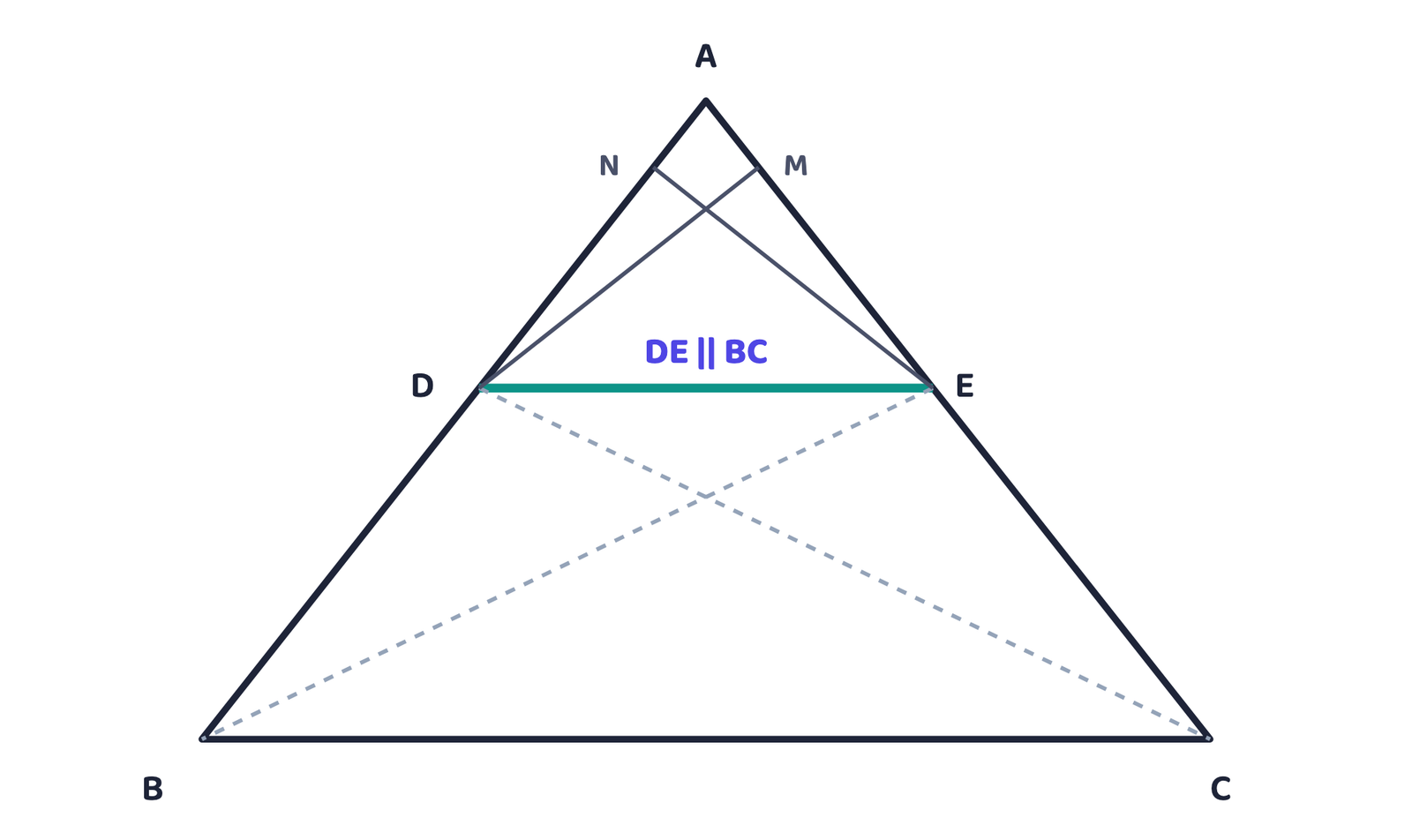
(⊥ means “perpendicular to”) are the heights used for the areas.
Proof. Given with , D on AB and E on AC. To prove
. Join BE and CD; draw and .
Here ar(ADE) means the area of .
Practise writing the BPT proof (Theorem 6.1) in full. Draw the figure, write what is
given, what is to be proved and the construction, then the two area ratios, with a reason
for every step. Step (3) needs its reason too: BDE and DEC are on the same base DE and
between the same parallels BC and DE, so ar(BDE) = ar(DEC).
Other forms of BPT. From you can get two more
forms by turning fractions upside down and adding 1 to both sides. The three forms are equivalent, and each follows from the
others:
| Form | How you get it |
|---|---|
| Theorem 6.1 itself | |
| turn upside down, add 1, turn back (worked in Example 1) | |
| add 1 to both sides of , then turn upside down |
Q. A line intersects sides AB and AC of at D and E and is parallel to
BC. Prove that .
Solution: , so by Theorem 6.1, .
Flip both sides: . Add 1 to both sides:
, i.e. . Flip again:
.
3.1 Converse of BPT
The converse of a statement swaps what is given and what is proved. BPT says
“parallel, so same ratio”; its converse says “same ratio, so parallel”. A converse is not
automatically true, so it needs its own check.
Try it. Draw an angle at A. Mark five equal steps on each arm:
on one arm and on the other, and join BC. Now join : it cuts
both arms in the ratio . cuts both in , in , in
. Every one of these lines comes out parallel to BC.
If a line divides any two sides of a triangle in the same ratio, then the line is
parallel to the third side.
We assume the opposite and show it leads to something impossible. Suppose
but DE is not parallel to BC. Draw a line through
D parallel to BC, meeting AC at a second point (read “E dash”). By BPT,
, so . Adding 1 to both
sides gives , so . Then E and are the same
point, and after all.
BPT (Theorem 6.1)
- Given: a line is parallel to one side
- Get: the other two sides are cut in the same ratio
- Use it to find a length
Converse (Theorem 6.2)
- Given: two sides are cut in the same ratio
- Get: the line is parallel to the third side
- Use it to prove lines parallel
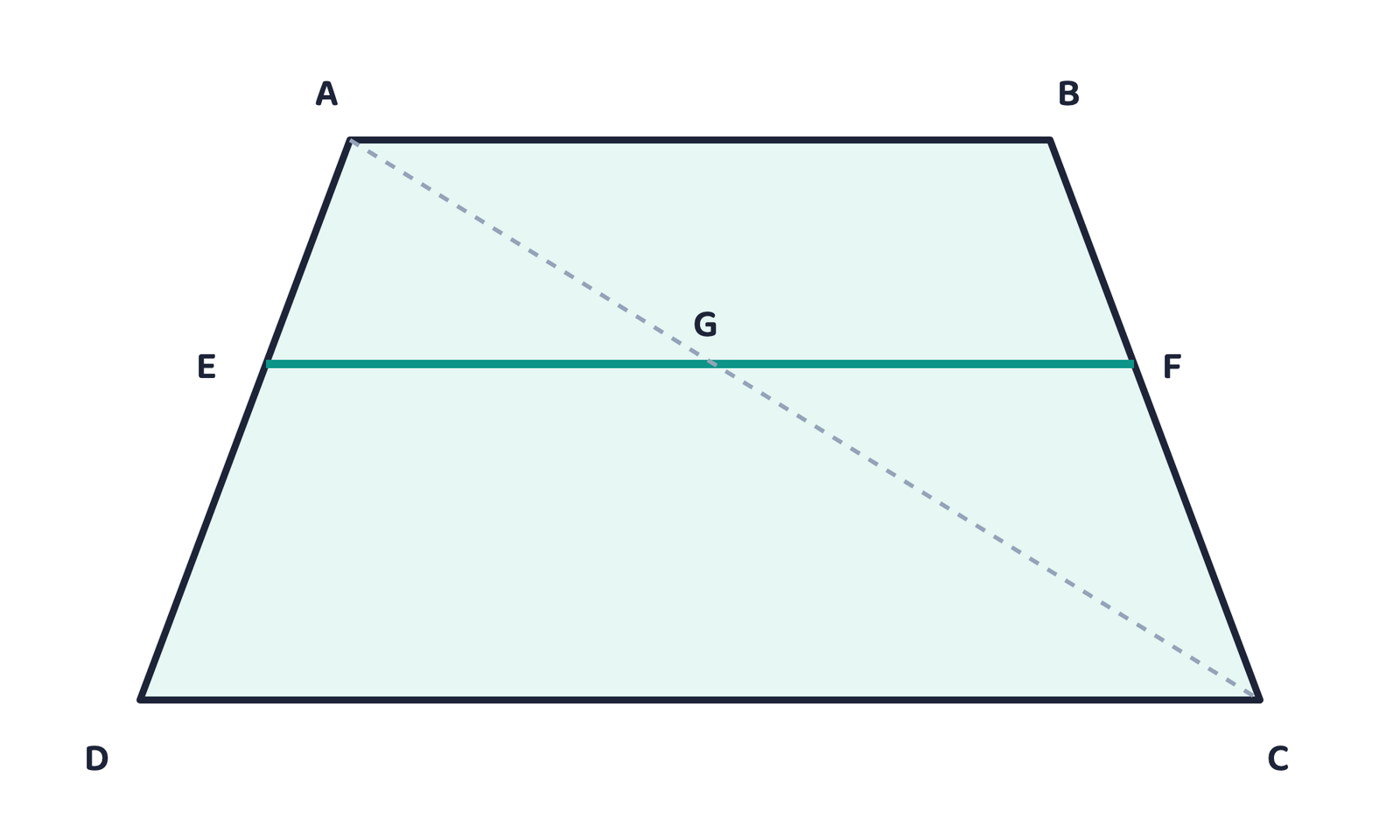
and .
Q. ABCD is a trapezium with . E and F lie on the non-parallel
sides AD and BC with . Show that .
Solution: Join AC, cutting EF at G. and , so
(lines parallel to the same line are parallel to each other).
In , , so …(1).
In , , so , i.e.
…(2). From (1) and (2),
.
Q. In , S is on PQ and T is on PR with
and . Prove that PQR is an isosceles triangle.
Solution: , so (Theorem 6.2).
Therefore (corresponding angles, as ) …(1). Given
…(2). From (1) and (2), , so
(sides opposite equal angles). Hence
is isosceles.
4 Criteria for Similarity of Triangles
By definition, and are similar if
, , and
. That is six facts to check. Just as
Class 9 had short tests for congruence (SSS, SAS and so on), triangles have short tests
for similarity, called criteria (one test is a criterion), that need far fewer facts.
“” is read “triangle ABC is similar to triangle DEF”;
the symbol means “is similar to”. The letters must follow the correspondence
, , . So you may write
, but not or
.
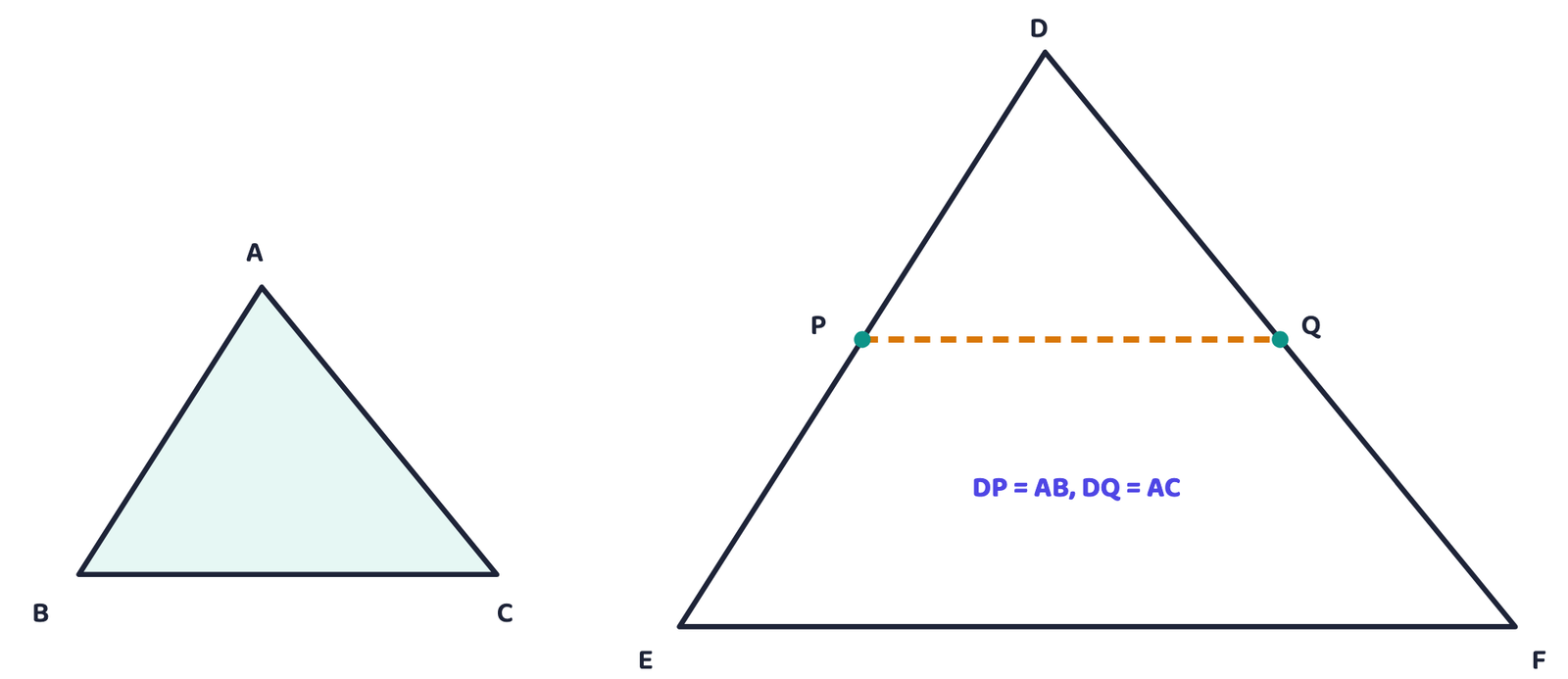
6.5 below. Mark P on DE with and Q on DF with (the book calls this
“cutting” ; P and Q must fall on the sides DE and DF, which is why the book takes
in Theorem 6.4), and join PQ. The proofs then show
( means “is congruent to”) and
.
4.1 AAA and AA criterion
If in two triangles, corresponding angles are equal, then their corresponding sides are
in the same ratio (or proportion) and hence the two triangles are similar.
The book reaches this through Activity 4: with cm, cm and the same angles
and at both bases, the ratios come out
, and and also measure about 0.6.
Given , , . Mark ,
and join PQ (Figure 5). Then (SAS: ,
, ). So , and since these are
corresponding angles on the lines PQ and EF, . By BPT,
, which (as in Example 1) gives ,
i.e. . Repeating the same construction at vertex E gives
, so
.
Two angles equal ⇒ third angle equal
The angles of a triangle add up to 180°, so if two angles match, the third matches
automatically. So: if two angles of one triangle are respectively equal to two angles
of another triangle, the triangles are similar. This may be referred to as the AA
similarity criterion for two triangles.
4.2 SSS criterion
If in two triangles, sides of one triangle are proportional to (i.e., in the same ratio
of) the sides of the other triangle, then their corresponding angles are equal and hence
the two triangles are similar.
The book reaches this through Activity 5: sides 3, 6, 8 cm and 4.5, 9, 12 cm are all in the
ratio , and measuring shows , and
.
Given , with the ratio less than 1 (so
ABC is the smaller triangle). Mark , and join PQ. The given ratios now say
, so P and Q cut DE and DF in the same ratio, and
(Theorem 6.2). So and
(corresponding angles), which makes and equiangular, and by
Theorem 6.3, . But ,
so and . Now (SSS), so
, , .
4.3 SAS criterion
If one angle of a triangle is equal to one angle of the other triangle and the sides
including these angles are proportional, then the two triangles are similar.
The book reaches this through Activity 6: cm, cm, cm, cm, so
, with ; measuring shows
and .
Given and . Mark ,
and join PQ. Now , so P and Q cut DE and DF in the same ratio
and (Theorem 6.2). Also (SAS
congruence). Hence and
(corresponding angles, ), so
.

one included between the two proportional sides.
If in two right triangles, the hypotenuse and one side of one triangle are proportional
to the hypotenuse and one side of the other triangle, then the two triangles are similar.
This may be referred to as the RHS Similarity Criterion. If you use this criterion in
Example 2, Chapter 8, the proof will become simpler.
(The hypotenuse is the side opposite the right angle. The book states RHS without proof.
Using it is optional: the book only says that it makes the proof of Example 2 in Chapter 8,
Introduction to Trigonometry, simpler.)
| Criterion | What you must show | Matching congruence rule (Class 9) |
|---|---|---|
| AAA / AA | Two pairs of corresponding angles equal | (no AAA congruence: equal angles do not fix size) |
| SSS | All three pairs of sides in the same ratio | SSS: sides equal |
| SAS | One angle equal + the two sides including it in the same ratio | SAS: two sides and included angle equal |
| RHS | Right triangles: hypotenuse and one side in the same ratio | RHS: hypotenuse and one side equal |
For polygons you need both conditions. For triangles, Theorems 6.3 and 6.4 show that
one condition implies the other: equal angles force proportional sides, and
proportional sides force equal angles.
4.4 Solved examples on the criteria

opposite, and that equal angle is where the similarity starts.
Q. Line segments PS and QR cross at O, and (Figure 7, left).
Prove that .
Solution: , so and
(alternate angles). Also (vertically opposite angles). Therefore
(AAA criterion).
Q. In : , , , ,
. In : , , . Find .
Solution: ,
, .
All three ratios are equal, so (SSS). Hence
(corresponding angles). By angle sum,
, so
.
In Example 5 the answer is , not .
Match the sides first (AB with RQ, BC with QP, CA with PR), then read the vertices off:
A↔R, B↔Q, C↔P. Get this order wrong and you will pick the wrong angle.
Q. Line segments AB and CD intersect at O (Figure 7, right), and
(the dot means multiplication). Show that
and .
Solution: Divide both sides of by :
…(1).
(vertically opposite angles) …(2). From (1) and (2),
(SAS). So
and
(corresponding angles of similar triangles).

the ground, and the light ray AE makes the same angle E with the ground for both.
Q. A girl of height 90 cm is walking away from the base of a lamp-post at a speed
of 1.2 m/s. If the lamp is 3.6 m above the ground, find the length of her shadow after
4 seconds.
Given
, , speed , time
To find
Shadow m
Solution: . In and ,
and is common, so (AA).
Therefore , i.e. .
So , , . The shadow is 1.6 m long.
Pole, tree, tower and person-and-shadow problems can usually be solved by AA, as in
Example 7: both objects are vertical (90° each) and the sun’s or lamp’s ray makes one common
angle. With sunlight, height ÷ shadow is the same for both objects. With a lamp, as here,
compare each height with the distance from the foot of that object to the tip of the shadow:
(BE m). Convert all lengths to one unit
(cm to m) before forming the ratio.
Q. CM and RN are medians of and (a
median joins a vertex to the mid-point of the opposite side), and
. Prove: (i)
(ii) (iii) .
Solution: From the similarity, …(1)
and , , …(2).
(i) M, N are mid-points, so , . From (1),
, i.e. …(3). Also
from (2) …(4). By (3) and (4),
(SAS) …(5).
(ii) From (5), by (1).
(iii) , and
(since , ). So
, and
(SSS).
In similar triangles, corresponding medians are in the same ratio as corresponding
sides (Example 8, and Exercise 6.3 Q16). Beyond the NCERT text, and not proved in the book:
the same holds for corresponding angle bisectors (lines cutting an angle into two
equal parts) and for corresponding altitudes (perpendiculars from a vertex to the
opposite side).
5 Which criterion? A quick decision path
Older editions of this chapter also had “Areas of Similar Triangles” and “Pythagoras
Theorem”. Neither is in the CBSE 2026-27 Class X syllabus, and the current NCERT book has no
section on them.
Do not prepare them for this chapter. The book’s first page still mentions a proof of
Pythagoras Theorem: ignore that line, the proof is no longer in the chapter.
- Similar = same shape, size may differ. Congruent figures are always similar, but similar figures need not be congruent.
- All circles, all squares and all equilateral triangles are similar.
- Similar polygons need both: corresponding angles equal and corresponding sides in the same ratio (the scale factor).
- BPT (Theorem 6.1): ; proved using areas, key step ar(BDE) = ar(DEC).
- Converse (Theorem 6.2): .
- AAA (Theorem 6.3), and AA is enough because the angle sum is 180°.
- SSS (Theorem 6.4): all three sides in the same ratio.
- SAS (Theorem 6.5): one angle equal and the sides including it proportional.
- RHS: right triangles with hypotenuse and one side proportional (stated, not proved).
- Write similarity in the correct vertex order; shadow problems such as Example 7 use AA.