
- How to write a chemical equation and balance it using the hit-and-trial method
- How to show physical states (s, l, g, aq) and reaction conditions in an equation
- The types of chemical reaction (combination, decomposition, displacement, double displacement, and oxidation-reduction) and how to spot each from an equation
- The difference between an exothermic and an endothermic reaction
- Oxidation and reduction, in terms of gain or loss of oxygen and hydrogen
- How to recognise corrosion and rancidity in everyday life, and how rancidity is slowed down
decomposition reactiondisplacement reactiondouble displacement reaction
precipitationoxidationreductionexothermicendothermic
corrosionrancidity
1What Is a Chemical Reaction?
Milk turns sour in summer. An iron tawa (griddle) rusts. Grapes ferment, food cooks, food is digested inside the body, and we breathe. In every one of these, the starting substance changes into something with a different nature and identity. Whenever this kind of chemical change happens, we say a chemical reaction has taken place.
Clean a magnesium ribbon with sandpaper, burn it over a spirit lamp, and collect the ash formed in a watch-glass. The magnesium combines with oxygen from the air to form magnesium oxide (a white ash): this is itself an example of a chemical reaction.
Adding potassium iodide solution to lead nitrate solution gives a yellow solid (Activity 1.2). Adding dilute hydrochloric or sulphuric acid to zinc granules gives bubbles of hydrogen gas around the granules, and the flask becomes warm (Activity 1.3).
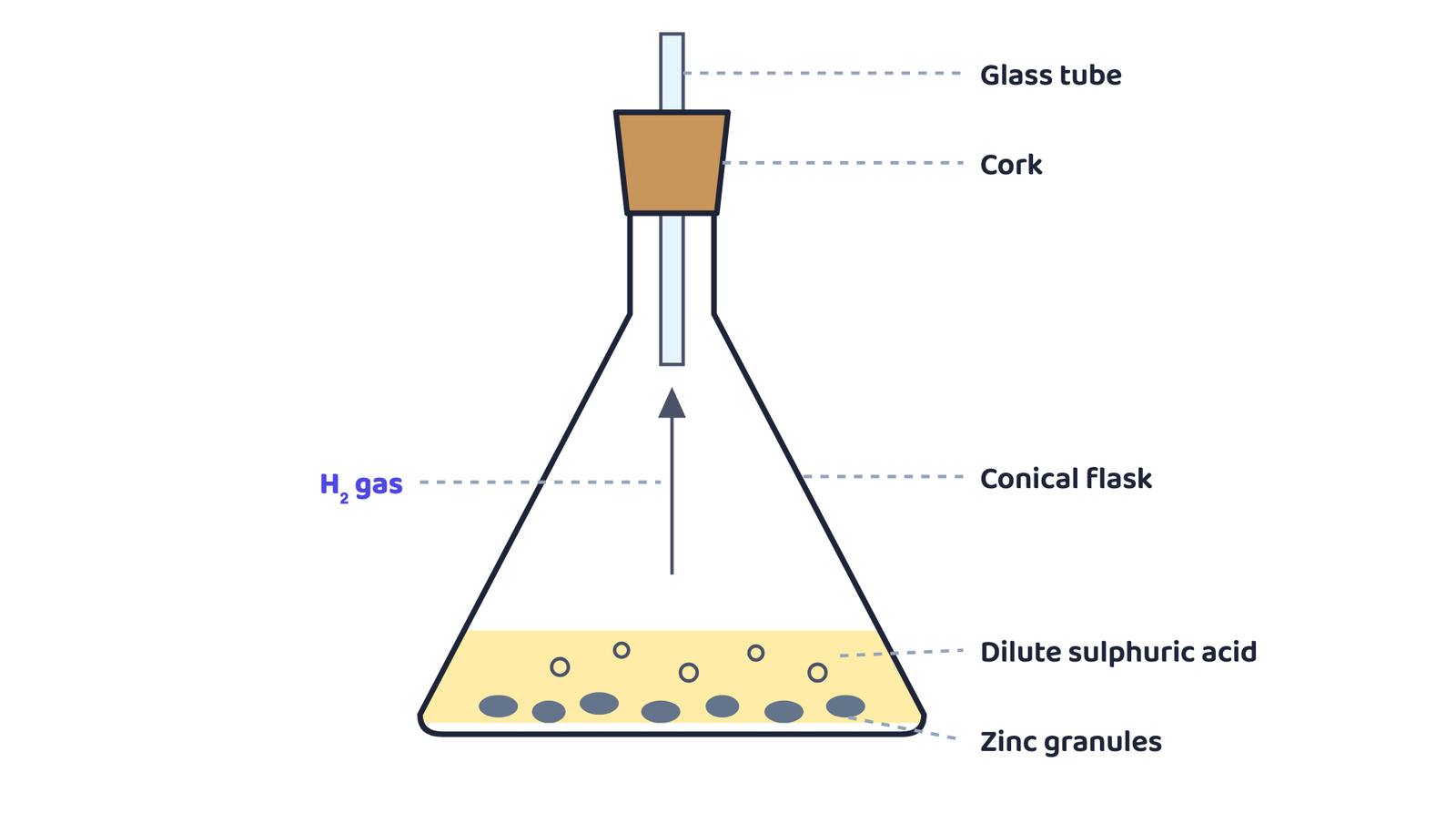
From these three activities, any of the following observations tells us that a chemical reaction has taken place:
- change in state
- change in colour
- evolution of a gas
- change in temperature
2Chemical Equations
Writing out a reaction in a full sentence gets long, so it is written in short as a word-equation instead:
A chemical equation is the short way of representing a chemical reaction using chemical formulae instead of words: for example .
When the number of atoms on the two sides of an equation is not equal, the equation is called a skeletal chemical equation. The equation above, , is a skeletal equation as written: it has 2 oxygen atoms on the left but only 1 on the right.
2.1 Why an Equation Must Be Balanced
The law of conservation of mass states that mass can neither be created nor destroyed in a chemical reaction. So the total number of atoms of each element present in the reactants must equal the number in the products. An equation is called balanced only when this is true.
“Why should chemical equations be balanced?” is Exercise question 4 of this chapter. Always name the law of conservation of mass in the answer: just saying “atoms must be equal” does not give the reason.
Check the reaction of Activity 1.3, : Zn 1 = 1, H 2 = 2, S 1 = 1, O 4 = 4. Every element has the same number of atoms on both sides, so this equation is already balanced.
2.2 Balancing an Equation: the Hit-and-Trial Method
Example: balance .
Never change a compound’s formula to balance atoms. To balance oxygen you write a coefficient “4” in front of , giving . You never change the formula itself to or .
Try it yourself: the book asks you to balance the skeletal equation by the same steps. Oxygen first: there are 2 O atoms on the left, so write on the right. Now there are 2 Mg atoms on the right, so write on the left: , balanced.
2.3 Step VII: Physical States and Reaction Conditions
To make an equation more informative, the physical state of each substance is written in brackets after it:
| Symbol | State |
|---|---|
| (s) | solid |
| (l) | liquid |
| (g) | gas |
| (aq) | aqueous (dissolved in water) |
, and photosynthesis:
. (A catalyst is a substance that speeds up a reaction without being used up itself, which is why it is written on the arrow rather than as a reactant.)
3Types of Chemical Reactions
During any chemical reaction, atoms of one element never turn into atoms of another element: bonds between atoms simply break and re-form to give new substances. The book studies the types of reaction one by one: combination, decomposition, displacement, double displacement, and oxidation-reduction.
3.1 Combination Reaction
Adding water slowly to calcium oxide (quicklime) makes the beaker warm, and slaked lime (calcium hydroxide) is formed, with heat also released.
A combination reaction is one in which two or more substances (elements or compounds) combine to form a single product.
The burning of magnesium in Activity 1.1 () is also a combination reaction: a single product is formed, and heat is given out along with it.
Whitewashing walls uses a solution of slaked lime. It slowly reacts with carbon dioxide in the air to form a thin layer of calcium carbonate : .
It is this layer that makes the wall shine after 2-3 days. Marble has the same chemical formula, .
An exothermic reaction is one in which heat is given out along with the product. Examples: burning natural gas (), respiration
( + energy), and vegetable matter turning into compost.
3.2 Decomposition Reaction
A decomposition reaction is the exact opposite of a combination reaction: a single reactant breaks down into two or more simpler products.
Thermal decomposition (Activity 1.5)
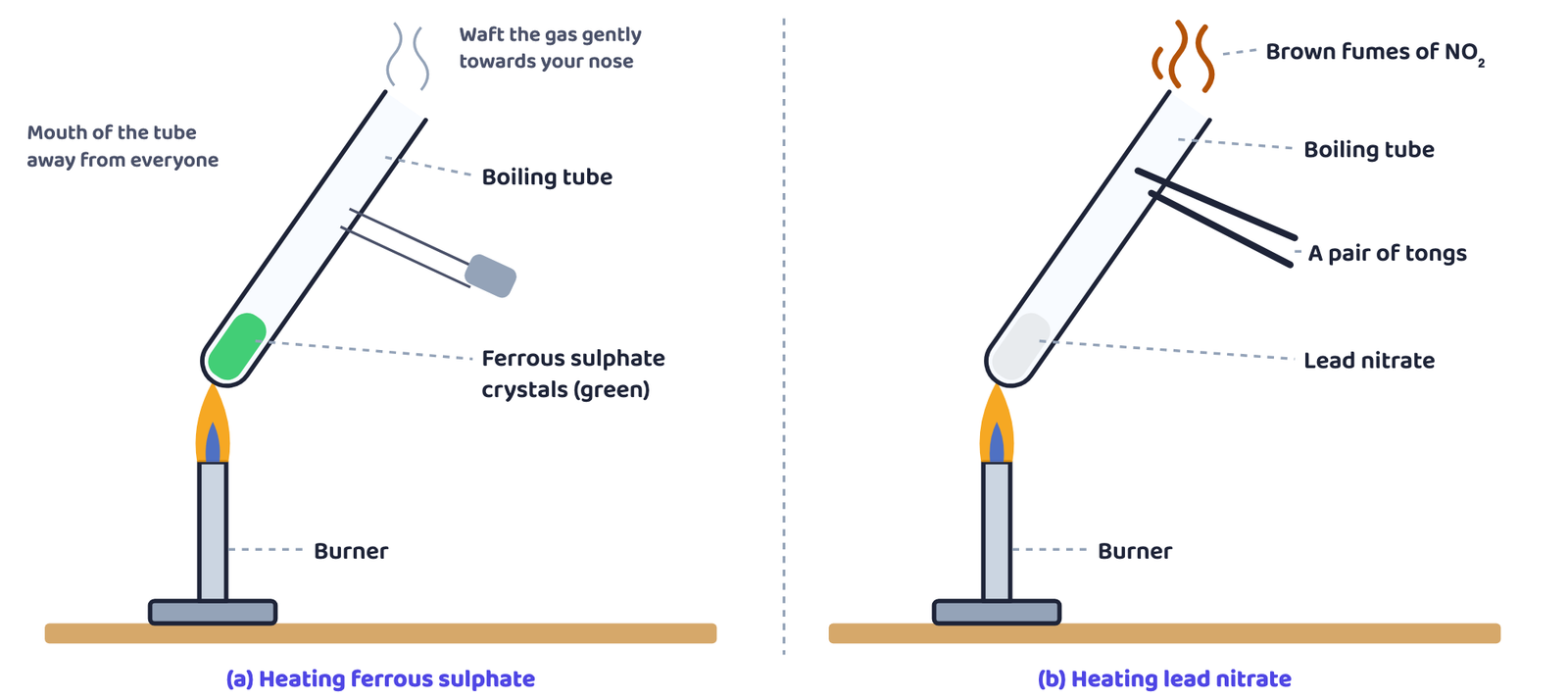
Decomposition caused by heating is called thermal decomposition. Heating green ferrous sulphate crystals changes their colour and gives off the characteristic odour of burning sulphur:
.
Ferrous sulphate crystals () first lose water when heated, and their colour changes. Then the compound decomposes to ferric oxide (), sulphur dioxide () and sulphur trioxide (). Ferric oxide is a solid, while and are gases.
Thermal decomposition of limestone
: an important decomposition reaction used in various industries. Calcium oxide is called lime or quick lime; one of its many uses is in the manufacture of cement.
Activity 1.6
Heating lead nitrate produces brown fumes of nitrogen dioxide:
Electrolysis of water (Activity 1.7)
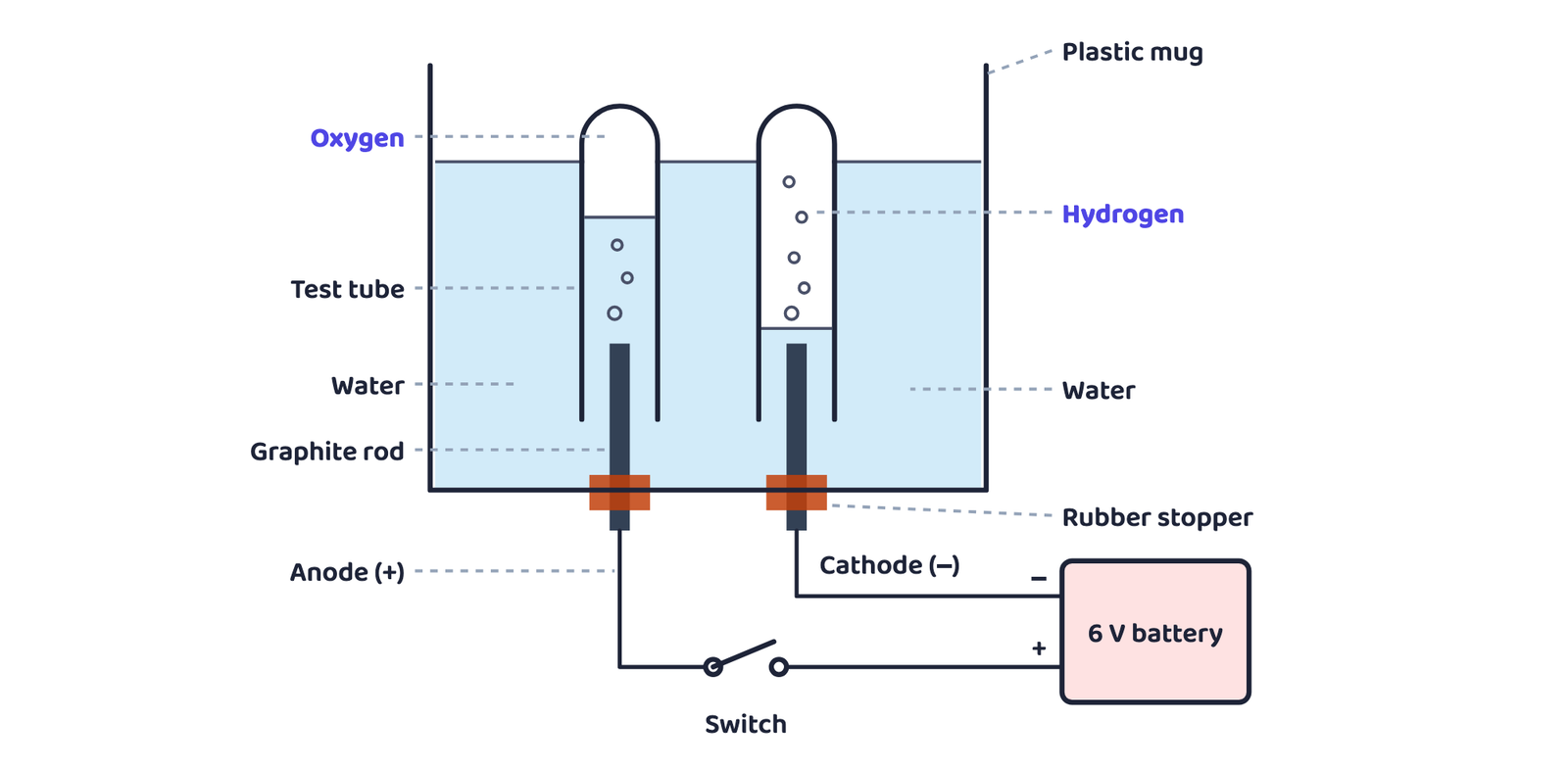
Passing electric current through acidified water forms hydrogen and oxygen gas: the volume of hydrogen collected is exactly double that of oxygen ().
Photolytic decomposition (Activity 1.8)
Decomposition caused by light is called photolytic decomposition. White silver chloride turns grey on standing in sunlight: .
Silver bromide behaves the same way: .
This is the principle used in black-and-white photography.
Every decomposition reaction above needs energy, in the form of heat, light or electricity, to break down the reactants.
An endothermic reaction is a reaction in which energy is absorbed.
Take about 2 g barium hydroxide in a test tube, add 1 g of ammonium chloride and mix with a glass rod. Touch the bottom of the test tube with your palm: it feels cold. The reaction absorbs heat from its surroundings (including your hand), so it is an endothermic reaction.
3.3 Displacement Reaction
Dipping iron nails in a copper sulphate solution turns the nails brownish, and the solution’s blue colour fades: the iron has displaced the copper from its compound.

A displacement reaction is one in which a more reactive element displaces a less reactive element from its compound.
Zinc and lead are both more reactive than copper, so each one displaces copper from its compounds.
3.4 Double Displacement Reaction
Mixing solutions of sodium sulphate and barium chloride produces a white precipitate immediately.
The white substance formed is insoluble in water; an insoluble substance formed in this way is known as a precipitate. The white precipitate of is formed by the reaction of and ions; the other product, sodium chloride, remains in the solution. Any reaction that produces a precipitate can be called a precipitation reaction.
A double displacement reaction is a reaction in which there is an exchange of ions between the reactants.
Activity 1.2 (mixing lead(II) nitrate and potassium iodide solutions) is also a double displacement reaction: a yellow precipitate of lead iodide forms, .
3.5 Oxidation and Reduction
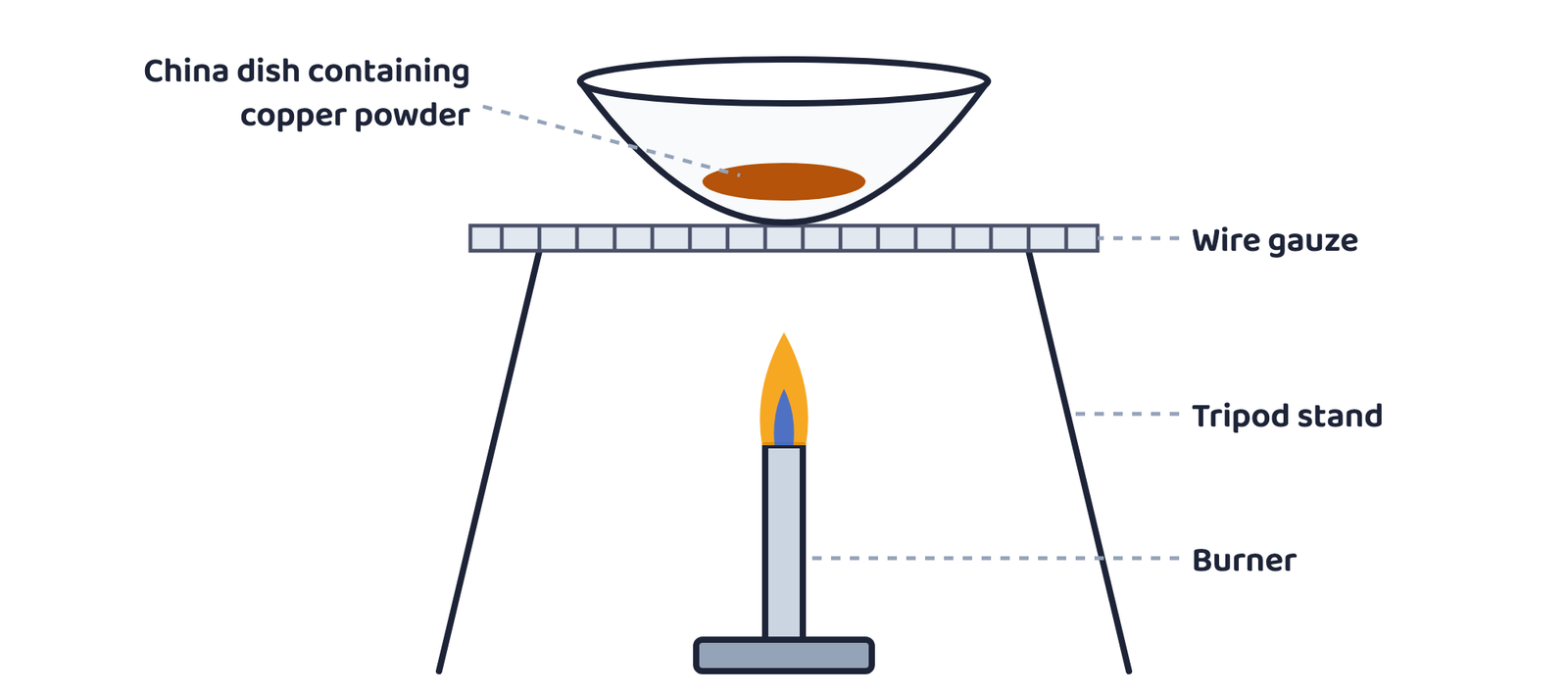
Heating copper powder in air deposits a black coating (copper(II) oxide) on it: the copper has gained oxygen. Passing hydrogen gas over this same black powder turns it back to reddish-brown copper: here the copper oxide has lost oxygen.
Oxidation
- Gain of oxygen
- or loss of hydrogen
- : the copper is oxidised
Reduction
- Loss of oxygen
- or gain of hydrogen
- : the copper oxide is reduced
Oxidation = gain of oxygen or loss of hydrogen. Reduction = loss of oxygen or gain of hydrogen.
In , copper(II) oxide loses oxygen and is reduced, while hydrogen gains oxygen and is oxidised. So in this reaction one reactant gets oxidised while the other gets reduced. Such reactions are called oxidation-reduction or redox reactions. Other examples:
(HCl is oxidised to , is reduced to )
In Activity 1.1, magnesium gains oxygen to form magnesium oxide, so magnesium is oxidised.
4Effects of Oxidation in Everyday Life
4.1 Corrosion
When a metal is attacked by substances around it, such as moisture and acids, it is said to corrode, and this process is called corrosion. Examples: the reddish-brown coating on iron (rusting), the black coating on silver and the green coating on copper.
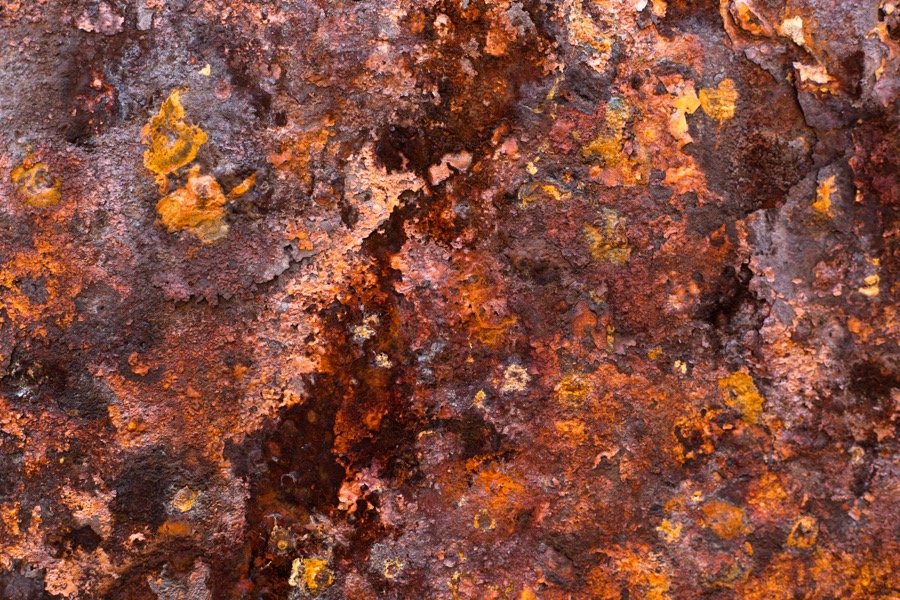
Corrosion causes damage to car bodies, bridges, iron railings, ships and all objects made of metals, especially those of iron; every year an enormous amount of money is spent to replace damaged iron. Painting iron articles keeps moisture and air away from the iron surface, which prevents rusting. (Corrosion is studied in more detail in Chapter 3.)
4.2 Rancidity
Rancidity is the process by which fats and oils in food are oxidised by oxygen in the air, changing their smell and taste (“going stale” or “off”).
Adding antioxidants
Substances that slow down oxidation are added to fat- and oil-containing foods.
Airtight containers
Keeping food away from contact with air (oxygen) slows oxidation down.
Nitrogen flushing
Packets of oily/fatty food, such as chips, are flushed with nitrogen gas to push oxygen out.
Every chemical reaction either joins something together (combination), breaks something apart (decomposition), or swaps something’s place (displacement/double displacement). And in almost every one, energy is either given out or taken in.
This chapter in one line
- Can I state every step of the hit-and-trial method for balancing an equation, without looking?
- Can I identify each type of reaction (combination, decomposition, displacement, double displacement, redox) from one example equation?
- Can I define oxidation and reduction without getting them confused?
- Can I explain why iron articles are painted, and name the three ways rancidity is slowed down?
- Balanced equation = equal atoms of every element on both sides (law of conservation of mass)
- Types: combination (A+B→AB), decomposition (AB→A+B), displacement (A+BC→AC+B), double displacement (exchange of ions), redox (one reactant oxidised, the other reduced)
- Oxidation = gain of O/loss of H; reduction = loss of O/gain of H
- Exothermic = energy given out; endothermic = energy absorbed
- Corrosion (rust, blackening) and rancidity (stale food) are both everyday examples of oxidation