
Exam-useful questions from this chapter, grouped by marks, each with a full model answer. Try writing the answer yourself first, then check it against this one.
1 1-Mark Questions
Q. Define electric current and give its SI unit.
Answer: Electric current is the rate of flow of electric charge through a conductor: . Its SI unit is the ampere (A).
Q. What is the direction of conventional electric current in a circuit?
Answer: It is taken as opposite to the direction of flow of electrons (since current was originally defined as the flow of positive charge).
Q. Name the device used to measure potential difference, and state how it is connected.
Answer: A voltmeter measures potential difference. It is always connected in parallel across the two points concerned.
Q. State Ohm’s law.
Answer: The potential difference V across a metallic conductor is directly proportional to the current I flowing through it, provided the temperature remains constant: .
Q. What is a rheostat used for?
Answer: A rheostat is used to change (increase or decrease) the resistance in a circuit without changing the source voltage.
Q. Write the formula relating resistance R, resistivity , length l and area of cross-section A.
Answer: .
Q. Why are alloys preferred over pure metals for making heating elements?
Answer: Alloys generally have higher resistivity than pure metals and do not oxidise (burn) readily even at high temperatures.
Q. What is the commercial unit of electrical energy, and what is it commonly called?
Answer: The kilowatt hour (kWh); it is commonly called a “unit” on the electricity bill.
2 2-Mark Questions
Q. Differentiate between a conductor, a resistor and an insulator on the basis of resistance.
Answer: Compare components of the same size: a good conductor offers a low resistance (e.g. copper); a conductor having some appreciable resistance is called a resistor; a poor conductor offers a higher resistance; and an insulator offers an even higher resistance (e.g. rubber, glass).
Q. Two resistors of 5 Ω and 10 Ω are connected in series to a 6 V battery. Find the current in the circuit.
Answer: Total resistance . Current .
Q. Two resistors of 6 Ω and 3 Ω are connected in parallel. Find their equivalent resistance.
Answer: , so .
Q. Why does the connecting cord of an electric heater not glow while its heating element does?
Answer: The heating element (nichrome) has a much higher resistance than the thick copper cord. By Joule’s law, , for the same current the heat produced is much greater where resistance is higher, so only the element gets hot enough to glow.
Q. State two advantages of connecting electrical appliances in parallel rather than in series in a household circuit.
Answer: (1) Each appliance gets the full mains voltage and can draw the current it individually needs. (2) If one appliance fails or is switched off, the rest keep working, unlike a series circuit where one failure breaks the whole loop.
Q. A current of 2 A flows through a 5 Ω resistor for 30 seconds. Calculate the heat produced.
Answer: .
Q. An electric bulb draws a current of 0.5 A from a 220 V supply. Calculate its power and resistance.
Answer: . .
Q. Why is tungsten used for making bulb filaments, and why is the bulb filled with nitrogen and argon?
Answer: Tungsten has a very high melting point (3380°C), so it can glow white-hot without melting. The bulb is filled with chemically inactive nitrogen and argon gases to prevent the hot filament from reacting and to prolong its life.
3 4-Mark Questions
Q. Derive the expression for the equivalent resistance of three resistors , and connected in series.
Answer: In series, the same current I flows through all three resistors, and the total potential difference is the sum of the individual potential differences: . By Ohm’s law, , , , . Substituting: . Cancelling the common current I: .
Q. Derive the expression for the equivalent resistance of three resistors , and connected in parallel.
Answer: In parallel, each resistor has the same potential difference V across it, and the total current is the sum of the branch currents: . By Ohm’s law, , , , . Substituting: . Cancelling the common voltage V: .
Q. A copper wire of resistance 5 Ω is drawn out so that its length is increased to twice its original length. Calculate its new resistance, assuming its volume remains constant.
Answer: Volume is constant, so if length doubles (), area becomes half (), since is fixed. New resistance .
Q. Three resistors of 2 Ω, 3 Ω and 6 Ω are connected in parallel to a 12 V battery. Find (a) the equivalent resistance, (b) the current through each resistor, and (c) the total current drawn from the battery.
Answer: (a) , so . (b) Each resistor gets the full 12 V: , , . (c) Total current (also checks out as ).
Q. In a circuit, and are connected in parallel; separately, , and are connected in parallel; the two parallel groups are then joined in series across a 6 V battery. Find (a) the equivalent resistance of the circuit, and (b) the total current drawn from the battery.
Answer: (a) First group: , so . Second group: , so . The two groups are in series, so . (b) Total current .
Q. State Joule’s law of heating. An electric heater of resistance 20 Ω draws a current of 5 A. Calculate the heat produced in 1 minute.
Answer: Joule’s law: heat produced is (i) directly proportional to the square of the current for a given resistance, (ii) directly proportional to resistance for a given current, and (iii) directly proportional to time. Here, .
Q. Explain, with reasons, why household electrical circuits are wired in parallel and not in series.
Answer: Appliances like a bulb and a heater need very different currents to operate properly, and a series circuit forces the same current through everything, so they cannot be run together in series. Also, if even one component in a series circuit fails, the whole circuit breaks and every appliance stops working. Parallel wiring solves both problems: each appliance gets the full mains voltage and draws only the current it needs, and if one appliance fails, the rest keep working unaffected.
4 6-Mark Questions
Q. A wire of resistivity , length l and area of cross-section A has resistance R. Derive the formula from the observations of Activity 11.3, and calculate the resistivity of a wire of length 2 m, area of cross-section , and resistance 20 Ω.
Answer: Activity 11.3 shows that resistance doubles when length doubles (same thickness and material), so ; resistance increases when the wire becomes thicker (larger area), so ; and resistance changes if the material changes, showing a material-dependent constant is needed. Combining these two proportionalities with a constant of proportionality (the material’s resistivity) gives . For the numerical: .
Q. With the help of a circuit diagram, describe Activity 11.1 used to verify Ohm’s law, and explain what conclusion is drawn from the V-I graph obtained.
Answer: A circuit is set up with a nichrome wire XY (about 0.5 m long), an ammeter, a voltmeter, a plug key and four 1.5 V cells. The cells, the wire XY, the ammeter and the plug key are joined in series in one path; the voltmeter is connected in parallel across the ends X and Y of the wire, as in the circuit diagram below.
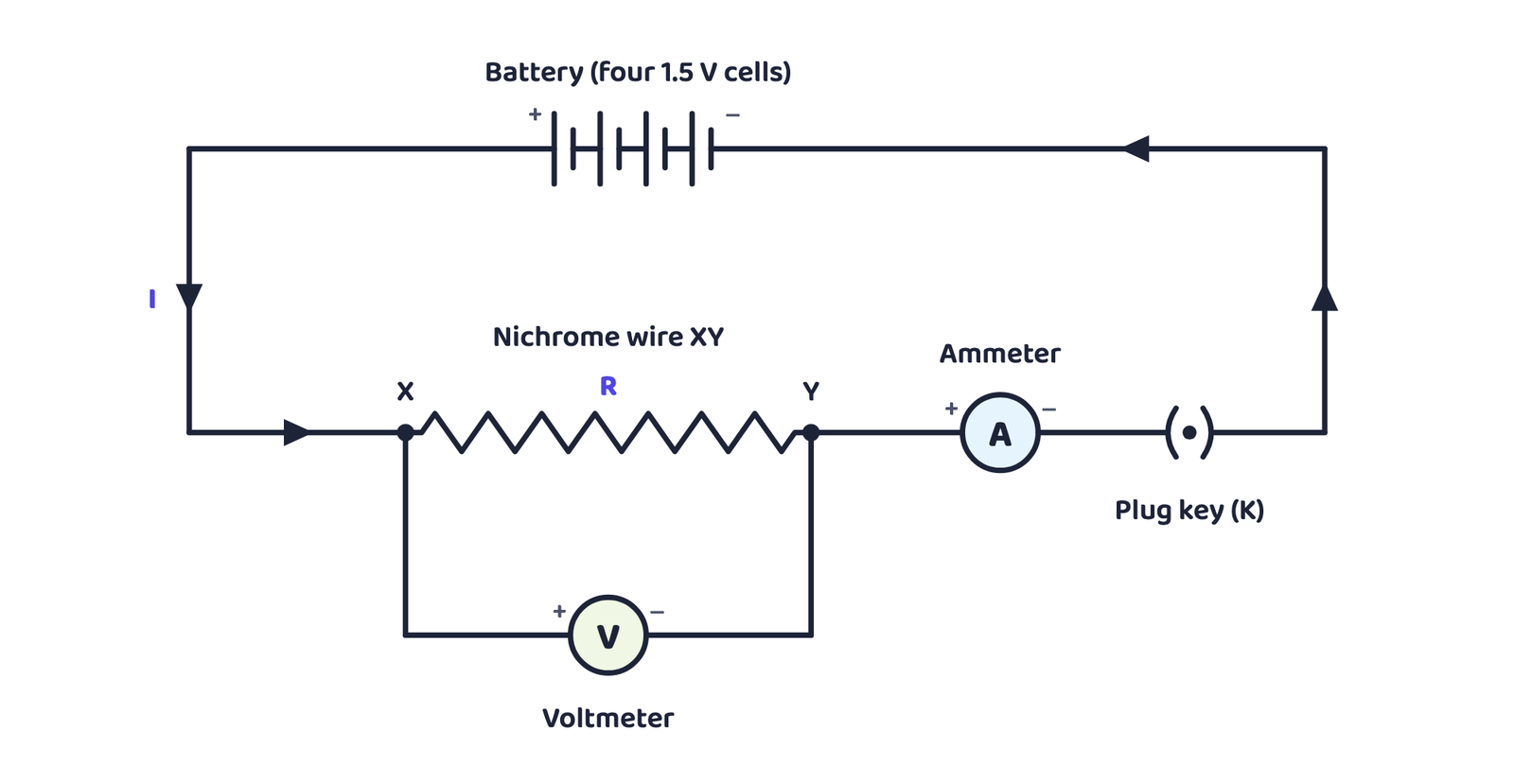
Using first one cell, the ammeter and voltmeter readings (I and V) are noted; the same is repeated using two, three and then four cells, giving four pairs of readings. The ratio V/I is calculated each time and found to stay approximately constant. Plotting V (y-axis) against I (x-axis) gives a straight line passing through the origin. This straight-line, through-the-origin shape shows that V is directly proportional to I, provided the temperature of the wire stays the same: this is Ohm’s law, and the constant slope V/I is the wire’s resistance R.
Q. An electric iron of resistance 50 Ω draws a current of 4 A. Calculate (a) the power consumed, (b) the heat produced in 30 minutes, and (c) the cost of using it for 30 minutes a day for 10 days at ₹6.00 per unit.
Answer: (a) . (b) . (c) Energy per day ; over 10 days ; cost .
Q. Explain the heating effect of electric current, and derive the formula starting from the definitions of potential difference and current.
Answer: In a purely resistive circuit, all the source’s energy is eventually given out as heat. The work done in moving a charge Q through potential difference V is (definition of potential difference), so the source supplies energy at the rate (power) (since ). In time t, the total energy supplied is , and since the circuit is purely resistive, this energy is entirely converted to heat: . Applying Ohm’s law, , gives . This is Joule’s law of heating, showing heat depends on the square of the current, on resistance, and on time.
5 Case Studies
(A) 1 mark What current does the iron draw when it is switched on?
Answer: .
(B) 1 mark What is the resistance of the iron’s heating element?
Answer: (working it out from the rounded current instead, , gives , a rounding artifact of first rounding I to 4.54 A, not a separate answer).
(C) 2 marks Which standard fuse rating should be used for the iron’s circuit, and why?
Answer: A 5 A fuse, because the iron alone draws about 4.54 A, and the next standard rating (1, 2, 3, 5, 10 A) above this value must be chosen so the fuse does not blow under normal use but still protects against a real overload.
(D) 2 marks If the iron is used for 2 hours a day for 15 days, what is the cost of running it at ₹5.00 per unit?
Answer: Energy per day ; over 15 days ; cost .