
Complete, step-by-step solutions to all 23 in-text questions and every question in the Chapter 11 “Electricity” exercises, exactly as worded in the NCERT English edition. Try working out the answer yourself first, then check it against this one.
A In-text Questions
The question boxes printed inside the chapter, after the sections they test, answered first in book order. The end-of-chapter exercises follow below.
Questions after Section 11.1
Q. What does an electric circuit mean?
Answer: A continuous and closed path along which an electric current flows is called an electric circuit.
Q. Define the unit of current.
Answer: The SI unit of current is the ampere (A). One ampere is the current that flows when one coulomb of charge passes through a cross-section of a conductor in one second: 1 A = 1 C/1 s.
Q. Calculate the number of electrons constituting one coulomb of charge.
Answer: Charge on one electron = 1.6 × 10⁻¹⁹ C.
Number of electrons in 1 C = 1 ÷ (1.6 × 10⁻¹⁹) = 6.25 × 10¹⁸, that is, nearly 6 × 10¹⁸ electrons.
Questions after Section 11.2
Q. Name a device that helps to maintain a potential difference across a conductor.
Answer: A cell or a battery (one or more cells joined together).
Q. What is meant by saying that the potential difference between two points is 1 V?
Answer: It means that 1 joule of work is done in moving a charge of 1 coulomb from one point to the other: 1 V = 1 J/1 C.
Q. How much energy is given to each coulomb of charge passing through a 6 V battery?
Answer: Using V = W/Q, W = VQ = 6 V × 1 C = 6 J. Each coulomb of charge is given 6 J of energy.
Questions after Section 11.5
Q. On what factors does the resistance of a conductor depend?
Answer: The resistance of a conductor depends on (i) its length, (ii) its area of cross-section and (iii) the nature of its material. It also changes with temperature.
Q. Will current flow more easily through a thick wire or a thin wire of the same material, when connected to the same source? Why?
Answer: Through the thick wire. Resistance is inversely proportional to the area of cross-section (R ∝ 1/A), so a thick wire has less resistance than a thin wire of the same material and length, and more current flows through it.
Q. Let the resistance of an electrical component remains constant while the potential difference across the two ends of the component decreases to half of its former value. What change will occur in the current through it?
Answer: From Ohm’s law, I = V/R. If R stays the same and V becomes half, the current I also becomes half of its former value.
Q. Why are coils of electric toasters and electric irons made of an alloy rather than a pure metal?
Answer: An alloy has a higher resistivity than its constituent metals, so it produces more heat, and it does not oxidise (burn) readily at high temperatures. That is why heating coils are made of an alloy such as nichrome.
Q. Use the data in Table 11.2 to answer the following: (a) Which among iron and mercury is a better conductor? (b) Which material is the best conductor?
Answer: (a) Iron. Its resistivity (10.0 × 10⁻⁸ Ω m) is much lower than that of mercury (94.0 × 10⁻⁸ Ω m), so iron conducts better.
(b) Silver, which has the lowest resistivity in the table (1.60 × 10⁻⁸ Ω m).
Questions after Section 11.6.1
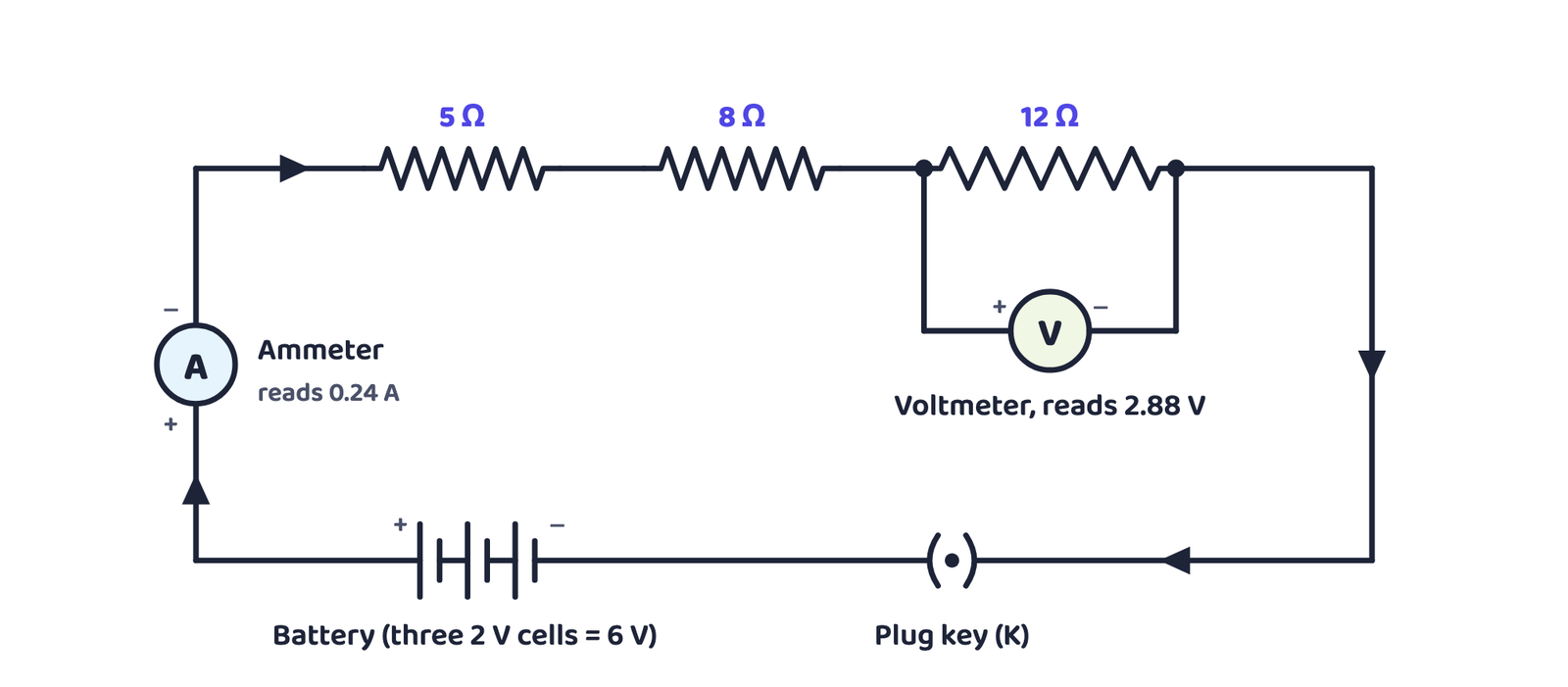
Q. Draw a schematic diagram of a circuit consisting of a battery of three cells of 2 V each, a 5 Ω resistor, an 8 Ω resistor, and a 12 Ω resistor, and a plug key, all connected in series.
Answer: Draw one closed loop: the three 2 V cells joined end to end (positive terminal of one to the negative terminal of the next) form a 6 V battery; from the battery, the wire goes through the 5 Ω, 8 Ω and 12 Ω resistors one after another, then through the plug key, and back to the battery (see the diagram). Every component is in the same single path, so they are all in series.

Q. Redraw the circuit of Question 1, putting in an ammeter to measure the current through the resistors and a voltmeter to measure the potential difference across the 12 Ω resistor. What would be the readings in the ammeter and the voltmeter?
Answer: The ammeter goes in series anywhere in the loop, and the voltmeter is connected in parallel across the 12 Ω resistor.
Total resistance R = 5 + 8 + 12 = 25 Ω; battery voltage V = 3 × 2 = 6 V.
Ammeter reading: I = V/R = 6/25 = 0.24 A.
Voltmeter reading: V = IR = 0.24 × 12 = 2.88 V.
Questions after Section 11.6.2
Q. Judge the equivalent resistance when the following are connected in parallel: (a) 1 Ω and 10⁶ Ω, (b) 1 Ω and 10³ Ω, and 10⁶ Ω.
Answer: In parallel, the equivalent resistance is always less than the smallest individual resistance.
(a) 1/R = 1/1 + 1/10⁶ = 1.000001, so R ≈ 0.999999 Ω, that is, just under 1 Ω.
(b) 1/R = 1/1 + 1/10³ + 1/10⁶ = 1.001001, so R ≈ 0.999 Ω, again just under 1 Ω.
Q. An electric lamp of 100 Ω, a toaster of resistance 50 Ω, and a water filter of resistance 500 Ω are connected in parallel to a 220 V source. What is the resistance of an electric iron connected to the same source that takes as much current as all three appliances, and what is the current through it?
Answer: 1/Rp = 1/100 + 1/50 + 1/500 = (5 + 10 + 1)/500 = 16/500, so Rp = 500/16 = 31.25 Ω.
An iron that takes as much current as all three together must have the same resistance, 31.25 Ω.
Current through it: I = V/R = 220/31.25 = 7.04 A.
Q. What are the advantages of connecting electrical devices in parallel with the battery instead of connecting them in series?
Answer: (i) Each device gets the full voltage of the source. (ii) Each device draws only the current it needs, so devices needing different currents can work together. (iii) If one device fails or is switched off, the others keep working. (iv) The total resistance of the circuit is reduced.
Q. How can three resistors of resistances 2 Ω, 3 Ω, and 6 Ω be connected to give a total resistance of (a) 4 Ω, (b) 1 Ω?
Answer: (a) Connect the 3 Ω and 6 Ω resistors in parallel, and this combination in series with the 2 Ω resistor: 3 × 6/(3 + 6) = 2 Ω, then 2 + 2 = 4 Ω.
(b) Connect all three in parallel: 1/R = 1/2 + 1/3 + 1/6 = (3 + 2 + 1)/6 = 1, so R = 1 Ω.
Q. What is (a) the highest, (b) the lowest total resistance that can be secured by combinations of four coils of resistance 4 Ω, 8 Ω, 12 Ω, 24 Ω?
Answer: (a) Highest: all four in series, 4 + 8 + 12 + 24 = 48 Ω.
(b) Lowest: all four in parallel, 1/R = 1/4 + 1/8 + 1/12 + 1/24 = (6 + 3 + 2 + 1)/24 = 12/24, so R = 2 Ω.
Questions after Section 11.7
Q. Why does the cord of an electric heater not glow while the heating element does?
Answer: The same current flows through both, but the heating element (an alloy such as nichrome) has a much higher resistance than the copper cord. Heat produced, H = I²Rt, is proportional to resistance for the same current, so the element gets hot enough to glow while the low-resistance cord hardly heats up.
Q. Compute the heat generated while transferring 96000 coulomb of charge in one hour through a potential difference of 50 V.
Answer: H = VQ = 50 V × 96000 C = 4.8 × 10⁶ J. (The time, one hour, is not needed once the charge is known.)
Q. An electric iron of resistance 20 Ω takes a current of 5 A. Calculate the heat developed in 30 s.
Answer: H = I²Rt = 5² × 20 × 30 = 25 × 20 × 30 = 15000 J = 1.5 × 10⁴ J.
Questions after Section 11.8
Q. What determines the rate at which energy is delivered by a current?
Answer: Electric power. The rate at which electrical energy is delivered (or consumed) is P = VI, so it is determined by the potential difference and the current; it can also be written P = I²R = V²/R.
Q. An electric motor takes 5 A from a 220 V line. Determine the power of the motor and the energy consumed in 2 h.
Answer: Power P = VI = 220 × 5 = 1100 W = 1.1 kW.
Energy in 2 h: E = P × t = 1100 W × 7200 s = 7.92 × 10⁶ J, which is 1.1 kW × 2 h = 2.2 kWh.
B End-of-chapter Exercises
- 1 markA piece of wire of resistance R is cut into five equal parts. These parts are then connected in parallel. If the equivalent resistance of this combination is R’, then the ratio R/R’ is:
(a) 1/25(b) 1/5(c) 5(d) 25 - 1 markWhich of the following terms does not represent electrical power in a circuit?
(a) (b) (c) (d) - 1 markAn electric bulb is rated 220 V and 100 W. When it is operated on 110 V, the power consumed will be:
(a) 100 W(b) 75 W(c) 50 W(d) 25 W - 1 markTwo conducting wires of the same material and of equal lengths and equal diameters are first connected in series and then in parallel in a circuit across the same potential difference. The ratio of heat produced in series and parallel combinations would be:
(a) 1:2(b) 2:1(c) 1:4(d) 4:1 - 2 marksHow is a voltmeter connected in the circuit to measure the potential difference between two points?
- 4 marksA copper wire has diameter 0.5 mm and resistivity of . What will be the length of this wire to make its resistance 10 Ω? How much does the resistance change if the diameter is doubled?
- 4 marksThe values of current I flowing in a given resistor for the corresponding values of potential difference V across the resistor are given below. Plot a graph between V and I, and calculate the resistance of that resistor.
I (amperes) 0.5 1.0 2.0 3.0 4.0 V (volts) 1.6 3.4 6.7 10.2 13.2 - 2 marksWhen a 12 V battery is connected across an unknown resistor, there is a current of 2.5 mA in the circuit. Find the value of the resistance of the resistor.
- 2 marksA battery of 9 V is connected in series with resistors of 0.2 Ω, 0.3 Ω, 0.4 Ω, 0.5 Ω and 12 Ω, respectively. How much current would flow through the 12 Ω resistor?
- 2 marksHow many 176 Ω resistors (in parallel) are required to carry 5 A on a 220 V line?
- 2 marksShow how you would connect three resistors, each of resistance 6 Ω, so that the combination has a resistance of (i) 9 Ω, (ii) 4 Ω.
- 2 marksSeveral electric bulbs designed to be used on a 220 V electric supply line are rated 10 W. How many lamps can be connected in parallel with each other across the two wires of a 220 V line if the maximum allowable current is 5 A?
- 4 marksA hot plate of an electric oven connected to a 220 V line has two resistance coils A and B, each of 24 Ω resistance, which may be used separately, in series, or in parallel. What are the currents in the three cases?
- 4 marksCompare the power used in the 2 Ω resistor in each of the following circuits: (i) a 6 V battery in series with 1 Ω and 2 Ω resistors, and (ii) a 4 V battery in parallel with 12 Ω and 2 Ω resistors.
- 2 marksTwo lamps, one rated 100 W at 220 V, and the other 60 W at 220 V, are connected in parallel to electric mains supply. What current is drawn from the line if the supply voltage is 220 V?
- 2 marksWhich uses more energy, a 250 W TV set in 1 hr, or a 1200 W toaster in 10 minutes?
- 2 marksAn electric heater of resistance 44 Ω draws 5 A from the service mains for 2 hours. Calculate the rate at which heat is developed in the heater.
- 6 marksExplain the following: (a) Why is tungsten used almost exclusively for the filament of electric lamps? (b) Why are the conductors of electric heating devices, such as bread-toasters and electric irons, made of an alloy rather than a pure metal? (c) Why is the series arrangement not used for domestic circuits? (d) How does the resistance of a wire vary with its area of cross-section? (e) Why are copper and aluminium wires usually employed for electricity transmission?
- (d) 25. Each of the five equal parts has resistance . In parallel, , so . Thus .
- (b) . , and are all standard forms of power (); does not match any of them.
- (d) 25 W. Resistance of the bulb, (fixed by the filament). At 110 V: .
- (c) 1:4. Let each wire have resistance . Series: , so . Parallel: , so . Since heat produced power (same , same ): .
- A voltmeter is always connected in parallel across the two points between which the potential difference is to be measured, never in series, because a voltmeter has very high resistance and would almost stop the current if placed in series.
- Length ≈ 122.7 m. Area . From : . Since , doubling the diameter makes four times as large, so the resistance falls to one-quarter: new .
- R ≈ 3.3 Ω. Plotting V (y-axis) against I (x-axis) gives a straight line through the origin (Ohm’s law). The slope, , taken from the line gives the resistance: (each individual pair, 3.2, 3.4, 3.35, 3.4, 3.3, averages to this same value).

V-I graph of the given readings: the points lie on a straight line through the origin; slope = 13.2 V ÷ 4.0 A ≈ 3.3 Ω.
- R = 4800 Ω (4.8 kΩ). . .
- I ≈ 0.67 A. Total resistance (series) . . In a series circuit this same current flows through every resistor, including the 12 Ω one.
- 4 resistors. Required total resistance . For resistors of 176 Ω in parallel, . Setting gives .
- (i) 9 Ω: Connect one 6 Ω resistor in series with the parallel combination of the other two: .
(ii) 4 Ω: Connect one 6 Ω resistor in parallel with the series combination of the other two: .
- 110 lamps. Current per bulb . Maximum number of bulbs total allowable current ÷ current per bulb .
- Separately: ≈9.17 A each. Series: ≈4.58 A. Parallel: ≈18.3 A. Each coil alone: . In series: , . In parallel: , .
- Equal: 8 W in the 2 Ω resistor in both circuits. (i) Series: , , power in 2 Ω . (ii) Parallel: the 2 Ω resistor gets the full battery voltage, , so power . The ratio of power used in the 2 Ω resistor is 1:1.
- ≈0.73 A. Both lamps get the full 220 V (parallel). Total power . Current drawn .
- The TV uses more energy. TV: . Toaster: . .
- Rate of heat production = 1100 W (1.1 kW). : this is the rate at which heat is generated every second. (Total heat produced over the full 2 hours .)
- (a) Tungsten has a very high melting point (3380°C), so it can be heated to a high enough temperature to glow brightly without melting.
- (b) Alloys have higher resistivity than pure metals and, importantly, do not oxidise (burn) readily even at high temperatures: a pure metal coil would burn out quickly at the temperatures a heating element must reach.
- (c) In series, if even one appliance fails or is switched off, the circuit breaks and every other appliance stops working; also, different appliances need different currents to work properly, which a single series current cannot provide. Parallel wiring avoids both problems.
- (d) Resistance is inversely proportional to the area of cross-section (): a thicker wire (larger area) has lower resistance.
- (e) Copper and aluminium have very low resistivity, so they conduct electricity with very little energy lost as heat, which is exactly what a transmission line needs.