
- What an ecosystem is, and how biotic and abiotic components work together in it
- Food chains, food webs and trophic levels, and why food chains rarely run past 3-4 steps
- The 10% rule of energy transfer, and how it causes biological magnification of pesticides
- How the ozone layer forms, why it is depleting, and what CFCs have to do with it
- The difference between biodegradable and non-biodegradable waste, and why plastics persist
food chainfood webtrophic level10% rule
biological magnificationozone layerCFCs
biodegradablenon-biodegradable
1 The Ecosystem and Its Components
All organisms (plants, animals, microorganisms and human beings) interact constantly with
each other and with the physical world around them, and together they maintain a balance in
nature. This whole interacting system, living and non-living together, is called an ecosystem.
Ecosystem: all the interacting organisms in an area, together with the non-living
constituents of the environment.
Biotic components: the living organisms of an ecosystem, namely plants, animals,
microorganisms and humans.
Abiotic components: the physical, non-living factors of an ecosystem, namely
temperature, rainfall, wind, soil and minerals.
A garden is a working example: grasses and trees, flowering plants such as rose, jasmine and
sunflower, and animals such as frogs, insects and birds all interact, and their growth and
reproduction are shaped by the abiotic factors around them. That whole garden is one ecosystem.
Natural ecosystems
- Forests
- Ponds
- Lakes
Human-made (artificial) ecosystems
- Gardens
- Crop-fields
- An aquarium you set up yourself
Organisms in every ecosystem, natural or artificial, are grouped by how they get their food:
Producers (autotrophs)
Make their own food (organic compounds such as sugars and starch, built from simple raw
materials like water and carbon dioxide, called inorganic substances) using the Sun’s energy
in the presence of chlorophyll, the green substance in leaves. All green plants and certain
bacteria fall in this group.
Consumers
Depend on producers directly or indirectly for food. There are four kinds:
herbivores (eat only plants), carnivores (eat only animals), omnivores
(eat both, e.g. humans, bears) and parasites (live on or inside another organism and
feed off it, e.g. a tapeworm).
Decomposers
Microorganisms (bacteria and fungi) that break down dead remains and waste into simple
inorganic substances, returning them to the soil for plants to use again.
“What would happen to the garbage, dead plants and animals if decomposers were absent?” is a
favourite reasoning question. Answer: nutrients would stop returning to the soil, dead matter
would simply pile up, and plants would have fewer of the raw materials they need to grow.
2 Food Chains, Food Webs and Trophic Levels
Food chain: a series of organisms, each feeding on the one before it.
Trophic level: each step or level of a food chain.
A simple food chain on land (a “terrestrial” food chain), with all four trophic levels in order:
The book’s Figure 13.1 shows three food chains found in nature, one each in a forest, a
grassland and a pond:
| Where | Food chain (each arrow points from the eaten to the eater) |
|---|---|
| (a) In a forest | Trees and plants → Deer → Tiger |
| (b) In a grassland | Grass → Grasshopper → Frog → Snake → Eagle (a bird of prey) |
| (c) In a pond | Aquatic plants → Small aquatic animals → Fish → Heron (a fish-eating bird) |
Every one of these chains begins with a green plant, the producer. The pond chain is the one
to remember for an aquatic example; the grassland chain shows that a chain can occasionally
run to five steps.
Every organism is usually eaten by two or more kinds of organisms, which are in turn eaten by
several others, so instead of one straight line, the real relationship branches into a
food web: several food chains interlinked through the organisms they share.
Food web: a network of interconnected food chains, formed because most organisms are
eaten by more than one other organism, and themselves eat more than one kind of organism.

2.1 Energy Flow and the 10% Rule
Sunlight is the ultimate source of energy for almost every ecosystem, but very little of it
actually gets used at each step:
When green plants are eaten by primary consumers, a great deal of energy is lost as heat, some
goes into digestion and physical activity, and only the rest goes towards growth and reproduction. On
average, only about 10% of the food eaten becomes new body mass, passed on to the next trophic
level. At every step, the other roughly 90% is lost, mostly as heat.
This is why food chains generally have only three or four steps: by the fourth level, there is
barely any usable energy left to support a fifth. It is also why there are always far more
individual organisms at the lower trophic levels than at the higher ones, with producers being the
most numerous of all. On top of this, energy in an ecosystem only ever flows in one
direction, from producers to primary consumers to secondary consumers and so on, and never
flows back down to the level it came from.
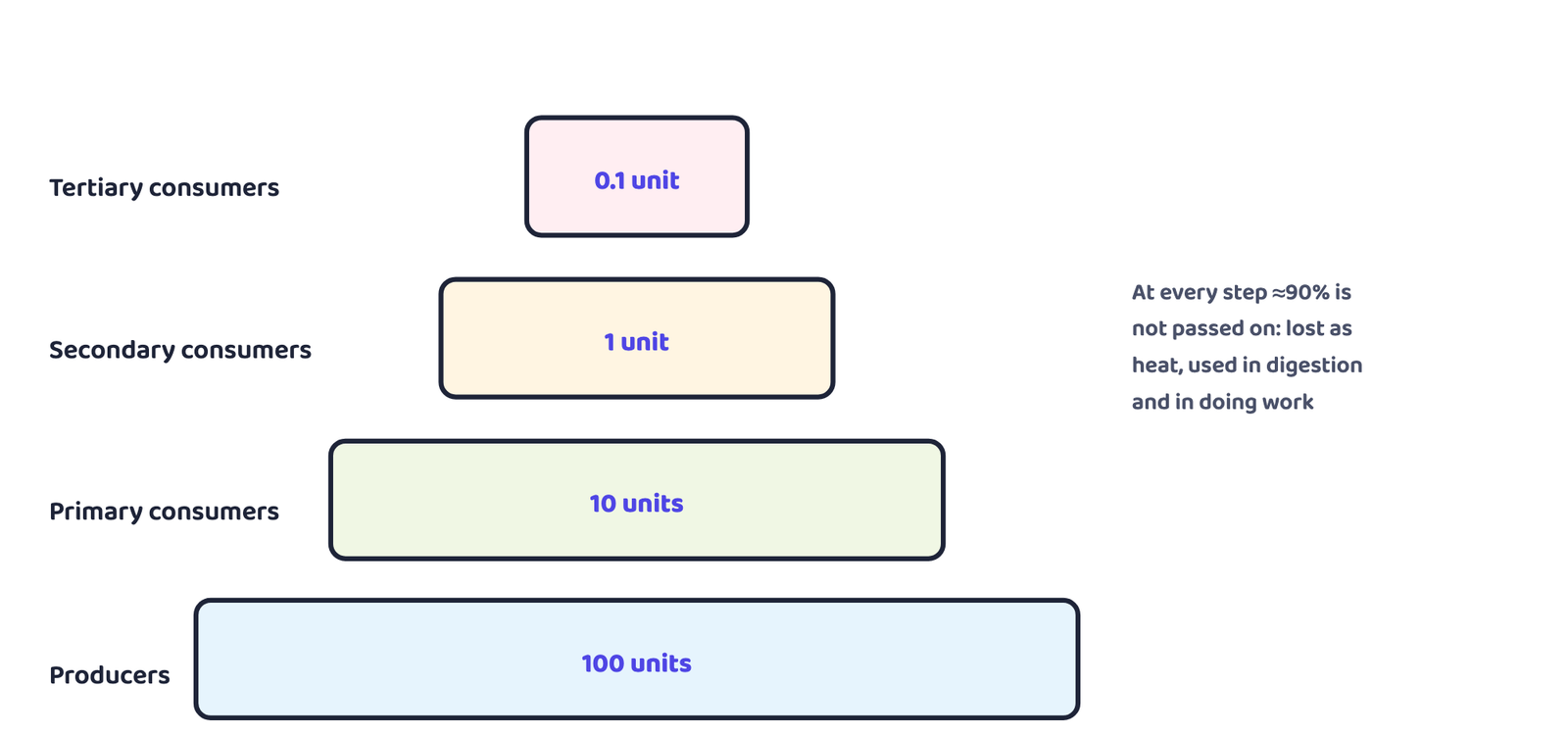
of energy at the producer level, each higher level receives only about a tenth of the level below
it. (These round numbers are only to show the pattern, not exact figures to memorise.)
“Why do food chains rarely have more than 3-4 trophic levels?” is asked almost every year.
Answer in this order: energy decreases at every step (only ~10% passes on) → by the 4th or 5th
level there simply isn’t enough usable energy left to support another level.
2.2 Biological Magnification
Pesticides and other chemicals sprayed to protect crops are washed into the soil or into water
bodies. From the soil they are absorbed by plants along with water and minerals; from water bodies
they are taken up by aquatic plants and animals: this is how they first enter a food chain.
Because these chemicals cannot be broken down naturally, they accumulate a little more at every
trophic level they pass through.
Biological magnification: the increasing build-up of a harmful chemical that cannot be
broken down naturally (such as a pesticide) at each successive trophic level of a food chain.
Since human beings sit at the top of virtually every food chain, the maximum concentration of
these chemicals builds up in the human body. This is exactly why food grains such as wheat and
rice, vegetables, fruits, and even meat carry pesticide residues that washing cannot fully remove.
Biological magnification does not mean the chemical becomes more toxic as it moves up the
chain: the chemical itself stays the same. What increases is how much of it builds up
(its concentration) in the bodies of organisms at higher trophic levels, because the body
cannot break it down or pass it back out.
3 How Do Our Activities Affect the Environment?
Human activity affects the environment in many ways, but this chapter looks closely at two of
them: the depletion of the ozone layer, and the growing problem of waste disposal.
3.1 The Ozone Layer and How It Is Getting Depleted
Ozone (O₃): a molecule made of three atoms of oxygen. The O₂ we normally breathe is
essential for all aerobic life (life that needs oxygen to survive), but ozone itself is a deadly
poison. At the higher levels of the
atmosphere, though, ozone performs an essential protective job: it shields the Earth’s surface
from the Sun’s ultraviolet (UV) radiation, which is highly damaging to organisms and is known to
cause skin cancer in humans.
atoms; each atom then combines with another molecule to form ozone.
The amount of ozone in the atmosphere began dropping sharply in the 1980s. This decline
has been linked to synthetic (human-made) chemicals called CFCs (chlorofluorocarbons), used
as refrigerants (the substance that keeps a fridge cold) and in fire extinguishers. In 1987, the United Nations Environment
Programme (UNEP) got countries to agree to freeze CFC production at 1986 levels, and it
is now mandatory worldwide for manufacturers to make CFC-free refrigerators.
3.2 Managing the Garbage We Produce
Our digestive enzymes (the substances in our body that break food down) only work on specific
substances: a particular enzyme breaks down only a particular kind of material, which is exactly
why our bodies get no energy from trying to eat something like coal. Bacteria and other saprophytes
(organisms, like decomposers, that feed on dead or decaying matter) work the same specific way: the
enzymes they use to break down dead matter also act only on particular substances. So many
human-made materials, especially plastics, simply do not get broken down by them at all. Such
materials are only acted on by physical processes like heat and pressure, so lying in the soil or a
dump, they persist for a very long time.
Biodegradable
- Broken down by biological processes
- e.g. kitchen waste, vegetable peels, paper, cloth
- Returns to the soil as usable nutrients
Non-biodegradable
- Not broken down by biological processes
- e.g. plastics and other synthetic materials
- Either persists for a very long time, or harms organisms in the ecosystem
Biodegradable substances are broken down by biological processes.
Non-biodegradable substances are not broken down this way: they may simply persist in
the environment for a long time, or they may harm members of the ecosystem.
Disposable cups in trains: tea used to be served in plastic glasses that had to be
returned to the vendor. Disposable cups were then introduced, hailed as a step forward for
hygiene, but nobody at that time thought about the impact of throwing away millions of them daily. Kulhads
(disposable cups made of clay) were then suggested as an alternative, but a little thought showed
that making kulhads on a large scale would result in the loss of fertile top-soil. Now disposable
paper cups are being used. The book ends the box by asking what the advantages of disposable
paper cups are over disposable plastic cups. The key advantage: paper is biodegradable, so used
paper cups are broken down by decomposers, while plastic cups are non-biodegradable and persist
in the environment for a long time.
We are generating more waste today because of three changes in how we live: an improved
lifestyle simply produces more waste, we now throw away more of what we use instead of reusing it,
and changes in packaging have made much of that waste non-biodegradable.
✓ Good waste practice
- Separate biodegradable and non-biodegradable waste at source
- Find out how your local body (panchayat / municipal corporation / resident welfare association, RWA) collects and treats waste
- Check that sewage (used water carrying waste) is treated before it reaches local water bodies
✗ Avoid
- Mixing biodegradable and non-biodegradable waste together
- Letting industrial waste reach soil or water untreated
- Assuming something labelled “eco-friendly” has no environmental cost of its own: kulhads, for example, would cost fertile top-soil if made on a large scale
If asked “how can you help reduce waste disposal problems,” give concrete methods: segregate
(sort) waste at home into biodegradable and non-biodegradable, reduce use of disposable plastics,
compost biodegradable kitchen waste (let it break down naturally into manure), and support
recycling of paper, glass and metal.
Every food chain in nature obeys the same two rules: energy always moves the same way, from
producers upward, and at every step, most of it is lost.
This chapter in one line
- Can I name the biotic and abiotic components of an ecosystem, with an example of each?
- Can I draw a 4-step food chain and label all four trophic levels?
- Can I explain the 10% rule and use it to explain why food chains are short?
- Can I explain biological magnification in my own words, with an example?
- Can I write the two equations for ozone formation and explain why ozone depletion matters?
- Can I define biodegradable and non-biodegradable waste, each with two examples?
- Ecosystem = biotic (living) + abiotic (temperature, rainfall, wind, soil, minerals) components
- Producers (autotrophs) → primary consumers (herbivores) → secondary consumers (small carnivores) → tertiary consumers (large carnivores): four trophic levels, in that order
- Green plants capture ~1% of sunlight energy; only ~10% of food eaten passes to the next trophic level, so food chains rarely exceed 3-4 steps
- A food web is many food chains sharing organisms, not a single line
- Biological magnification: pesticides that cannot be broken down naturally build up most in organisms at the top of the food chain, including humans
- Ozone (O₃) shields Earth from UV radiation; CFCs have depleted it since the 1980s; UNEP’s 1987 agreement froze CFC production at 1986 levels
- Biodegradable waste is broken down biologically; non-biodegradable waste (like plastics) persists because the enzymes that break things down only work on specific substances