
- Why money solves the “double coincidence of wants” problem that a barter system creates
- How banks use deposits to give loans, and why this makes credit possible on a large scale
- How the same credit can help a borrower (Salim) or trap a borrower in debt (Swapna)
- What the “terms of credit” are, using Megha’s house loan and the Sonpur village examples
- Why formal credit (banks, cooperatives) is cheaper than informal credit (moneylenders, traders), and why the poor still depend on the informal sector
- How Self-Help Groups help the poor overcome the collateral problem, and why the Grameen Bank of Bangladesh is called one of the biggest success stories in reaching the poor
1Money as a Medium of Exchange
Money is used in a very large part of everyday life, so much so that it is
easy to overlook how strange it would be to live without it. Imagine a shoe
manufacturer who wants to sell shoes and buy wheat. Without money, he would
have to find a wheat-growing farmer who not only wants to sell wheat, but also
wants to buy shoes in exchange. Both people would have to agree to sell and
buy each other’s exact commodities at the same time.
This requirement is called the double coincidence of wants: “what a
person desires to sell is exactly what the other wishes to buy.” In a
barter system, where goods are exchanged directly without money,
double coincidence of wants is an essential feature.
Money removes this problem. A person holding money can exchange it for any
commodity or service they want, so everyone prefers to receive payment in
money and then exchange that money for whatever they need. The shoe
manufacturer now only has to find any buyer for his shoes; once he has
the money, he can buy wheat, or anything else, from anyone selling it.
Money is called a medium of exchange because it acts as the crucial
intermediate step in a transaction, eliminating the need for double
coincidence of wants.
2Modern Forms of Money
Before coins, people used a variety of objects as money: since very early
times, Indians used grains and cattle, and later metallic coins of gold,
silver and copper, a phase that continued well into the last century. Modern
currency is different from all of these: it is not made of a precious metal,
and unlike grain or cattle, it has no everyday use of its own.
The book’s coin pictures run from early punch-marked coins (may be 2500
years old), through Gupta coins, a Tughlaq coin and a gold mohar from Akbar’s
reign, to a modern coin.
Modern currency is accepted as a medium of exchange because it is
authorised by the government of the country. In India, the Reserve
Bank of India (RBI) issues currency notes on behalf of the central
government, and the law does not allow any other individual or organisation
to issue currency. No one in India can legally refuse a payment made in
rupees.
2.1 Deposits with banks, and demand deposits
People do not need all their money in cash all the time. Workers who receive
a salary at the end of the month, for instance, have extra cash at the start
of the month. They deposit this with a bank, which accepts the deposit and
pays interest on it. Because these deposits can be withdrawn “on demand,” they
are called demand deposits.
Demand deposits are bank deposits that can be withdrawn by the
account holder whenever they need the money. Since they are widely accepted
as a means of payment, along with currency, they also count as money in the
modern economy.
A demand deposit can be paid out by cheque instead of cash. A cheque is a
paper instructing the bank to pay a specific amount from the payer’s account
to whoever is named on it.
A shoe manufacturer, M. Salim, has to pay his leather supplier. He
writes a cheque for the amount, instructing his bank to pay the leather
supplier. The supplier deposits the cheque in his own bank account, and the
money is transferred from Salim’s account to the supplier’s account in a
couple of days. The whole transaction is completed without any cash
changing hands.
3Loan Activities of Banks
What do banks do with the deposits they collect? They keep back only a small
part as cash, and lend out the rest.
Since only some depositors come to withdraw cash on any given day, banks can
manage comfortably with this small cash reserve, and lend out the major
portion of their deposits to meet the huge demand for loans in the economy.
Banks mediate between depositors, who have surplus money, and
borrowers, who need money. The difference between the interest charged
on loans and the interest paid on deposits is the bank’s main source of
income.
4Two Different Credit Situations
Credit (loan) refers to an agreement in which the lender supplies
the borrower with money, goods or services in return for a promise of
future payment.
Credit is not automatically good or bad for the borrower: it depends on the
situation. The chapter compares two examples.
(1) Festival Season: Salim
- Gets an order for 3,000 pairs of shoes, to be delivered in a month
- Takes credit from two sources: leather on credit from his supplier, and a cash advance from the trader for 1,000 pairs
- Completes the order on time, makes a good profit, and repays both loans
- Credit meets his working-capital needs and helps him earn more
(2) Swapna’s Problem
- Small farmer with 3 acres, growing groundnut, borrows from a moneylender for cultivation
- Pest attack destroys the crop despite spraying expensive pesticides
- Cannot repay; debt grows; next year’s normal crop still isn’t enough to clear the old loan
- She is caught in a debt trap and must sell part of her land
A debt trap is what happens when credit, instead of helping a
borrower increase their earnings, pushes them into a situation “from which
recovery is very painful”, as with Swapna, where a crop failure meant the
loan could not be repaid and had to be settled by selling land.
In rural areas, the main demand for credit is for crop production: seeds,
fertilisers, pesticides, water, electricity and equipment repair all cost
money, and there is a gap of three to four months between buying these inputs
and selling the harvested crop. Farmers usually take a crop loan at the start
of the season and repay it after harvest, so repayment depends crucially on
the success of that one harvest.
“Whether credit would be useful or not, therefore, depends on the risks in
the situation and whether there is some support, in case of loss.”
the chapter’s own conclusion, comparing Salim and Swapna
5Terms of Credit
Every loan agreement fixes an interest rate that the borrower must pay along
with the principal. Lenders may also demand collateral.
Collateral is an asset the borrower owns (such as land, a building,
a vehicle, livestock, or deposits with a bank), which is used as a guarantee
to the lender until the loan is repaid. If the borrower cannot repay, the
lender has the right to sell the collateral to recover the payment.
Megha takes a loan of ₹5 lakh from a bank to buy a house.
The annual interest rate is 12 per cent, and the loan is to be repaid
over 10 years in monthly instalments. She had to submit her
employment and salary records before the bank agreed to the loan, and the
bank retained the house’s own papers as collateral, returned to her only
once the loan is fully repaid with interest.
Interest rate, collateral, documentation requirements, and the mode of
repayment, taken together, are called the terms of credit. Terms of
credit vary a great deal from one credit arrangement to another, depending
on the nature of the lender and the borrower.
6Variety of Credit Arrangements: A Village Example
Two students, Rohit and Ranjan, wanted to know who lends and who borrows in
their own area, so they interviewed people in their village, Sonpur
(interview recorded 15th Nov, 2019). Here is what they found:
Shyamal: Small Farmer
Grows potato on 1.5 acres. Until a few years ago, borrowed from the
village moneylender at 5 per cent per month (60 per cent per annum). For
the last few years, borrows instead from an agricultural trader in the
village at 3 per cent per month; besides interest, the trader makes him
promise to sell the crop to him; the trader profits by buying cheap
right after harvest and selling later at a higher price.
Arun: Farmer With a Bank Loan
Has 7 acres and is one of the few in Sonpur to get a bank loan for
cultivation, at 8.5 per cent per annum, repayable anytime in the next
three years. Plans to repay after harvest, store the rest of his potatoes
in cold storage, and use the cold-storage receipt to apply for a fresh
bank loan, a facility the bank offers to its existing crop-loan
borrowers.
Rama: Landless Labourer
Works as an agricultural labourer, with no work for several months of
the year. Depends on her employer, a medium landowner in Sonpur, who
charges 5 per cent per month interest; she repays by working for him, and
usually needs a fresh loan before the old one is cleared. Currently owes
him ₹5,000. Rama tells us that the only source of credit for the
landless people in Sonpur are the landowner-employers.
Krishak Cooperative
A cooperative society functioning near Sonpur, with 2,300 farmer
members. It accepts deposits from members, uses them as collateral to
obtain a large loan from a bank, and re-lends this to members for farm
implements, cultivation, agricultural trade, fishery, and house
construction. Once a loan is repaid, another round of lending begins.
The chapter gives the moneylender’s rate as 5% per month (60% per
annum), but gives no annual figure for the trader’s 3% per month
(3 × 12 = 36% a year at simple interest).
7Formal Sector Credit in India
Loans can be grouped as formal sector loans (from banks and
cooperatives) or informal sector loans (from moneylenders, traders,
employers, relatives and friends).
A cooperative is a society whose members pool their resources for
cooperation in certain areas. There are several types, such as farmers
cooperatives, weavers cooperatives and industrial workers cooperatives.
Besides banks, cooperatives are the other major source of cheap credit in
rural areas.

banks alone provide 51% of rural credit; moneylenders, the largest informal
source, provide 23%.
The Reserve Bank of India (RBI) supervises the formal sector: it monitors
banks to see they actually maintain their minimum cash balance, and that they
lend not only to profit-making businesses and traders but also to small
cultivators, small-scale industries and small borrowers. Banks must
periodically report to the RBI how much they are lending, to whom, and at
what interest rate.
There is no organisation supervising the informal sector. Informal
lenders can charge whatever interest rate they choose, and no one stops them
from using unfair means to recover their money.
Because informal lenders usually charge much higher interest than formal
lenders, the cost of borrowing is much higher for the poor, leaving them with
less income for themselves (as with Shyamal); in some cases, the amount to be
repaid can even exceed the borrower’s income, leading to a debt trap (as with
Rama). High borrowing costs can also stop people from starting a new
enterprise. This is why banks and cooperative societies need to lend more,
particularly in rural areas, so that dependence on informal sources falls
and cheap, affordable credit becomes available for the country’s
development.
8Formal and Informal Credit: Who Gets What?
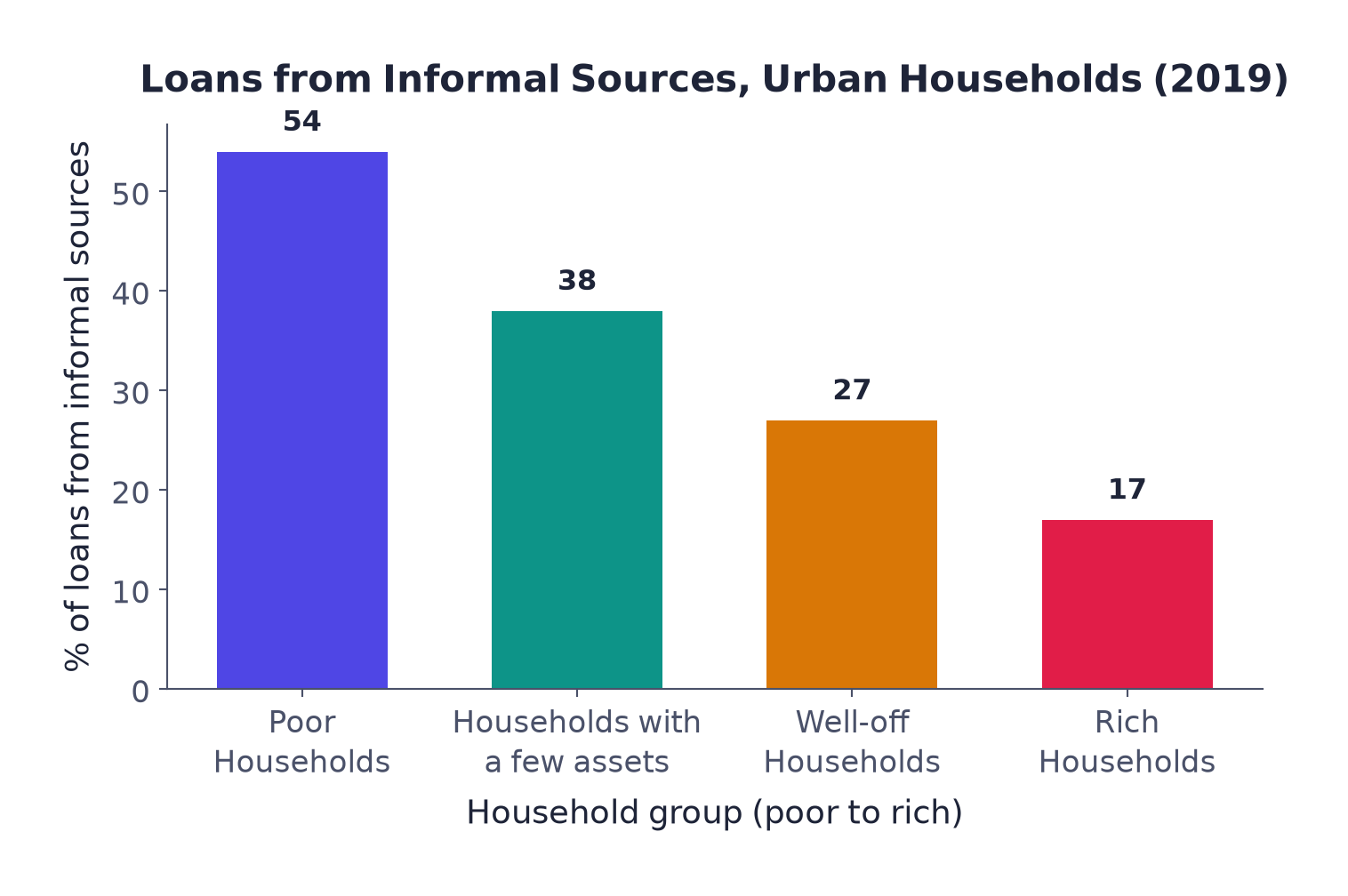
informal sources, 2019: 54% for poor households, falling to just 17% for
rich households (so their remaining 46% and 83% respectively come from
formal sources). A similar pattern holds in rural areas.
Graph 2 divides urban households into four groups, from poor to rich: poor
households, households with a few assets, well-off households and rich
households. Poor urban households get 54% of their loans from informal sources, while
rich urban households get only 17% of theirs from informal sources. The
richer a household, the more of its credit comes from formal, cheaper
sources.
First, the formal sector still meets only about half of the total
credit needs of rural people; the rest comes from informal sources.
Second, while formal-sector loans need to expand, it is equally
important that everyone receives them: at present, it is the richer households
who receive formal credit whereas the poor depend on informal sources, so
formal credit needs to be distributed more equally.
9Self-Help Groups for the Poor
Why do poor households still depend on informal credit? Banks are not
present everywhere in rural India, and even where they are, a bank loan is
much harder to get than an informal loan: it needs proper documents and
collateral (as with Megha).
Absence of collateral is one of the major reasons the poor cannot get
bank loans. Informal lenders such as moneylenders know their borrowers
personally and are often willing to lend without collateral, but they
charge very high interest, keep no records of transactions, and harass
poor borrowers.
In recent years, a newer way of lending to the poor has developed: organise
the rural poor, especially women, into small Self-Help Groups (SHGs)
that pool their savings.
A Self-Help Group (SHG) typically has 15-20 members, usually
from one neighbourhood, who meet and save regularly. Savings per member
range from ₹25 to ₹100 or more, depending on the members’ ability
to save. Members can take small loans from the group itself, at an interest
rate lower than a moneylender’s.
This group responsibility is exactly why banks are willing to lend to poor
women organised in SHGs, even though they have no collateral. SHGs help
overcome the collateral problem, provide timely loans at a reasonable rate,
and act as building blocks for organising the rural poor: members use loans to
release mortgaged land, meet working-capital needs (seeds, fertilisers,
bamboo, cloth), buy housing materials, or acquire assets like a sewing
machine, handloom or cattle. Beyond credit, the regular meetings give women a
platform to discuss health, nutrition, domestic violence and other social
issues, alongside becoming more financially self-reliant.
Started in the 1970s as a small project, the Grameen Bank of
Bangladesh had grown by 2018 to over 9 million members across
about 81,600 villages, almost all of them women from the poorest
sections of society. Its founder, Professor Muhammad Yunus, won the
2006 Nobel Prize for Peace and said: “If credit can be made available
to the poor people on terms and conditions that are appropriate and
reasonable these millions of small people with their millions of small
pursuits can add up to create the biggest development wonder.”
“On one side are the depositors who keep their money in the banks and on
the other side are the borrowers who take loans from these banks. …
Credit, as we saw can have a positive impact, or in certain situations make
the borrower worse off.”
the chapter’s own summing up
- Can I explain, with the shoe-manufacturer example, why money solves the double coincidence of wants?
- Can I explain, using Salim and Swapna, why the same credit can help one borrower and trap another?
- Can I list all four terms of credit, and use Megha’s house loan as an example?
- Can I state Shyamal’s, Arun’s and Rama’s interest rates and sources of credit without looking?
- Can I read Graph 1 and Graph 2 and explain what each one shows?
- Can I explain why absence of collateral is one of the major reasons the poor cannot get bank loans, and how an SHG helps overcome this?
- Money is a medium of exchange: it removes the need for a double coincidence of wants that a barter system requires
- Currency is accepted because the government authorises it; demand deposits count as money too, and can be paid by cheque
- Banks keep about 5% of deposits as cash and lend the rest; the gap between loan interest and deposit interest is their main source of income
- Credit can help (Salim’s festival-season loan) or trap a borrower in debt (Swapna’s crop failure)
- Terms of credit = interest rate + collateral + documentation + repayment mode (Megha: ₹5 lakh, 12%, 10 years)
- In Sonpur, Shyamal borrows from a trader now instead of a 60%/year moneylender; Arun gets a cheaper 8.5%/year bank loan; Rama, landless, depends only on her landowner-employer
- Graph 1: banks (51%) and moneylenders (23%) are rural India’s two biggest credit sources; the RBI supervises only the formal sector
- Graph 2: poorer households depend far more on informal credit (54% for the poor vs 17% for the rich); the chapter says the formal sector still meets only about half of rural credit needs
- SHGs (15-20 members, save regularly, group responsible for repayment) let poor women organised in SHGs get bank loans even without collateral; the Grameen Bank of Bangladesh (founder Muhammad Yunus, 2006 Nobel Peace Prize) is one of the biggest success stories in reaching the poor
- 1 markDefine collateral.
- 1 markWhat is a demand deposit?
- 3 marksWhy does a barter system need a “double coincidence of wants,” and how does money remove this problem?
- 3 marksUsing Salim’s and Swapna’s examples, explain how credit can have both a positive and a negative role.
- 3 marksWhat are the terms of credit? Illustrate using Megha’s house loan.
- 5 marksWhy do banks in India need to expand formal credit, especially to the poor? Use Graph 1 and Graph 2 in your answer.
- 5 marksExplain how Self-Help Groups help the rural poor overcome the problem of collateral.