
- How the French Revolution first turned “the people” into “the nation,” and what Napoleon did with that idea across Europe
- What liberal nationalism actually stood for, and why the Zollverein made economic unity a step toward political unity
- Why 1848 is called the “revolution of the liberals,” and what the Frankfurt Parliament tried and failed to do
- How Germany and Italy were unified, by very different methods, between 1859 and 1871
- Why nations were drawn as women (Marianne, Germania), and how nationalism turned from a liberal idea into a cause of the First World War
In 1848 the French artist Frédéric Sorrieu made a set of four prints imagining his dream of a world of “democratic and social Republics.” In the first print, the peoples of Europe and America walk in a long procession past a statue of Liberty, each nation recognisable by its own flag and costume. Leading the procession are the United States and Switzerland, already nation-states by this time; France has just reached the statue, followed by the peoples of Germany, Austria, the Kingdom of the Two Sicilies, Lombardy, Poland, England, Ireland, Hungary and Russia. At the time Sorrieu drew this, the German peoples did not yet exist as a united nation: the black, red and gold flag they carry expresses the liberal hope of 1848 to unify the German-speaking principalities. In Sorrieu’s utopian vision the peoples of the world are grouped as distinct nations, identified through their flags and national costume: a world that did not yet exist. This chapter is about how, during the nineteenth century, the idea of the nation-state came to replace the old multi-national dynastic empires of Europe, and how that idea was built, contested and eventually turned to very different ends.
Utopian describes a vision of a society so ideal that it is unlikely to actually exist.
In 1882, the French philosopher Ernst Renan gave a lecture at the Sorbonne titled “What is a Nation?” Renan rejected the idea that a nation is formed simply by sharing a language, race, religion or territory. Instead, he argued that a nation is “the culmination of a long past of endeavours, sacrifice and devotion,” built on shared glories and a shared will to keep achieving things together, and that its existence is “a daily plebiscite,” a continuous, everyday choice by its people to keep living together as one nation, not a one-time historical accident.
A plebiscite is a direct vote by which all the people of a region are asked to accept or reject a proposal.
1The French Revolution and the Idea of the Nation
The first clear expression of nationalism came with the French Revolution of 1789. Before this, France was a full-fledged territorial state, but it was ruled by an absolutist monarch: sovereignty belonged to the king, not the people, and there was no restraint on the power he exercised. The Revolution transferred that sovereignty from the monarchy to a body of French citizens, and proclaimed that it was the people who would henceforth constitute the nation.
Absolutist describes a centralised, militarised and repressive form of monarchical rule that has no restraints on the power the ruler exercises.
A nation-state is a state in which the majority of citizens, and not just the rulers, come to share a sense of common identity and history, as opposed to a dynastic empire, where diverse peoples are held together only by common allegiance to one ruler.
From the very start, French revolutionaries introduced measures to build this collective identity among ordinary French people:
New symbols
A new tricolour flag replaced the royal standard; new hymns were composed and oaths taken in the nation’s name
New institutions
The Estates General, elected by “active citizens,” was renamed the National Assembly
Administrative unity
A centralised system framed uniform laws for all citizens; internal customs duties were abolished, and one system of weights and measures was adopted
One language
Regional dialects were discouraged; the French spoken and written in Paris became the common language of the nation
The revolutionaries also declared it France’s mission to liberate the peoples of Europe from despotism: in other words, to help other peoples of Europe become nations too. When the news of events in France reached other European cities, students and the educated middle classes set up Jacobin clubs, and the French army carried the idea of nationalism abroad as it moved into Holland, Belgium, Switzerland and much of Italy in the 1790s.
Napoleon destroyed democracy in France, but in the territories he controlled he exported many of the Revolution’s administrative ideas. The Civil Code of 1804, usually called the Napoleonic Code, did away with all privileges of birth, established equality before the law, and secured the right to property. Across the Dutch Republic, Switzerland, Italy and Germany, Napoleon simplified administrative divisions, abolished the feudal system, freed peasants from serfdom and manorial dues, and removed guild restrictions in towns.
Reactions to French rule were mixed. In Holland, Switzerland and cities like Brussels, Mainz, Milan and Warsaw the French armies were at first welcomed as bringers of liberty. But enthusiasm turned to hostility once it was clear the new administration came with increased taxation, censorship and forced conscription into French armies. The advantages of reform were outweighed, in local eyes, by the cost of occupation.
“What changes did Napoleon introduce…?” is a “Write in brief” question in the NCERT exercises. Answer in separate points: Civil Code (equality before law, right to property), abolition of feudalism/serfdom, removal of guild restrictions, simplified administration.
2The Making of Nationalism in Europe
Looking at a map of mid-eighteenth-century Europe, there were no nation-states as we know them today. Germany, Italy and Switzerland were divided into kingdoms, duchies and cantons. Eastern and Central Europe were ruled by autocratic monarchies over territories where diverse peoples, often speaking different languages and belonging to different ethnic groups, did not see themselves as sharing one identity. The Habsburg Empire that ruled Austria-Hungary was a patchwork of Germans, Italians, Magyars, Poles, Bohemians, Slovaks, Slovenes, Croats and Romanians, held together only by common allegiance to the emperor.
2.1 The Aristocracy and the New Middle Class
Socially and politically, a landed aristocracy was Europe’s dominant class, numerically small but united by a common way of life across regions: estates in the countryside, town-houses, French as the language of diplomacy, and families linked by marriage. The majority of the population was peasantry, farmed as tenants in the west and as serfs on vast estates in Eastern and Central Europe.
As industrial production and trade grew in Western and parts of Central Europe, new social groups emerged: a working-class population, and middle classes of industrialists, businessmen and professionals. It was among this educated, liberal middle class that ideas of national unity gained popularity, especially once aristocratic privileges began to be questioned.
2.2 What did Liberal Nationalism Stand for?
Liberalism comes from the Latin root liber, meaning free. For the new middle classes it stood for freedom for the individual and equality of all before the law; politically, it meant government by consent: an end to autocracy and clerical privilege, a constitution, and a representative government through parliament. Economically, it stood for free markets and an end to state-imposed restrictions on the movement of goods and capital. Nineteenth-century liberals also stressed the inviolability of private property.
Liberal equality before the law did not necessarily mean universal suffrage: in revolutionary France, the right to vote and to be elected was granted only to property-owning men. Women and men without property were excluded, and the Napoleonic Code went further, reducing women to the legal status of minors under their fathers’ or husbands’ authority. Only for a brief period under the Jacobins did all adult males enjoy suffrage.
Suffrage is the right to vote.
The economic side of liberalism is best seen in the German-speaking regions. Napoleon’s reforms had left behind a confederation of 39 states, each with its own currency and its own weights and measures. A merchant travelling from Hamburg to Nuremberg in 1833 to sell his goods had to cross 11 customs barriers and pay a duty of about 5% at each one. Even a simple length of cloth, the elle, meant something different everywhere:
| City | Length of 1 elle |
|---|---|
| Frankfurt | 54.7 cm |
| Mainz | 55.1 cm |
| Nuremberg | 65.6 cm |
| Freiburg | 53.5 cm |
Commercial classes viewed such barriers as obstacles to growth. In 1834 a customs union, the Zollverein, was formed at Prussia’s initiative and joined by most German states. It abolished tariff barriers and cut the number of currencies from over thirty to just two; a growing railway network further stimulated trade. As the German economist Friedrich List wrote in 1834, the Zollverein was meant to “bind the Germans economically into a nation”: economic unification was, quite deliberately, being used to build political unification.
The Zollverein (1834) was a customs union of most German states, formed at Prussia’s initiative, which abolished internal tariff barriers and reduced the number of currencies in use from over thirty to two.
2.3 A New Conservatism after 1815
Conservatism is a political philosophy that stressed the importance of tradition, established institutions and customs, and preferred gradual development to sudden change.
After Napoleon’s defeat in 1815, European governments turned conservative, but conservatives did not simply want to undo everything Napoleon had done. They saw that modernisation (an efficient bureaucracy, a modern army, ending feudalism) could actually make old monarchies stronger. In 1815, the powers who had defeated Napoleon, Britain, Russia, Prussia and Austria, met at Vienna, hosted by the Austrian Chancellor Duke Metternich, to draw up a settlement undoing the changes of the Napoleonic wars.
The Treaty of Vienna (1815) created conservative, autocratic regimes across Europe. They tolerated no criticism, imposed censorship on newspapers, books, plays and songs, and sought to curb activities that questioned the legitimacy of autocratic governments. Yet the memory of the Revolution continued to inspire liberals: freedom of the press became one of their major rallying causes.
2.4 The Revolutionaries
Fear of repression after 1815 drove many liberal-nationalists underground into secret societies that trained revolutionaries and spread their ideas. The best known of these was Giuseppe Mazzini (born Genoa, 1805), a member of the secret Carbonari society who was exiled at just 26, in 1831, for attempting a revolution in Liguria. In exile he founded two more underground societies: Young Italy in Marseilles, and Young Europe in Berne, drawing like-minded young men from Poland, France, Italy and the German states.
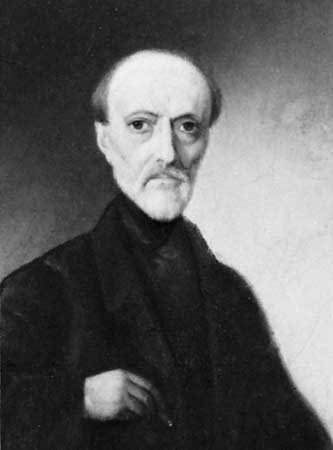
Mazzini’s model, small conspiratorial societies aiming at revolution, spread to Germany, France, Switzerland and Poland, and his uncompromising opposition to monarchy genuinely frightened the conservative order.
3The Age of Revolutions: 1830-1848
As conservative regimes tried to hold on to power, liberalism and nationalism became linked with revolution across Italy, the German states, the Ottoman provinces, Ireland and Poland. These revolutions were led by liberal-nationalists of the educated middle-class elite: professors, schoolteachers, clerks and businessmen.
The Greek war of independence was an event that mobilised nationalist feelings among the educated elite across Europe. Poets and artists lauded Greece as the cradle of European civilisation; the English poet Lord Byron raised funds and went to fight, dying of fever in 1824.

3.1 The Romantic Imagination and National Feeling
Nationalism did not spread through wars and treaties alone. Culture built the idea of the nation too, through art, poetry, stories and music. Romanticism, a cultural movement, generally criticised the glorification of reason and science and focused instead on emotion, intuition and a shared cultural past as the basis of a nation. The German philosopher Johann Gottfried Herder (1744-1803) argued that a nation’s true spirit (volksgeist) lived among its common people, das volk, and could be recovered through their folk songs, poetry and dances.
Jacob (b. 1785) and Wilhelm Grimm (b. 1786), born in Hanau, Germany, spent six years travelling village to village collecting old folktales, publishing their first collection in 1812 (the familiar Grimms’ Fairy Tales) and later a 33-volume German dictionary. Both were also active in liberal politics, especially the movement for freedom of the press. They saw their folklore collection as part of a wider effort to build German national identity against French cultural domination.
The emphasis on vernacular language and the collection of local folklore was not just to recover an ancient national spirit, but also to carry the modern nationalist message to large audiences who were mostly illiterate. Language carried the same nationalist charge in Poland, which had been partitioned at the end of the eighteenth century by Russia, Prussia and Austria and no longer existed as an independent state. The composer Karol Kurpiński turned folk dances like the polonaise and mazurka into nationalist symbols. After Russian occupation forced the Polish language out of schools, the clergy began using Polish for Church gatherings and religious instruction as a weapon of national resistance: many priests and bishops were jailed or exiled to Siberia for refusing to preach in Russian. An armed rebellion against Russian rule in 1831 was ultimately crushed.
3.2 Hunger, Hardship and Popular Revolt
The 1830s brought severe economic hardship: population grew faster than jobs, rural people crowded into city slums, and small producers faced competition from cheap machine-made imports from an already-industrialised England. A poor harvest or rising food prices could tip whole regions into crisis.
The journalist Wilhelm Wolff described Silesian weaving villages with 18,000 inhabitants, where weavers who supplied cloth to contractors were pushed into desperate poverty as those contractors kept cutting their payments. On 4 June, a large crowd marched to the contractor’s mansion demanding higher wages; treated with scorn, they forced their way in, smashed windows and furniture, and looted the storehouse of cloth. The contractor fled, returned with the army a day later, and in the clash that followed, eleven weavers were shot.
3.3 1848: The Revolution of the Liberals
Parallel to revolts of the poor across Europe, a separate revolution, led by the educated middle classes, was under way in 1848. In France, the February 1848 events forced the monarch to abdicate and a republic based on universal male suffrage was proclaimed. Elsewhere, where no independent nation-state yet existed (Germany, Italy, Poland, the Austro-Hungarian Empire), liberal-minded men and women combined demands for constitutionalism with national unification, pressing for a nation-state on parliamentary principles: a constitution, freedom of the press and freedom of association.
In the German states, political associations of middle-class professionals, businessmen and prosperous artisans gathered in Frankfurt and voted for an all-German National Assembly. On 18 May 1848, 831 elected representatives marched to take their seats in the Frankfurt Parliament, convened in the Church of St Paul.

The deputies drafted a constitution for a German nation to be headed by a monarchy subject to parliament, and offered the crown on these terms to Friedrich Wilhelm IV, King of Prussia. He rejected it and joined other monarchs in opposing the elected assembly. As aristocratic and military opposition grew, and the middle-class-dominated parliament lost the support of workers and artisans whose demands it resisted, troops were finally called in and the assembly was forced to disband.
Carl Welcker (Frankfurt Parliament deputy)
- “Nature has created men and women to carry out different functions”
- Man: protector, provider, meant for public life
- Woman: “weaker… requires the protection of man,” her sphere is the home
Louise Otto-Peters (1819-95), political activist
- Founded a women’s journal (first issue, 21 April 1849) and later a feminist political association
- “Liberty is indivisible!”: argued that freedom claimed for men only was no true freedom at all
- An anonymous reader’s letter to her paper (25 June 1850) asked why “highly talented women owning considerable property” were excluded from the vote while “the stupidest cattle-herder” had it “simply because he is a man”
A feminist is someone aware of women’s rights and interests, based on the belief that the genders are socially, economically and politically equal.
An ideology is a system of ideas reflecting a particular social and political vision.
Despite active participation in political associations, newspapers and demonstrations, women were denied suffrage in the Assembly’s own election and admitted only as observers to the visitors’ gallery when the parliament convened.
Do not write that 1848 “failed everywhere.” Though conservative forces suppressed liberal movements that year and could not restore the old order completely, monarchs realised that repeated revolution and repression had to end with some concessions. In the years after 1848, serfdom and bonded labour were abolished in both the Habsburg dominions and in Russia, and the Habsburg rulers granted the Hungarians greater autonomy in 1867.
4The Making of Germany and Italy
4.1 Germany: Can the Army be the Architect of a Nation?
After 1848, nationalism in Europe moved away from its earlier association with democracy and revolution: conservatives now mobilised nationalist sentiment for state power and political domination instead. This is exactly the process by which Germany and Italy were unified as nation-states. The liberal, elected-parliament path tried in 1848 had been crushed by the combined forces of the monarchy and the military, backed by Prussia’s large landowners, the Junkers. From then on, Prussia’s chief minister, Otto von Bismarck, led the drive for unification with the Prussian army and bureaucracy as his instruments, not an elected assembly.
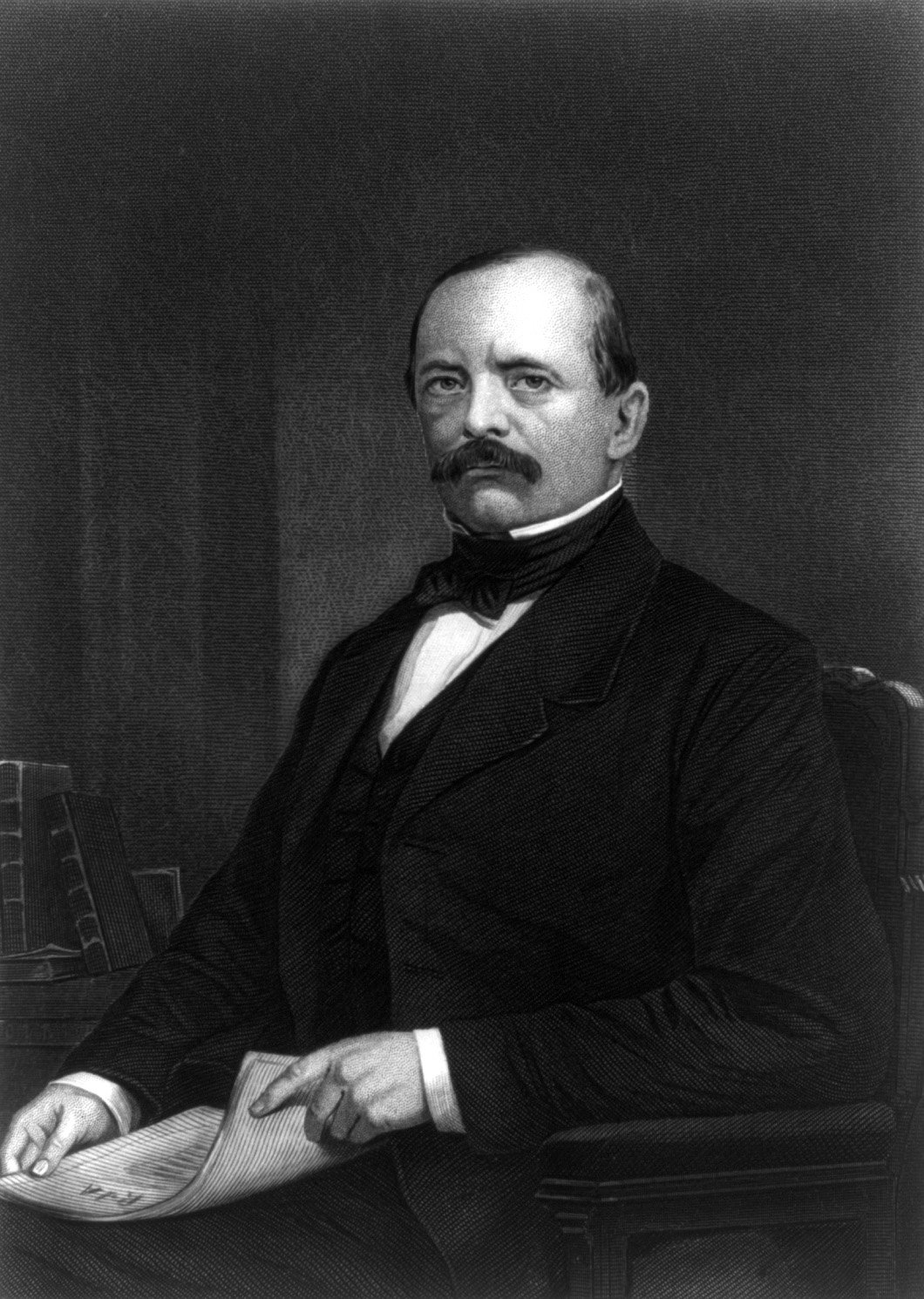
The new German state placed strong emphasis on modernising currency, banking, and the legal and judicial systems. Prussian measures and practices often became a model for the rest of Germany. This is the clearest example in the chapter of nationalism achieved from above, by state power, rather than by a popular liberal movement.
“Briefly trace the process of German unification” is a “Write in brief” question in the NCERT exercises. A complete answer names, in order: (1) the failed liberal attempt of 1848, (2) Prussia’s leadership under Bismarck, (3) the three wars, and (4) the 1871 Versailles proclamation.
4.2 Italy Unified
Italy, like Germany, had a long history of political fragmentation. In the mid-nineteenth century it was divided into seven states; only Sardinia-Piedmont was ruled by an Italian princely house. The north was under Austrian Habsburgs, the centre under the Pope, and the south under the Bourbon kings of Spain. Even the Italian language had not acquired one common form and still had many regional and local variations.
Mazzini’s Young Italy had tried to build a unitary republic in the 1830s, but after the failure of revolutionary uprisings in both 1831 and 1848, the task fell instead to Sardinia-Piedmont’s ruler, King Victor Emmanuel II, guided by his chief minister Count Camillo Cavour, who was neither a revolutionary nor a democrat, but a skilled diplomat.
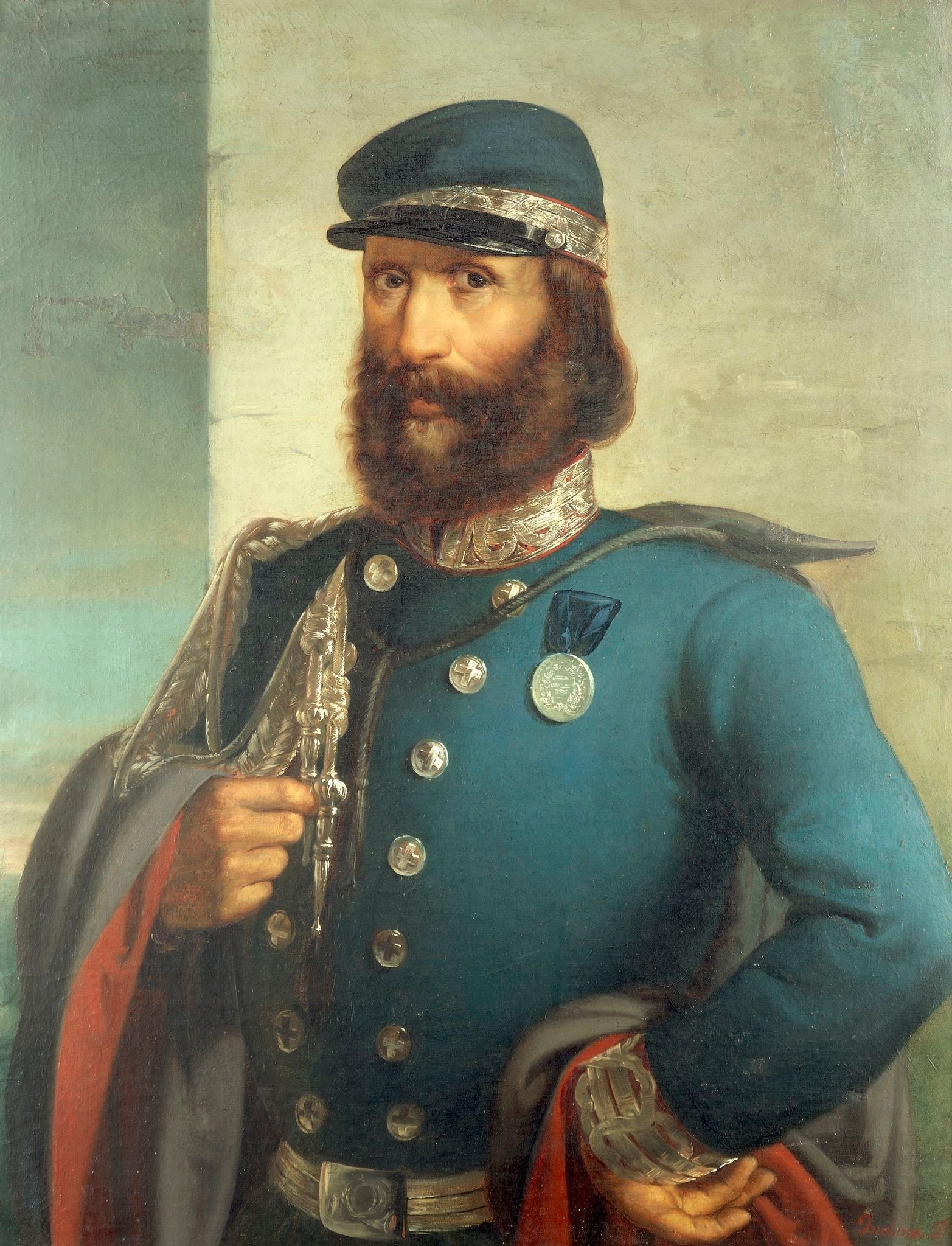
Much of Italy’s population, among whom illiteracy was very high, remained unaware of liberal-nationalist ideology even as unification was completed on their behalf: the peasants of southern Italy who supported Garibaldi had, the chapter notes, never even heard of “Italia.”
4.3 The Strange Case of Britain
Britain is sometimes held up as the model nation-state, but its formation was a slow, drawn-out process, not a sudden revolution. There was no “British nation” before the eighteenth century: the primary identities on the British Isles were ethnic ones: English, Welsh, Scot, Irish, each with its own culture and traditions.
Ethnic relates to a common racial, tribal or cultural origin or background that a community identifies with or claims.
As the English nation grew in wealth and power, the English parliament, which had seized power from the monarchy in 1688, became the instrument through which a British nation-state, centred on England, was forged. The Act of Union (1707) joined England and Scotland into the “United Kingdom of Great Britain,” but in practice meant England imposing its influence on Scotland: the British parliament was dominated by English members, and Scotland’s distinctive culture and institutions were systematically suppressed: Catholic Highland clans were forbidden their Gaelic language and national dress, and large numbers were forcibly driven out of their homeland.
Ireland suffered a similar fate. Deeply divided between Catholics and Protestants, it saw the English help Protestants establish dominance over a largely Catholic population. After the failed revolt of Wolfe Tone’s United Irishmen (1798), Ireland was forcibly incorporated into the United Kingdom in 1801. The new “British nation” was built by actively promoting a single dominant culture: the Union Jack, the national anthem, the English language, while the older nations survived only as subordinate partners.
5Visualising the Nation
A ruler can be represented easily enough through a portrait or statue, but how does an artist give a face to an entire nation? Eighteenth and nineteenth-century artists solved this by personifying nations as female figures. This female form stood for no real woman; it gave the abstract idea of the nation a concrete, human shape: an allegory.
An allegory is when an abstract idea (such as liberty, greed or freedom) is expressed through a person or a thing. An allegorical image or story carries two meanings at once: one literal, one symbolic.
In France, the nation was personified as Marianne, a popular Christian name chosen to underline the idea of a people’s nation. She carried the attributes of Liberty and the Republic: the red cap, the tricolour, the cockade, and her image appeared on public statues, coins and postage stamps.
In Germany, the allegorical figure was Germania, shown wearing a crown of oak leaves (the German oak stood for heroism). Philip Veit painted his Germania in 1848 as a banner meant to hang from the ceiling of the Church of St Paul during the Frankfurt Parliament.
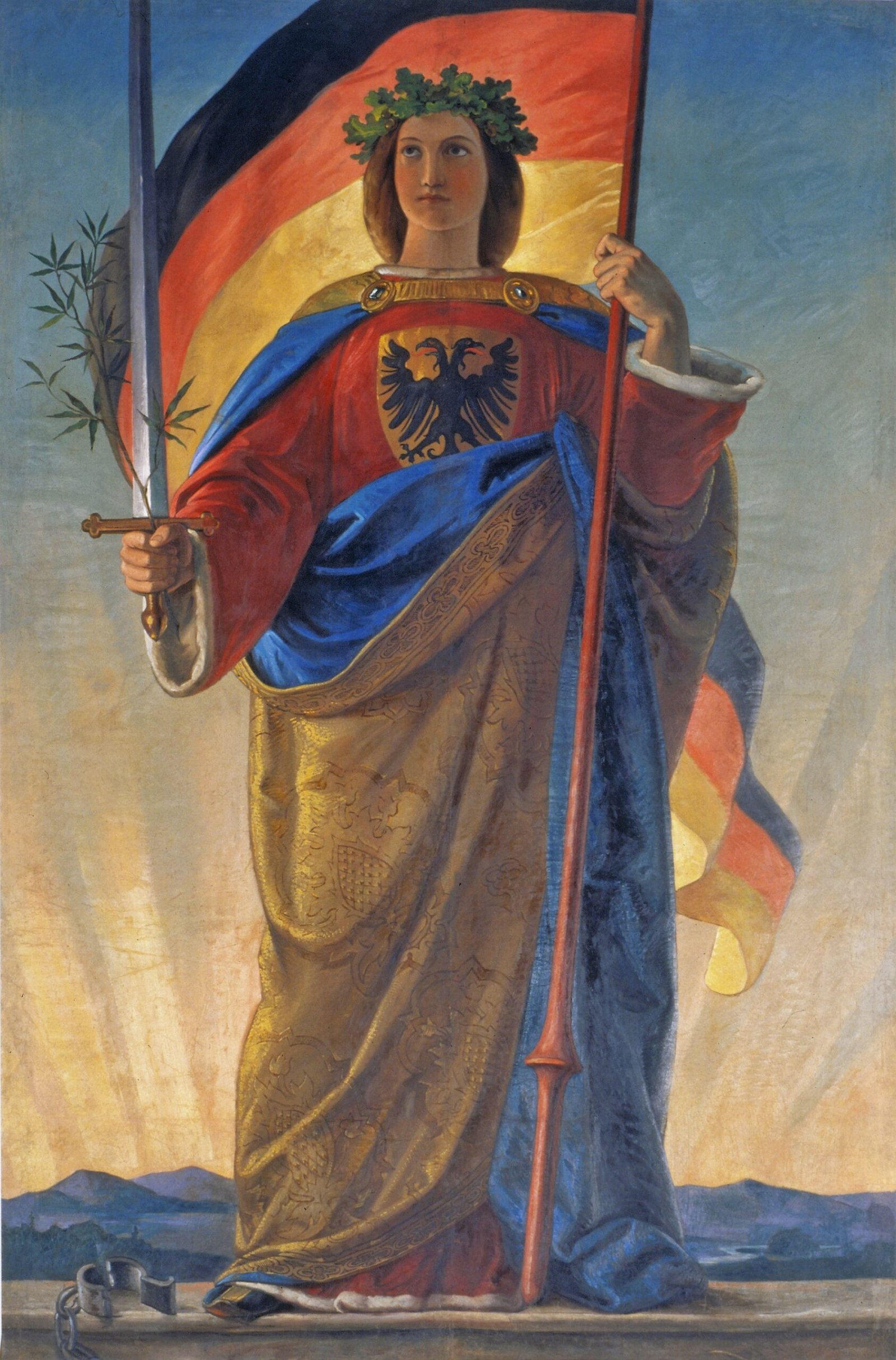
| Attribute of Germania (Box 3, NCERT) | What it symbolised |
|---|---|
| Broken chains | Being freed |
| Breastplate with eagle | Symbol of the German empire, strength |
| Crown of oak leaves | Heroism |
| Sword | Readiness to fight |
| Olive branch around the sword | Willingness to make peace |
| Black, red and gold tricolour | Flag of the liberal-nationalists of 1848, banned by the Dukes of the German states |
| Rays of the rising sun | Beginning of a new era |
“Who were Marianne and Germania? What was the importance of the way they were portrayed?” is a “Write in brief” question in the NCERT exercises. Answer both halves: (1) name and describe each figure, and (2) explain WHY personification mattered: it gave an abstract idea (the nation) a concrete form; statues of Marianne were put up in public squares to remind people of the national symbol of unity and to persuade them to identify with it.
6Nationalism and Imperialism
By the last quarter of the nineteenth century, nationalism had lost the idealistic, liberal-democratic character it carried in the first half of the century. It hardened into a narrow creed, and the major European powers began manipulating the nationalist aspirations of subject peoples to serve their own imperial ambitions.
The most serious flashpoint was the Balkans: the region of Romania, Bulgaria, Albania, Greece, Macedonia, Croatia, Bosnia-Herzegovina, Slovenia, Serbia and Montenegro, whose peoples were broadly called Slavs, and much of which lay under Ottoman control. As Romantic nationalism spread here alongside the Ottoman Empire’s slow disintegration, the region became explosive: each Balkan people used history to claim they had once been independent and had only been “subjugated by foreign powers,” so their struggles were framed as attempts to win back long-lost independence.
Rivalry between the great powers, Russia, Germany, England and Austro-Hungary, each wanting to extend its own influence over the Balkans at the others’ expense, made the Balkans an area of intense conflict. This tangle of Balkan nationalism and big-power rivalry led to a series of wars in the region, and finally to the First World War in 1914.
The chapter closes by pointing out that nationalism did not stay a European idea. The many countries colonised by European powers during the nineteenth century developed anti-imperial movements that were nationalist in the sense that they struggled to form independent nation-states, inspired by a collective identity forged in confrontation with imperialism, even though each built its own specific variety of nationalism rather than copying Europe’s. But the idea that societies should be organised into ‘nation-states’ came to be accepted as natural and universal.
7All Definitions in One Place
- Can I list the measures French revolutionaries took to build a collective identity, without looking?
- Can I explain why the Zollverein (an economic union) mattered for German political unification?
- Can I name the outcome of the Congress of Vienna in four separate points?
- Can I trace German unification and Italian unification as two separate timelines, without mixing up Bismarck and Cavour?
- Can I explain who Marianne and Germania were, and why personification mattered?
- Can I explain, in my own words, why nationalist tension built up in the Balkans?
- Nationalism’s first clear expression: the French Revolution of 1789, when sovereignty passes from king to citizens
- Napoleon exported the Civil Code (1804) to the regions under French control but ruled through conquest, so reform and resentment grew together
- Liberal nationalism = freedom + equality before law + constitutional government, NOT automatic universal suffrage
- Zollverein (1834): economic union of German states used to build toward political union
- Congress of Vienna (1815): restored old monarchies, boxed France in with buffer states, left the German confederation untouched
- Mazzini’s Young Italy/Young Europe: secret societies for revolution, not the method that finally worked
- 1830: July Revolution (France) and Greek independence struggle (1821-32)
- 1848: Frankfurt Parliament (831 deputies) fails when Friedrich Wilhelm IV rejects the crown; women denied suffrage despite active participation
- Germany unified “from above”: Bismarck, Prussian army, three wars, 1871 Versailles proclamation
- Italy unified through Cavour’s diplomacy + Garibaldi’s volunteers: Victor Emmanuel II proclaimed king, 1861; Rome joins only in 1870
- Britain: no sudden revolution, Act of Union 1707, Ireland forced into the Union in 1801
- Marianne (France) and Germania (Germany): female allegories that gave the abstract “nation” a face people could rally behind
- Book’s dates box also lists: 1797 Napoleon invades Italy (Napoleonic wars begin); 1859-1870 unification of Italy; 1866-1871 unification of Germany; 1905 Slav nationalism gathers force in the Habsburg and Ottoman Empires
- Post-1871: nationalism turns narrow and aligns with imperialism; Balkan rivalry among Russia, Germany, England, Austro-Hungary leads to the First World War