
- What biodiversity means, and why India’s forests and wildlife matter to your everyday life, not just to a national park somewhere far away
- What the Indian Wildlife (Protection) Act, 1972 actually protects, and how Project Tiger tried to save the tiger and the habitats it depends on
- How India’s forests are officially classified into Reserved, Protected and Unclassed forests, and which states have which kind
- How ordinary villagers, not just the government, have protected forests and wildlife, through movements like Chipko and programmes like Joint Forest Management
1Biodiversity: Our Living Wealth
Look around your own neighbourhood. There are almost certainly birds, insects, trees and small animals living there that you barely notice, because they are simply part of the background of daily life. That everyday mix of living things all around us, in every corner of the country, is what this chapter is about.
Biodiversity (or biological diversity) is the rich variety of wildlife and cultivated species (plants, animals and micro-organisms). In the chapter’s words, it is “immensely rich in wildlife and cultivated species, diverse in form and function but closely integrated in a system through multiple network of interdependencies”.
India is one of the world’s richest countries in terms of its vast array of biological diversity. The textbook adds: “This is possibly twice or thrice the number yet to be discovered.” These resources are so well integrated in our daily life that we take them for granted, but lately they are under great stress, mainly due to insensitivity to our environment.
Forests are not just scenery. They are primary producers, which means they are the base of the food chain: plants make their own food using sunlight, and every other living thing, directly or indirectly, depends on that food. The plants, animals and micro-organisms of this web re-create the quality of the air we breathe, the water we drink and the soil that produces our food, without which we cannot survive.
Wildlife and farm crops both carry huge biodiversity. A wild variety of rice or wheat might look useless next to the crop we actually grow, but it can carry a gene for disease resistance or drought tolerance that plant breeders need one day. Losing a wild variety can mean losing an option we did not even know we needed.
The textbook’s Fig. 2.1 shows how closely people live with forests: tribal girls using bamboo saplings in a nursery at Mukhali near Silent Valley, tribal women selling minor forest produce, and leaf litter collection by women folk.
1.1 Why Conservation Is Necessary
Conservation simply means protecting something from being destroyed, damaged or used up. Wildlife populations and forest cover have been declining fast, which is exactly why conservation has become essential.
For “Why is conservation of forests and wildlife necessary?”, give these points separately, not as one long sentence:
Preserves ecological diversity
Keeps our life-support systems, water, air and soil, working properly.
Preserves genetic diversity
Lets plants and animals breed and grow better as species, keeping useful genetic variety alive.
Supports agriculture and fisheries
The chapter’s examples: in agriculture we are still dependent on traditional crop varieties; fisheries are heavily dependent on the maintenance of aquatic biodiversity.
2Protecting India’s Wildlife: Laws and Project Tiger
2.1 The Indian Wildlife (Protection) Act, 1972
By the 1960s and 1970s, people working in conservation started demanding a proper national wildlife protection programme. The government responded with a law.
The Indian Wildlife (Protection) Act was implemented in 1972, with various provisions for protecting habitats. Its thrust was towards protecting the remaining population of certain endangered species by banning hunting, giving legal protection to their habitats, and restricting trade in wildlife. An all-India list of protected species was also published.
After this Act, the central government and many state governments established national parks and wildlife sanctuaries. The central government also announced special projects for animals that were in grave danger. The animals the chapter names are:
| Animal | How the chapter groups it |
|---|---|
| Tiger | Gravely threatened; given its own central project (Project Tiger, below) |
| One-horned rhinoceros | Gravely threatened; central government project |
| Kashmir stag (hangul) | Gravely threatened; central government project |
| Freshwater crocodile, saltwater crocodile, gharial | The three types of crocodiles; central government project |
| Asiatic lion | Gravely threatened; central government project |
| Indian elephant | Most recently given full or partial legal protection against hunting and trade |
| Black buck (chinkara) | Most recently given full or partial legal protection against hunting and trade |
| Great Indian bustard (godawan) | Most recently given full or partial legal protection against hunting and trade |
| Snow leopard | Most recently given full or partial legal protection against hunting and trade |
Students often write “the Wildlife Act protected the tiger” as if it protected only one animal. It protected a whole list of named species, and Project Tiger (below) is a separate, later campaign focused specifically on the tiger.
2.2 Project Tiger
The tiger is one of the key wildlife species in India’s whole web of forest life, so what happened to the tiger is a good example of why conservation matters.
In 1973, the authorities realised that the tiger population had dwindled to 1,827 from an estimated 55,000 at the turn of the century. The major threats to the tiger population were:
✘ What was destroying tiger numbers
- Poaching for trade
- Shrinking habitat
- Depletion of prey base species (the animals tigers eat)
- Growing human population
- The trade of tiger skins and the use of their bones in traditional medicines, especially in the Asian countries
✓ What Project Tiger did about it
- Launched in 1973, one of the well-publicised wildlife campaigns in the world
- Tiger reserves include Corbett, Sunderbans, Bandhavgarh, Sariska, Manas and Periyar (table below)
- Viewed not only as an effort to save an endangered species, but with equal importance as a means of preserving biotypes (habitat types) of sizeable magnitude
Since India and Nepal provide habitat to about two-thirds of the surviving tiger population in the world, these two nations became prime targets for poaching and illegal trading.
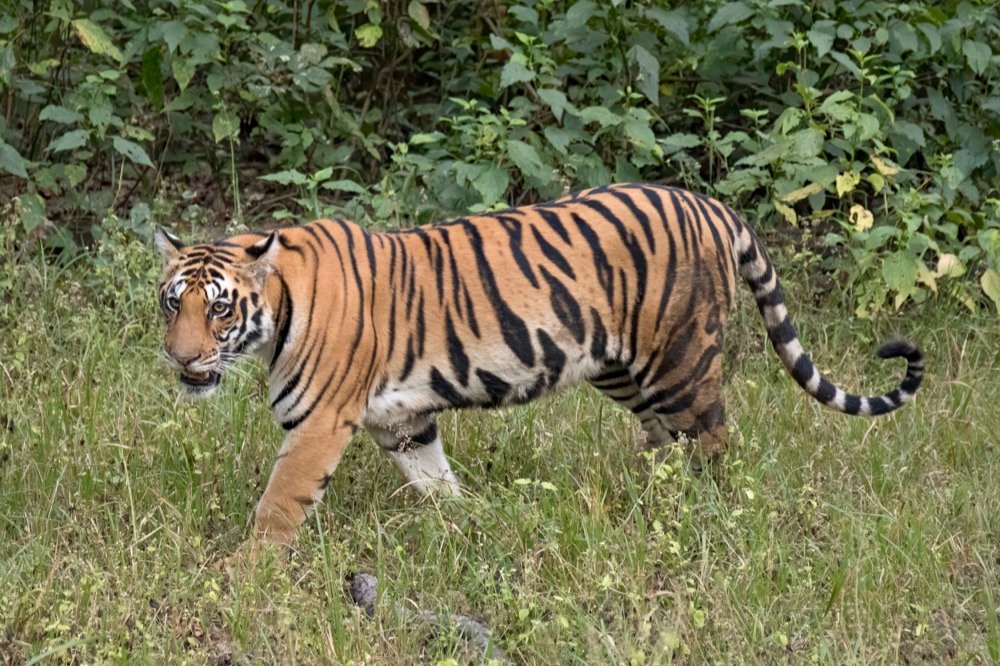
Some of the tiger reserves of India named in the chapter are:
| Tiger reserve | State |
|---|---|
| Corbett National Park | Uttarakhand |
| Sunderbans National Park | West Bengal |
| Bandhavgarh National Park | Madhya Pradesh |
| Sariska Wildlife Sanctuary | Rajasthan |
| Manas Tiger Reserve | Assam |
| Periyar Tiger Reserve | Kerala |

2.3 Conservation Widens: From One Species to All Biodiversity
The conservation projects are now focusing on biodiversity rather than on a few of its components. There is now a more intensive search for different conservation measures, and increasingly even insects are beginning to find a place in conservation planning.
“1-9-9-1: plants finally get IN”
Insects were added to the protected list by the 1980 and 1986 notifications; plants were added only in 1991, starting with six species.
3Types and Distribution of Forest and Wildlife Resources
Even if we want to conserve our vast forest and wildlife resources, it is rather difficult to manage, control and regulate them. In India, much of the forest and wildlife resources are either owned or managed by the government, through the Forest Department or other government departments. These are classified into three categories.
More than half of the total forest land has been declared Reserved Forests. Reserved forests are regarded as the most valuable as far as the conservation of forest and wildlife resources is concerned.
Protected Forests make up almost one-third of India’s total forest area, as declared by the Forest Department. This forest land is protected from any further depletion (further reduction or damage).
Unclassed Forests are the other forests and wastelands, belonging to both government and private individuals and communities.
Reserved and Protected Forests together are called permanent forest estates. They are maintained for producing timber and other forest produce, and for protective reasons.
| State | Notable pattern |
|---|---|
| Madhya Pradesh | Largest area under permanent forests: 75% of its own total forest area |
| Jammu & Kashmir, Andhra Pradesh, Uttarakhand, Kerala, Tamil Nadu, West Bengal, Maharashtra | Large percentage of their forest area is Reserved Forest |
| Bihar, Haryana, Punjab, Himachal Pradesh, Odisha, Rajasthan | Large percentage of their forest area is Protected Forest |
| All north-eastern states, and parts of Gujarat | Very high percentage of Unclassed Forest, managed by local communities |
A match-the-following question on Reserved, Protected and Unclassed forests appears in the NCERT exercise (Exercise 2). Know the three definitions in Definitions 3, 4 and 5 above.
4Community and Conservation
Conservation in India is not only something the government does from above. Forests are also home to some of the traditional communities. In some areas, local communities are struggling to conserve these habitats along with government officials, recognising that only this will secure their own long-term livelihood. In many areas, villagers themselves are protecting habitats and explicitly rejecting government involvement.
4.1 Villagers Protecting Their Own Habitats
Sariska Tiger Reserve, Rajasthan: villagers have fought against mining by citing the Wildlife Protection Act.
Bhairodev Dakav “Sonchuri”, Alwar district, Rajasthan: the residents of five villages declared 1,200 hectares of forest as the Sonchuri, declaring their own set of rules and regulations which do not allow hunting, and protecting the wildlife against any outside encroachments.
4.2 The Chipko Movement and Farmer Conservation
The famous Chipko Movement in the Himalayas has not only successfully resisted deforestation in several areas but has also shown that community afforestation with indigenous species can be enormously successful.
(General knowledge, not stated in the chapter: in the Chipko Movement, villagers, many of them women, hugged trees to stop them from being cut down; chipakna is Hindi for “to stick to”.)
Farmers and citizen’s groups like the Beej Bachao Andolan (Save the Seeds Movement) in Tehri and Navdanya have shown that adequate levels of diversified crop production without the use of synthetic chemicals are possible and economically viable.
4.3 Joint Forest Management (JFM)
Joint Forest Management (JFM) is a programme for involving local communities in the management and restoration of degraded forests. It depends on local (village) institutions that undertake protection activities, mostly on degraded forest land managed by the forest department. In return, the members of these communities are entitled to intermediary benefits like non-timber forest produce and a share in the timber harvested by “successful protection”.
JFM has been in formal existence since 1988, when the state of Odisha passed the first resolution for joint forest management.
4.4 Sacred Groves: Nature Worship as Conservation
Nature worship is a very old tribal belief, based on the idea that everything nature has created deserves protection. This belief has kept several virgin (untouched) forests alive in their original form, called Sacred Groves, literally “the forests of God and Goddesses”. These patches of forest have been left untouched by the local people, and any interference with them is banned. Sacred qualities are also often ascribed to springs, mountain peaks, plants and animals, which are closely protected.
| Community | What they worship |
|---|---|
| Mundas and Santhals of Chota Nagpur | Mahua (Bassia latifolia) and kadamba (Anthocephalus cadamba) trees |
| Tribals of Odisha and Bihar | Tamarind (Tamarindus indica) and mango (Mangifera indica) trees, during weddings |
| Many of us | Peepal and banyan trees are considered sacred |
Bishnoi villages, Rajasthan: in and around Bishnoi villages, herds of blackbuck, chinkara, nilgai and peacocks can be seen as an integral part of the community, and nobody harms them. Troops of macaques and langurs around many temples are fed daily and treated as a part of temple devotees.
The clear lesson from both environmental destruction and reconstruction in India is that local communities everywhere have to be involved in some kind of natural resource management. But there is still a long way to go before local communities are at the centre-stage in decision-making. The chapter’s advice: “Accept only those economic or developmental activities, that are people centric, environment-friendly and economically rewarding.”
“The tree is a peculiar organism of unlimited kindness and benevolence and makes no demand for its sustenance, and extends generously the products of its life activity. It affords protection to all beings, offering shade even to the axemen who destroy it.”
Gautama Buddha (487 B.C.)
- Can I define biodiversity, and give one reason conservation matters, without looking?
- Can I state the tiger population figures at the turn of the century (about 55,000) and in 1973 (1,827)?
- Can I name and define all three forest categories: Reserved, Protected, Unclassed?
- Can I name at least two community conservation examples besides Chipko?
- Biodiversity = rich variety of wildlife and cultivated species; India is one of the world’s richest countries in biological diversity
- Forests are primary producers; plants, animals and micro-organisms re-create our air, water and soil
- Conservation preserves ecological diversity, our life support systems and genetic diversity (agriculture and fisheries depend on it)
- The Indian Wildlife (Protection) Act, 1972 banned hunting of certain endangered species and gave legal protection to their habitats
- Project Tiger (1973) came after the tiger population dwindled from an estimated 55,000 to 1,827
- India + Nepal provide habitat to about two-thirds of the world’s surviving tigers
- Insects were added to the protected list through the 1980 and 1986 notifications; plants were added only in 1991
- Forests are classified as Reserved (more than half; most valuable), Protected (about one-third; protected from further depletion) and Unclassed (other forests and wastelands)
- Madhya Pradesh has the largest area under permanent forests (75% of its own forest area)
- Communities protect forests too: Sariska villagers, the Sonchuri of Alwar, the Chipko Movement, Beej Bachao Andolan, JFM (since 1988, Odisha) and Sacred Groves