Pattern: CBSE 2026-27 official Sample Question Paper (SQP) design · Maximum marks: 80 · Time: 3 hours. Solve the paper first, then open the marking scheme at the end to check your answers.
SOCIAL SCIENCE (087)
General Instructions:
- This question paper contains 38 questions. All questions are compulsory.
- The question paper has four sections and contains Multiple Choice Questions (MCQ), Very Short Answer (VSA), Short Answer (SA), Long Answer (LA) and Case/Source Based Questions (CBQ).
• Section A: History, 20 marks • Section B: Geography, 20 marks
• Section C: Political Science, 20 marks • Section D: Economics, 20 marks - Very Short Answer (VSA) questions carry 2 marks each. The answer to each should not exceed 40 words.
- Short Answer (SA) questions carry 3 marks each. The answer to each should not exceed 60 words.
- Long Answer (LA) questions carry 5 marks each. The answer to each should not exceed 120 words.
- Case/Source Based Questions (CBQ) have three sub-questions and carry 4 marks each. The answer to each should not exceed 100 words.
- The map-based questions carry 5 marks in two parts: Q. 9 in Section A, History (2 marks) and Q. 19 in Section B, Geography (3 marks).
- There is no overall choice in the question paper. However, an internal choice has been given in a few questions. Attempt only one of the choices in such questions.
- Note: a separate question has been given for Visually Impaired candidates in place of questions with visual inputs, maps etc. Such questions are to be attempted by Visually Impaired candidates only.
- It did away with all privileges based on birth.
- It established equality before the law.
- It secured the right to property.
- It brought back guild restrictions in the towns of the regions under French control.
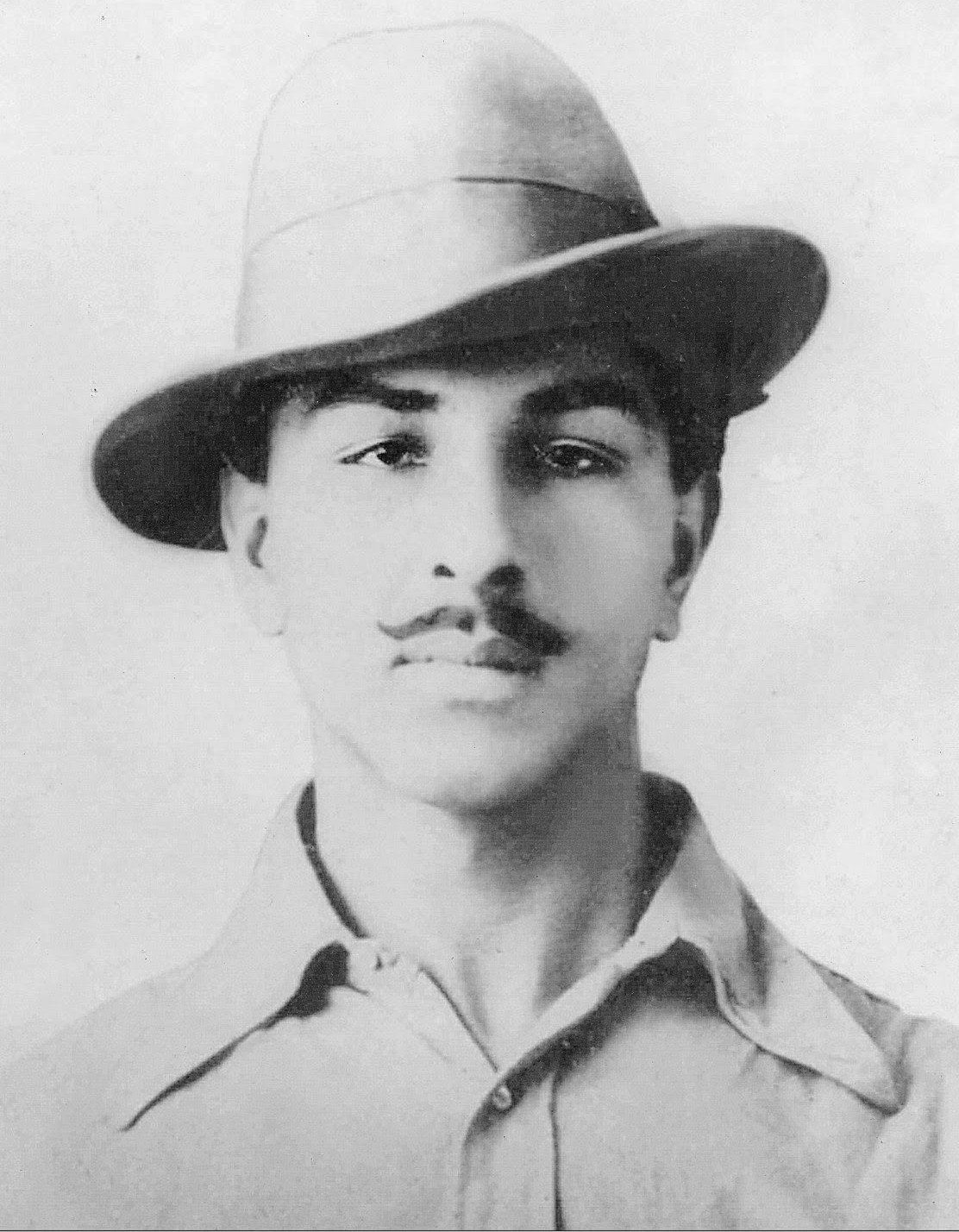
Which two leaders formed the Swaraj Party within the Congress to argue for a return to council politics?
Statement I: Along the silk routes, precious metals such as gold and silver flowed from Asia to Europe in return for European goods.
Statement II: Poverty, hunger, disease and the persecution of religious dissenters led thousands of people to flee Europe for America.
- Balgangadhar Tilak was imprisoned for writing with sympathy in his Kesari about Punjab revolutionaries.
- Marco Polo returned to Italy from China with the knowledge of woodblock printing.
- The Deoband Seminary was founded and began publishing thousands of fatwas.
- Rammohun Roy began publishing the Sambad Kaumudi.
Choose the correct option:
‘It is said of “passive resistance” that it is the weapon of the weak, but the power which is the subject of this article can be used only by the strong. This power is not passive resistance; indeed it calls for intense activity. The movement in South Africa was not passive but active …
‘Satyagraha is not physical force. A satyagrahi does not inflict pain on the adversary; he does not seek his destruction … In the use of satyagraha, there is no ill-will whatever.
‘Satyagraha is pure soul-force. Truth is the very substance of the soul. That is why this force is called satyagraha. The soul is informed with knowledge. In it burns the flame of love. … Non-violence is the supreme dharma …
‘It is certain that India cannot rival Britain or Europe in force of arms. The British worship the war-god and they can all of them become, as they are becoming, bearers of arms. The hundreds of millions in India can never carry arms. They have made the religion of non-violence their own …’
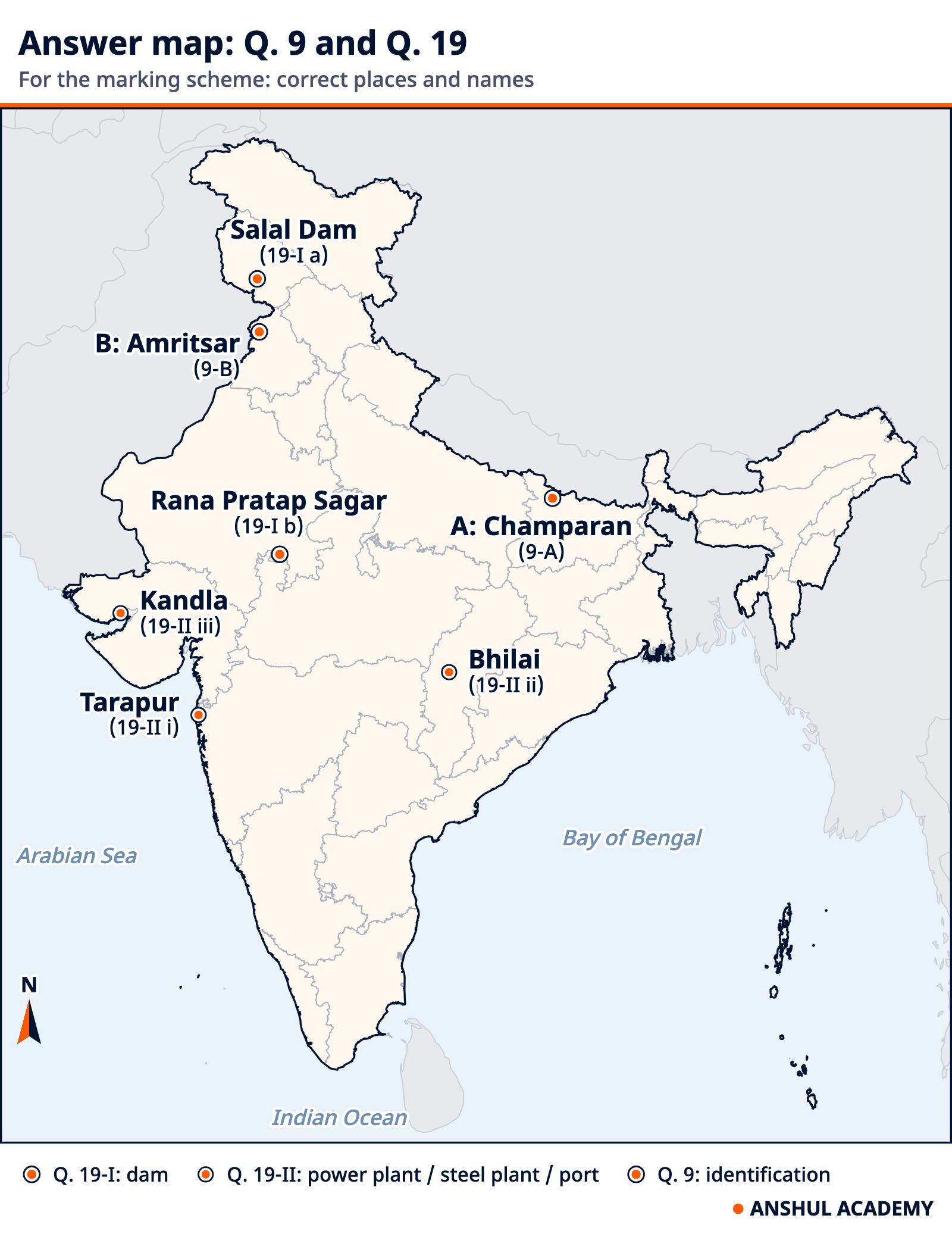
Two places A and B have been marked on the given outline map of India. Identify them and write their correct names on the lines drawn near them.
A. The place in Bihar where Gandhiji travelled in 1917 to inspire the peasants to struggle against the oppressive plantation system.
B. The city where General Dyer opened fire on a crowd gathered in an enclosed ground on 13 April 1919.
A. Name the coastal village in Gujarat where Gandhiji’s Salt March ended on 6 April 1930.
B. Name the city where Gandhiji organised a satyagraha movement among cotton mill workers in 1918.
| Column I (Project) | Column II (River basin and main use) |
|---|---|
| 1. Bhakra Nangal | X. Narmada river; water for drought-prone and desert areas |
| 2. Hirakud | Y. Mahanadi basin; conservation of water with flood control |
| 3. Sardar Sarovar | Z. Sutluj-Beas basin; hydel power and irrigation |
Choose the correct option:
Assertion (A): Rice is grown in Punjab, Haryana, western Uttar Pradesh and parts of Rajasthan, although these areas receive less rainfall.
Reason (R): A dense network of canal irrigation and tubewells has made it possible to grow rice in these areas.
Mahatma Gandhi declared Vinoba Bhave as his spiritual heir. He also participated in Satyagraha as one of the foremost satyagrahis. He was one of the votaries of Gandhi’s concept of gram swarajya. After Gandhiji’s martyrdom, Vinoba Bhave undertook padyatra to spread Gandhiji’s message covered almost the entire country. Once, when he was delivering a lecture at Pochampally in Telangana, some poor landless villagers demanded some land for their economic well-being. Vinoba Bhave could not promise it to them immediately but assured them to talk to the Government of India regarding provision of land for them if they undertook cooperative farming. Suddenly, Shri Ram Chandra Reddy stood up and offered 80 acres of land to be distributed among 80 land-less villagers. This act was known as ‘Bhoodan’. Later he travelled and introduced his ideas widely all over India. Some zamindars, owners of many villages offered to distribute some villages among the landless. It was known as Gramdan. However, many land-owners chose to provide some part of their land to the poor farmers due to the fear of land ceiling act. This Bhoodan- Gramdan movement initiated by Vinoba Bhave is also known as the Blood-less Revolution.
On the given outline map of India, locate and label the following with suitable symbols:
I. (a) Salal Dam (on the Chenab river, Jammu and Kashmir) 1
OR
(b) Rana Pratap Sagar Dam (on the Chambal river, Rajasthan)
II. Any two of the following: 1 × 2 = 2
(i) A nuclear power plant in Maharashtra
(ii) An iron and steel plant in Chhattisgarh
(iii) A major sea port in Gujarat
Answer any three of the following:
(i) On which river is the Salal Dam built?
(ii) Name a nuclear power plant located in Maharashtra.
(iii) Name the iron and steel plant located in Chhattisgarh.
(iv) Name the major sea port located in Gujarat.
Assertion (A): It is not yet known whether the Supreme Court’s order on candidates’ affidavits has reduced the influence of the rich and the criminals in elections.
Reason (R): There is no system to check whether the information about property and criminal cases given by the candidates is true.
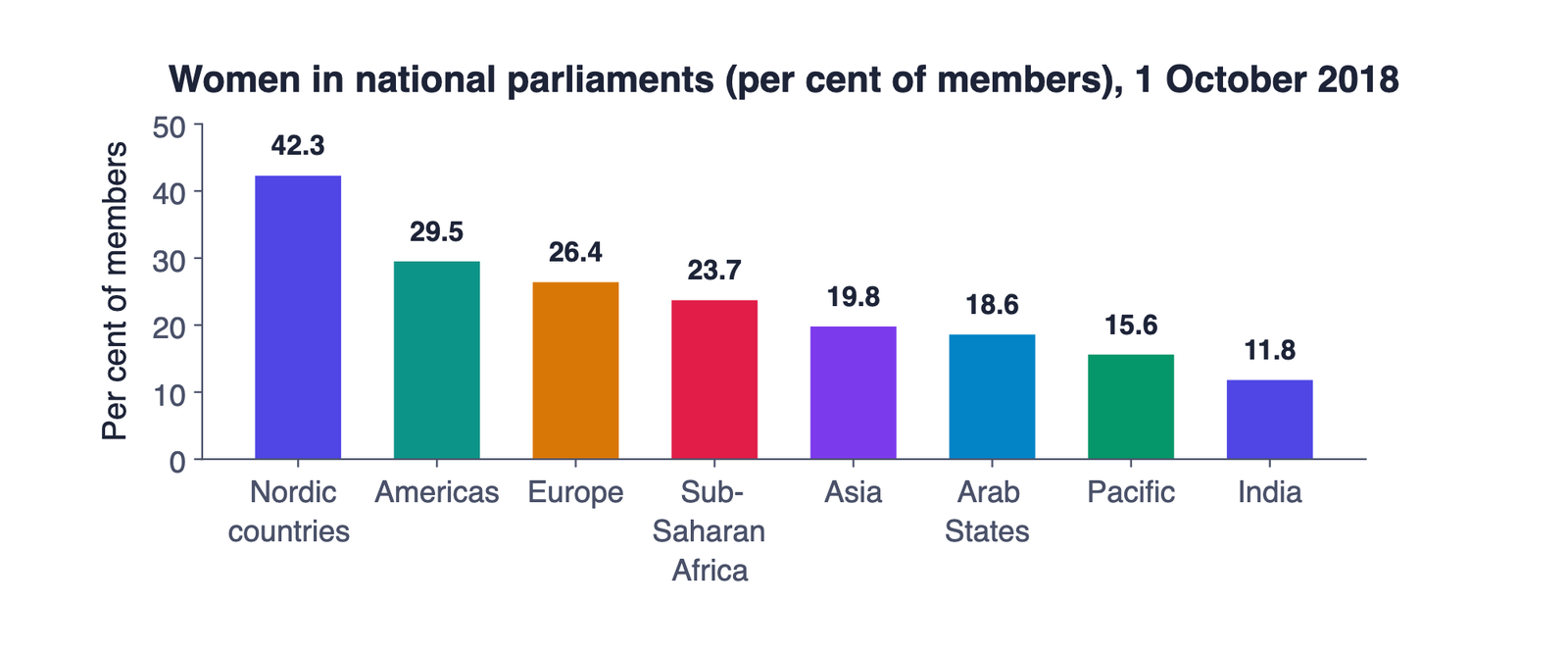
Which law, passed in 2023, provides 33 per cent reservation of seats for women in the Lok Sabha and the State Legislative Assemblies?
No society can fully and permanently resolve conflicts among different groups. But we can certainly learn to respect these differences and we can also evolve mechanisms to negotiate the differences. Democracy is best suited to produce this outcome. Non-democratic regimes often turn a blind eye to or suppress internal social differences. Ability to handle social differences, divisions and conflicts is thus a definite plus point of democratic regimes. But the example of Sri Lanka reminds us that a democracy must fulfil two conditions in order to achieve this outcome: It is necessary to understand that democracy is not simply rule by majority opinion. The majority always needs to work with the minority so that governments function to represent the general view. Majority and minority opinions are not permanent. It is also necessary that rule by majority does not become rule by majority community in terms of religion or race or linguistic group, etc. Rule by majority means that in case of every decision or in case of every election, different persons and groups may and can form a majority. Democracy remains democracy only as long as every citizen has a chance of being in majority at some point of time. If someone is barred from being in majority on the basis of birth, then the democratic rule ceases to be accommodative for that person or group.
Statement I: The Reserve Bank of India supervises the functioning of formal sources of loans; banks have to submit information to it on how much they lend, to whom and at what interest rate.
Statement II: Moneylenders in the informal sector must also report their interest rates to the Reserve Bank of India.
| Column I (Activity) | Column II (Sector) |
|---|---|
| 1. A fisherman catching fish in the sea | X. Tertiary sector |
| 2. A mill making sugar from sugarcane | Y. Primary sector |
| 3. A truck driver carrying vegetables to a city market | Z. Secondary sector |
Choose the correct option:
Assertion (A): After Independence, the Indian government put barriers on foreign trade and foreign investment and allowed imports of only essential items such as machinery, fertilisers and petroleum.
Reason (R): The government believed at that time that competition from imports would improve the quality of goods made by the new Indian industries.
| Country | I | II | III | IV | V | Average |
|---|---|---|---|---|---|---|
| X | 9,800 | 10,200 | 10,000 | 9,900 | 10,100 | 10,000 |
| Y | 2,000 | 2,000 | 2,000 | 2,000 | 42,000 | 10,000 |
(i) What is meant by the sustainability of development? 1
(ii) ‘Groundwater is a renewable resource, yet it is being overused in India.’ Explain this statement with the help of two facts from the textbook. 2
(iii) Why is the question of crude oil reserves a matter of concern for a country like India? Give two reasons. 2
Map for Q. No. 9 (Section A) and Q. No. 19 (Section B)

Marking Scheme / अंकन योजना (उत्तर देखें)
SOCIAL SCIENCE (087)
For examiners and students:
- For objective questions, both the letter of the correct option and the answer are given.
- For descriptive questions, value points are given. ‘Any two/three/five’ means full marks for that many correct points from those listed.
- Any other relevant point based on the textbook is also accepted, where this is stated.
- Trade: the routes, over land and by sea, linked Asia with Europe and northern Africa; Chinese silk and pottery, and textiles and spices from India and Southeast Asia, travelled along them, while gold and silver flowed from Europe to Asia.
- Culture: trade and cultural exchange went hand in hand; early Christian missionaries and, a few centuries later, early Muslim preachers travelled these routes, and Buddhism spread from eastern India in several directions through intersecting points on the silk routes.
- Very cheap small books were sold at crossroads in nineteenth-century Madras towns, so poor people going to markets could buy them; public libraries set up from the early twentieth century expanded access to books.
- From the late nineteenth century issues of caste discrimination were written about in printed tracts and essays: Jyotiba Phule wrote about the injustices of the caste system in Gulamgiri (1871); B.R. Ambedkar and E.V. Ramaswamy Naicker (Periyar) wrote powerfully on caste and were read all over India.
- Workers wrote about their own lives: Kashibaba, a Kanpur millworker, published Chhote Aur Bade Ka Sawal (1938) on the links between caste and class exploitation; the poems of Sudarshan Chakr were collected as Sacchi Kavitayan.
- By the 1930s Bangalore cotton millworkers, following Bombay workers, set up libraries to educate themselves.
- The Balkans was a region of geographical and ethnic variation (modern Romania, Bulgaria, Albania, Greece, Macedonia, Croatia, Bosnia-Herzegovina, Slovenia, Serbia, Montenegro) whose people were broadly known as Slavs; a large part was under the Ottoman Empire.
- The spread of romantic nationalism together with the disintegration of the Ottoman Empire made the region explosive; one by one the subject nationalities broke away, used history to claim they had once been independent, and saw their struggles as winning back long-lost independence.
- The Balkan states were fiercely jealous of each other and each hoped to gain more territory at the expense of the others.
- The region became the scene of big power rivalry: Russia, Germany, England and Austro-Hungary each wanted to counter the others’ hold and extend its own control, which led to a series of wars and finally the First World War.
- In 1848 middle-class Germans tried to unite the regions of the German Confederation into a nation-state governed by an elected parliament (the Frankfurt Parliament).
- This liberal initiative was repressed by the combined forces of the monarchy and the military, supported by the large landowners of Prussia (the Junkers).
- From then on Prussia took over the leadership of the movement for unification; its chief minister Otto von Bismarck was the architect of the process, carried out with the help of the Prussian army and bureaucracy.
- Three wars over seven years, with Austria, Denmark and France, ended in Prussian victory and completed unification; in January 1871 the Prussian king William I was proclaimed German Emperor at Versailles.
- The new state demonstrated the dominance of Prussian state power; it emphasised modernising the currency, banking, legal and judicial systems, and Prussian measures became a model for the rest of Germany. Nationalism was thus mobilised by conservatives to promote state power.
- Awadh: peasants led by Baba Ramchandra, a sanyasi who had been an indentured labourer in Fiji, rose against talukdars and landlords who demanded very high rents, cesses and begar; they demanded reduction of revenue, abolition of begar and social boycott of oppressive landlords (nai-dhobi bandhs).
- Awadh: the Oudh Kisan Sabha was set up by October 1920, headed by Jawaharlal Nehru, Baba Ramchandra and others, with over 300 branches within a month; in 1921 houses of talukdars and merchants were attacked and grain hoards taken over, in forms the Congress leadership was unhappy with.
- Gudem Hills (Andhra Pradesh): the government had closed large forest areas, stopping people from grazing cattle or collecting fuelwood and fruits, and forced them to contribute begar for road building, so the hill people revolted in the early 1920s.
- Gudem Hills: Alluri Sitaram Raju spoke of Gandhiji’s greatness and asked people to wear khadi and give up drinking, but said India could be liberated only by force; the rebels carried on guerrilla warfare until Raju was captured and executed in 1924.
- Assam plantations: under the Inland Emigration Act of 1859 workers could not leave the tea gardens without permission; for them freedom meant the right to move freely and keep links with their villages.
- Assam plantations: hearing of the movement, thousands defied the authorities and headed home, believing Gandhi Raj was coming and they would get land; stranded by a railway and steamer strike, they were caught by the police and brutally beaten.
- Because it calls for intense activity and can be used only by the strong; it is not a weapon of the weak (the movement in South Africa was active, not passive).
- A satyagrahi does not inflict pain on the adversary or seek his destruction; there is no ill-will at all.
- India cannot rival Britain or Europe in force of arms; the British worship the war-god and can all become bearers of arms.
- The hundreds of millions in India can never carry arms, and they have made the religion of non-violence their own.
- Satyagraha is soul-force based on truth and love, with no ill-will; non-violence is the supreme dharma.
- Agro-industries depend on agriculture for their raw materials, for example cotton for textile mills, jute for jute mills and sugarcane for sugar mills; agro-industries have given a major boost to agriculture by raising its productivity.
- Industries sell their products, such as irrigation pumps, fertilisers, insecticides, pesticides, plastic and PVC pipes, machines and tools, to farmers; so the development of industry helps agriculture and vice versa.
- Miners: the dust and noxious fumes inhaled by miners make them vulnerable to pulmonary diseases. (1)
- Miners: the risk of collapsing mine roofs, inundation and fires in coal mines is a constant threat. (1)
- Environment: water sources in the region get contaminated; dumping of waste and slurry degrades land and soil and increases stream and river pollution. (1)
- Need: mineral formation is so slow that the rate of replenishment is infinitely small compared with present consumption; minerals are finite and non-renewable, and continued extraction raises costs as ores of decreasing quality are mined from greater depth. (1)
- Ways: use mineral resources in a planned and sustainable manner; adopt improved technologies that allow the use of low-grade ores at low cost; recycle metals and use scrap metals and other substitutes. (1)
- Benefit: the impounded water is used for many integrated purposes: irrigation, electricity generation, water supply for domestic and industrial uses, flood control, recreation, inland navigation and fish breeding. (1)
- Regulating and damming rivers affects their natural flow, causing poor sediment flow and excessive sedimentation at the bottom of the reservoir; this gives rockier stream beds and poorer habitats for aquatic life, and dams fragment rivers, making it difficult for aquatic fauna to migrate for spawning.
- Reservoirs created on flood plains submerge the existing vegetation and soil, which decompose over time.
- Dams built to control floods have triggered floods because of sedimentation in the reservoir, and big dams have mostly failed to control floods during excessive rainfall; sedimentation also deprives flood plains of silt, a natural fertiliser.
- The projects have induced earthquakes and caused water-borne diseases, pests and pollution resulting from excessive use of water.
- Irrigation has changed cropping patterns towards water-intensive and commercial crops, causing salinisation of the soil; projects also lead to inter-state disputes, such as the Krishna-Godavari dispute over the diversion of water at Koyna.
- At Pochampally (Telangana), Shri Ram Chandra Reddy offered 80 acres of land to be distributed among 80 landless villagers; this act of gifting land was called Bhoodan.
- In Gramdan, zamindars who owned many villages offered to distribute some whole villages among the landless, not just a piece of land.
- It redistributed land to the landless peacefully and voluntarily, through gifts of land, without any violence or conflict. (1)
- Many land-owners gave part of their land to poor farmers out of fear of the land ceiling act, which would have limited the land they could hold. (1)
- Put pressure on political parties through petitions, publicity and agitations; ordinary citizens, pressure groups, movements and the media can do this, and parties that fear losing public support become more serious about reforms.
- Those who want reform can join political parties; it is difficult to change the quality of democracy if ordinary citizens do not take part and simply criticise from outside.
- Coming together: independent States come together on their own to form a bigger unit, pooling sovereignty and retaining identity to increase their security; the constituent States usually have equal power and are strong. Example: USA, Switzerland or Australia. (1)
- Holding together: a large country decides to divide its power between the constituent States and the national government; the central government tends to be more powerful and units may have unequal powers. Example: India, Spain or Belgium. (1)
- The Constitution prescribes that the number of Dutch- and French-speaking ministers in the central government shall be equal; some special laws need the support of a majority of members from each linguistic group, so no single community can decide unilaterally.
- Many powers of the central government have been given to the State Governments of the two regions; the State Governments are not subordinate to the central government.
- Brussels has a separate government in which both communities have equal representation; the French-speaking people accepted this because the Dutch-speaking community accepted equal representation in the central government.
- A third kind of government, the ‘community government’, is elected by people of one language community (Dutch, French or German-speaking) wherever they live, and has power over cultural, educational and language-related issues.
- Women in different parts of the world organised and agitated for equal rights: for voting rights, and for enhancing the political and legal status of women and improving their educational and career opportunities; radical (feminist) movements aimed at equality in personal and family life too.
- Political expression of gender issues helped improve women’s role in public life: women now work as scientists, doctors, engineers, lawyers, managers and university teachers, which were earlier not considered suitable for them.
- The Equal Remuneration Act, 1976 provides that equal wages should be paid for equal work, though in almost all areas of work women are still paid less than men.
- One-third of the seats in local government bodies, in panchayats and municipalities, are now reserved for women; there are more than 10 lakh elected women representatives in rural and urban local bodies.
- After a long demand by women’s organisations, the Nari Shakti Vandan Adhiniyam (2023) will give 33 per cent reservation of seats for women in the Lok Sabha, State Legislative Assemblies and the Delhi Assembly.
- This shows that disadvantaged groups benefit when social divisions become a political issue; women’s low representation in legislatures (14.36 per cent in the Lok Sabha in 2019) could be addressed only politically.
- Linguistic States: after 1947 old State boundaries were changed so that people who spoke the same language lived in the same State; some States (Nagaland, Uttarakhand, Jharkhand) were made on the basis of culture, ethnicity or geography.
- Linguistic States: though some leaders feared disintegration and the Centre resisted them for a time, linguistic States have actually made the country more united and administration easier.
- Language policy: the Constitution gave no language the status of national language; Hindi is the official language, but besides Hindi there are 21 other Scheduled Languages, and States have their own official languages.
- Language policy: the leaders were cautious in spreading Hindi; when non-Hindi States demanded it, the Centre agreed to continue English along with Hindi after 1965, avoiding a Sri Lanka-like situation.
- Centre-State relations: earlier, when the same party ruled the Centre and most States, the Centre often misused the Constitution to dismiss State governments run by rival parties, which undermined federalism.
- Centre-State relations: after 1990 the rise of regional parties and the era of coalition governments at the Centre led to a new culture of power sharing and respect for the autonomy of State governments; a Supreme Court judgement also made it difficult to dismiss State governments arbitrarily.
- They often turn a blind eye to them or suppress them.
- Sri Lanka.
- Democracy is not simply rule by majority opinion; the majority must work with the minority so that the government represents the general view.
- In every decision or election different persons and groups may form a majority; democracy remains democracy only as long as every citizen has a chance of being in the majority at some time.
- If a group is permanently barred from being in the majority because of birth (religion, race, language), democratic rule stops being accommodative for it, as the example of Sri Lanka shows.
- Several basic services, such as hospitals, educational institutions, post and telegraph, police stations, courts, municipal corporations, defence, transport, banks and insurance companies, are required in any country; in a developing country the government has to provide them.
- The development of agriculture and industry leads to the development of services such as transport, trade and storage; the greater the development of the primary and secondary sectors, the greater the demand for such services.
- As income levels rise, some sections of people demand many more services, such as eating out, tourism, shopping, private hospitals, private schools and professional training, especially in big cities.
- New services based on information and communication technology have become important and essential, and their production has been rising rapidly.
- Salim: he took credit from the leather supplier and an advance from the trader to meet working capital needs; he completed the order on time, made a good profit and repaid the loans, so credit played a vital and positive role and increased his earnings. (1)
- Swapna: she took a loan from the moneylender for cultivation, but her crop failed because of pests; she could not repay, the debt grew, and she had to sell part of her land. Credit pushed her into a debt trap and made her worse off. (1)
- Conclusion: whether credit is useful depends on the risks in the situation and whether there is some support in case of loss. (1)
- Meaning: globalisation is the process of rapid integration or interconnection between countries; more and more goods and services, investments and technology are moving between countries. (1)
- MNCs: more and more MNCs have been looking for locations around the world that would be cheap for their production, so foreign investment by MNCs in these countries has been rising; they play a major role in the globalisation process. (1)
- Foreign trade: foreign trade between countries has been rising rapidly, and a large part of it is controlled by MNCs, whose activities involve substantial trade in goods and services; greater foreign trade and investment have led to greater integration of production and markets. (1)
- Some facilities need spending large sums of money, beyond the capacity of the private sector, which would also charge a high rate for their use: construction of roads, bridges, railways and harbours, generating electricity and providing irrigation through dams. The government undertakes such heavy spending so that they are available to everyone.
- The government produces and supplies electricity at rates that industries, especially small-scale units, can afford; selling it at the cost of generation might force many units to shut down.
- The government buys wheat and rice from farmers at a ‘fair price’, stores them in its godowns and sells them at a lower price to consumers through ration shops, supporting both farmers and consumers.
- Providing health and education facilities for all is a primary responsibility of the government, such as running proper schools and giving quality elementary education.
- The government pays attention to aspects of human development such as safe drinking water, housing for the poor, food and nutrition, and lowering infant mortality.
- It is also the duty of the government to take care of the poorest and most ignored regions of the country through increased spending in such areas.
- (i) Development is sustainable when it meets present needs without using up resources in a way that harms future generations; resources must be used so that the present level of development can be kept up, and increased, in the future. (1)
- (ii) A renewable resource is overused if we use more than what is replenished by rain; about 300 districts have reported a water level decline of over 4 metres during the past 20 years. (1)
- (ii) Nearly one-third of the country is overusing its groundwater reserves, and in another 25 years 60 per cent of the country would be doing the same if present use continues (especially in Punjab and western Uttar Pradesh, hard rock plateau areas, some coastal areas and growing cities). (1)
- (iii) Crude oil is non-renewable, with a fixed stock on earth; at the present rate of extraction world reserves would last only about 50 years more (Table 1.7: 47 years; accept either). (1)
- (iii) India does not have enough stocks of its own and depends on importing oil from abroad, so any rise in oil prices becomes a burden for everyone. (1)
Answers to Q. No. 9 and 19 (on the map)