
- The full sequence of events of the Wavewalker’s storm, from Plymouth to Ile Amsterdam
- Who each person on board is, and what part they play in the crisis
- Why the story is told in three shifting sections, and what changes in each one
- The themes, vocabulary and literary devices in the chapter
1About the Chapter
The author byline credits two writers, Gordon Cook and Alan East, with this true, first-person account of a family’s near-disaster at sea. The book never names the narrator; he is simply “I,” the father and captain.
A first-person narrative is an account told by someone who was part of the events, using “I” and “we.” It makes the danger feel immediate, because the narrator describes what he saw and felt during the events.
2The Voyage and the Crew
The narrator, a 37-year-old businessman, and Mary had dreamed of this three-year, 105,000 km voyage for years, honing their skills for sixteen years beforehand. Two days out of Cape Town, strong gales began, with waves up to 15 metres.
3The Storm: A Timeline
Jon says: “we aren’t afraid of dying if we can all be together — you and Mummy, Sue and I.” A six-year-old’s words give the chapter its title: being together matters more than fear of death.
Sue plays down her injury. On the first night she says only “my head hurts a bit”, pointing to a big bump above her eyes; later she shows the deep cut on her arm, and explains: “I didn’t want to worry you when you were trying to save us all.” Do not write that she said nothing about her injury.
4Reaching Safety: A Closing Reflection
Once ashore, the narrator credits Larry and Herbie, cheerful under the direst stress; Mary, who held the wheel through the worst hours; and, most of all, Sue (whose injury later needed six minor operations) and Jon, truly not afraid to die.
5Characters at a Glance
| Character | Role and key trait |
|---|---|
| The narrator (father) | Captain of Wavewalker; works through every crisis, from repairs to navigation, though he admits horror and doubt |
| Mary (mother) | Stays at the wheel through the most dangerous hours |
| Jonathan / Jon (son, 6) | Asks if they are going to die, then speaks the line that gives the chapter its title |
| Suzanne / Sue (daughter, 7) | Plays down a serious injury so as not to worry her father; gives him a hand-made card |
| Larry Vigil | American crewman from Cape Town; pumps tirelessly, stays cheerful under stress |
| Herb “Herbie” Seigler | Swiss crewman from Cape Town; works alongside Larry |
6The Story’s Three-Part Structure
NCERT’s “Understanding the Text” asks how the narration shifts across three sections, and asks you to give a subtitle to each section.
| Section | What happens | How it is narrated | Suggested subtitle |
|---|---|---|---|
| 1 | The voyage from Plymouth (July 1976) to Cape Town and into the gales; preparations on January 2; the huge wave hits; the narrator is swept overboard and gets back on board; the first night of flooding, repairs and Sue’s injury, which she plays down | Calm and factual at first, then fast, moment-by-moment, carrying the panic of the crisis | “The Wave That Nearly Sank Us” |
| 2 | Damage assessment (January 3); the choice of Ile Amsterdam; the renewed storm; Jon’s line; the heave-to; the sextant reading on January 6; Sue’s card | Slower, reflective; the family’s emotional low point | “Not Afraid, If We Are Together” |
| 3 | Rechecking the calculations with an uncorrected spare compass; the course of 185 degrees; the children spot the island; a safe landing and the narrator’s closing tribute | Technical at first, then relieved and reflective | “Finding Ile Amsterdam” |
7Themes
8Literary Devices
Simile: a comparison using “like”/”as.” The narrator was tossed “like a rag doll.”
Understatement: stating something serious calmly. Nearly drowning, he “felt quite peaceful.”
Allusion: a brief reference to another well-known work. The section heading “Water, Water, Everywhere” echoes a line from Coleridge’s poem The Rime of the Ancient Mariner (the book does not name the source).
Autobiographical narrative (a form of writing, not a literary device): a true account from the writer’s own memory, not imagination. The book’s own note calls the chapter “a first person account of an adventurous ordeal”.
9Notice These Expressions
| Expression | Meaning |
|---|---|
| honing our seafaring skills | steadily sharpening sailing ability over years |
| ominous silence | a threatening stillness warning of danger |
| Mayday calls | radio distress calls for a genuine emergency |
| pinpricks in the vast ocean | tiny, easy-to-miss points against a huge ocean |
| a tousled head | untidy, messed-up hair |
10Working with Words
| Word | Meaning here (nautical) | Other common meaning |
|---|---|---|
| knot | unit of a ship’s speed | a tangled loop in rope, string or hair |
| stern | the rear of a ship | strict or harsh |
| boom | pole holding a sail’s foot | a loud sound, or a sudden increase |
| hatch | a covered deck opening | to plan secretly; a bird/egg hatching |
| anchor | device that holds a ship in place | a news presenter; a source of stability |
The three “-ship” words: airship (an engine-powered, steerable aircraft), flagship (a fleet’s lead ship, or a company’s best product), lightship (a ship anchored as a floating lighthouse). “Take on,” used as “we took on two crewmen,” means to employ or engage someone.
11Thinking About Language
The book asks for other words for “storm” (it gives typhoon and cyclone), for terms for vessels in your own language (it lists yacht, boat, canoe, ship, steamer, schooner), which Indian language catamaran comes from (check the dictionary), and what emotions boatmen’s songs usually express. The book gives no answers to these; for catamaran, dictionaries trace it to the Tamil kattumaram, “tied logs”.
12Fact File: Ile Amsterdam
| Detail | As given in the chapter |
|---|---|
| Location | South Indian Ocean, between southernmost parts of Australia and South Africa |
| Latitude and longitude | 37 92 S, 77 67 E, as printed in the table. These are not valid degree-minute figures (minutes run only to 59); in degrees and minutes the island lies at about 37°50′ S, 77°33′ E, so check an atlas before quoting a position. |
| Sovereignty | France |
| Political status | Part of French Southern and Antarctic Lands |
| Population | 35 (census notes: meteorological station staff). The story itself says “all 28 inhabitants of the island” cheered the family ashore; the book does not reconcile the two figures. |
| Land area | 86 square kilometres |
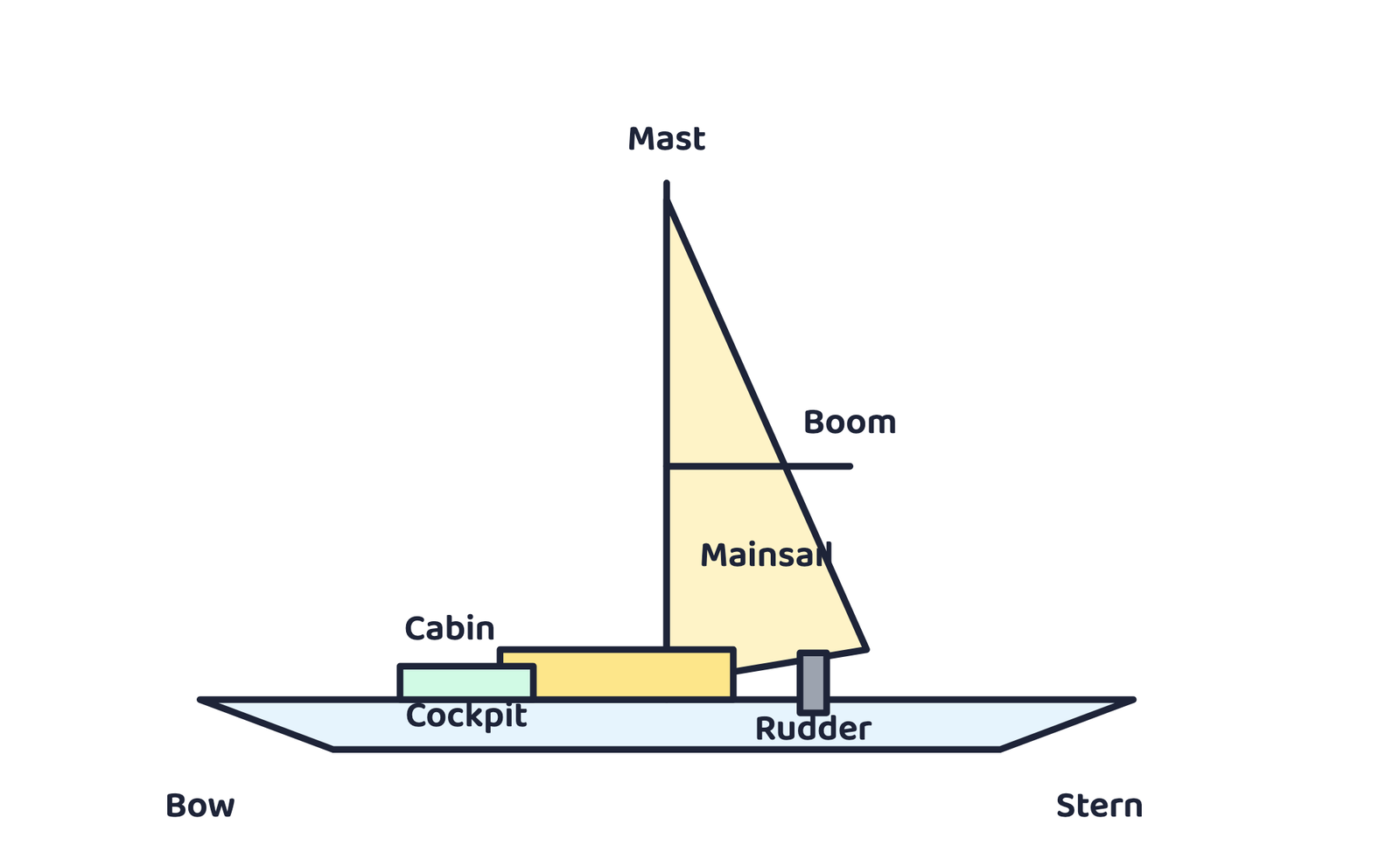
13Labelled Diagram: Parts of a Yacht
- Can I list the boat’s name, size, departure port/date, and both crewmen’s names and nationalities?
- Can I describe, in order, the weather the family faces: the gales out of Cape Town, the great wave of January 2, and the renewed storm of January 4 and 5?
- Can I quote Jon’s exact line about not being afraid to die?
- Can I name and explain all three sections of the story’s structure?
- Three sections: crisis (the great wave of January 2), lowest point (the renewed storm, Jon’s line, the heave-to), resolution (finding Ile Amsterdam)
- Every crew member has a clear role: the narrator repairs and navigates, Mary steers, Larry and Herb pump
- The title line belongs to Jon, not the narrator; get the exact words right
- Central themes: courage, family togetherness, optimism under stress, children’s quiet resilience