- Why the earth’s surface is uneven, and the difference between endogenic and exogenic forces
- The exact difference between a geomorphic process and a geomorphic agent
- The two branches of endogenic processes: diastrophism and volcanism
- The three types of weathering, and why exfoliation is a result, not a process
- The three forms of mass movement and the five kinds of landslide
- Which erosional agents are controlled by climate, and which are not
- The five factors that control how soil forms
diastrophismvolcanismweatheringexfoliation
mass movementlandslideerosionkarstpedogenesis
1Why Is the Earth’s Surface Uneven?
The previous chapters explained how the earth’s crust formed and how its plates have been
moving. That movement is exactly why the surface is uneven today: the earth’s crust is
dynamic, moving both horizontally and vertically, and it moved a little faster in the past
than it does now. Differences in the internal forces that built the crust are responsible for the
differences we see on its outer surface.
At the same time, the surface is also under constant attack from outside, powered by energy from
the sun. This gives us two opposing groups of forces.
Endogenic forces
- Originate from within the earth
- Mainly land-building forces
- Continuously elevate or build up parts of the surface
Exogenic forces
- Originate from outside the earth (sunlight-driven)
- Mainly land-wearing forces
- Wear down (degradation) relief and fill up (aggradation) basins
Gradation is the process by which erosion reduces the differences in relief between the
higher and lower parts of the earth’s surface. Endogenic forces keep building up relief, so
exogenic processes never manage to fully even it out, and differences remain as long as the two
opposing forces keep acting.
Almost every living organism helps sustain the earth’s surface environment in some way. But
humans, through over-use of resources, have caused extensive damage. The chapter’s own point is
practical: use the surface, but do not use up its potential for the future.
2Geomorphic Processes, Agents and Denudation
Two words look similar in this chapter but mean different things, and exam answers often lose
marks for mixing them up.
A geomorphic process is a force applied on earth materials that affects them. A
geomorphic agent is a mobile medium, such as running water, moving ice, wind, waves or
currents, that removes, transports and deposits earth material. Diastrophism and volcanism are
endogenic geomorphic processes; weathering, mass wasting, erosion and deposition are
exogenic geomorphic processes.
| Process | Agent | |
|---|---|---|
| What it is | A force acting on earth material | A mobile medium that carries the material |
| Examples | Weathering, erosion, deposition | Running water, groundwater, glaciers, wind, waves and currents |
| What drives it | Gradients: from higher to lower levels, high pressure to low pressure | Gravity, which activates every downslope movement of matter |
All exogenic geomorphic processes together are covered by one umbrella term.
Denudation (“to strip off” or “to uncover”) includes weathering, mass wasting/movement,
erosion and transportation. Each of these processes has its own distinct driving force, but
gravity and kinetic energy power the whole chain.
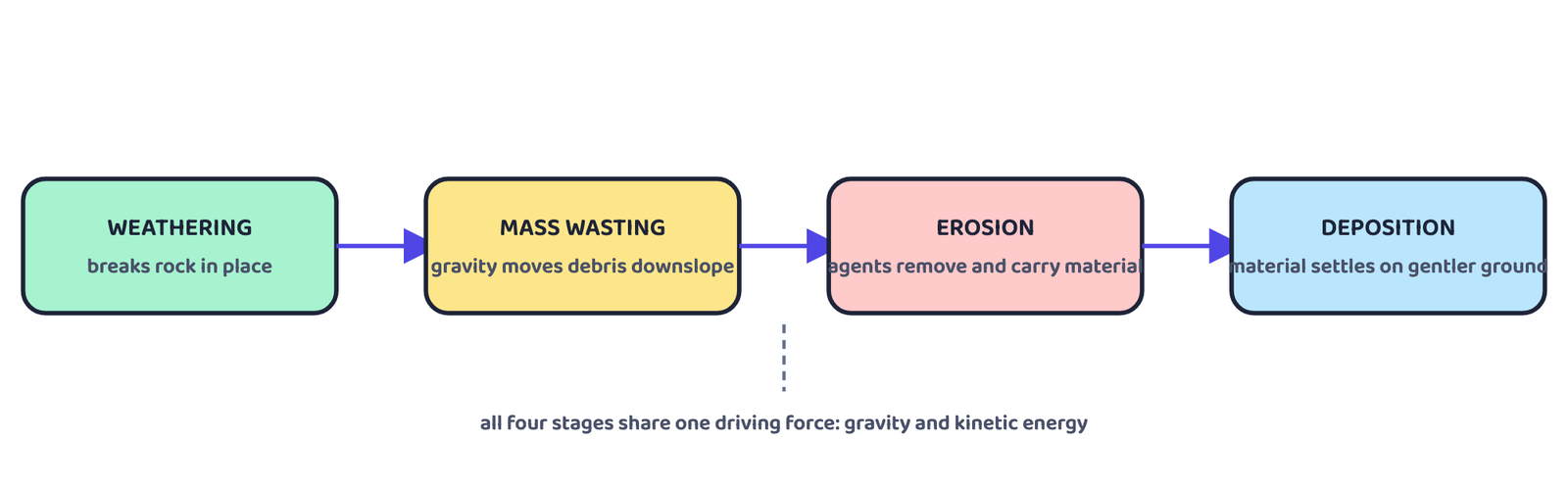
mass wasting, erosion and deposition, each with its own driving force but powered overall by
gravity. A schematic process chart, not a picture of any real landscape.
3Endogenic Processes: Diastrophism and Volcanism
Endogenic processes get their energy mainly from radioactivity, rotational and tidal friction,
and primordial heat left over from the earth’s origin. This energy drives two groups of processes,
both of which were introduced in the previous unit and chapter, so only the exam-relevant facts are
repeated here.
| Type of diastrophism | What it involves |
|---|---|
| Orogenic | Mountain-building through severe folding, affecting long and narrow belts of the crust |
| Epeirogenic | Continent-building; uplift or warping of large parts of the crust |
| Earthquakes | Local, relatively minor movements |
| Plate tectonics | Horizontal movement of crustal plates |
Orogeny is a mountain-building process and severely deforms the crust into folds.
Epeirogeny is a continent-building process and causes only simple deformation. Through
orogeny, epeirogeny, earthquakes and plate tectonics, the crust can fault and fracture, and all
four cause pressure-volume-temperature (PVT) changes that in turn induce metamorphism of
rocks.
Volcanism includes the movement of molten rock (magma) onto or toward the surface, and
the formation of intrusive and extrusive volcanic forms. This is covered in detail under volcanoes
and igneous rocks in earlier chapters of this unit; here it only matters as the second branch of
endogenic geomorphic processes.
4What Controls Exogenic Processes
Exogenic processes get their energy from the atmosphere (ultimately the sun) and from the slopes
and gradients that tectonic factors create.
Stress is force applied per unit area on a solid, produced by pushing or pulling, and it
induces deformation. Shear stress is a stress acting along the faces of earth materials
(a separating force) that results in angular displacement or slippage. It is this stress that
breaks rocks.
Besides gravitational stress, earth materials are also subjected to molecular stresses from
temperature change, crystallisation and melting. Together, all of this stress-building is the
basic reason weathering, mass movement and erosion happen at all.
Climate
Temperature and precipitation are the two key climatic elements. Different climatic regions,
caused by latitude, seasons and land-water spread, produce different exogenic processes. Local
variation also comes from altitude, aspect (a north-facing slope receives different insolation
than a south-facing one, and east-facing differs from west-facing), wind velocity and
direction, and how precipitation relates to evaporation, temperature range and frost depth.
Rock type and structure
Structure includes folds, faults, orientation and inclination of beds, presence of joints,
bedding planes, hardness or softness of minerals, chemical susceptibility, and permeability. A
rock resistant to one process may not resist another, and the same rock can behave differently
under different climatic conditions.
Because of these two controls, exogenic processes operate at different rates in different
places, and this difference in rate is exactly what creates variety in topography. The effects are
usually small and slow, imperceptible in the short term, but severe over a long run of continued
“fatigue”.
Depth of the weathering mantle varies from one climatic regime to another (after Strakhov, 1967). This is the reason the same rock weathers to very different depths in different parts of the world.
5Weathering
Weathering is the mechanical disintegration and chemical decomposition of rocks through
the action of elements of weather and climate. Because very little or no motion of material takes
place, it is an in-situ (on-site) process. This is exactly why weathering is not the same
as transportation.
There are three major groups of weathering processes. Very rarely does only one operate by
itself, but usually one is dominant.
| Type | How it works | Needs / examples |
|---|---|---|
| Chemical | Decomposes, dissolves or reduces rock to a fine clastic state through chemical reactions | Solution, carbonation, hydration, oxidation, reduction. Needs water and air (oxygen, CO₂) plus heat; decomposing plants/animals add more CO₂ underground |
| Physical / mechanical | Breaks rock through applied physical forces, without changing its chemistry | Gravitational forces (overburden pressure, load, shearing stress); expansion forces (temperature change, crystal growth, animal activity); water pressure (wetting-drying cycles) |
| Biological | Contribution or removal of minerals/ions from growth or movement of organisms | Burrowing and wedging by earthworms, termites, rodents; human ploughing; decaying plant/animal matter producing humic and carbonic acids; plant roots exerting mechanical pressure |
Do not write that physical weathering is caused only by temperature change. Water pressure from
wetting-and-drying cycles and gravitational forces (overburden pressure, load, shearing) are
equally part of physical weathering: thermal expansion and pressure release are simply the most
common causes, not the only ones.
6Effects and Significance of Weathering
One special, named effect of physical weathering is worth learning on its own.
Exfoliation is a result, not a process: the flaking off of more or less curved
sheets from a rock or bedrock, leaving smooth, rounded surfaces. It happens due to unloading and
thermal expansion/contraction (and salt weathering). Exfoliation domes result from
unloading; tors result from thermal expansion.
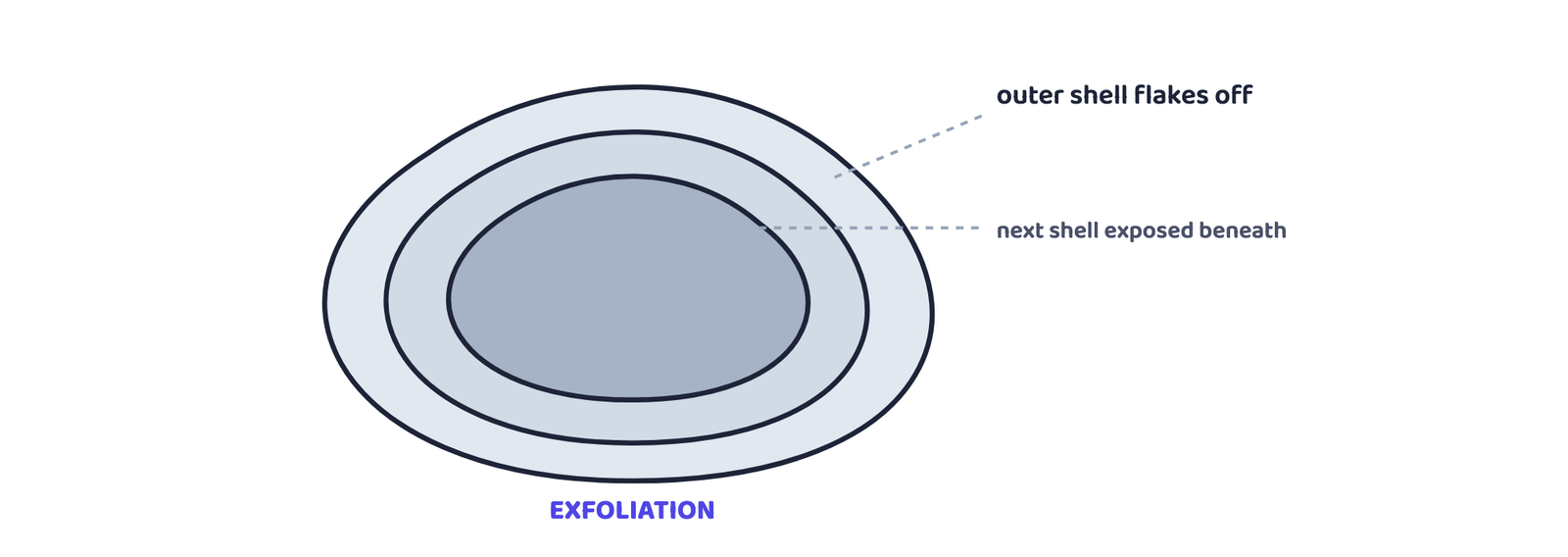
driven by unloading and by repeated thermal expansion and contraction. A schematic process
diagram, not a picture of any real rock formation.
Weathering matters far beyond just breaking rock:
Prepares the ground
Breaks rock into fragments and prepares the way for regolith and soil formation. Erosion
cannot be significant if rock is not first weathered.
Supports biodiversity
Forests and biomes depend on the depth of the weathering mantle beneath them.
Enriches valuable ores
Groundwater leaches away soluble material through chemical or physical action, concentrating
what remains. This is called enrichment, and it applies to ores of iron, manganese,
aluminium and copper, of real importance to the national economy.
7Mass Movements
Mass movements transfer the mass of rock debris down a slope under the direct influence
of gravity alone. No geomorphic agent (running water, glaciers, wind, waves, currents)
participates directly. Air, water or ice do not carry the debris; rather, the debris may carry
air, water or ice with it. This is why mass movements do NOT come under erosion, even though
material does shift from one place to another.
Weathering is not a pre-requisite for mass movement, but it aids it heavily: mass movements are
far more active on weathered slopes than on unweathered ones. Movement ranges from slow to rapid
and takes three forms.
Heave
Slow, upward heaving of soil, typically caused by frost growth or similar causes.
Flow
Material moves as a viscous mass down the slope.
Slide
Rapid, perceptible movement, the basis of the five landslide types below.
Weak unconsolidated materials, thinly bedded rocks, faults, steeply dipping beds, vertical
cliffs, heavy or torrential rainfall and lack of vegetation all favour mass movement.
Landslides are relatively rapid and perceptible, and the material involved is relatively
dry.
| Landslide type | What happens |
|---|---|
| Slump | Slipping of one or several units of rock debris with backward rotation, relative to the slope |
| Debris slide | Rapid rolling or sliding of debris without backward rotation |
| Debris fall | Nearly a free fall of earth debris from a vertical or overhanging face |
| Rockslide | Sliding of individual rock masses down bedding, joint or fault surfaces; very fast and destructive on steep slopes; occurs as planar failure along steeply-dipping discontinuities |
| Rock fall | Free fall of rock blocks over a steep slope, away from the slope face; comes from superficial layers only. This is what separates it from rockslide, which affects material to a substantial depth |
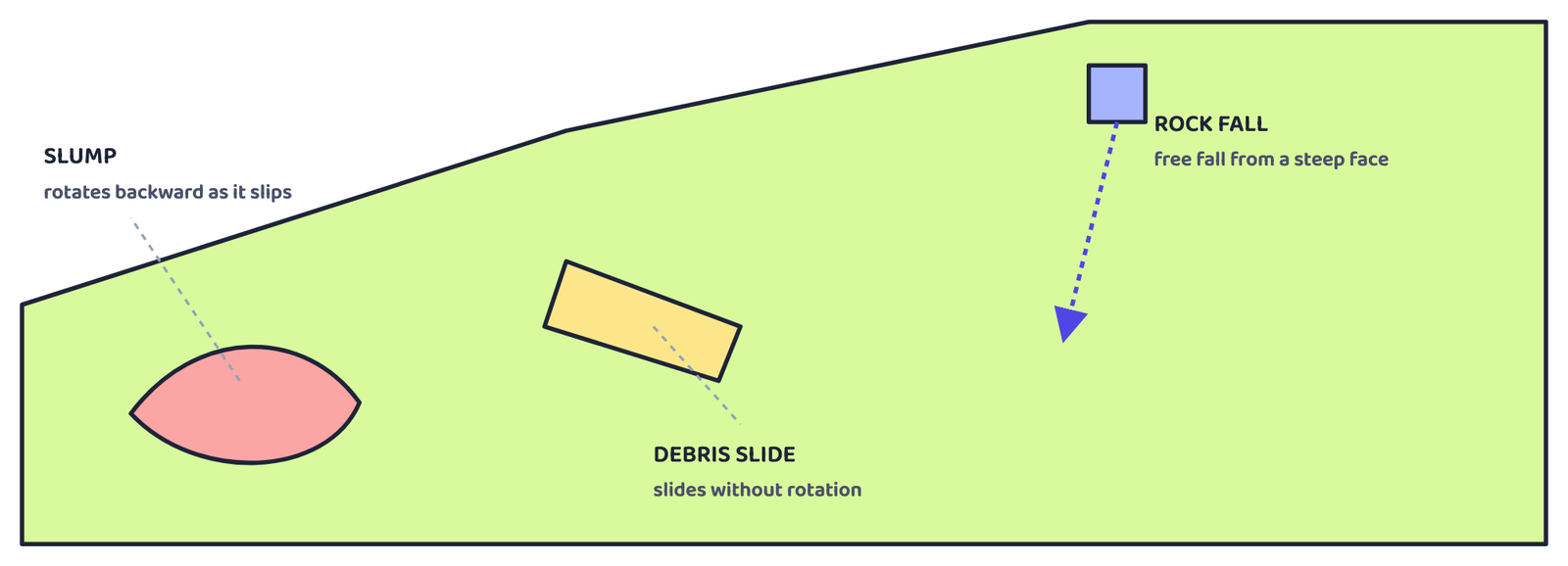
slump rotates backward as it slips, debris slide moves without rotation, and rock fall drops
freely from an overhanging face. Not a picture of any real hillside.
Himalayas
- Tectonically active
- Mostly sedimentary, unconsolidated to semi-consolidated material
- Very steep slopes
- Debris avalanches and landslides occur very frequently
Nilgiris and Western Ghats
- Tectonically more stable, very hard rocks
- Still have steep cliffs and escarpments
- Pronounced mechanical weathering from temperature range; heavy short-duration rainfall
- Debris avalanches, landslides and direct rock falls occur, just less often than the Himalayas
8Erosion and Deposition
Erosion involves the acquisition and transportation of rock debris. Once weathering (or
any other process) breaks massive rock into fragments, erosional agents (running water,
groundwater, glaciers, wind and waves) remove and transport it elsewhere. Abrasion, by the
debris these agents carry, adds further to erosion. Erosion degrades relief, wearing the
landscape down; weathering aids erosion but is not essential for it to happen.
Of the five erosional agents, three are controlled directly by climate, and represent the three
states of matter: wind (gaseous), running water (liquid) and glaciers (solid).
The other two agents are not controlled by climate. Waves are controlled by their
location along the interface of the lithosphere and hydrosphere: the coastal region. The work of
groundwater depends more on the lithological character of the region: if rocks are
permeable and soluble, and water is available, karst topography develops. Landforms
produced by each of these agents are described in the next chapter, not this one.
Deposition is a consequence of erosion, not the direct “work” of any agent by itself.
As erosional agents lose velocity (and so energy) on gentler slopes, the material they carry
starts to settle. Coarser material is deposited first, finer material later, and depressions get
filled up. The same five erosional agents also act as depositional (aggradational) agents.
9Soil Formation
Pedogenesis (soil formation) depends first on weathering: the depth of the weathering
mantle is the basic input for soil to form. Pedology is the science of soil; a
pedologist is a soil scientist.
Five factors control soil formation, acting together rather than separately.
| Factor | Role | What it decides |
|---|---|---|
| Parent material | Passive control | Residual (in-situ weathered) vs transported soils; young soils closely resemble the parent rock; in limestone areas soils clearly reflect the parent rock even when mature |
| Topography | Passive control | Controls sunlight exposure and drainage. Thin soil on steep slopes, thick soil on flat upland. Gentle slopes with slow erosion and good percolation favour soil formation most |
| Climate | Active control | Moisture and temperature. Excess water causes eluviation (downward transport) and illuviation (deposit lower down); wet climates cause desilication; dry climates form hardpans (salt crust); tropical/intermediate zones form kanker (calcium carbonate nodules) |
| Biological activity | Active control | Vegetation and organisms add humus, moisture-holding and nitrogen. Cold climates accumulate humus (slow bacteria) or peat (sub-arctic/tundra); humid tropical climates oxidise vegetation fast, leaving little humus. Nitrogen fixation is done by bacteria such as Rhizobium in the root nodules of leguminous plants |
| Time | Third important control | Determines maturity and profile development. Recently deposited alluvium or glacial till gives young soils with poor or no horizons; there is no fixed absolute time for maturity |
If asked to distinguish “the process of soil formation” from “soil-forming factors”: the
process is the sequence of colonisation, humus build-up and maturation described above; the
factors (parent material, topography, climate, biological activity, time) are what control
how that process runs and how fast. Parent material and topography are called passive
controls; climate and biological activity are active controls; time is the third
important factor that decides maturity.
- Can I state the exact difference between a geomorphic process and a geomorphic agent?
- Can I list the four types of diastrophism and the difference between orogeny and epeirogeny?
- Can I name the three types of weathering and give one example of each?
- Can I name all five types of landslide, in one line each?
- Can I name the three climate-controlled erosional agents and the two that are not?
- Can I list the five soil-forming factors and say which are passive and which are active?
- Endogenic forces build the surface up; exogenic forces wear it down; gradation is erosion reducing that relief difference
- Process = a force on earth material; agent = the mobile medium that carries it; denudation covers all exogenic processes together
- Diastrophism has 4 types: orogenic, epeirogenic, earthquakes, plate tectonics; volcanism is the other endogenic process
- Exogenic processes are controlled by climate (temperature, precipitation) and by rock type/structure
- Weathering: chemical, physical/mechanical, biological, an in-situ process, not transportation
- Exfoliation is a result (unloading + thermal expansion/contraction), not a process; weathering enriches ores by leaching away soluble material
- Mass movement: heave, flow, slide; 5 landslide types: slump, debris slide, debris fall, rockslide, rock fall
- Erosion agents: running water, groundwater, glaciers, wind, waves; wind/water/glaciers are climate-controlled (gaseous/liquid/solid); waves and groundwater are not
- Deposition is a consequence of erosion, coarse material settles first, fine material later
- Soil formation depends on 5 factors: parent material and topography (passive), climate and biological activity (active), and time
- 1 markWhich one of the following processes is a gradational process?
(a) Deposition(b) Diastrophism
(c) Volcanism(d) Erosion - 1 markWhich one of the following materials is affected by the hydration process?
(a) Granite(b) Clay
(c) Quartz(d) Salts - 1 markDebris avalanche can be included in the category of:
(a) Landslides(b) Slow flow mass movements
(c) Rapid flow mass movements(d) Subsidence - 1 markWhich type of diastrophism is mainly responsible for mountain building?
(a) Epeirogeny(b) Orogeny
(c) Earthquakes(d) Volcanism - 1 markA landslide with backward rotation of the rock debris is called:
(a) Debris slide(b) Rockslide
(c) Slump(d) Rock fall - 1 markWhich erosional agent is NOT controlled by climate?
(a) Wind(b) Running water
(c) Glaciers(d) Groundwater - 1 markKarst topography develops when:
(a) Rocks are impermeable and insoluble(b) Rocks are permeable, soluble and water is available
(c) A region has heavy glaciation(d) Wind is the only active agent - 1 markExfoliation domes are chiefly the result of:
(a) Unloading(b) Chemical solution
(c) Biological wedging(d) Carbonation - 1 markWhich of these is a passive control factor in soil formation?
(a) Climate(b) Biological activity
(c) Parent material(d) Time alone - 1 markRhizobium bacteria, important for nitrogen fixation, live in:
(a) Sandy desert soils(b) Root nodules of leguminous plants
(c) Glacial till(d) Ocean floor sediments
Reason (R): Weathering aids erosion greatly, but erosion is not entirely dependent on weathering having occurred first.
Reason (R): No geomorphic agent like running water, glaciers, wind or waves directly participates in mass movement; gravity alone moves the debris.
- 3 marksIt is weathering that is responsible for bio-diversity on the earth. How?
- 3 marksWhat are the mass movements that are real rapid and perceptible? List them.
- 3 marksWhat are the various mobile and mighty exogenic geomorphic agents, and what is the prime job they perform?
- 3 marksIs weathering essential as a pre-requisite in the formation of soils? Why?
- 5 marks“Our earth is a playfield for two opposing groups of geomorphic processes.” Discuss.
- 5 marksExogenic geomorphic processes derive their ultimate energy from the sun’s heat. Explain.
- 5 marksAre physical and chemical weathering processes independent of each other? If not, why? Explain with examples.
- 5 marksHow do you distinguish between the process of soil formation and soil-forming factors? What is the role of climate and biological activity as two important control factors in soil formation?
mechanical weathering. A nearby Himalayan slope has weaker, semi-consolidated rock and steeper gradients.
- 1 markWhich slope shows debris avalanches and landslides more often, and why?
- 2 marksName two factors, besides rock type, that still make the Western Ghats slope prone to rock falls.