
Every question from the Exercises at the end of NCERT’s Fundamentals of Physical Geography, Chapter 7, “Composition and Structure of Atmosphere” (Chapter 13 on this site), in the exact order and wording printed in the book (English edition), with a full answer for each, followed by the question asked in a box inside the chapter. Try answering it yourself first, then check against this one.
1 Multiple choice questions
Q. Which one of the following gases constitutes the major portion of the atmosphere?
(a) Oxygen (b) Nitrogen (c) Argon (d) Carbon dioxide
Answer: (b) Nitrogen. Nitrogen is the gas present in the largest quantity in the atmosphere, followed by oxygen; gases such as carbon dioxide, ozone and argon are found in much smaller, though still important, quantities.
Q. Atmospheric layer important for human beings is:
(a) Stratosphere (b) Mesosphere (c) Troposphere (d) Ionosphere
Answer: (c) Troposphere. The troposphere is where dust particles and water vapour are present and all weather events take place, which is why it is the most important layer for biological activity and human life.
Q. Sea salt, pollen, ash, smoke soot, fine soil – these are associated with:
(a) Gases (b) Dust particles (c) Water vapour (d) Meteors
Answer: (b) Dust particles. These are all different sources of dust particles; disintegrated meteor particles are also one such source, so “meteors” is not a separate category but one of the sources of dust particles.
Q. Oxygen gas is in negligible quantity at the height of atmosphere:
(a) 90 km (b) 120 km (c) 100 km (d) 150 km
Answer: (b) 120 km. The proportion of gases in the upper layers of the atmosphere changes with height; oxygen becomes negligible in quantity at a height of 120 km, while carbon dioxide and water vapour are found only up to 90 km.
Q. Which one of the following gases is transparent to incoming solar radiation and opaque to outgoing terrestrial radiation?
(a) Oxygen (b) Nitrogen (c) Helium (d) Carbon dioxide
Answer: (d) Carbon dioxide. Carbon dioxide lets sunlight in but absorbs part of the terrestrial radiation (heat) returning from the earth and reflects it back towards the surface, which is why it is largely responsible for the greenhouse effect.
2 Answer the following questions in about 30 words
Q. What do you understand by atmosphere?
Answer: The atmosphere is the mixture of gases, water vapour and dust particles that envelopes the earth all round. It is colourless and odourless, and 99 per cent of its mass is confined to a height of 32 km from the surface.
Q. What are the elements of weather and climate?
Answer: The main elements of weather and climate are temperature, pressure, winds, humidity, clouds and precipitation. They influence human life on earth and keep changing; they are described in detail in the chapters that follow.
Q. Describe the composition of atmosphere.
Answer: The atmosphere is composed of gases, water vapour and dust particles. Carbon dioxide (greenhouse gas) and ozone (found at 10-50 km, absorbs ultra-violet rays) are important gases; water vapour is about 4 per cent of the air in the wet tropics and under 1 per cent in deserts and polar regions; dust particles act as hygroscopic nuclei for clouds.
Q. Why is troposphere the most important of all the layers of the atmosphere?
Answer: The troposphere holds dust particles and water vapour, and all changes in weather and climate take place in this layer. This is why it is considered the most important layer of the atmosphere for biological activity.
3 Answer the following questions in about 150 words
Q. Describe the composition of the atmosphere.
Answer: The atmosphere is made up of gases, water vapour and dust particles. In its upper layers, the proportion of gases changes with height: oxygen becomes almost negligible at 120 km, while carbon dioxide and water vapour are found only up to 90 km. Carbon dioxide is transparent to solar radiation but opaque to terrestrial radiation, which is why it is responsible for the greenhouse effect; its volume has been rising steadily because of the burning of fossil fuels, which has also raised the temperature of the air. Ozone is found between 10 and 50 km above the earth’s surface and acts as a filter, absorbing ultra-violet rays and preventing them from reaching the surface. Water vapour decreases with altitude and latitude, from about 4 per cent of the air by volume in the warm, wet tropics to less than 1 per cent in dry, cold regions, and acts like a blanket, absorbing and preserving heat. Dust particles come from sources such as sea salts, fine soil, smoke-soot, ash, pollen and disintegrated meteor particles, and act as hygroscopic nuclei, helping water vapour condense into clouds.
Q. Draw a suitable diagram for the structure of the atmosphere and label it and describe it.
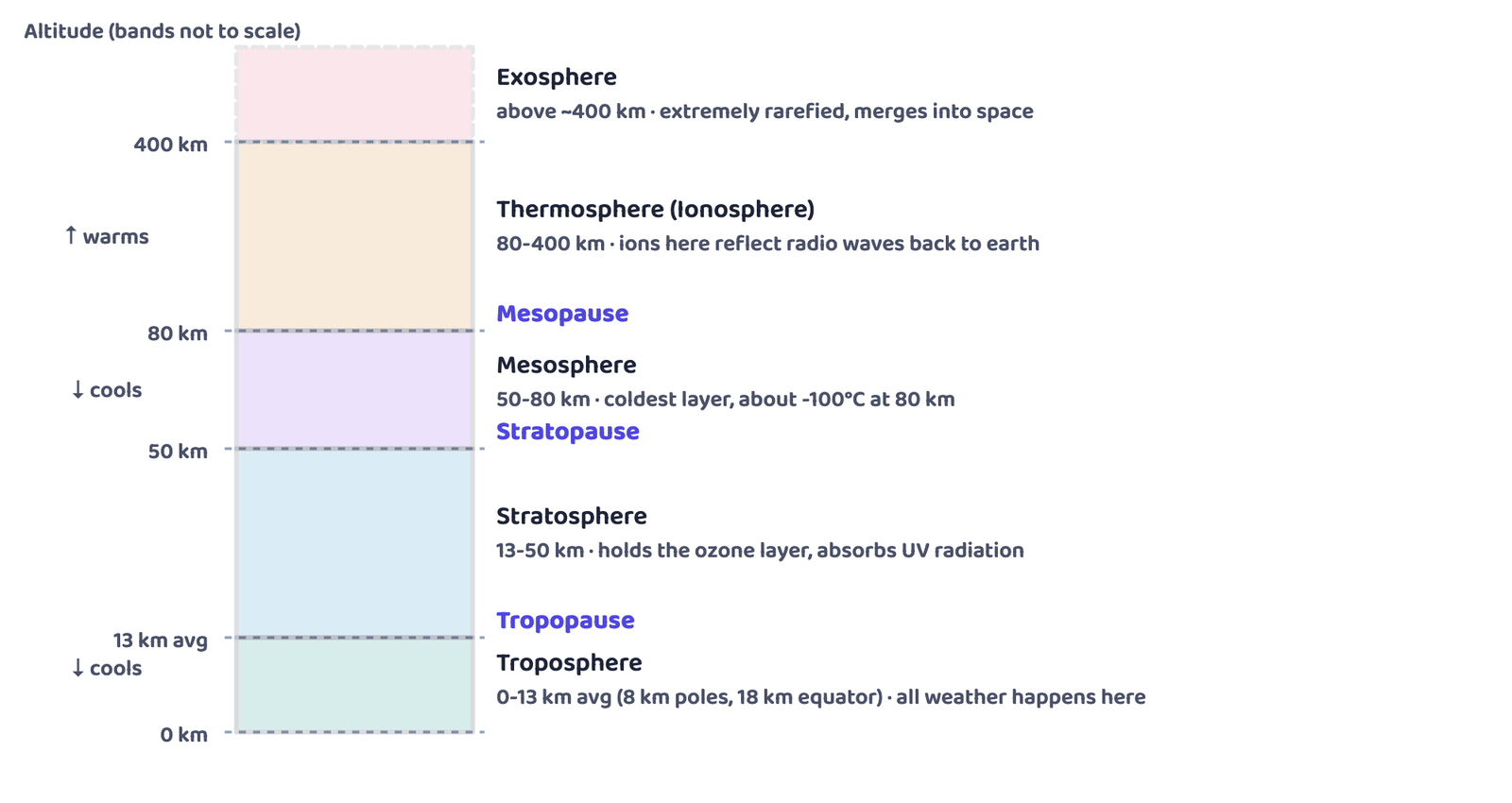
Answer: The atmosphere is not a uniform layer; its density is highest near the earth’s surface and decreases with height. Based on temperature behaviour, it is divided into five layers, from the surface upward: (1) Troposphere, from the surface to an average of 13 km (8 km at the poles, 18 km at the equator): temperature falls by 1°C for every 165 m of height, dust particles and water vapour are present, and all weather takes place here. Above it lies the tropopause, where temperature becomes nearly constant (about -80°C over the equator, -45°C over the poles). (2) Stratosphere, up to about 50 km: contains the ozone layer, which absorbs ultra-violet radiation. (3) Mesosphere, up to about 80 km: temperature falls again, reaching about -100°C; its upper limit is called the mesopause. (4) Ionosphere (thermosphere), 80 to 400 km: contains electrically charged ions, which reflect radio waves transmitted from the earth back to it, and temperature starts rising with height. (5) Exosphere, above about 400 km: the uppermost and most rarefied layer of the atmosphere, gradually merging with outer space. Geographers are mainly concerned with the first two of these layers, the troposphere and the stratosphere, since these most directly affect human life.
4 In-text question from the chapter
The chapter also asks this question in a box inside the text, in its opening section.
Q. Can you imagine what will happen to us in the absence of ozone in the atmosphere?
Answer: Ozone, found between 10 and 50 km above the earth’s surface (the ozone layer lies in the stratosphere), acts as a filter: it absorbs the ultra-violet rays radiating from the sun and prevents them from reaching the surface of the earth, shielding life from this intense, harmful form of energy. Without ozone, these ultra-violet rays would reach the ground directly. Humans would suffer severe sunburn, damage to the skin and eyes, and a much higher risk of skin cancer and other illness; plants, animals and life in the surface waters of the oceans would also be harmed. Life on the earth, as we know it, would not be possible.
Questions 1(i), (iv) and (v) are typical objective questions: the most abundant gas (nitrogen), the height at which oxygen becomes negligible (120 km), and the greenhouse gas (carbon dioxide). Question 3(ii) is the most direct base for long-answer questions: memorise the names, order and height range of all five layers, and practise drawing the temperature graph (temperature rises with height in the stratosphere).
1. Most abundant gas (Q1-i): Nitrogen. 2. Layer important for human life (Q1-ii): Troposphere. 3. Height at which oxygen becomes negligible (Q1-iv): 120 km. 4. Greenhouse gas (Q1-v): Carbon dioxide. 5. Five layers, in order (Q3-ii): Troposphere, Stratosphere, Mesosphere, Ionosphere (thermosphere), Exosphere. Learn these word for word.