
- What the atmosphere is made of, and why oxygen and carbon dioxide behave differently at great heights
- Why carbon dioxide warms the earth while ozone protects it, using the same idea of transparency to radiation
- How dust particles and water vapour help form clouds
- The five layers of the atmosphere, in order, and the one feature that defines each
- Why the troposphere alone is where all of our weather happens
1Why We Need the Atmosphere
A person can survive for some time without food or water, but not even a few
minutes without breathing. That single fact is why the atmosphere deserves a
close look. The atmosphere is a mixture of different gases that
envelopes the earth all round. It carries life-giving gases like oxygen for
humans and animals, and carbon dioxide for plants. Air itself is colourless
and odourless, and can only be felt when it blows as wind.
The atmosphere is the mixture of gases, water vapour and dust
particles that envelopes the earth all round.
2Composition of the Atmosphere
The atmosphere is made of three things: gases, water vapour and dust
particles. This mix is not the same at every height: the proportion of gases
changes higher up. Oxygen becomes almost negligible at a height of 120 km,
while carbon dioxide and water vapour are found only up to 90 km from the
earth’s surface.
2.0 Three ingredients of the atmosphere
Gases
Mainly nitrogen and oxygen, plus smaller but crucial amounts of carbon
dioxide and ozone.
Water vapour
A variable gas that decreases with altitude and changes with climate: more in the tropics, less near the poles.
Dust particles
Tiny solid particles from many sources, concentrated in the lower
atmosphere.
2.1 Gases: carbon dioxide and ozone
Carbon dioxide is meteorologically very important: it is transparent
to incoming solar radiation but opaque to outgoing terrestrial radiation. It
absorbs part of the earth’s outgoing heat and reflects some of it back
towards the surface: this is largely why it is responsible for the
greenhouse effect. The volume of most other gases stays constant, but
carbon dioxide’s volume has been rising for decades, mainly from the burning
of fossil fuels, which has also raised the temperature of the air.
Ozone is another important component, found between 10 and 50 km
above the earth’s surface. It acts as a filter, absorbing the ultra-violet
rays radiating from the sun and preventing them from reaching the earth’s
surface.
Carbon dioxide and ozone are opposites in an exam-friendly way: CO2 lets
sunlight in but traps outgoing heat (warms the earth); ozone blocks harmful
incoming UV rays before they arrive (protects the earth). Both ideas come
from the same principle of which radiation a gas lets through and which it
blocks.
Can you imagine what would happen to us in the absence of ozone in the
atmosphere? Without the ozone layer filtering ultra-violet rays, the
intense radiation reaching the surface would seriously harm life on
earth.
2.2 Water vapour
Water vapour is a variable gas that decreases with altitude. In the warm
and wet tropics it may account for as much as 4% of the air by volume;
in the dry and cold areas of deserts and polar regions it may be
less than 1%. It also decreases from the equator towards the poles. Water
vapour absorbs part of the incoming insolation and also preserves the earth’s
radiated heat: it acts like a blanket, keeping the earth from becoming
either too cold or too hot. It also contributes to the stability and
instability of the air.
2.3 Dust particles
The atmosphere has enough capacity to hold small solid particles that
originate from many sources: sea salts, fine soil, smoke-soot, ash, pollen,
dust and disintegrated meteor particles. Dust particles are generally
concentrated in the lower layers, though convectional air currents can carry
them to great heights. Their concentration is higher in subtropical and
temperate regions, where dry winds prevail, than in equatorial and polar
regions.
A hygroscopic nucleus is a dust or salt particle around which
water vapour condenses to produce clouds.
3Structure of the Atmosphere
The atmosphere is not one uniform layer. Density is highest near the
earth’s surface and decreases with increasing altitude. Depending on how
temperature behaves at each height, the column of atmosphere is divided into
five layers: troposphere, stratosphere, mesosphere, thermosphere and
exosphere.
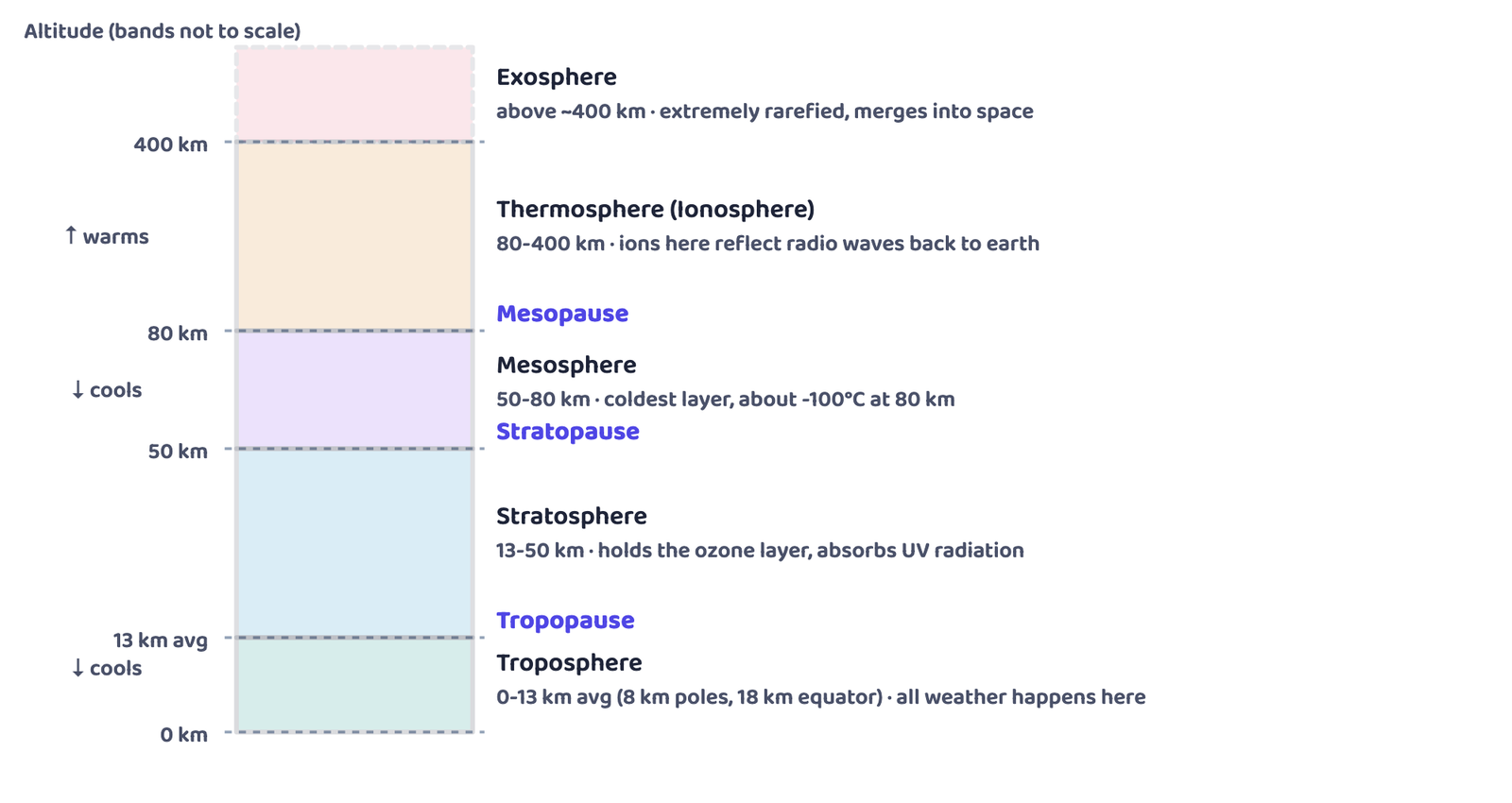
7.1; heights not to scale). Temperature falls through the troposphere, stays
nearly constant at the tropopause, rises with height through the
ozone-bearing stratosphere, falls again through the mesosphere to about
-100°C at 80 km, then rises through the thermosphere (ionosphere) before the
exosphere merges into space.
3.1 Troposphere
The troposphere is the lowermost layer of the atmosphere. Its
average height is 13 km, extending to roughly 8 km near the poles and about
18 km at the equator. It is thickest at the equator because heat is carried
to great heights there by strong convectional currents. This layer holds
dust particles and water vapour, and all changes in weather and climate
take place in this layer. Temperature decreases at the rate of 1°C for
every 165 m of height. It is the most important layer for all biological
activity.
The tropopause is the zone separating the troposphere from the
stratosphere, where air temperature is nearly constant: about -80°C over
the equator and about -45°C over the poles.
3.2 Stratosphere
The stratosphere lies above the tropopause and extends up to a
height of 50 km. Its important feature is that it contains the
ozone layer, which absorbs ultra-violet radiation and shields life on
earth from this intense, harmful form of energy. As the book’s Figure 7.1
shows, temperature in the stratosphere rises with height, from the
cold tropopause to about 0°C near 50 km: it is not a layer of
constant temperature (only the tropopause is).
3.3 Mesosphere
The mesosphere lies above the stratosphere and extends up to a
height of 80 km. Here, temperature once again starts decreasing with
increasing altitude, reaching about -100°C at 80 km. The upper limit of the
mesosphere is called the mesopause.
3.4 Ionosphere (Thermosphere)
The ionosphere is located between 80 and 400 km above the
mesopause. It contains electrically charged particles called ions: hence its name: and radio waves transmitted from earth are reflected back
to earth by this layer. Temperature here starts increasing with height.
3.5 Exosphere
The uppermost layer, above the thermosphere, is the exosphere: the
highest layer, about which very little is known. Whatever contents exist
there are extremely rarefied, and the layer gradually merges with outer
space.
| Layer | Approx. extent | Key feature |
|---|---|---|
| Troposphere | 0-13 km avg (8 km poles, 18 km equator) | All weather occurs here; temp. falls 1°C/165 m |
| Stratosphere | up to 50 km | Contains the ozone layer; temp. rises with height |
| Mesosphere | up to 80 km | Temp. falls again, to about -100°C at 80 km |
| Thermosphere (ionosphere) | 80-400 km | Ions reflect radio waves; temp. rises with height |
| Exosphere | above ~400 km | Extremely rarefied, merges into space |
All layers of the atmosphere influence us in some way, but geographers
are mainly concerned with just the first two: the troposphere and the
stratosphere.
the one idea to carry out of this chapter
4Elements of Weather and Climate
The main elements of the atmosphere that keep changing and that influence
human life on earth are temperature, pressure, winds, humidity, clouds and
precipitation. This chapter has only introduced the atmosphere itself: each of these elements is dealt with in detail in the chapters that
follow.
- Atmosphere = gases + water vapour + dust particles, held to the earth all round
- 99% of its mass lies within 32 km of the surface
- Carbon dioxide traps outgoing heat (greenhouse effect); ozone blocks incoming UV rays
- Water vapour: ~4% of air in the wet tropics, less than 1% in dry/cold regions
- Dust particles act as hygroscopic nuclei: the seeds around which clouds form
- Five layers by temperature: troposphere → stratosphere → mesosphere → thermosphere (ionosphere) → exosphere
- Troposphere: all weather happens here, temp. falls 1°C every 165 m, thickest at the equator
- Geographers study mainly the troposphere and the stratosphere
- Can I name all five layers of the atmosphere in order, with their approximate height?
- Can I explain why carbon dioxide warms the earth while ozone protects it?
- Can I draw and label the structure of the atmosphere from memory?
- 1 markWhich one of the following gases constitutes the major portion of the atmosphere?
(a) Oxygen(b) Nitrogen(c) Argon(d) Carbon dioxide - 1 markThe atmospheric layer most important for human beings is:
(a) Stratosphere(b) Mesosphere(c) Troposphere(d) Ionosphere - 1 markSea salt, pollen, ash, smoke soot and fine soil are associated with:
(a) Gases(b) Dust particles(c) Water vapour(d) Meteors - 1 markOxygen gas is in negligible quantity at a height of:
(a) 90 km(b) 120 km(c) 100 km(d) 150 km - 1 markWhich gas is transparent to incoming solar radiation and opaque to outgoing terrestrial radiation?
(a) Oxygen(b) Nitrogen(c) Helium(d) Carbon dioxide - 1 mark99% of the atmosphere’s total mass lies within a height of:
(a) 32 km(b) 50 km(c) 90 km(d) 120 km - 1 markThe average height of the troposphere is about:
(a) 13 km(b) 18 km(c) 8 km(d) 32 km - 1 markWhich one of the following is the correct order of atmospheric layers going outward from the surface?
(a) Troposphere-Stratosphere-Mesosphere-Thermosphere-Exosphere(b) Stratosphere-Troposphere-Mesosphere-Exosphere-Thermosphere(c) Troposphere-Mesosphere-Stratosphere-Thermosphere-Exosphere(d) Exosphere-Thermosphere-Mesosphere-Stratosphere-Troposphere - 1 markRadio waves transmitted from the earth are reflected back to the earth by the:
(a) Ionosphere(b) Stratosphere(c) Mesosphere(d) Exosphere - 1 markThe zone separating the troposphere from the stratosphere is called the:
(a) Mesopause(b) Tropopause(c) Stratopause(d) Exobase - 1 markDust and salt particles act as hygroscopic nuclei around which:
(a) Ozone is formed(b) Radio waves are reflected(c) Water vapour condenses to form clouds(d) Ions are produced - 1 markCarbon dioxide and water vapour are found only up to a height of:
(a) 50 km(b) 80 km(c) 90 km(d) 120 km - 1 markThe layer that contains the ozone layer and shields life on earth from harmful ultra-violet radiation is the:
(a) Troposphere(b) Mesosphere(c) Stratosphere(d) Exosphere - 1 markIn the troposphere, temperature decreases at the rate of 1°C for every:
(a) 100 m(b) 150 m(c) 200 m(d) 165 m - 1 markThe uppermost layer of the atmosphere, which gradually merges with outer space, is the:
(a) Thermosphere(b) Ionosphere(c) Mesosphere(d) Exosphere
- 1 mark
Assertion (A): The stratosphere shields life on earth from intense, harmful ultra-violet radiation.
Reason (R): The stratosphere contains the ozone layer, which absorbs ultra-violet radiation. - 1 mark
Assertion (A): The atmosphere contains life-giving gases such as oxygen and carbon dioxide.
Reason (R): Radio waves transmitted from the earth are reflected back to earth by the ionosphere. - 1 mark
Assertion (A): The troposphere is the most important layer for all biological activity.
Reason (R): The troposphere is the thickest layer of the atmosphere, extending up to 400 km. - 1 mark
Assertion (A): The troposphere is thicker over the poles than over the equator.
Reason (R): Strong convectional currents transport heat to great heights over the equator, making the troposphere thickest there.
- 1 markDefine the atmosphere.
- 1 markWhat is the tropopause?
- 1 markName the five layers of the atmosphere, in order, from the surface upward.
- 1 markWhat is a hygroscopic nucleus?
- 1 markWhich two layers of the atmosphere do geographers study in the greatest detail?
- 3 marksWhat do you understand by the atmosphere?
- 3 marksWhat are the elements of weather and climate?
- 3 marksDescribe the composition of the atmosphere.
- 3 marksWhy is the troposphere the most important of all the layers of the atmosphere?
- 3 marksWhy are carbon dioxide and ozone described as playing opposite yet vital roles for life on earth?
- 5 marksDescribe the composition of the atmosphere.
- 5 marksDraw a suitable diagram for the structure of the atmosphere, label it, and describe it.
- 5 marksExplain how the changing proportion of gases with altitude, and the way temperature behaves with height, together explain why the atmosphere is divided into five layers.