
- What Physical Education really means, the four standard definitions, and its aim and sixteen objectives
- How Physical Education developed in India after independence, year by year
- How playing surfaces, wearable gear, sports equipment and technology have changed
- Which Physical Education courses exist in India and the career options they open
- The Khelo India Programme (vision, mission, twelve verticals) and the Fit India Movement
In the CBSE Physical Education (048) curriculum, this is Unit 1: Changing Trends and Careers in Physical Education, worth 4 marks + 4 “b” marks. The “b” marks are concept-based questions (a tactile diagram, data interpretation or a case study) set for visually impaired candidates. The theory paper is 70 marks and the practical 30 marks. The prescribed book is CBSE’s own Physical Education Class XI textbook (2nd edition, 2023); there is no NCERT book for this subject.
1 Meaning of Physical Education
Ask people what Physical Education is and most will say sports, coaching, health education, yoga or personal fitness. The book says all of these belong to Physical Education, but they are not the whole of it. In essence, Physical Education uses physical activity or movement to bring positive changes in the physical, mental and emotional make-up of a person. It is a broad field of education that deals with the relationship between physical wellbeing, movement and the other domains of education.
1.1 The two words

- Physical means related to the body, that is, to any or all bodily characteristics: physical strength, physical endurance, physical fitness, physical appearance and physical health.
- Education means preparation for life, or systematic instruction and training.
- Together: Physical Education is a systematic training of an individual by using his/her own body to develop and maintain the body, develop motor skills and physical abilities, make a habit of a healthy lifestyle, and develop the ability to control emotions for a fuller living.
1.2 The modern concept: movement education
Movement education is the modern name of Physical Education. It stresses overall fitness and wellbeing, not only physical fitness, achieved through body movement, and shows how the body moves to develop efficient motor activity.
- Movement is governed by mechanical principles: a person must know the forces acting on the body so that the movement is meaningful.
- Movement is affected by physical fitness, emotions (fear and anxiety) and even atmospheric changes.
- Movement is also a means of communication.
- In movement education students have freedom of self-exploration: they find their own solutions to movement problems, choose methods that suit their abilities and follow their own methods of movement.
- So the PE curriculum must focus on the overall fitness of a human being, teaching people to value it, assess it and improve it.
1.3 Locomotor and non-locomotor movements

Locomotor movements
- The body travels from one place to another
- Walking, running, hopping, leaping, skipping, galloping (jumping is also locomotor)
Non-locomotor movements
- The body stays in place; parts of it move
- Stretching, twisting, turning, pushing, pulling, swinging
CBSE asked schools to keep one period every day for Health and Physical Education for classes 9 to 12 from session 2018-19, with the aim of the holistic development of the child. From April 2019, a daily Health and Physical Education period was made compulsory for Classes 1 to 8 as well.
2 Definitions of Physical Education
Physical Education is more than sports education. Four scholars’ definitions are in the book; learn each with its author.
“Physical Education is the sum of those experiences which come to the individual through movement.”
“Physical Education is an integral part of the total educational process. It is a field of endeavour that has as its aim the improvement of human performance through the medium of physical activities that have been selected with a view to realizing this outcome.”
“Physical Education is the sum of man’s physical activities selected as to kind, and conducted as to outcomes.”
“Physical Education is that phase of the whole field of education that deals with the big muscle activities and their related responses.”
Physical Education is a teaching-learning process in which physical activities are the medium of instruction, designed to improve physical fitness, motor skills, knowledge, sportsmanship, emotional stability and healthy behaviour. In short, it is a process of education aiming at the holistic development of a person through physical activity or body movement.
| Scholar | Key words to remember | What the definition stresses |
|---|---|---|
| Delbert Oberteuffer | sum of experiences, through movement | Learning comes from moving |
| Charles A. Bucher | integral part of total education; improvement of human performance | PE is part of education, and activities are chosen for an outcome |
| Jesse Feiring Williams | selected as to kind, conducted as to outcomes | The type of activity is chosen, and it is run for results |
| Jay B. Nash | big muscle activities and their related responses | Large-muscle activity and what it produces |
Bucher says activities are selected with a view to improving performance. So a teacher who wants better stamina in a class picks continuous running or skipping, not a slow game; one who wants better co-ordination picks ball-catching drills. The activity is the medium, the improved performance is the outcome, and the whole thing is part of the school’s education, not an extra.
3 Aim and Objectives of Physical Education
Physical Education is “education through movement“. It aims to make the most of our physical ability so that we are healthy, knowledgeable, skilful, creative, productive and influential in all walks of life.
The aim of Physical Education is the optimal and wholesome development of the individual for complete living, as well as optimum performance in sports competitions.
“The aim of Physical Education must be to make every child physically, mentally and emotionally fit and also to develop in him such personal and social qualities as will help him to live happily with others and build him up as a good citizen.”
National Plan of Physical Education and Recreation
3.1 The sixteen objectives
| # | Objective | What it means |
|---|---|---|
| 1 | Value of Physical Education | The chief objective: make people aware of and appreciate the value of PE and its contribution to a healthy, active lifestyle |
| 2 | Develop interest in the discipline | A high level of interest and personal engagement: initiative, enthusiasm, commitment |
| 3 | Optimum physical fitness and health | Work to one’s optimal physical capacity; healthy habits of sleep, exercise and food |
| 4 | Awareness of movement | Movement as a creative medium of communication, expression and aesthetic appreciation; fundamental movement skills support specific skills such as dance |
| 5 | Development of organ systems | Respiratory, circulatory, digestive, nervous and muscular systems develop, raising physical efficiency and capacity |
| 6 | Neuro-muscular co-ordination | A better relationship between the nervous system and the muscular system, giving control and balance among body parts |
| 7 | Emotional development | Competitions bring success and failure; PE teaches emotional stability and graceful acceptance of both; control of anger, pleasure, jealousy, fear, loneliness |
| 8 | Social development | Social contact and group living; cooperation, obedience, fair play, sacrifice, loyalty, sportsmanship, self-confidence |
| 9 | Develop motor skills | Skills needed for successful participation in sports and other physical activities |
| 10 | Enjoyment and satisfaction | Through physical activity |
| 11 | Development of evaluative skills | Knowledge of a variety of activities; evaluating one’s own and others’ performances |
| 12 | Interpretive development | Critically reflecting on physical activity in local and intercultural contexts |
| 13 | Character building | Morality, self-esteem, self-efficacy, resilience; lower stress, positive growth, better academic achievement, challenging life goals, pro-social behaviour |
| 14 | Remedial values | Safety habits and corrective exercises |
| 15 | Optimum sports performance | Brings a person to the optimum level of sports performance |
| 16 | Effective citizenship | Prepares an effective citizen who serves the country better |
Body · Mind · Society · Self
Sort the sixteen into four bins. Body: fitness and health, organ systems, neuro-muscular co-ordination, motor skills, remedial values, sports performance. Mind: value of PE, interest, awareness of movement, evaluative skills, interpretive development. Society: social development, effective citizenship. Self: emotional development, character building, enjoyment and satisfaction.
Neuro-muscular co-ordination is not “strong muscles”. It is the better working relationship between the nervous system and the muscular system, which gives control and balance among different body parts. Write both systems in the answer.
4 Development of Physical Education in India after Independence
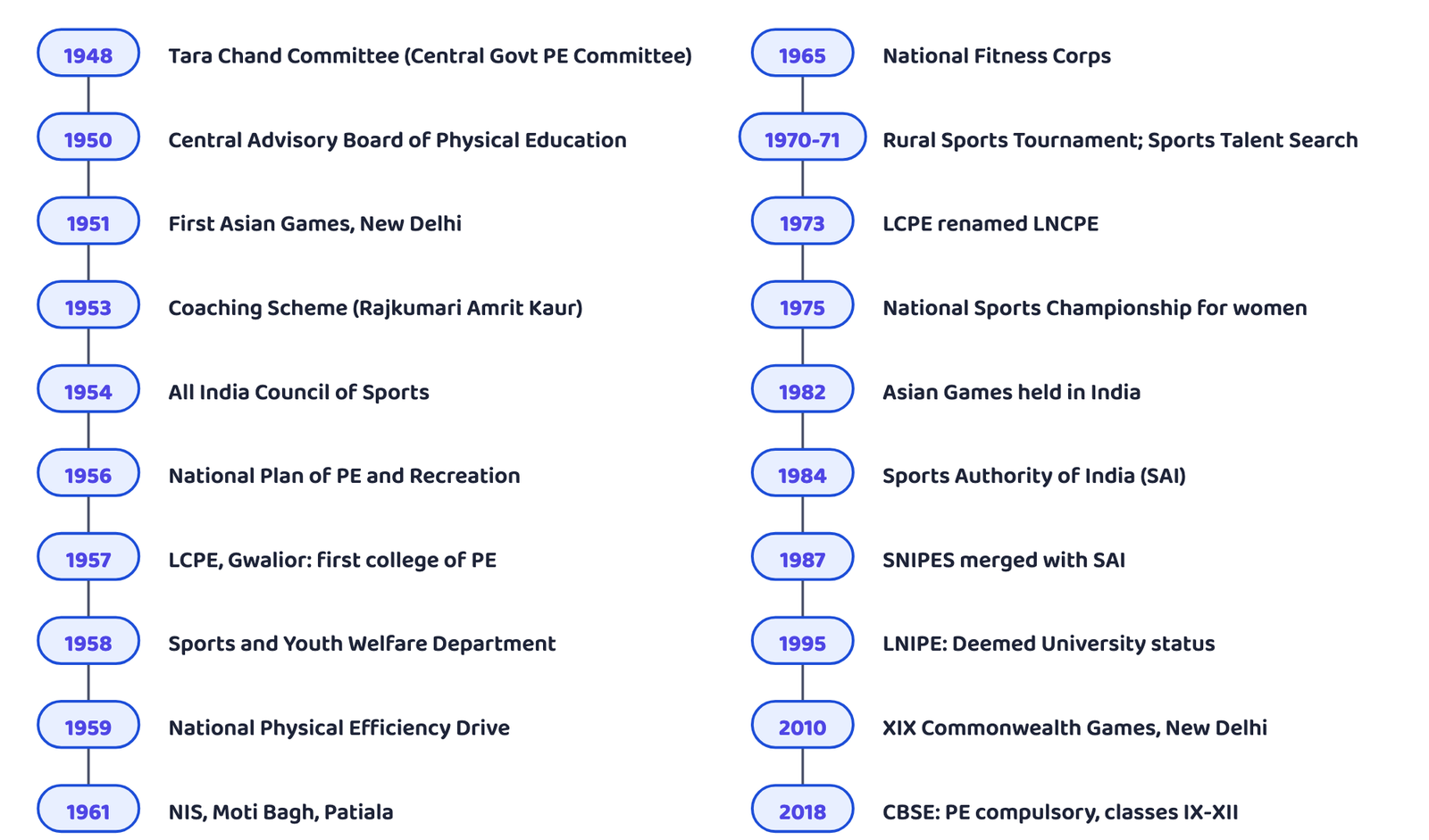
India progressed in every field after independence in 1947, and the Government of India introduced many schemes for Physical Education. Learn the years in order; a question can ask any one of them or ask you to trace the whole development.
4.1 Committees, boards and plans
- 1948: Central Government Physical Education Committee, also known as the Tara Chand Committee. It recommended a Central Institute of Physical Education and Recreation and improvement of the standards of games and sports in India.
- 1950: Central Advisory Board of Physical Education, set up to advise the government on Physical Education. One of its important objectives was to make Physical Education a compulsory subject at the elementary, middle and senior secondary levels.
- 1956: to promote indigenous physical activities, the Central Advisory Board prepared the National Plan of Physical Education and Recreation.
- 1954: All India Council of Sports, to act as a liaison between the Government and the National Sports Federations and to assist them in financial matters. Under it, State Sports Councils and District Sports Councils were set up.
4.2 Coaching and the NIS
- 1951: the First Asian Games were held in New Delhi, which motivated Indian youth to take part in games and sports at the international level.
- 1953: the then health minister Rajkumari Amrit Kaur introduced the Coaching Scheme for games and sports, to streamline coaching in India, since there was no professional coaching programme at that time.
- 1961: as a result, the National Institute of Sports (NIS) was set up at Moti Bagh, Patiala, Punjab, to produce qualified coaches in different games and sports.
4.3 The first college of Physical Education
Ten years after independence, in 1957, the Minister of Education and Culture, Government of India, established the first college of Physical Education at Gwalior, Madhya Pradesh. In 1995 it got the status of a Deemed University of the central government.
4.4 Schemes, fitness drives and SAI
- 1958: the Ministry of Education set up the Sports and Youth Welfare Department to promote Physical Education in India.
- 1959: the Ministry of Education sponsored the National Physical Efficiency Drive to evaluate the physical fitness status of people in India.
- 1965: the National Fitness Corps was established to make youth physically strong.
- 1970-71: the Rural Sports Tournament scheme, to involve rural youth and spot natural talent; the Sports Talent Search Scheme was launched in the same year to promote sportspersons of state and national level.
- 1975: the National Sports Championship for women was started to increase women’s participation in sports.
- 1982: the Asian Games were held in India, giving a huge boost to sports infrastructure and facilities.
- 1984: the Sports Authority of India (SAI) was established under the Department of Sports to maintain and properly use the infrastructure built for the Asian Games. SAI has two objectives: to promote sports, and to achieve sports excellence at the national and international level.
- 1987: the Society for National Institutes of Physical Education and Sports (SNIPES) was merged with SAI to promote and develop sports awareness among people.
- 2010: the XIX Commonwealth Games were held in New Delhi.
- 2018: CBSE made Physical Education a compulsory subject for classes IX to XII, mainstreaming Health and Physical Education.
In 1920, Harry Crowe Buck of Pennsylvania, United States, established the YMCA College of Physical Education at Chennai, Tamil Nadu. It was the first Physical Education college in Asia. (This is before independence; the LCPE of 1957 was the first college set up after independence.)
Do not mix up the two Patiala and Gwalior institutions. NIS Patiala (1961) trains coaches. LNIPE Gwalior (LCPE 1957, LNCPE 1973, LNIPE 1995) was the first college of Physical Education after independence. And SAI came in 1984, after the 1982 Asian Games, to look after their infrastructure.
5 Changing Trends in Sports
Three things have changed most in modern sport: the surface we play on, what athletes wear and use, and the technology around the game. The curriculum lists all three.
5.1 Playing surfaces
Many kinds of surfaces are now used for physical activity, exercise and sports. The type of field depends on the nature of the sport, geographic location, climate and infrastructure. Grass and clay courts are favoured outdoors because they are naturally available, but synthetic surfaces and artificial turf are now widely used instead, because they are easier to maintain and last better in hard weather such as rain. Where climate stops outdoor play for part of the year, indoor facilities with wooden or synthetic (rubberised or acrylic) surfaces are common.

| Surface | What it is made of / where used | Plus points | Problem |
|---|---|---|---|
| Clay and cinder track (natural) | Fine ash, carbon and rock | Softer surface, comfortable to run and jog | Hard to keep the surface even during rain, wind |
| Synthetic track | Rubber particles bound with latex or polyurethane, on an asphalt or concrete base; layers and textures added | Optimal traction and ideal running performance; used by most modern running tracks | – |
| Grass and clay turf (natural) | Natural grass | Soft, less pressure on the foot, low-impact, lower risk of overuse injuries | Tough to maintain, needs a high amount of care |
| Polygrass (synthetic flooring) | Looks like grass; officially approved in football; multi-utility areas of institutions and residential areas | Easy to maintain, durable, low maintenance | – |
| Astroturf (synthetic flooring) | Popular for hockey | Even surface with less friction, so the ball moves faster and movements become swifter | – |
| MUGA (Multi Utility Games Area) | Synthetic rubber; kindergarten playgrounds, recreation areas, outdoor gyms; also indoors | Greater shock absorbency, highly safe; rubberised surface easy to maintain and durable | – |
| Indoor courts | Wooden or synthetic; badminton also on synthetic mats laid on wooden floors; badminton, basketball, handball | Play all year, no weather or climate limits | – |
MUGA (Multi Utility Games Area) is a synthetic-rubber playing area on which many different activities can be planned and organised. It has greater shock absorbency, so it is safe for a wide range of activities, and it is easy to maintain and durable.
Cinder is a natural surface (fine ash, carbon, rock), not a synthetic one. Polygrass and astroturf are synthetic. So for “Which is a natural playing surface?” the answer is cinder.
5.2 Wearable gear and sports equipment
With new technology and the growth of sports sciences, sports equipment has changed in material, shape, size and weight, and wearable gear and devices now touch almost every part of an athlete’s preparation. They help athletes improve performance and prevent injury, help officials give correct and fast judgements, and, with media coverage, give improved aesthetics.

Safety
Helmets are lighter and stronger, so they take the impact of the ball. Gloves and guards of modern materials give extra protection.
Performance
New designs such as modern swimsuits counter friction; boots and footwear are aerodynamically designed for efficient movement.
Monitoring and judgement
GPS and devices that measure body chemistry and physiological status let athletes and coaches monitor performance and take remedial action.
Aesthetics
Trendy activity wear is adopted by top athletes because of media coverage, sports marketing and sponsorship; fitness enthusiasts prefer it because it gives self-confidence and boosts image.
5.3 Technology in sports
No sport is now untouched by technology, whether for officiating, performance analysis, or safety and mechanical analysis. As the sports industry and its popularity grew, the demand for technology grew too.

| Technology | How it works / where used |
|---|---|
| 1. Officiating technology | LED lights: in cricket stumps, to decide whether the ball has hit the stumps. Infra-red: “Hot Spot” is an infra-red imaging system that lets umpires and commentators see if the bat has struck the ball. Video: replays and slow-motion recordings in cricket, football, basketball; VAR is the video technology used by football referees during a match. Laser: detects fouls and removes subjective judgement: 3-D laser for scoring gymnasts, and laser on long and triple jump take-off boards to identify foul jumps. |
| 2. Protective equipment | Advanced materials make safer, more comfortable protective gear, such as cricketers’ helmets, so players play at their peak without risking safety. |
| 3. Timing system | GATES, laser or touch sensors give the most precise race time, down to the thousandth of a second, which removes rounding errors. |
| 4. Location tracking system | GPS in training and competition tracks players’ movement on the pitch and collects large amounts of performance data; also used in stadiums to manage spectators and crowds at mega events. |
| 5. Biomechanical and movement analysis software | Works with recorded or live video to judge quality of movement and find deviations scientifically. Sensors on bats, balls, rackets and footwear measure swing speed, power, directionality and force. Force platforms (force plates) measure the ground reaction forces of an athlete standing on or moving across them, to improve technique and correct errors. |
For “advantages of technology in sports”, use the book’s purposes as headings: correct officiating (fewer wrong decisions), safety (protective gear), exact timing, tracking and data for training and crowd control, and movement analysis to improve technique. One point per heading, with one example each.
6 Academic Courses in Physical Education
Physical Education is a fast-growing discipline in India and many institutions offer courses in it.
NCTE (National Council for Teacher Education) is the body that recognises the courses preparing teachers of Physical Education for the school system in India. It recognises only three courses for PE teachers: D.P.Ed., B.P.Ed. and M.P.Ed.

| Course | Full form | Prepares teachers for |
|---|---|---|
| D.P.Ed. | Diploma in Physical Education | Elementary stage: Classes I to VIII |
| B.P.Ed. | Bachelor of Physical Education | Teaching theory papers in Classes VI to X and conducting PE and sports activities for Classes XI-XII |
| M.P.Ed. | Master of Physical Education | Senior secondary Classes XI-XII; also Assistant Professors, Directors, Sports Officers in colleges and universities, and teacher educators in colleges and university departments of PE |
Research courses: Master of Philosophy (M.Phil.), Doctorate of Philosophy (Ph.D.) and Post Doctorate Fellowship (P.D.F.). Other courses are recognised by the University Grants Commission, New Delhi, or by the institutions themselves:
Post Graduate Diploma in
- Adventure Sports Administration
- Disability Sports
- Fitness Management
- Sports Coaching
- Sports Journalism
- Sports Management
- Sports Nutrition
- Yoga Education
Bachelor level
- B.A. (Programme) Sports and Performance
- Bachelor of Physical Education and Sports
- Bachelor of Physical Education (four-year course after 12th)
- B.Sc. Exercise Physiology
- B.Sc. in Physical Education
- B.Sc. in Physical Education, Health Education and Sports Sciences
M.B.A. in Sports Management · M.Tech. in Sports Technology · M.A. in Physical Education · M.A. in Sport and Exercise Psychology · M.A. in Yoga · Master of Journalism and Mass Communication (specialisation: Sports Journalism) · Master of Physical Education and Sports · M.Sc. in Exercise Physiology and Nutrition · M.Sc. in Physical Education · M.Sc. in Sports Biomechanics and Kinesiology · M.Sc. in Sports Coaching · M.Sc. in Sports Psychology and Sociology · M.Sc. in Yoga
7 Career Options in Physical Education
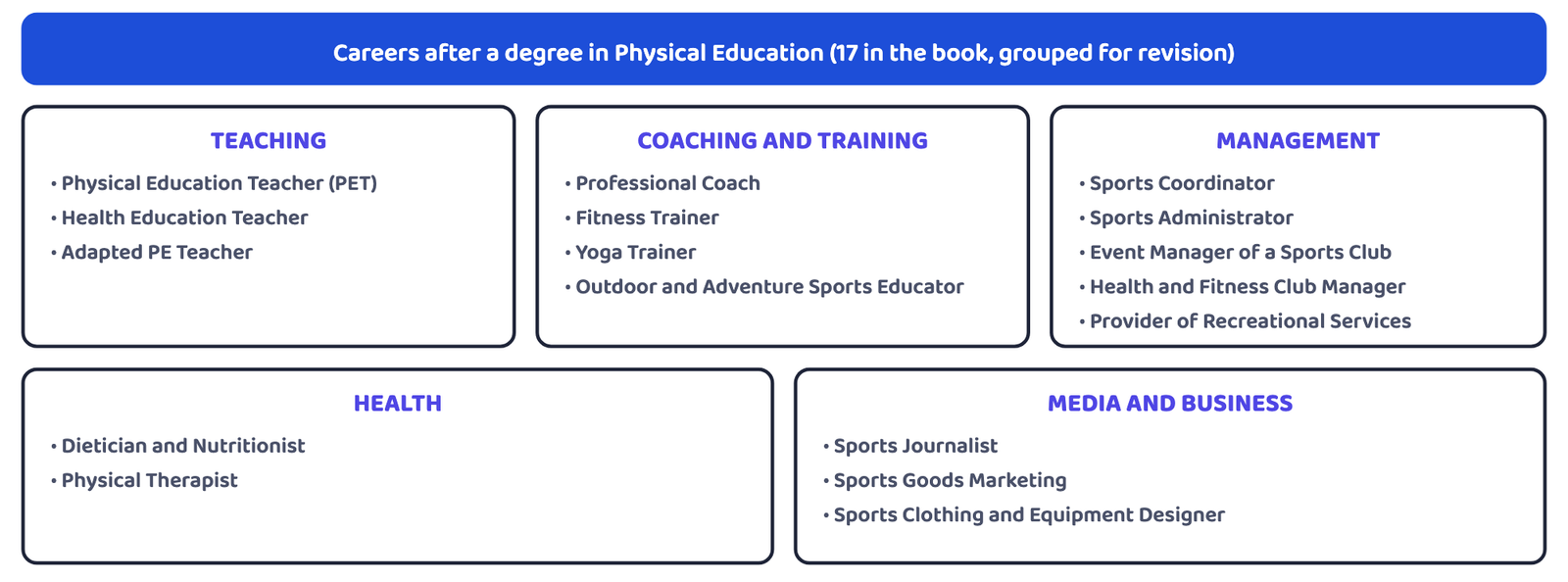
The most obvious career after a professional PE degree is Physical Education Teacher (PET) at an elementary, middle, secondary or senior secondary school. But it is not the only one. PE programmes prepare students for careers in both school and non-school settings: schools, colleges, universities, sports clubs, the fitness industry, health providers and more. Courses from sports coaching to sports journalism have become favoured career options because demand is growing.
| Career | What the book says about it |
|---|---|
| Physical Education Teacher | After D.P.Ed., B.P.Ed. or M.P.Ed., appointed as PET in a school or college |
| Health Education Teacher | One paper of the PE programme is wholly on health education |
| Sports Coordinator | Organising and directing recreational sports programmes, coaching, teaching, planning team activities |
| Professional Coach | After a Diploma in Sports Coaching; coach of a team or personal coach/trainer |
| Outdoor and Adventure Sports Educator | Any PE degree plus interest in outdoor and adventure sports |
| Sports Administrator | Supervision and administrative skills are taught in PE courses |
| Provider of Recreational Services | Run a recreational club (dodge ball, bean bags, bob ball) or an amusement park for adventure sports (river crossing, rappelling) |
| Event Manager of a Sports Club | A graduate of MBA in Sports Management |
| Health and Fitness Club Manager | Professional PE degree plus interest |
| Sports Clothing and Equipment Designer | For those with zeal for fashion designing |
| Dietician and Nutritionist | After any PE degree |
| Sports Goods Marketing | Sales and marketing of sports goods, a fast-growing industry |
| Yoga Trainer | Instructs groups or individuals in various levels and types of yoga |
| Fitness Trainer | After any PE course |
| Physical Therapist | After any PE programme |
| Sports Journalist | After a sports journalism course |
| Adapted Physical Education Teacher | A special curriculum trains people to meet the PE needs of persons with disability, since every person has the right to live life to the fullest |
Adapted Physical Education is the branch of Physical Education with a special curriculum that trains people to take care of the physical education needs of persons with disability.
When asked which skills besides a PE degree a non-teaching career needs, take them from the career descriptions themselves: organising and planning (sports coordinator, event manager), supervision and administration (administrator), communication and reporting (journalist), sales and marketing (sports goods), design interest (clothing and equipment designer), and genuine interest in the field, which the book stresses again and again.
8 Khelo India Programme
India’s performance in international sports is improving steadily even though only 5% of its population takes part in sports and games. If more people took part, the results could be different. To inspire young talent and give it world-class infrastructure and training, the “Khelo India National Programme for Development of Sports” was launched by the Ministry of Youth Affairs and Sports, Government of India, in the financial year 2017-2018.

Khelo India Programme is the Government of India’s programme to revive the sports culture at the grassroots level by building a strong framework for all sports played in the country and to establish India as a great sporting nation. Its two main objectives are mass participation and promotion of excellence in sports.
8.1 Vision and mission
Vision
- To further the sports culture in India, especially at the grassroots level
- To achieve sporting excellence in the country
Mission
- Sports for all, across gender and all age groups (full statement below)
“To encourage sports for all thus allowing the population across gender and all age groups to harness the power of sports through its cross-cutting influence, namely, holistic development of children and youth, community development, social integration, gender equality, healthy lifestyle, national pride and economic opportunities related to sports development.”
Mission of the Khelo India Programme
In short, the aim is a platform for every citizen, whatever the age or gender, to take part in sports and channel sporting skills. The aim and objectives: develop a sporting culture, identify talent from the grassroots and groom it for international success, and build a strong framework for every sport.
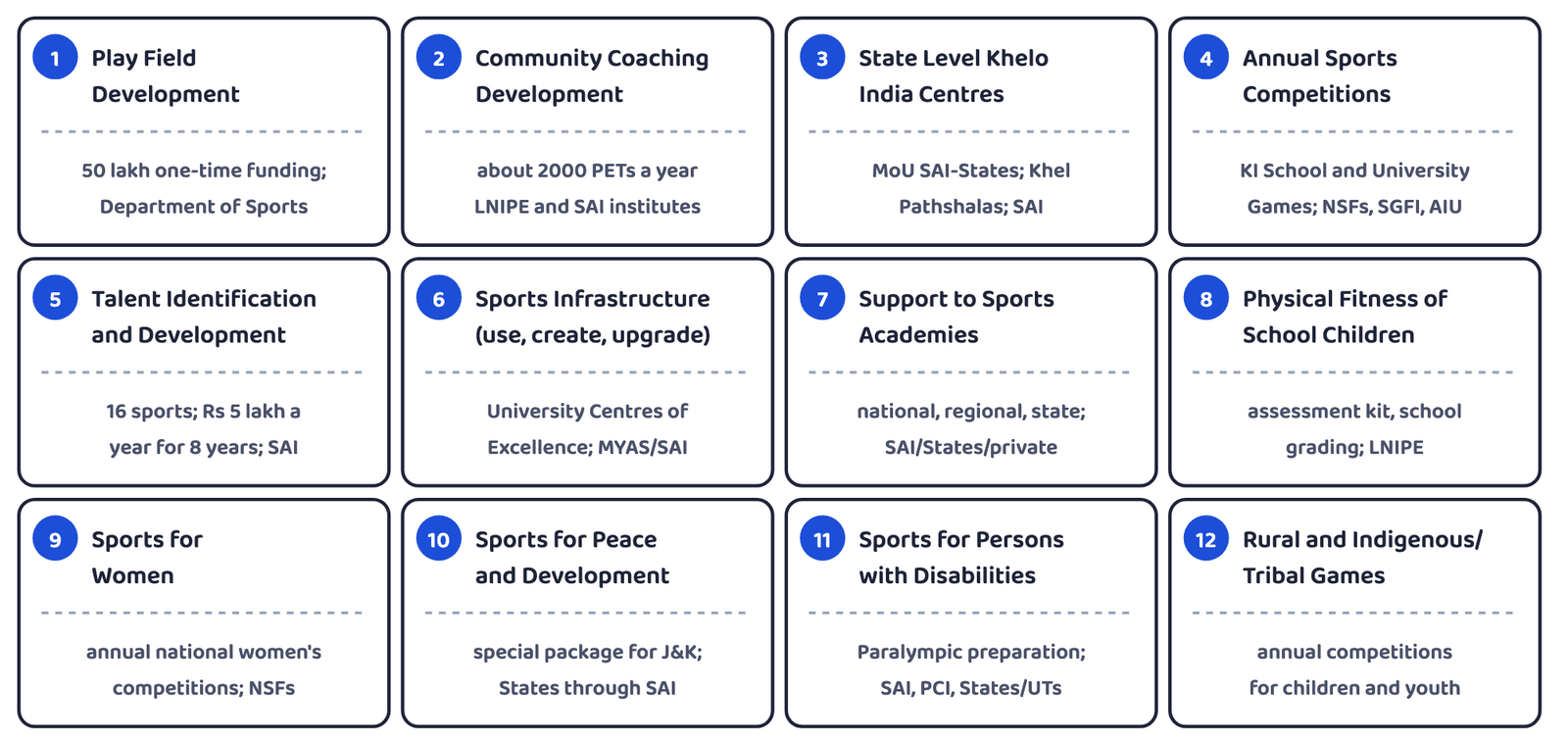
8.2 The twelve verticals
| # | Vertical | Key points | Implementing agency |
|---|---|---|---|
| 1 | Play Field Development | One-time funding up to 50 lakh to States/UTs for developing, managing, equipping and maintaining playfields and open spaces. NPFAI was registered as a Society under the Societies Registration Act, 1860, in February 2009. Playgrounds in all gram panchayats can be developed in convergence with MGNREGS. | Financial assistance by the Department of Sports |
| 2 | Community Coaching Development | Cascading model: about 2000 PETs a year trained as master trainers, who train other PETs and volunteers as community coaches | LNIPE and SAI institutes (content, protocols, training) |
| 3 | State Level Khelo India Centres | MoU between SAI and States/UTs to use unemployed trained coaches, staff, equipment, fields; day boarding and training; online coaching and education through Khel Pathshalas | SAI |
| 4 | Annual Sports Competitions | Platform to showcase skills and spot talent; Centre organises Khelo India National School Games and Khelo India National University Games; CSR funding via CPSEs and corporates for State Level Khelo India Centres | National Sports Federations with SGFI or AIU / University Sports Board; Department of Sports funds and monitors |
| 5 | Talent Identification and Development | Players from 16 priority sports; High-Powered Committee of SAI selects; chance to join SAI or top academies with Rs. 5 lakh a year for 8 years, based on performance | Department of Sports through SAI, and State Governments |
| 6 | Utilisation and Creation/Upgradation of Sports Infrastructure | (i) University Centre of Excellence Programme: grants for infrastructure, equipment, coaches, sports science back-up to identified universities; the Ministry of Human Resource Development to ensure that MYAS is on the UGC Steering Committee for Sports in Universities. (ii) Creation of Appropriate Sports Infrastructure: grants to States/UTs, SAI where there are gaps | Department of Sports funds; execution through MYAS/SAI |
| 7 | Support to National/Regional/State Sports Academies | Public and private academies identified for need-based support; aid for operation and maintenance | SAI/States/UTs/private entities, including eminent sportspersons |
| 8 | Physical Fitness of School Children | National physical fitness parameters per region; an easy assessment kit for every school; then a fitness-enhancement component; a grading system for schools | LNIPE and master trainers with States/UTs/Schools |
| 9 | Sports for Women | All components are gender neutral; this vertical holds annual national competitions for women, stressing sports where women’s participation is low | National Sports Federations through SAI/States/UTs |
| 10 | Sports for Peace and Development | Special package to J&K: soft support (coaches, equipment, competitions), village-level competitions; similar efforts in other extremism- and terrorism-affected areas | State Governments through SAI |
| 11 | Promotion of Sports among Persons with Disabilities | Finance to States/UTs and SAI for specialist infrastructure; classification of players, equipment, training and team preparation for Paralympic disciplines | SAI / Paralympic Committee of India (PCI) / States/UTs and other agencies |
| 12 | Promotion of Rural and Indigenous/Tribal Games | Annual competitions to encourage children and youth to take up rural, indigenous and tribal games | Not named in the book |
The 16 priority sports recognised by the Ministry of Youth Affairs and Sports are: archery, athletics, badminton, basketball, boxing, football, gymnastics, hockey, judo, kabaddi, kho-kho, shooting, swimming, volleyball, weightlifting and wrestling.
At the First Khelo India Youth Games 2018, Haryana topped the medal tally with 102 medals (38 gold, 26 silver, 38 bronze), followed by Maharashtra (111 medals including 36 gold) and Delhi (94 medals including 25 gold). On 27 February 2019, PM Narendra Modi launched the Khelo India App at the Youth Indian Parliament in Vigyan Bhawan, New Delhi.
The Khelo India Programme is not only about winning medals; the book calls it a mass movement to give every possible support to the youth for participation in sports.
9 Fit India Movement
The Fit India Movement was introduced on 29 August 2019 by the Prime Minister with the objective of making fitness an integral part of our lives. Its mission is to bring positive behavioural changes and to adopt a physically active, healthy lifestyle.
- PE = physical (body) + education (preparation for life); modern name: movement education
- Locomotor: walk, run, hop, leap, skip, gallop. Non-locomotor: stretch, twist, turn, push, pull, swing
- Definitions: Oberteuffer (experiences through movement), Bucher (integral part of total education), Williams (selected as to kind), Nash (big muscle activities)
- Aim: optimal, wholesome development for complete living + optimum sports performance; 16 objectives
- 1948 Tara Chand · 1950 CABPE · 1951 Asian Games · 1953 Coaching Scheme · 1954 AICS · 1956 National Plan · 1957 LCPE · 1958 Dept · 1959 NPED · 1961 NIS · 1965 NFC · 1970-71 rural and talent schemes · 1973 LNCPE · 1975 women · 1982 Asian Games · 1984 SAI · 1987 SNIPES · 1995 LNIPE · 2010 CWG · 2018 CBSE
- Surfaces: clay and cinder, synthetic track, grass, polygrass, astroturf, MUGA, wooden and synthetic courts
- Gear: safety, performance, monitoring and judgement, aesthetics. Technology: LED, Hot Spot, VAR, laser, GATES timing, GPS, force platforms
- NCTE: D.P.Ed. (I-VIII), B.P.Ed. (VI-X theory, XI-XII activities), M.P.Ed. (XI-XII, colleges)
- Khelo India: 2017-18, MYAS, ₹1,756 crore, 12 verticals, 16 priority sports. Fit India: 29 August 2019
- Can I write all four definitions with their authors?
- Can I list at least ten of the sixteen objectives with a line each?
- Can I trace PE in India from 1948 to 2018 in order?
- Can I classify playing surfaces and give two technologies used in officiating?
- Can I name the three NCTE courses and the classes each one covers?
- Can I name all twelve Khelo India verticals and the five Fit India objectives?
- 1 markWho defined Physical Education as “the sum of those experiences which come to the individual through movement”?
- 1 markIn which year was the Sports Authority of India established?
- 2 marksDifferentiate between locomotor and non-locomotor movements with two examples each.
- 3 marksExplain any three technologies used in officiating in sports.
- 5 marksExplain the development of Physical Education in India after independence.