
- What Olympism means, and the seven Fundamental Principles of Olympism
- The three core Olympic values (excellence, friendship, respect) and the five educational values
- How the ancient Olympic Games began, ran and ended, and how Coubertin revived them in 1896
- The Olympic symbol, flag, motto, creed, emblem, anthem, flame, doves, oath and awards
- The Olympic Movement: the IOC and its three organs, the NOCs (with India’s IOA) and the IFs
In the CBSE Physical Education (048) curriculum this is Unit 2 of Class XI. The curriculum names five topics: Olympism, concept and Olympic values (excellence, friendship and respect); Olympic value education (joy of effort, fair play, respect for others, pursuit of excellence, balance among body, will and mind); ancient and modern Olympics; Olympic symbols, motto, flag, oath and anthem; and the Olympic Movement structure (IOC, NOC, IFs, other members). The paper uses 1-mark MCQs (including assertion-reason and picture-based items), 2-, 3- and 5-mark answers and 4-mark case studies.
1 Olympism: The Concept
The Olympic symbols are the icons, flags and symbols used by the International Olympic Committee (IOC) for the Olympic Games. Behind all of them stands one idea, Olympism. It is the philosophy of the Olympic Games, developed and endorsed by the IOC. That is why the book also calls it the Olympic Movement.
Olympism is a philosophy of life, exalting and combining in a balanced whole the qualities of body, will and mind. Blending sport with culture and education, Olympism seeks to create a way of life based on the joy found in effort, the educational value of good example and respect for universal fundamental ethical principles.
- It promotes friendship, respect, fair play and sportsmanship through sports activities.
- It stands against discrimination on the basis of gender, race, religion or nationality.
- It widens Olympism from sports activities to promoting peace and brotherhood.
The goal of the Olympic Movement is to contribute to building a peaceful and better world by educating youth through sport without discrimination of any kind and in the Olympic spirit, which requires mutual understanding with a spirit of friendship, solidarity and fair play.
1.1 Fundamental Principles of Olympism
The Olympic Charter (the rule book of the Olympic Movement) describes seven Fundamental Principles. In short:
Philosophy of life
Balances body, will and mind; blends sport with culture and education; based on the joy of effort, the educational value of good example, social responsibility and respect for universal ethical principles.
Sport for humankind
Places sport at the service of the harmonious development of humankind, to promote a peaceful society that preserves human dignity.
One movement, five continents
A concerted, organised, universal and permanent action under the supreme authority of the IOC. It reaches its peak at the Olympic Games. Its symbol is five interlaced rings.
Sport is a human right
Everyone must be able to practise sport without discrimination, in the Olympic spirit of friendship, solidarity and fair play.
Political neutrality and autonomy
Sports organisations stay politically neutral; they freely set rules of sport, decide their structure, hold elections free from outside influence and apply good governance.
No discrimination
Rights under the Charter are for all, whatever the race, colour, sex, sexual orientation, language, religion, political or other opinion, national or social origin, property, birth or other status.
Belonging
Belonging to the Olympic Movement requires compliance with the Olympic Charter and recognition by the IOC.
“Life, Humankind, Movement, Right, Neutral, Non-discrimination, Belonging”
One word for each principle, in the book’s order. Say them on your fingers before writing a 5-mark answer.
2 Olympic Values
The Olympic Games have become a global celebration of sport and peace. Through sport, culture and education the Olympic Movement uses sport as a tool to promote fundamental ethical principles and harmonious development for all. The Paralympic movement promotes four universal values: courage, determination, inspiration and equality.
The three core values of Olympism are Excellence, Respect and Friendship. They make life worth living and help in decision-making on moral terms.
2.1 Friendship
Friendship, at the core of the Olympic Movement, means seeing sport as an instrument for mutual understanding between individuals and between peoples all over the world.
- Brings Olympic and Paralympic athletes and people from around the world together in sport, play and competition.
- Breaks down barriers: we look beyond differences of gender, ability, culture, race or religion. Welcoming differences builds stronger bonds.
- Friendships become the basis of community connections, for working together and supporting each other.
2.2 Respect
Respect, which lies at the heart of Olympism, means respect for yourself and your body, for other people, for rules and regulations, for sport and for the environment.
Respect is the key to strong friendships, fair play and sportsmanship. Understanding the impact of our actions, positive or negative, is part of playing an active role in our communities.
| Respect includes | Type |
|---|---|
| Knowing that we can offend or hurt someone by not letting them join in our game | Respect of others |
| Listening to and asking for the ideas, opinions and beliefs of everyone: boys, girls, people living with a disability | Respect for others |
| Helping others feel safe from violence: teasing, bullying, and verbal, physical and sexual violence | Respect for others |
| Taking care of ourselves by eating healthy food and getting enough rest and exercise | Self-respect |
| Being confident to share and defend our ideas and opinions | Self-respect |
2.3 Excellence
Excellence means doing the best we can, on the field of play or in our professional life.
- The important thing is not winning, but taking part, making progress and enjoying the healthy combination of body, will and mind.
- It is about having an ambition and reaching it through determination, effort and perseverance.
- Excellence is also in the classroom, where all children have the right to an education (Article 28 of the UN Convention on the Rights of the Child), and in helping children chase their dreams.
A one-line situation often decides the answer. “Mutual understanding” = friendship. “Helping others feel safe from violence” = respect. “Doing your best” = excellence. “Commitment” and “trust” are not among the three core values.
3 Olympic Value Education
Olympic Value Education rests on the Olympic idea that learning takes place through the balanced development of body and mind. Its five educational values come from three domains of learning: mental, emotional and physical.
J-F-R-P-B: “Just Friends Really Play Ball”
Joy of effort, Fair play, Respect for others, Pursuit of excellence, Balance.
3.1 Joy of effort
The UNESCO Charter says every human being has a fundamental right to access to physical education and sport, which are essential for the full development of his or her personality, and that the freedom to develop physical, intellectual and moral powers through them must be guaranteed in education and in social life. So a child must enjoy and have fun with sport. A child forced to over-exert, without good experiences to remember, may develop bad memories of sport. Sport should give the chance to enjoy the energy and effort, whatever the outcome; sports and physical activities should be promoted with proper opportunity to enjoy them.
As a 5-year-old in a small village in Kenya, Kipchoge Keino lived four miles from school with no public transport. He walked or ran to school and back, and enjoyed the running so much that he would even come home for lunch and run back. He developed an excellent aerobic system, competed nationally, became an international athlete, and later worked with the Kenyan police as a fitness trainer.
3.2 Fair play
Fair play refers to playing by the rules. Learnt in sport, it develops and reinforces similar behaviour in everyday life and towards the community.
- In sport, players follow the rules; referees and officials enforce them through penalties and punishments.
- Fair play is seen in shaking hands with the opponent after the game and appreciating the opponent’s extraordinary performance.
- “Playing beyond the rules of the game” violates fair play.
At the 1964 Winter Games in Innsbruck, Austria, bobsleigher Eugenio Monti, already a bronze medallist in the four-man bobsleigh, saw that his main rivals in the two-man event, Robin Dixon and Tony Nash of Great Britain, had lost a bolt from their sled. He lent them the bolt from his own sled. They won gold; Monti finished third and received a special Fair Play Trophy from CIFP. Four years later he won gold in both the two-man and four-man bobsleigh.
3.3 Respect for others
The Olympic Charter’s goal is to build a peaceful and better world by educating youth through sport practised in accordance with Olympism and its values. In a multicultural world we must accept and respect diversity, value all peoples and cultures whatever their race, age, gender or ability, and solve conflicts without violence. Sport helps because one team can hold people of many cultures, all working for one goal: victory for the team.
- Bringing peace is harder where there are ancient hatreds, conflicting values or great economic differences. Example: since the end of Apartheid, South Africans have worked together to build a society that respects people of all races.
- Racism and intolerance often come from ignorance and fear. Acceptance grows when people live, work and play together, so sportspersons and educators must teach it.
At the Nazi-hosted 1936 Berlin Games, Jesse Owens, a black athlete from the USA, won four gold medals. In the long jump he had failed twice to qualify when the German Luz Long, European record holder and his rival, advised him to adjust his starting point so he would not overstep the take-off board. Owens qualified, and in the final Long even calmed the crowd so Owens could concentrate. Owens won; Long took silver.
3.4 Pursuit of excellence
In today’s competitive world everyone wants to become the best. Focusing on excellence helps young people make positive, healthy choices and become the best they can be in whatever they do.
- Sport gives players the chance to become the best, or to make healthy choices, in safe social and physical surroundings. A healthy, clean and safe community puts the welfare of young people first.
- Sport attends to the needs of all children and youth: girls and boys, children with learning disabilities, and children with hearing, vision and other physical disabilities.
- It gives a place free from discrimination, harassment and intimidation, where individual differences and cultural traditions are valued.
3.5 Balance between body, will and mind
Deng Yaping of China started table tennis at five, won her provincial junior title at nine and her first national title at 13. Being less than 1.5 m tall, she was first rejected for the national team, but her talent, confidence and perseverance got her selected in 1988. She won her first international doubles title in 1989 at 16, the Asian Cup in 1989 and the world singles title in 1991.
Pierre de Coubertin believed that reviving the Olympic Games would stimulate interest in sport among young people. Today the Movement goes beyond sport, embracing culture, art, environmental awareness and education, all of which help young people build a balanced approach to life.
- Coubertin criticised modern education for its extreme compartmentalisation: each strength working in isolation, muscles seen only as animal function, the brain treated as tiny air-tight compartments.
- He believed learning happens in the whole body, not just the mind; physical learning takes place in body and mind, but cannot happen without will.
- Sport is a medium of balancing body, will and mind.
A young Japanese gymnast, Fujimoto, broke his knee in the floor exercise but did not tell his team-mates. He performed his rings routine, landed a double somersault with a full twist perfectly, stood the required three seconds and then collapsed. He could not take painkillers because of doping rules. His team-mates, inspired by his courage, did their best and won the team gold, defeating the USSR.
| Educational value | Key idea | Book example |
|---|---|---|
| Joy of effort | Enjoy the activity; no forced over-exertion | Kipchoge Keino |
| Fair play | Play by the rules | Eugenio Monti, 1964 |
| Respect for others | Accept diversity, promote peace | Jesse Owens and Luz Long, 1936 |
| Pursuit of excellence | Become your best through healthy choices | No example in the book |
| Balance of body, will and mind | Learning happens in the whole body | Deng Yaping; Fujimoto, 1976 |
4 The Ancient Olympic Games
The ancient Olympic Games were held in honour of Zeus, ruler of the Greek gods and goddesses, as part of a religious festival. The name comes from Mount Olympus, the highest mountain in Greece, or from Olympia, a town in Elis in ancient Greece. The festival and games began in 776 BCE at Olympia.
4.1 Who could take part
- Participants were free male citizens of the different city-states of Greece.
- Every participant had to complete 10 months of training before the Games.
- Women were not allowed to take part, and not even allowed to watch.
- Loophole: in chariot races the owner, not the rider, was declared champion, and anyone could own a chariot. Kyniska, daughter of a Spartan king, used this to win victory wreaths in 396 BCE and 392 BCE.
4.2 Olympiad and the sacred truce
The Games were held every four years; the period between two Games was called an Olympiad.
- The month of the Games was a sacred month: disputes and wars stopped and peace was declared so athletes and spectators could travel.
- The truce lasted one month at first, later three. No wars, no arms carried in Elis, and no hindrance to any spectator, athlete or theoriai (official missions of the cities).
- The book records a story that when the Persians invaded Greece in 480 BCE, raising an allied army was delayed because so many people wanted to go to the Olympics.
4.3 Events
The stadion was a foot race over one length of the stadium track: 600 ancient feet, or 192 m. It was the only event for the first 12 Olympics and stayed the most prestigious.
- Heats were run first; heat winners went to the final. Athletes were grouped by lot for fairness, and pairings in other events were also drawn by lot.
- The stadion winner gave his name to that Games. Koroibos, a cook and baker from Elis, won the stadion at the first recorded Games in 776 BCE.
- The Games were a one-day event until 684 BCE, then three days; in the 5th century BCE, five days. The programme grew to 18 events.
- Sports included foot races, chariot and horse races, the pentathlon (running, long jump, discus, javelin, wrestling), boxing, wrestling and pankration (Pancratium). The open-air track for horse racing was the hippodrome.
4.4 Oath, ceremony and rewards
4.5 The end of the ancient Games
The Roman Emperor Theodosius I legally abolished the Games in 393 or 394 AD, because they had lost their original values through corruption, professionalism and foul play. The famous statue Discobolus (a copy of a 5th-century BC Greek statue) shows an ancient Olympic discus thrower.
5 The Modern Olympic Games
The Games returned 1503 years after Theodosius I closed them, in 1896 at Athens, Greece. The idea came from the French nobleman Baron Pierre de Coubertin.
5.1 How the modern Games began
- Coubertin was keen on education and believed that the best way to develop young minds was to develop their bodies too: learning and athletics should go together.
- After visiting the ruins of ancient Olympia, he felt that restarting the Games was the best way to build interest in sport.
- He hoped the Games would revive the ideals of physical, mental and spiritual excellence; build courage, endurance and fair play; turn the tide of growing commercialism in sport; and bring all nations together without barriers of race, creed, language and colour.
- Coubertin wrote the Olympic Charter, the protocol and the athletes’ oath, and planned the ceremonies.
- At the 1896 Games the Greek hosts most wanted to win the marathon. Spyridon Louis took the lead four kilometres from the finish and won by more than seven minutes, before 100,000 spectators.
- The Games are a competition between sportspersons, not between countries. Athletes are selected by their country’s National Olympic Committee.
5.2 The Winter Olympics
- Figure skating (1908 and 1920) and ice hockey (1920) were held at the Summer Games, but the IOC wanted more winter sports.
- The 1921 Olympic Congress in Lausanne decided to hold a winter version. The first Winter Olympic Games were held in 1924 at Chamonix, France, three months before the Paris Games.
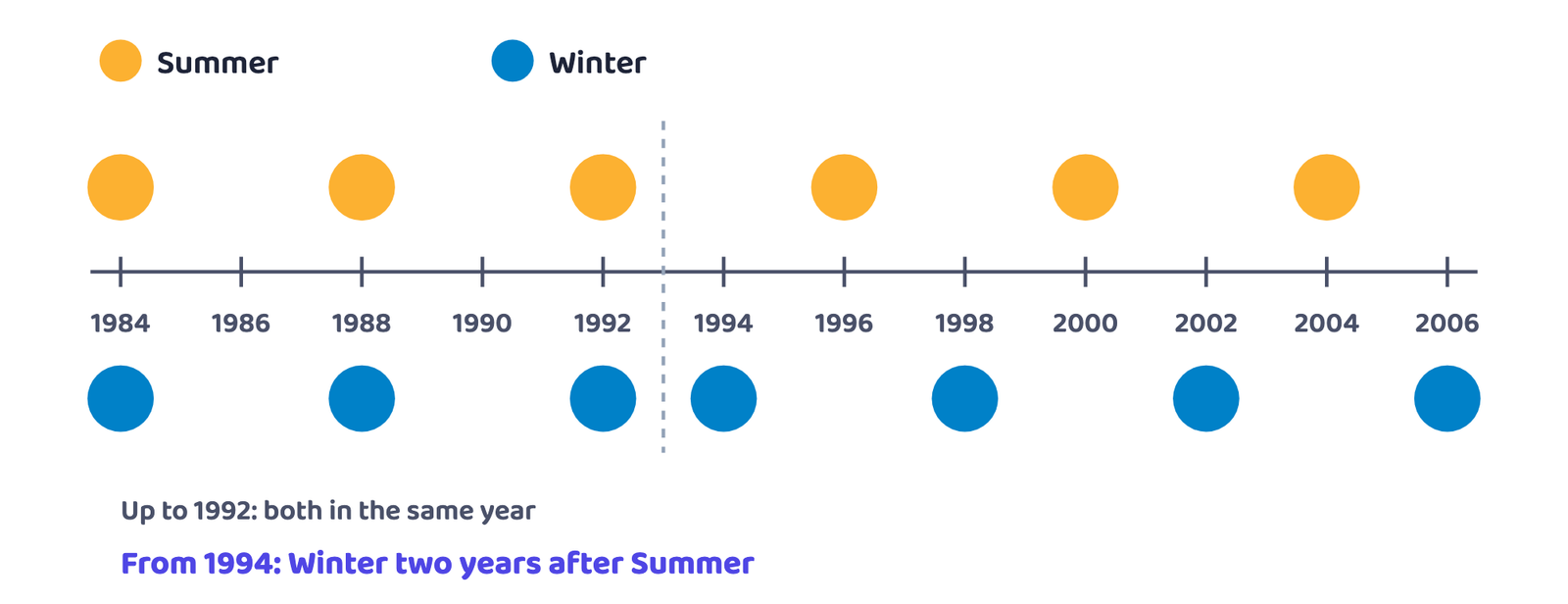
- The idea that one country hosts both was soon dropped. Winter and Summer Games were held in the same year until 1992 (Albertville, France). From 1994, Winter Games are held every four years, two years after each Summer Games.
| Summer Olympics (from the book’s list; 1916, 1940, 1944 not held) | Winter Olympics | ||
|---|---|---|---|
| 1896 | Athens, Greece | 1924 | Chamonix, France |
| 1900 | Paris, France | 1928 | St. Moritz, Switzerland |
| 1904 | St. Louis, USA | 1932 | Lake Placid, USA |
| 1908 | London, Great Britain | 1936 | Garmisch-Partenkirchen, Germany |
| 1912 | Stockholm, Sweden | 1948 | St. Moritz, Switzerland |
| 1920 | Antwerp, Belgium | 1952 | Oslo, Norway |
| 1924 | Paris, France | 1956 | Cortina d’Ampezzo, Italy |
| 1928 | Amsterdam, Netherlands | 1960 | Squaw Valley, USA |
| 1932 | Los Angeles, USA | 1964 | Innsbruck, Austria |
| 1936 | Berlin, Germany | 1968 | Grenoble, France |
| 1948 | London, Great Britain | 1972 | Sapporo, Japan |
| 1952 | Helsinki, Finland | 1976 | Innsbruck, Austria |
| 1956 | Melbourne, Australia (equestrian: Stockholm) | 1980 | Lake Placid, USA |
| 1960 | Rome, Italy | 1984 | Sarajevo, Yugoslavia |
| 1964 | Tokyo, Japan | 1988 | Calgary, Canada |
| 1968 | Mexico City, Mexico | 1992 | Albertville, France |
| 1972 | Munich, Germany | 1994 | Lillehammer, Norway |
| 1976 | Montreal, Canada | 1998 | Nagano, Japan |
| 1980 | Moscow, USSR | 2002 | Salt Lake City, USA |
| 1984 | Los Angeles, USA | 2006 | Turin, Italy |
| 1988 | Seoul, Korea | 2010 | Vancouver, Canada |
| 1992 | Barcelona, Spain | 2014 | Sochi, Russia |
| 1996 | Atlanta, USA | 2018 | PyeongChang, South Korea |
| 2000 | Sydney, Australia | ||
| 2004 | Athens, Greece | ||
| 2008 | Beijing, China | ||
| 2012 | London, Great Britain | ||
| 2016 | Rio de Janeiro, Brazil | ||
| 2020 | Tokyo, Japan | ||
Host names are given in their standard spelling. Winter 1928 and 1948: St. Moritz; Winter 1932: Lake Placid, USA.
5.3 Ancient and modern Games compared
| Point | Ancient Olympics | Modern Olympics |
|---|---|---|
| Period | 776 BCE to 393/394 AD | 1896 to today |
| Nature | Religious festival in honour of Zeus | Not a religious festival |
| Venue | Always Olympia, Greece | A host city chosen for each Games |
| Who took part | Free male Greek citizens only, after 10 months of training | Athletes from every nation that has an IOC-recognised NOC |
| Women | Not allowed to compete or even watch | Men and women equally encouraged and honoured (women since 1900) |
| Dress | Competed without clothes | Proper sports kit compulsory |
| Events | Individual events; one race at first, up to 18 events over 5 days | Many sports, including team events (28 sports in 2016) |
| War and peace | Wars stopped for a sacred truce | Wars were not stopped: Games cancelled in 1916, 1940, 1944 |
| Reward | One winner; olive crown (kotinos) | Gold, silver and bronze medals; diplomas for 1st to 8th |
| Oath | Before the statue of Zeus | One athlete and one judge of the host nation, holding the Olympic flag |
Both are held every four years (an Olympiad); both begin with an oath; the flame lit at Olympia links the two; both carry the ideals of peace and fair play. The differences are the rows of the table above.
The curriculum’s learning outcomes ask you to tell the Olympic Games apart from the Paralympics and the Special Olympics. The book gives only the Paralympic values (courage, determination, inspiration, equality). Basic facts: the Paralympic Games are for athletes with physical, visual or intellectual impairments; they grew from the 1948 Stoke Mandeville Games organised by Sir Ludwig Guttmann, and the first Paralympic Games were held in Rome in 1960. The Special Olympics are for people with intellectual disabilities and were founded by Eunice Kennedy Shriver in 1968.
6 Olympic Symbols and Ideals
6.1 The Olympic creed
The Olympic creed, the guiding principle of the modern Games, is a quote by Baron de Coubertin: “The most important thing in the Olympic Games is not to win but to take part, just as the most important thing in life is not the triumph but the struggle. The essential thing is not to have conquered but to have fought well.”
6.2 The Olympic symbol
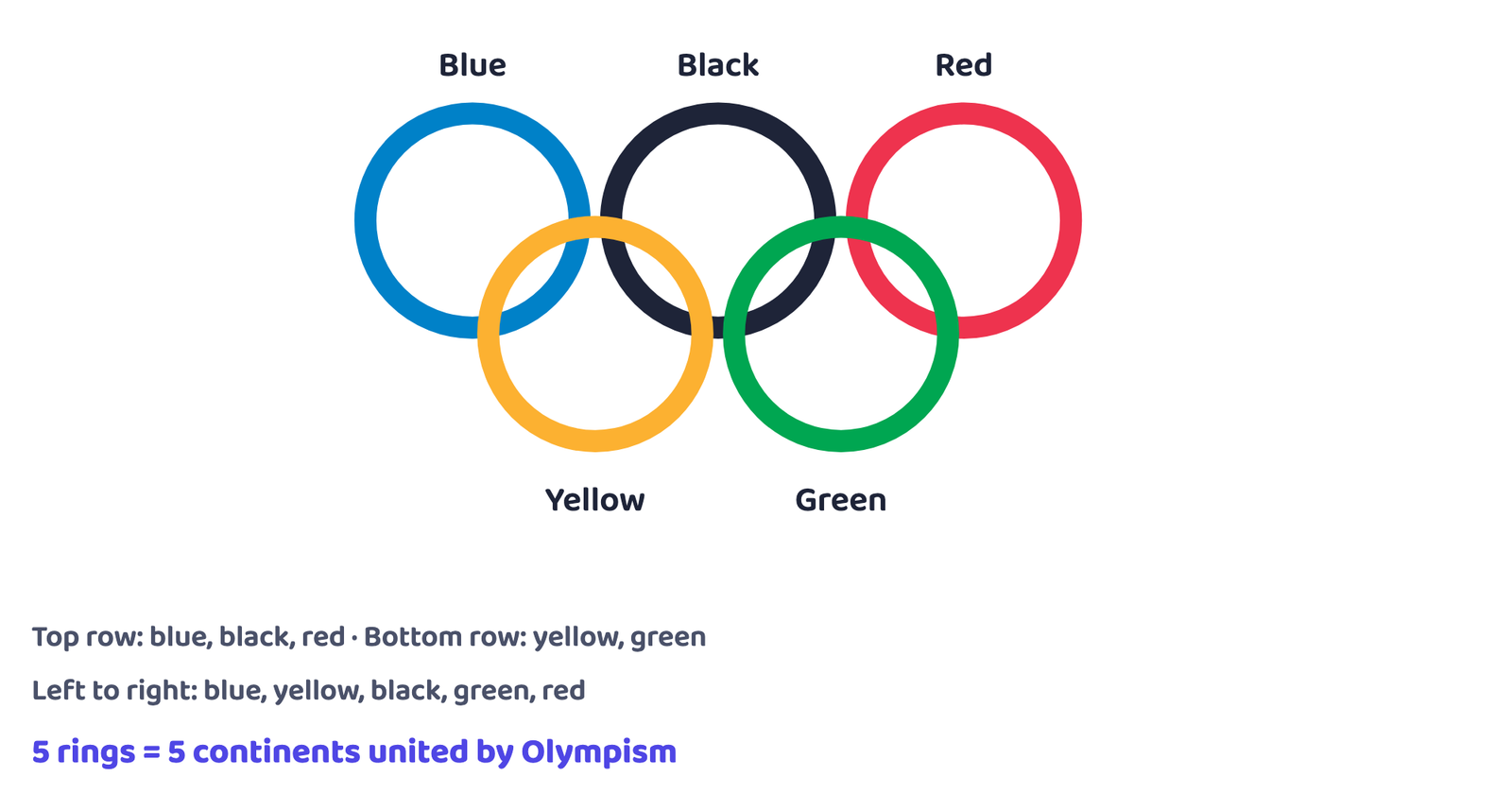
The Olympic symbol is five interlocked rings of equal size in five colours. From left to right: blue, yellow, black, green and red. Blue, black and red are on top; yellow and green are below.
The five rings show the union of the five continents (North and South America, Africa, Asia, Australia and Europe) and the unity of sportspersons from all continents at the Games (see Figure 1).
6.3 The Olympic flag
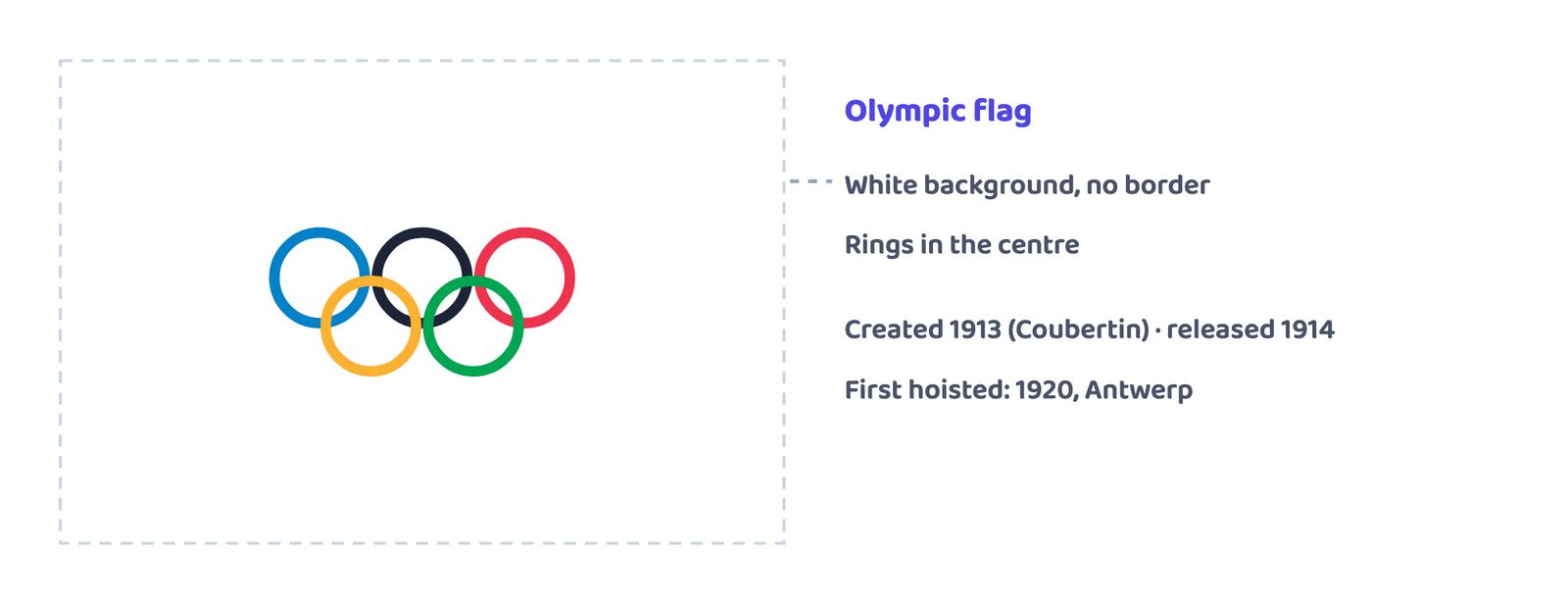
- Created by Baron Coubertin in 1913 and released in 1914.
- A white background without any border, with the five rings in the centre.
- Coubertin (1931): the rings represent the five continents united by Olympism, while the six colours (the white ground plus the five ring colours) are those that appear on all the national flags of the world.
- First hoisted in 1920 at Antwerp, Belgium.
6.4 The Olympic motto
The Olympic motto is “Citius – Altius – Fortius“, Latin for “Faster – Higher – Stronger“. It expresses the aspirations of the Olympic Movement.
- Proposed by Coubertin when the IOC was created in 1894.
- Coubertin borrowed it from his friend Henri Didon, a Dominican priest and athletics enthusiast.
- First announced at the 1924 Paris Games.
Citius = Faster, Altius = Higher, Fortius = Stronger. Students often swap Altius and Fortius. Altius sounds like “altitude”, which is height.
6.5 Olympic emblems
An Olympic emblem is a design that joins the Olympic rings with one or more distinctive elements; each Olympic Games has its own.
- Created and proposed by the Organising Committee of the Olympic Games (OCOG) or the host country’s NOC; approved by the IOC.
- Used in promotional material, by sponsors and on the uniforms of every competitor. All emblems are the property of the IOC.
6.6 The Olympic anthem
The Olympic Hymn or anthem was composed by Spiro Samara. It is played when the Olympic flag is raised at the opening of the Games. It begins “Immortal spirit of antiquity”. In it, the spirit of the ancient Games is asked to give life to the noble games, to crown the victors with unfading flowers, to make the athletes’ hearts strong, and to turn the world into a temple to which all nations come.
6.7 The Olympic flame and torch relay
- The flame was first lit at the 1928 Amsterdam Games. It is a continuity symbol linking the ancient and modern Games.
- The first torch relay was for the 1936 Berlin Games: 3,331 runners through Greece, Bulgaria, Yugoslavia, Hungary, Austria, Czechoslovakia and Germany. Every Summer Games since has had one.
- Being a torchbearer is an honour, often given to local people with a record of community service, besides athletes and celebrities.
- Winter Games have had a relay starting in Olympia since 1964. In 2014, two Russian cosmonauts carried the torch outside the International Space Station, about 200 miles above Earth.
6.8 Release of doves
- After the cauldron is lit, doves are released as a symbol of peace. First done in 1896, again in 1920; an official part of the Summer Games’ Opening Ceremony since 1920.
- Not done at the Winter Games because it is too cold for the birds; white balloons are sometimes used instead.
- The order matters: cauldron first, then doves. At Seoul 1988 it was done the other way round and many doves died in the flames.
6.9 The athletes’ oath
- Taken by one athlete and one judge of the host nation at the Opening Ceremony, on behalf of all competitors and judges, usually in the host country’s language.
- First taken in 1920 at Antwerp, Belgium, by Victor Boin. It was at first a declaration that all athletes were amateurs; the wording changed as amateur status stopped being required.
- Since 1984 it is taken while holding a corner of the Olympic flag (earlier, the host nation’s flag).
- A reference to doping was added in 2000. The officials’ oath came in 1972 and the coaches’ oath in 2010.
The athletes’ oath as given in the book
6.10 Olympic awards
- Winner: gold; runner-up: silver; second runner-up: bronze, given on the podium while the winner’s national anthem is played. Places 1 to 8 get a diploma; every participant gets a commemorative medal.
- In 1896 winners got a silver medal and an olive branch; runners-up a laurel branch and a copper or bronze medal. In 1900 most winners got cups or trophies.
- The gold-silver-bronze order dates from the 1904 St. Louis Games; the IOC later assigned medals retroactively for 1896 and 1900.
- From 1928 to 2004 the front of every medal showed Nike (Greek goddess of victory), the rings, the Coliseum of ancient Athens, an amphora, a chariot, and the year, Olympiad number and host city. A new design in 2004 showed the Panathenaic Stadium and a new Nike. Each host city may add its own special details to the other side.
- The IOC lays down the physical properties and has the final say on design; the host country’s NOC develops the medals.
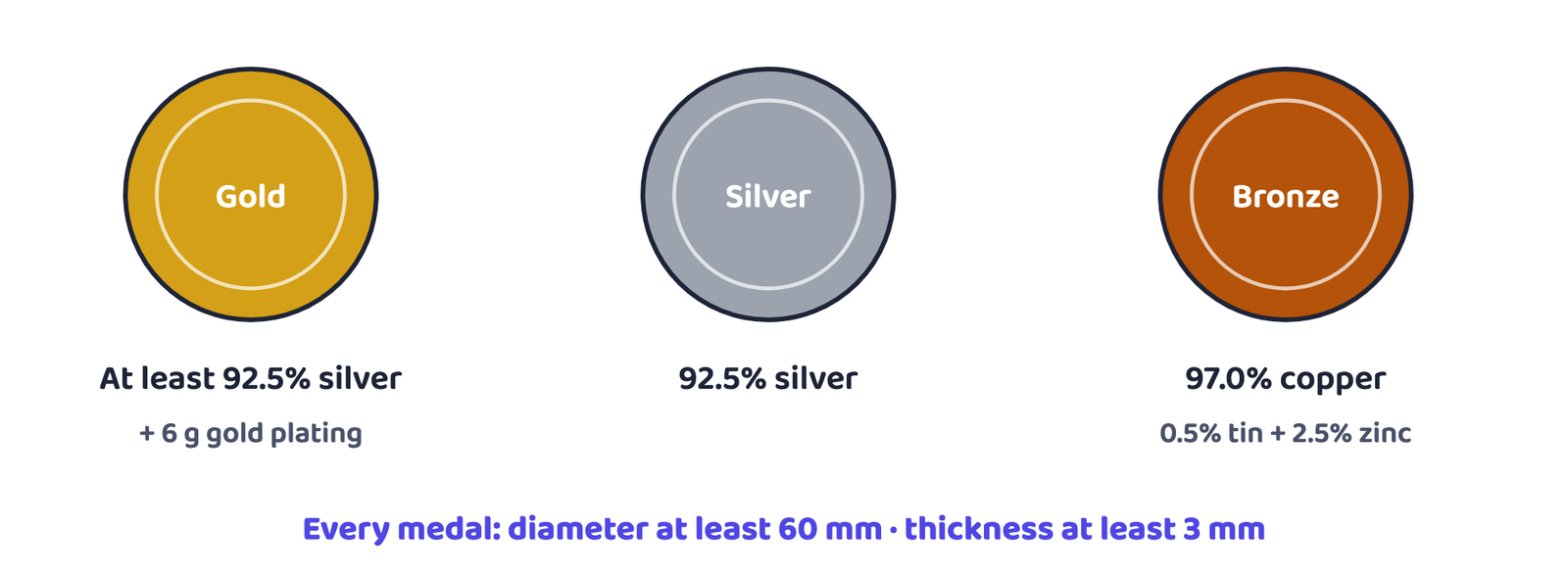
Every medal is usually circular with a chain or ribbon attachment, and has the sport written on it.
Olympic mascots have been part of the Games since 1968. They give concrete form to the Olympic spirit, spread the values of each Games, promote the history and culture of the host city and add a festive mood.
7 The Olympic Movement Structure
Under the supreme authority and leadership of the IOC, the Olympic Movement takes in all organisations, athletes and other persons who agree to be guided by the Olympic Charter. Anyone belonging to it in any capacity is bound by the Charter and must abide by the decisions of the IOC.
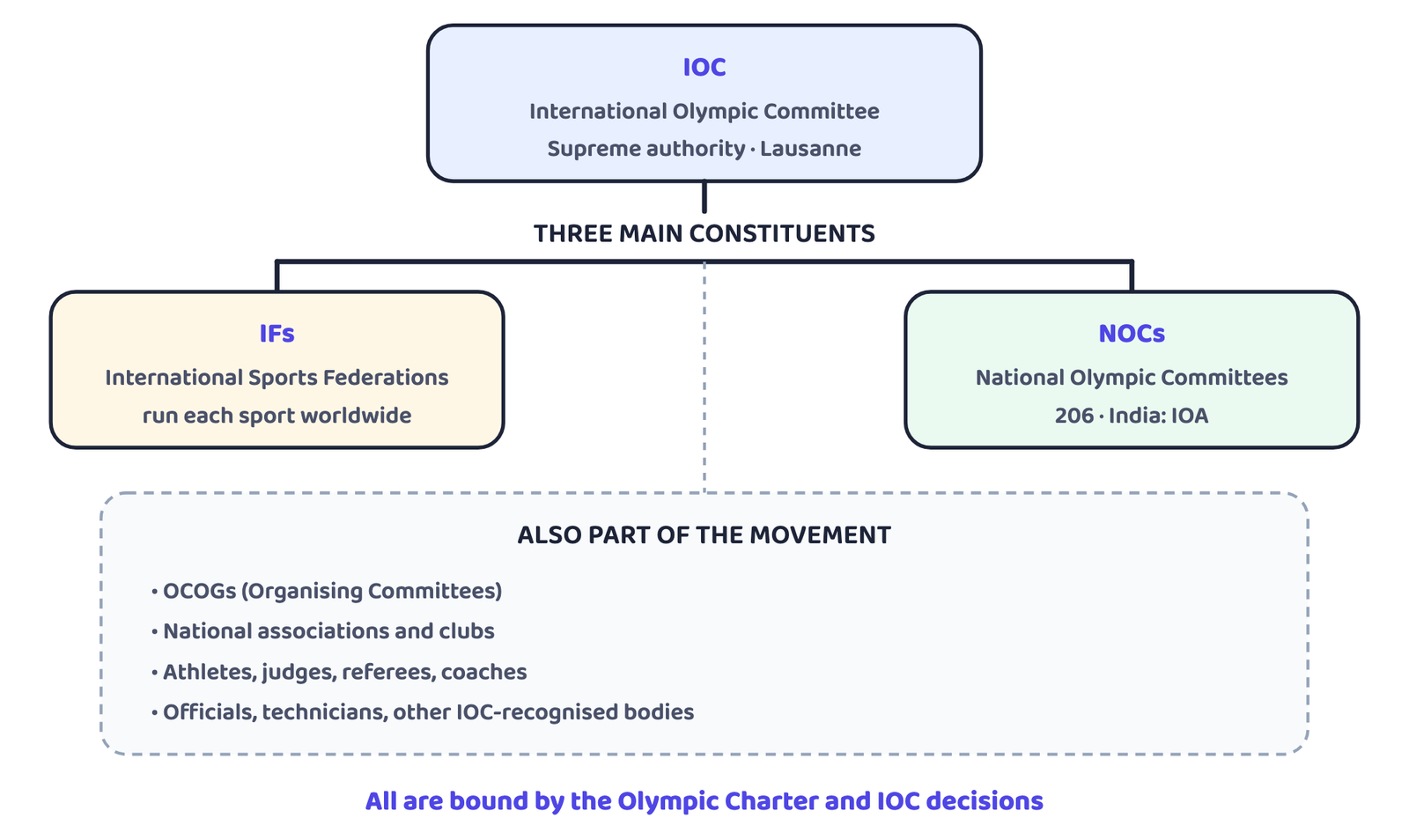
- Three main constituents: the IOC, the International Sports Federations (IFs) and the National Olympic Committees (NOCs).
- Others: the Organising Committees for the Olympic Games (OCOGs); national associations, clubs and persons belonging to the IFs and NOCs, especially the athletes, whose interests are a fundamental element; judges, referees, coaches, other officials and technicians; and other organisations recognised by the IOC.
7.1 The International Olympic Committee (IOC)
The International Olympic Committee (IOC) is the non-governmental, non-profit organisation, based in Lausanne, Switzerland, that is the supreme authority of the Olympic Movement. It was constituted by Pierre de Coubertin on 23 June 1894, with Demetrios Vikelas as its first president.
- Spreads the Olympic Movement through IFs, NOCs, OCOGs, the United Nations and others; holds the rights over the Games, the symbols and related elements.
- Organises the Summer (from 1896, Athens) and Winter (from 1924, Chamonix) Games. Summer Games fall in leap years; Winter Games two years later. Example: Summer 2000 Sydney and 2004 Athens; Winter 2002 Salt Lake City and 2006 Turin.
- Organises the Youth Olympic Games (YOG), summer and winter, every four years: first Summer YOG Singapore 2010, first Winter YOG Innsbruck 2012.
- The UN General Assembly made the IOC a permanent observer in 2009, so it can attend and speak at UN General Assembly meetings. In 1993 the General Assembly approved a resolution reviving the Olympic Truce.
Mission and role of the IOC
Mission (Olympic Charter): to promote Olympism throughout the world and to lead the Olympic Movement. Its 17 roles:
| # | Role of the IOC |
|---|---|
| 1 | Promote ethics and good governance in sport and education of youth through sport; make sure fair play prevails and violence is banned |
| 2 | Support the organisation, development and coordination of sport and competitions |
| 3 | Ensure the regular celebration of the Olympic Games |
| 4 | Cooperate with public or private bodies to place sport at the service of humanity and promote peace |
| 5 | Strengthen the unity of the Movement, protect its independence, keep political neutrality and preserve the autonomy of sport |
| 6 | Act against any form of discrimination affecting the Movement |
| 7 | Support elected athletes’ representatives, with the IOC Athletes’ Commission as their supreme representative |
| 8 | Promote women in sport at all levels, to implement equality of men and women |
| 9 | Protect clean athletes and the integrity of sport: lead the fight against doping, manipulation of competitions and corruption |
| 10 | Support medical care and health of athletes |
| 11 | Oppose political or commercial abuse of sport and athletes |
| 12 | Support the social and professional future of athletes |
| 13 | Develop sport for all |
| 14 | Show concern for the environment and sustainable development; require Games to be held accordingly |
| 15 | Promote a positive legacy for host cities and countries |
| 16 | Support initiatives blending sport with culture and education |
| 17 | Support the International Olympic Academy (IOA; not the Indian Olympic Association) and other bodies for Olympic education |
Organisation of the IOC: three organs

The Session is the general meeting of the members of the IOC. It is the IOC’s supreme organ and its decisions are final.
- An ordinary Session is held once a year; an extraordinary Session may be called by the President or on the written request of at least one-third of the members.
- Quorum: half the total membership plus one. Decisions by a majority of votes cast; a two-thirds majority to change the Fundamental Principles or the Rules of the Charter.
- Each member has one vote; abstentions and blank or spoiled votes are not counted; no voting by proxy; secret ballot when the Charter requires it, the Chairman decides, or at least a quarter of members present ask; in a tie, the Chairman decides. The Session may delegate powers to the Executive Board.
| Powers of the Session | Duties of the Executive Board |
|---|---|
| 1. Adopt or amend the Olympic Charter | 1. Monitor observance of the Charter |
| 2. Elect IOC members, the Honorary President, honorary and honour members | 2. Approve internal governance regulations |
| 3. Elect the President, Vice-Presidents and Executive Board members | 3. Prepare the annual report and financial statements (IFRS and Swiss law) for the Session, with the auditor’s report |
| 4. Elect the host city of the Olympic Games | 4. Report to the Session on any proposed change of Rule or Bye-law |
| 5. Elect the city of an ordinary Session (the President chooses for an extraordinary one) | 5. Recommend persons for election to the IOC |
| 6. Approve the annual report and financial statements | 6. Set up and supervise the procedure for choosing Games hosts |
| 7. Appoint the independent auditor | 7. Set the agenda of the Sessions |
| 8. Award or withdraw full recognition of NOCs, IFs, their associations and other bodies | 8. Appoint or dismiss the Director General on the President’s proposal |
| 9. Expel IOC members; withdraw honorary status | 9. Keep all minutes, financial statements and records |
| 10. Adopt or amend the Athletes’ Rights and Responsibilities Declaration (on the Athletes’ Commission’s recommendation) | 10. Take legally binding decisions and issue regulations (codes, rulings, norms, guidelines, manuals) |
| 11. Decide all other matters given to it by law or the Charter | 11. Meet the IFs and NOCs at least once every two years, chaired by the IOC President |
| 12. Create and confer the IOC’s honorary distinctions | |
| 13. Exercise all powers not given to the Session or the President |
- Executive Board: founded in 1921 to manage the IOC’s affairs. It has the President, four Vice-Presidents and ten members, elected by the Session by secret ballot and majority of votes cast. It is responsible for administration and management.
- The President: elected by the Session by secret ballot for four years, renewable for four more. Represents the IOC, organises and prepares all Executive meetings, may delegate power to the Director General and act on the IOC’s behalf. If the President cannot work, the senior Vice-President takes over.
7.2 National Olympic Committees (NOCs)
A National Olympic Committee (NOC) is the national-level unit of the Olympic Movement. Its mission is to develop, promote and protect the Olympic Movement in its country, in accordance with the Olympic Charter.
- There are 206 NOCs. The IOC is the sole authority to recognise an NOC.
- NOCs promote the fundamental principles, the values of Olympism and Olympic education in their countries; help athletes reach the highest level with training and logistics; send athletes to the Olympic Games; and may nominate their cities to host the Games.
India’s NOC: the Indian Olympic Association (IOA)
- Prime objective: promote and develop the Olympic Movement in India. In early years IOA selected the players; after 1947 selection and training went to the National Sports Federations. Now IOA arranges transport, board and lodging for officials and players.
- Governing body for the Olympic Movement and the Commonwealth Games in India; affiliated to the IOC, CGF (Commonwealth Games Federation), OCA (Olympic Council of Asia) and ANOC (Association of National Olympic Committees); recognised by the Ministry of Youth Affairs and Sports.
- Sends Indian athletes and teams to the Olympic Games, Commonwealth Games, Asian Games and other multi-sport events of the IOC, CGF, OCA and ANOC.
- National Sports Federations affiliated to IFs whose sport is in the Summer or Winter Olympic programme
- National Sports Federations affiliated to IFs whose sport is not in the Olympics but is in the Asian and/or Commonwealth Games
- Indian citizens who are members of the IOC
- Two active or retired Olympians (one male, one female); retired ones must leave the post by the end of the third Olympiad after their last Games
- State Olympic Associations
- Union Territories’ Olympic Associations
- Services Sports Control Board
- The National Federation of the Indian game Kho-Kho
7.3 International Sports Federations (IFs)
International Sports Federations (IFs) are international non-governmental organisations recognised by the IOC as administering one or more sports at world level; they are responsible for the integrity of their sport internationally.
- National federations of that sport are affiliated to them. IFs keep their independence and autonomy, but to be recognised their statutes, practice and activities must conform with the Olympic Charter.
- They manage the everyday running of their sport, organise its events at the Games, supervise athlete development at every level, ensure regular competitions and fair play.
- They may make proposals to the IOC about the Charter and the Games, give opinions on candidate host cities (especially technical capability), help prepare Olympic Congresses and take part in IOC commissions.
To discuss common problems and fix event calendars, the federations formed:
(i) ASOIF: Association of Summer Olympic International Federations
(ii) AIOWF: Association of International Olympic Winter Sports Federations
(iii) ARISF: Association of IOC Recognised International Sports Federations
- Olympism = philosophy of life: body, will, mind; sport + culture + education. Against discrimination by gender, race, religion, nationality.
- Seven Fundamental Principles in the Olympic Charter; symbol of the Movement = five interlaced rings.
- Core values: Excellence, Respect, Friendship. Paralympic values: courage, determination, inspiration, equality.
- Five educational values (mental, emotional, physical domains): joy of effort (Keino), fair play (Monti 1964), respect for others (Owens and Long 1936), pursuit of excellence, balance of body, will and mind (Deng Yaping; Fujimoto 1976).
- Ancient: Zeus, Olympia (Elis), 776 BCE, Koroibos, stadion 192 m, free Greek men, 10-month training, women barred, Kyniska; truce; kotinos; ended by Theodosius I, 393/394 AD.
- Modern: Coubertin; idea 1892; IOC 1894; Athens 1896 (241 athletes, 14 countries, 43 events); women from 1900; Winter from 1924 Chamonix; split from 1994.
- Rings: blue, yellow, black, green, red. Flag 1913/1914, first hoisted Antwerp 1920. Motto: Faster, Higher, Stronger (Didon; announced Paris 1924). Anthem: Spiro Samara.
- Flame: first 1928 Amsterdam; lit at Temple of Hera; first relay 1936 Berlin (3,331 runners). Doves since 1896/1920. Oath: Victor Boin, 1920; flag corner since 1984; doping 2000; officials 1972; coaches 2010.
- Medals: gold-silver-bronze from 1904; min 60 mm, 3 mm; gold = 92.5% silver + 6 g gold.
- Movement: IOC + IFs + NOCs (+ OCOGs, clubs, athletes, officials). IOC: 23 June 1894, Vikelas, Lausanne, English and French. Organs: Session, Executive Board (1921; 1 + 4 + 10), President (4 + 4 years).
- NOCs: 206. IOA: 1927, Dorabji Tata, A.G. Noehren. IF associations: ASOIF, AIOWF, ARISF.
- Can I write the definition of Olympism and list the seven Fundamental Principles?
- Can I name the three core values and the five educational values, each with the book’s example?
- Can I draw the five rings in the right order and colours, and explain the flag?
- Can I write five differences between the ancient and modern Games?
- Can I draw the Olympic Movement chart and the three organs of the IOC?