
- Explain the meaning and importance of wellness, health and physical fitness, with the book’s definitions
- Tell exercise, physical activity and physical fitness apart, and list the benefits of physical activity
- Describe the seven components of wellness and the four dimensions of health
- Distinguish health-related fitness (five components) from skill-related fitness (six components)
- Name the traditional sports and regional games of India and explain how they promote wellness
- List the qualities of a good leader and explain how physical education creates leaders
- Explain first aid, its aims, and each step of the P.R.I.C.E. protocol
In the CBSE Physical Education (048) curriculum for Class XI, this is Unit 5: Physical Fitness, Wellness, and Lifestyle, worth 5 marks. The curriculum lists five topics: meaning and importance of wellness, health and physical fitness; their components or dimensions; traditional sports and regional games for promoting wellness; leadership through physical activity and sports; and introduction to first aid (PRICE). The prescribed book is CBSE’s own Physical Education Class XI textbook, where the unit is titled “Physical Fitness, Health, and Wellness”.
Why does this chapter matter? Lifestyles have changed: people sit for long hours and eat more fast food. The book points out that cases of diabetes in India have risen in the last decade, and doctors blame changes in lifestyle and eating habits. Physical activity, a healthy diet and a change in lifestyle are the recommended answer. This chapter explains the three ideas behind that answer: wellness, health and physical fitness.
1 Wellness: Meaning and Importance
The WHO says health is “a state of physical, mental, and social well-being, not merely the absence of disease.” The word health mostly looks at whether a person is ill or not. Wellness goes further than just “no disease”. It is much more than physical health, exercise or nutrition: it is the full integration of physical, mental and spiritual well-being.
Wellness is about personal responsibility. A person living a life of wellness takes proactive steps (acts before trouble starts) for her or his own well-being, and controls the risk factors that can harm her or him.
Risk factors are different types of actions or conditions that increase a person’s chances for illness or injury. For example, smoking is a risk factor for lung cancer, and alcohol is a risk factor for liver damage.
Wellness matters because everything we do and every emotion we feel relates to our well-being, and our well-being in turn affects our actions and emotions. It is an ongoing cycle. Optimal (the best possible) wellness reduces stress and the risk of illness and ensures positive interactions with others.
1.1 Definitions of wellness
Wellness is “the optimal state of health of individuals and groups. There are two focal concerns: the realization of the fullest potential of an individual physically, psychologically, socially, spiritually, and economically, and the fulfilment of one’s role expectations in the family, community, place of worship, workplace, and other settings.” (WHO Health Promotion Glossary Update 2006)
“Wellness is an active process through which people become aware of, and make choices toward, a more successful existence.” (National Wellness Institute)
A continuous process
Wellness is a continuous and thoughtful process to stay healthy and achieve total wellbeing. It is a positive and ideal state, seen in a person’s day-to-day work, contribution to society, optimal functioning and healthy quality of life.
Charles B. Corbin, Gregory J Welk, William R Corbin, Karen A Welk
The integration of many components (physical, emotional/mental, intellectual, social and spiritual) that expand one’s potential to live and work effectively and to make a significant contribution to society. Wellness, as opposed to illness (a negative), is sometimes described as the positive component of good health.
Overall physical wellness comes from a balance of physical activity, nutrition and mental well-being. Health-related lifestyle habits lead to longevity (a long life), a better quality of life and total wellbeing.
1.2 Importance of wellness
- Lifestyle education: a wellness programme gives health-related lifestyle education with the support and resources needed to achieve wellness.
- Responsibility: it makes the individual responsible for good decisions, good practices and preventive measures for the best physical, emotional and social functioning.
- Understanding health issues: wellness programmes help people understand injuries, chronic diseases, cancer, cardiovascular disease, STDs, obesity, nutrition, diabetes and other lifestyle diseases. So they increase longevity and improve quality of life.
- Good behaviour, fewer social evils: it promotes habits like quitting smoking and giving up alcohol abuse, and helps reduce social evils like violence, abuse, child labour, gender inequality and the caste system. The individual adopts positive values and becomes a good citizen.
- Balance: it helps keep a balance between work, personal life and health, which gives efficient, consistent output and better general health and fitness through regular activity.
- Healthy social environment: people share and solve personal and social problems, so the individual becomes socially accessible and culturally sensitive.
- Clean environment: the components of wellness (physical, emotional, mental, social, environmental, occupational and spiritual) are inter-connected and help make the environment free of disease and pollution.
2 Health: Meaning, Importance and Definitions
Health is not merely the absence of disease; it is a state of complete physical, mental and social wellbeing. Today many people work in a hectic environment and get little time for physical activity, and fast foods like burgers and pizzas have become the easy choice. This makes people unhealthy and open to many diseases.
Food affects us physically, mentally and socially. If you eat pizza for dinner every day, your stomach may feel bloated (physical). Feeling unwell affects your mood (mental), and you will not feel like meeting people (social). So we should exercise regularly and eat healthy food to be healthy in all three ways.
2.1 Definitions of health
Health is hard to define, although everyone feels sure of its meaning. The book gives these definitions:
| Source | Definition of health |
|---|---|
| Webster | “the condition of being sound in body, mind or spirit, especially freedom from physical disease or pain.” |
| Oxford New English Dictionary | “soundness of body or mind; that condition in which its functions are duly and efficiently discharged.” |
| (c) | “a condition or quality of the human organism expressing the adequate functioning of the organism in given conditions, genetic and environmental.” |
| (d) | “a modus vivendi enabling imperfect men to achieve a rewarding and not too painful existence while they cope with an imperfect world.” (Modus vivendi means a way of living.) |
| Perkins | “a state of relative equilibrium of body form and function which results from its successful dynamic adjustment to forces tending to disturb it.” |
Health (WHO, 1948), given in the preamble to the WHO constitution: “Health is a state of complete physical, mental and social wellbeing and not merely an absence of disease or infirmity.” In recent years it has been amplified (widened) to include “the ability to lead a socially and economically productive life”.
Health
- Focuses on a person’s illness status: ill or not ill
- WHO: complete physical, mental and social wellbeing
- Has four dimensions: physical, mental, social, emotional
Wellness
- Goes beyond the absence of disease
- Full integration of physical, mental and spiritual well-being; an active, continuous process
- Has seven components; the individual takes responsibility
3 Physical Fitness: Meaning and Definitions
Three terms are often used as if they mean the same thing. They do not:
Exercise
Planned, structured and repetitive bodily movements aimed at improving one or more components of physical fitness. Example: swimming as an exercise to improve cardiovascular endurance.
Physical activity
Any bodily movement that is not specifically designed for physical fitness but significantly increases resting energy expenditure. Example: walking increases energy use, though the book notes it does not target a fitness component.
Physical fitness
A state of health and well-being and the ability to perform aspects of sports, occupations and daily activities.
3.1 Definitions of physical fitness
“Physical fitness is the ability to carry out daily tasks with vigour and alertness, without undue fatigue and with ample energy to enjoy leisure time pursuits and to meet unforeseen emergencies.” (H. Harrison Clarke, 1976)
| Author | Definition |
|---|---|
| Charles A. Bucher (1958) | “Fitness is the ability of an individual to lead a full and balanced life. It includes physical, mental, emotional, social and spiritual factors and capacity for their wholesome expression.” |
| American College of Sports Medicine | “Physical fitness is the ability to perform moderate to vigorous levels of physical activity without undue fatigue and the capability of maintaining such ability throughout life.” |
| Werner W.K. Hoeger and Sharon A. Hoeger (2014) | “Individuals are physically fit when they can meet both the ordinary and the unusual demands of daily life safely and effectively without being overly fatigued and still have energy left for leisure and recreational activities.” |
| Corbin, Welk, Corbin and Welk (2015) | “Physical fitness is associated with a person’s ability to work effectively, enjoy leisure time, be healthy, resist hypokinetic diseases or conditions, and meet emergency situations.” |
What the definitions share: a fit person does daily tasks efficiently without undue fatigue, still has energy for recreation, and can handle an emergency.
A doctor checks patients in a room, a farmer works hard in the field, and a sportsperson performs on the field. Each is fit if she or he completes daily work without undue fatigue, has energy left for leisure (a walk, table tennis, football), and can meet an emergency: the doctor called to a distant patient, or the farmer rushing to save his paddy crop from a natural calamity after a day’s work.
3.2 Benefits of physical activity
Exercise promotes health, maintains or improves physical appearance and improves the overall quality of life. Physically active people have fewer health problems than inactive people.
Physical and physiological
Better posture (less back and neck pain); balance of lean body mass and fat; healthy body weight; faster recovery after injury, disease or workout; more flexible joints (less arthritic pain); healthy bones and bone mass (lower risk of osteoporosis); better athletic performance and high energy; a higher resting metabolic rate and better immunity. So the person is energetic at work, in leisure and in emergencies.
Mental and psychological
Better brain function, memory and creative thinking; better self-image, morale, self-confidence and self-esteem; less tension, stress and anxiety, so better mental health.
Social
Better emotional health and self-esteem improve social relations; self-confidence helps a person reach out; sports build leadership qualities and bonds of friendship; meeting people with a common interest gives new friends and a support network.
Improved health
Greater longevity, slower ageing, lower death rate from chronic diseases; better sleep quality and duration, fewer sleep disorders like sleep apnea and restless leg syndrome; lower risk of heart disease, type 2 diabetes, high blood pressure, adverse blood lipid profile, metabolic syndrome, colon and breast cancers; keeps blood thin, lowering the chance of heart disease and stroke.
Improved financial condition
An active person falls ill less often, and less disease means bigger savings of money and time.
4 Components of Wellness
Physical fitness is an important dimension of the wellness programme, but fitness alone does not lower the risk of disease. Think of a person who does aerobic exercise thrice a week, weight training and stretching, and keeps a good fat percentage, but eats junk food regularly, smokes and drinks alcohol. She or he is still raising the chances of cardiovascular disease. Wellness therefore also includes spirituality, a healthy diet, personal safety, avoiding drug abuse, preserving the environment, preventing disease and managing stress.

| Component | What it means | Key points from the book |
|---|---|---|
| 1. Physical wellness | Ability to meet the demands of day-to-day work and take care of one’s own health | Balance of physical activity, nutrition and mental well-being; regular vigorous activity, balanced diet, proper rest, no tobacco or alcohol, healthy environment, safety precautions. A physically fit person has optimum muscular endurance, muscular strength, cardiovascular endurance, flexibility and a fit body composition |
| 2. Emotional wellness | Ability to understand and balance one’s emotions, accept one’s own weaknesses and respect another’s strength | Inspires self-care, relaxation, stress reduction and inner strength; accept feelings, understand why, decide how to act; learn and grow from experiences; cope with stress. Key words: trust, self-esteem, self-confidence, optimism |
| 3. Mental (intellectual) wellness | Ability to learn, evaluate and accept new ideas, think creatively, have a good sense of humour and keep learning lifelong | Creative and mentally stimulating activities; developed through academics, cultural and community involvement and personal hobbies; stimulates curiosity; open-minded and accepting of others’ ideas |
| 4. Social wellness | Ability to interact positively with people of different cultures, ages, gender and religion without building stereotypes | Healthy, nurturing, supportive relationships; balance social life with academic and professional life; a positive social network raises self-esteem; builds communication, trust, conflict management and emotional resilience |
| 5. Environmental wellness | Respecting the environment and natural resources | Respect for all nature and species; organic food, less use of petroleum products, less air, water, noise and land pollution and food contamination; we are answerable to future generations; recycle and reduce waste |
| 6. Occupational wellness | Ability to balance work and leisure, handle workplace stress and build relationships with co-workers | Search for a calling; exploring careers; satisfaction from one’s job, not a high post or large salary; consider internal and external rewards when picking a job |
| 7. Spiritual wellness | Finding the meaning and direction of life (not just religion) | Be in tune with one’s spiritual self; find meaning in life events and define one’s purpose; harmony between inner self and outside world; beliefs, principles and values; brings faith, love, peace, joy, closeness, altruism, compassion and forgiveness |
Individual A has a good salary in a reputed company but cannot carry out its plans and policies well, so A is stressed. Individual B earns less and holds a lower post, yet is satisfied with life. B has better occupational wellness, because it is about job satisfaction, not the post or the pay.
- Holistic: instead of focusing on symptoms, it integrates body, mind and spirit as one whole.
- Self as the only true healer: wellness is one’s own responsibility; health professionals only help the healing process. So think positive thoughts, because negative thinking strips one of power and control.
- Outcome-oriented: as soon as a problem is identified, energy goes into solutions.
“PEMS-EOS”
Physical, Emotional, Mental, Social, Environmental, Occupational, Spiritual.
5 Components (Dimensions) of Health
Health gives us the strength and energy to fully enjoy life. The book classifies it into four dimensions:
Physical health
Your body stays with you for life. A healthy body does all daily work with energy and still enjoys time with family and friends. Exercise daily, walk as much as you can and eat healthy.
Mental health
“A sound mind stays in a sound body.” Physical health helps mental health: clearer thoughts and more confidence in daily situations. Include meditation and yoga in daily life.
Social health
Understanding and appreciating the people we live with; it gives the strength to build strong relations and enjoy companionship, which is needed to live a healthy life.
Emotional health
An emotionally strong person has control over circumstances and deals with different situations with ease. It makes us more balanced and affects our decision-making ability.
6 Components of Physical Fitness
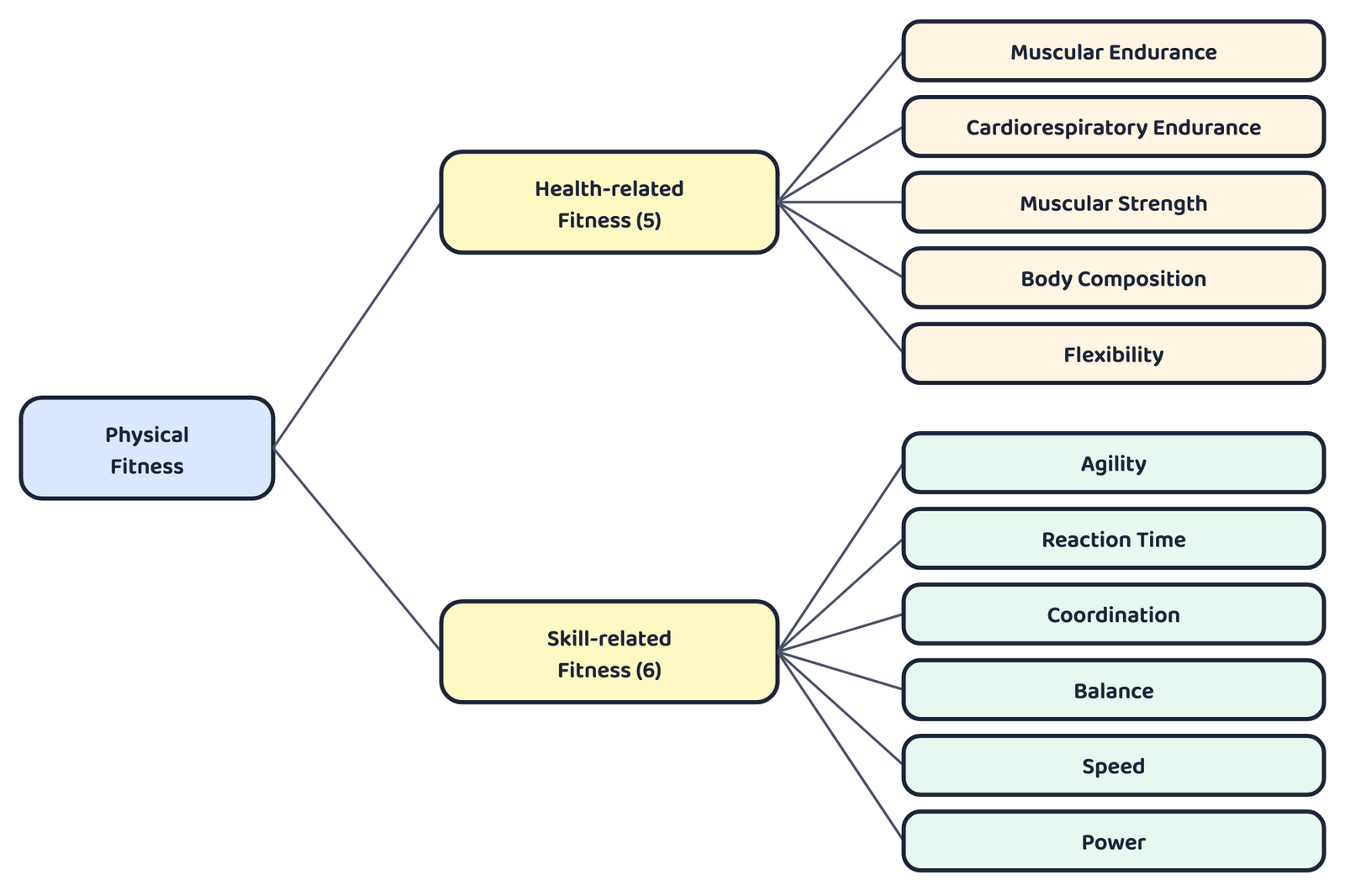
- Muscular endurance, cardiorespiratory endurance, flexibility, muscular strength, body composition
- Part of everyone’s daily life: needed by a doctor as much as a sportsman or farmer
- Moderate strength keeps posture and prevents neck, back or knee pain; a high amount of strength increases performance in weightlifting, jumps and throws
- A higher level is directly related to the degree of skill performance
- Agility, balance, coordination, reaction time, power, speed
- Associated with performance: high level of motor skills for sports and certain jobs
- Also called sports fitness or motor fitness; very specific and multi-dimensional
- Agility is needed in combat sports as well as by a fire fighter
Body composition is the relative percentage of fat and lean body mass. Lean body mass is the fat-free mass of the body: muscle, bone and other tissues except fat.
A healthy person should have a relatively low percentage of body fat. Body fat is linked with heart disease, diabetes and hypertension, so body composition should be checked regularly.
Muscular endurance is the ability of a muscle group to execute repeated contractions over a period of time sufficient to cause muscular fatigue, or to maintain a specific percentage of the maximum voluntary contraction for a prolonged period of time. In short: the ability of a muscle or group of muscles to repeatedly exert force against resistance.
A fit person repeats movements for longer without undue fatigue. Equipment to measure it: free weights (barbells, dumbbells), a gym mat (curl-ups, push-ups) and a stopwatch.
Cardiorespiratory endurance is the ability of the heart, blood vessels, blood and respiratory systems to supply nutrients and oxygen to the muscles, and the ability of the muscles to utilize fuel to allow continuous exercise.
Poor cardiorespiratory fitness restricts daily activity because the heart cannot supply enough blood to the body. Its activities are called aerobic exercises: walking, jogging, swimming, cycling, cross-country race, skiing, water aerobics, climbing stairs and skipping a rope.
Muscular strength is the maximal force that can be generated by a specific muscle or muscle group: the maximum force a muscle can exert against some resistance in a single effort.
A strong person can lift or control her or his own body weight, push an almirah or lift a gas cylinder.
Flexibility is the ability of a joint to move effectively through its full range of motion without incurring pain.
It depends on muscle length, joint structure and other factors. Low flexibility makes daily activities harder and causes problems like lower back pain. Whole-body flexibility cannot be tested in one go, but the sit and reach test is widely used for the hamstring, hip and lower back muscles.
Fast twitch fibres contract quickly, especially in brief, high-intensity activity needing strength, such as sprinting. Slow twitch fibres contract slowly, especially in sustained activity needing endurance, such as long-distance running.
Types of muscle contraction

| Type | What happens | Example |
|---|---|---|
| Static | Muscle exerts force, but no movement takes place | Pushing a wall, pulling a rope |
| Dynamic | Movement can be seen when the muscle exerts force | Push-ups, pull-ups |
| Concentric | The muscle shortens as it contracts | Lifting a heavy weight: the biceps shortens and the arm bends at the elbow |
| Eccentric | The muscle lengthens while it is still working | Lowering the weight in a biceps curl |
Reaction time is the ability to respond quickly to a stimulus: the interval between the presentation of a stimulus and the initiation of the muscular response to it. Examples: a sprinter reacting to the starter’s gun, a goalkeeper reacting to a penalty kick.
Power is the ability to act fast with resistance. It is a combination of strength and speed. Examples: throwing the shot put, long jump, kicking in karate.
Balance is the ability to maintain the state of equilibrium while moving or in a stationary position. Static balance: equilibrium in a stationary position. Dynamic balance: equilibrium during motion.
Speed is the ability to perform a movement in the shortest possible time: the minimum time taken to complete a task. Examples: 100 m and 200 m sprint, ice hockey.
Agility is the ability to change the direction of the body rapidly and accurately. It is a combination of speed, balance, power and coordination. Examples: rugby, football, hockey.
Coordination is the ability to perform a motor task by using body movements and senses accurately and fluently. Examples: juggling in football, hitting a tennis ball, kicking a football.

When asked for the difference, write one line each: speed is moving in the shortest possible time (100 m sprint); agility is changing direction quickly and accurately and itself needs speed, balance, power and coordination (football dribble, hockey).
7 Traditional Sports and Regional Games
Sports and games are as old as society. Some began from the need to survive (archery), some for social interaction (Antakshri), and the wish to express emotions gave rise to dance forms and traditional games. These games reflect the beliefs and culture of a society.
India has always been a land of sports. Its sports history goes back to the Mahabharata period, when chaupar and archery were famous. Games were invented according to the resources and people of each region: the boat race Vallamkali is famous in Kerala and is still held every year at Onam.
7.1 Types of traditional sports and regional games

| Type | Book’s examples and points |
|---|---|
| 1. Board games | Two major board games from our region are played worldwide: chaupar (origin of ludo) and shatranj (now known as chess) |
| 2. Combat games | Invented mainly for self-defence, not to hurt others. Kalarippayattu, one of the oldest martial arts of India, invented in Kerala, is considered the originator of judo and karate |
| 3. Games with the help of animals | Horse riding is an ancient sport worldwide; in India it entered games through polo, still played today |
| 4. Racquet games | Ball badminton (played with a racquet and a rubber ball) was invented in India; some believe modern badminton began in Pune |
| 5. Team games | Build a sense of belongingness; kho-kho and kabaddi are believed to have originated in India |
| 6. Play games | Childhood games that are part of our culture: gilli danda (one small and one big stick); atya patya, mentioned in Tamil literature and played across the country under different names |
| 7. Indian gymnastics | Mallakhamb, from Maharashtra: malla = gymnastics, khamb = pole, so mallakhamb means gymnastics on a pole |
7.2 Importance of traditional sports and regional games
These games gave people a sense of belonging and achievement and were important for their physical and mental health. Their importance lies in four areas:
Physical aspect
“Survival of the fittest”: people needed fitness to face harsh climate, search for food and fight opponents. Traditional games kept them fit to face any adversity. Example: Thang-ta, an ancient martial art of Manipur, played with sword and spear.
Social aspect
Man is a social animal. Many games were designed to promote social and peer interaction; they help children build social skills and relationships from a young age.
Psychological aspect
Physical activity improves self-confidence, self-esteem, motivation, personality and leadership skills. Traditional games gave people a platform to show talent and win recognition from peers and society.
Emotional aspect
Lessons from these games carry into life. Being emotionally strong means keeping one’s nerves under control and staying focused in harsh situations.
8 Leadership through Physical Activity and Sports
Leadership is the art of motivating a group of people to act towards achieving a common goal. It can be defined as a certain set of characteristics, behaviour or style that one exhibits on a day-to-day basis, through one’s thoughts, words and actions.
The leader is the person in the group who has the combination of personality and leadership skills that makes others want to follow her or his direction.
| Thinker | Quotation |
|---|---|
| H.T. Mazumdar | “A leader is one who has power in authority.” |
| LaPierre | “Leadership is the behaviour that affects the behaviour of the people more than their behaviour affects that of a leader.” |
| John C. Maxwell | “A leader is one who knows the way, goes the way, and shows the way.” |
| Anonymous | “With great power comes great responsibility.” |
| Arnold H. Glasow | “A good leader takes little more than his share of the blame and little less than his share of the credit.” |
8.1 Qualities of a good leader

| Quality | What it means |
|---|---|
| 1. Honesty | A leader responsible for a team must be straightforward; if she or he makes honest and ethical behaviour a key value, the team follows |
| 2. Delegation of duty | Focuses on key responsibilities and delegates work, duties and even authority to team members, then oversees how they perform |
| 3. Communication skills | Communication is the key to success; without it no one understands the mission, goals and vision. It must be consistent when assigning tasks or giving instructions |
| 4. Confidence | Confident enough that others follow her or his instructions and the team trusts her or him |
| 5. Commitment | Works alongside everyone else; this earns the team’s respect and instils the same drive in members |
| 6. Accountability | Takes responsibility for everyone’s performance and her or his own choices; does not blame others when things go wrong but makes things right: leaders are fixers |
| 7. Enthusiasm | From a Greek word meaning “possessed by a god”; a motivating, energetic, passionate and dynamic leader, enthusiastic about her or his own work and role |
| 8. Focus | Focused, thinks rationally and is self-driven to work harder for better results |
| 9. Ability to inspire | Persuading others to follow is the hardest job; possible only by setting a good example |
| 10. Responsibility | Leadership is about responsibility, not power; the leader takes responsibility for both failures and successes |
MS Dhoni told his players not to think about winning or losing, but to play their best cricket, enjoy the match and give 100%. When sledging is common, Rahul Dravid’s boys showed exemplary behaviour. A leader influences the behaviour, attitudes and thoughts of others: “Be the change you wish to see in the world” (Gandhi).
8.2 Creating leaders through physical education
Leadership is a complex process that involves the effort of an individual to help groups identify and achieve personal and group goals. Physical activity and sport programmes offer great opportunities for youth to develop important life skills, including leadership.
Leaders have both innate (inborn) and acquired (learnt) qualities. Physical education can create and develop the acquired ones. Sports are highly interactive and give young people many leadership “moments”: for example, a young captain learns leadership by enforcing rules for teammates. The Duke of Wellington said: “The battle of Waterloo was won on the playing fields of Eton.”
Parental involvement also plays a key role. Parents should be included in physical activity instruction and in co-curricular and community programmes, so that they encourage their children’s participation. This builds a psycho-social environment that promotes activity. Active collaboration between teachers, coaches, parents and community personnel helps students become great sports leaders, with life skills that make them more productive members of society.
9 First Aid and P.R.I.C.E.
The term First Aid was officially adopted in England for the first time in 1879 by St. John’s Ambulance Association. The Red Cross and Red Crescent are still the largest providers of first aid worldwide.
First aid is the immediate and temporary care given to the victim of an accident, injury or sudden illness, to preserve life, prevent the condition from worsening and promote recovery, until professional medical help becomes available.
- It covers both the first step in a serious condition, such as CPR (cardiopulmonary resuscitation) while waiting for an ambulance, and the complete treatment of a minor condition, such as putting a plaster on a cut.
- The person who gives the treatment is called an ‘aides’, and the help given is the ‘first aid’.
- It uses relatively simple techniques and rudimentary (basic) equipment, and can be given by any person with basic training until professional medical help arrives, at the spot or during transport to a hospital or the casualty’s home.
9.1 Aims and objectives of first aid
- To prepare properly for any emergency, to avoid errors and act quickly and calmly.
- To assess and address life-threatening conditions first.
- To minimise further injury, infection and complications.
- To make the victim as comfortable as possible, so that she or he saves energy.
- To transport the victim to a medical facility as needed.
9.2 P.R.I.C.E.
The traditional protocol for a sports injury, R.I.C.E. (Rest, Ice, Compression, Elevation), has been modified to P.R.I.C.E. by adding Protection, because protecting the injured area from further damage is crucial to healing.
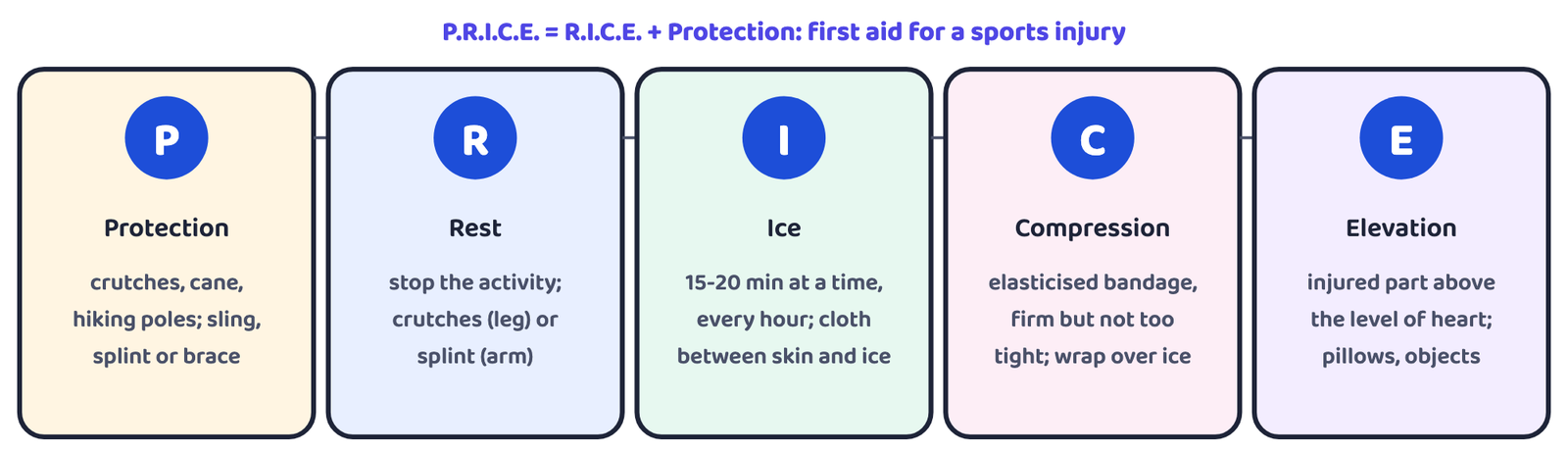
| Step | How | Why |
|---|---|---|
| P: Protection | Limit or avoid weight-bearing with crutches, a cane or hiking poles; partly immobilise with a sling, splint or brace | Protects the area from further injury |
| R: Rest | Stop using the injured part; crutches for leg, knee, ankle and foot injuries; a splint for arm, elbow, wrist and hand injuries | Continuing could cause more injury, delay healing, increase pain and stimulate bleeding |
| I: Ice | Keep a damp or dry cloth between skin and ice pack; not longer than 15 to 20 minutes at a time; apply every hour for 10 to 20 minutes, as long as pain or inflammation lasts | Contracts blood vessels, stops internal bleeding from injured capillaries, reduces swelling and hastens healing |
| C: Compression | Elasticised bandage, compression sleeve or cloth; wrap firmly but do not cut blood supply; wrap over ice; loosen if too tight | Reduces swelling and the seeping of fluid into the injured area; a too-tight bandage may cause more swelling |
| E: Elevation | Raise the injured part above the level of the heart using objects and pillows | Decreases swelling and pain |
Do not put ice directly on the skin, and do not keep it on for more than 15 to 20 minutes at a time. Do not tie the compression bandage so tight that it blocks blood supply.
- Wellness: full integration of physical, mental, spiritual well-being; WHO Glossary 2006: optimal state of health, two focal concerns; NWI: active process toward a more successful existence
- Risk factors: smoking (lung cancer), alcohol (liver damage)
- Health (WHO 1948): complete physical, mental, social wellbeing, not merely absence of disease or infirmity; amplified: socially and economically productive life
- Exercise = planned, structured, repetitive; physical activity = any bodily movement; fitness = state of health and ability to do daily tasks
- Fitness definitions: Bucher 1958, Clarke 1976 (vigour, alertness, emergencies), ACSM, Hoeger 2014, Corbin 2015
- Benefits of activity: physical, mental, social, health, financial
- Wellness 7: physical, emotional, mental (intellectual), social, environmental, occupational, spiritual; holistic, self-healer, outcome-oriented
- Health 4: physical, mental, social, emotional
- Health-related 5: muscular endurance, cardiorespiratory endurance, muscular strength, body composition, flexibility (sit and reach)
- Skill-related 6: agility, reaction time, coordination, balance (static, dynamic), speed, power (strength + speed)
- Contractions: static, dynamic, concentric (shortens), eccentric (lengthens); fast twitch (sprint), slow twitch (distance)
- Traditional games: board (chaupar, shatranj), combat (Kalarippayattu), animals (polo), racquet (ball badminton), team (kho-kho, kabaddi), play (gilli danda, atya patya), mallakhamb; Vallamkali at Onam; Thang-ta of Manipur
- Leader 10: honesty, delegation, communication, confidence, commitment, accountability, enthusiasm, focus, ability to inspire, responsibility; Maxwell: knows, goes, shows the way
- First aid: England 1879, St. John’s Ambulance Association; PRICE = Protection, Rest, Ice (15-20 min), Compression, Elevation (above heart)
- Can I write the WHO definitions of health and wellness and one more definition of each?
- Can I explain the difference between exercise, physical activity and physical fitness?
- Can I write Clarke’s definition of physical fitness and name four other authors?
- Can I explain five benefits of physical activity?
- Can I describe all seven components of wellness with one example each?
- Can I differentiate health-related and skill-related fitness and define each component?
- Can I name the seven types of traditional games with examples and four areas of their importance?
- Can I explain the ten qualities of a leader and how physical education creates leaders?
- Can I define first aid, list its aims and explain each step of PRICE?