
- Tell a disorder from a disability, and explain the medical, social and biopsychosocial models
- Name the types of physical, intellectual and learning disabilities, with their nature and signs
- List the causes of disability: pre-natal, perinatal, post-natal and the nine sub-divided causes
- Follow disability etiquette: attitude, communication, social and physical etiquette
- State the aim and the seven objectives of Adaptive Physical Education
- Explain the role of the counsellor, physiotherapist, occupational therapist, PE teacher, speech therapist and special educator
In the CBSE Physical Education (048) curriculum, this is Class XI Unit 4: Physical Education & Sports for CWSN, worth 4 marks + 3 “b” marks. The “b” marks are concept-based questions (a tactile diagram, data interpretation or a case study) for visually impaired candidates. CWSN stands for Children with Special Needs. The prescribed book is CBSE’s own Physical Education Class XI textbook.
At the Commonwealth Games in Manchester, England, in 2002, medals won by disabled competitors were counted towards their countries’ final totals for the first time. They marched with their national teams, lived in the athletes’ village and competed in the same stadiums at peak times. Former athlete Desmond Green called it “a revolution in sport”. One of the athletes was the South African swimmer Natalie du Toit, who had lost her leg in a road accident.
1 Concept of Disorder and Disability
Parents and teachers of children with special needs hear two words again and again: disorder and disability. Some people call Autism, Dyslexia or ADHD “disorders”, others call them “disabilities”. The two words are often used as if they mean the same thing, but they do not.
1.1 Disorder
Disorder is the disruption or disturbance caused to the normal functions of a body. It is a ‘characteristic’ classified in medical terms according to a clinically significant disturbance in a person’s physical, cognitive and emotional regulation or behaviour.
- Physical disorder: for example, a stomach disorder. It disturbs normal functioning but can be treated.
- Mental or cognitive disorder: for example, an anxiety disorder.
- More common examples: substance abuse disorder, addiction disorder, attention disorder, eating disorder.
- The most important point: a person with a disorder can be treated and restored to the fitness they had before. Disorders have chances of being reversed.
- A disorder is flexible and individual: it may not show in every situation, and what troubles one person may not trouble another in the same situation.
Associated
A disorder can be associated with a disturbance in physical or mental functioning.
Kinds
Mental, attention, eating, anxiety, substance abuse and addiction disorders, and so forth.
Reversal
A person with a disorder can be treated to be as they were before.
Looked at in more detail, a disorder is described by medical conditions that come with painful symptoms, impairment or a significantly increased risk of death. In disability sports, the athletes are people who have had disorders for a long period, which have led to a functional disability, that is, a limitation in doing basic living tasks. This legally termed and classified functional disability is called Disability.
1.2 Disability
Disability is a condition that produces a long-term impairment that affects activities of daily living, such as eating, walking and maintaining personal hygiene. The term covers all kinds of impairments, activity limitations and participation restrictions.
- Disability is an integral part of human life. Almost everyone faces a temporary or permanent impairment at some point.
- Some children have needs that are special needs, in addition to the needs they share with other children.
- Many people with disabilities need assistive technologies such as low-vision devices, wheelchairs or hearing aids.
Forms in which disability may occur
| Form | Meaning |
|---|---|
| Congenital | Present from birth |
| During lifetime | Occurring at some point in a person’s life |
| Invisible (hidden) | Not noticeable easily |
| Temporary | Recovery is possible |
These conditions, or impairments, may be cognitive, developmental, intellectual, mental, physical, sensory, or a combination of several factors.
1.3 Disorder vs disability
Disorder
- About the characteristic or type of impairment
- A medical condition that may give rise to a physical or intellectual disorder
- Can be treated and reversed
- Flexible: may not show in every situation
- e.g. anxiety disorder, eating disorder, attention disorder
Disability
- About functional inability or limitation
- Activity limitation and participation restriction
- Long-term: affects daily living
- A legal term used in disability sports
- e.g. amputation, blindness, cerebral palsy
Disorder = what it IS · Disability = what it STOPS
A disorder describes the condition (its characteristic). A disability describes what the person cannot do because of it (the function lost).
1.4 The law: from the UN to the RPwD Act
The Convention reaffirms that all persons with all types of disabilities must enjoy all human rights and fundamental freedoms.
Barriers are communicational, cultural, economic, environmental, institutional, political, social, attitudinal or structural factors that stop persons with disabilities from taking part fully in society.
- Attitudinal: stereotyping, i.e. assuming a person with disability must be unhealthy and live a dull life.
- Communicational: no books or material in Braille for a visually impaired person.
- Social: the conditions in which people are born, grow, live, learn, work and age; for example, persons with disabilities are more likely to be unemployed.
- Institutional: laws, policies, strategies or practices that discriminate, even if not on purpose.
2 Definition of Disability
| Term | Meaning | Example (book) |
|---|---|---|
| Impairment | A problem in body function or an alteration in body structure | Paralysis, blindness |
| Activity limitation | Difficulty in executing activities | Walking, eating |
| Participation restriction | Problems with involvement in any area of life | Discrimination in employment or transportation |
2.1 ICF: domains of functioning
The International Classification of Functioning, Disability, and Health (ICF) lists nine broad domains of functioning which can be affected; the book names them as:
- Learning and applying knowledge
- General tasks and demands
- Communication
- Basic physical mobility, domestic life and self-care (activities of daily living)
- Interpersonal interactions and relationships
- Community, social and civic life, including employment
- Other major life areas
2.2 Three models of disability

| Model | How it sees disability | What it calls for |
|---|---|---|
| Medical model | A feature of the person, directly caused by disease, trauma or another health condition | Medical care: individual treatment by professionals to ‘correct’ the problem |
| Social model | A socially created problem, not an attribute of the person; caused by an unaccommodating physical environment and attitudes | A political response |
| Biopsychosocial model | Joins what is true in both, without reducing disability to one aspect | A coherent view of health: biological, individual and social. The ICF is based on this model. |
2.3 Children With Special Needs (CWSN)
CWSN are children who have some difficulties which may impede their ability to function adequately in the family, community or school. These difficulties may be physical, cognitive, linguistic, social, emotional or psychological, so they may need special and extra inputs to overcome their challenges.
Many disabilities are congenital or appear before adulthood, so understanding CWSN is essential to help them lead a life with dignity.
According to the RPwD Act 2016, persons with disabilities include those who have long-term physical, mental, intellectual or sensory impairments which, in interaction with various barriers, may hinder their full and effective participation in society on an equal basis with others.
2.4 Emotional and Behavioural Disorders (EBD)
EBD is a broad category used in schools to group a range of difficulties of children and adolescents. A child shows one or more of these to a marked degree, for a long time, in a way that harms his or her education:
- Difficulty to learn that cannot be explained by intellectual, sensory or health factors
- Difficulty to build or keep good relationships with peers and teachers
- Inappropriate behaviour or feelings under normal circumstances
- A general, pervasive mood of unhappiness or depression
- A tendency to develop physical symptoms or fears linked to personal or school problems
2.5 Sporting activities under the RPwD Act 2016
3 Types and Nature of Disability
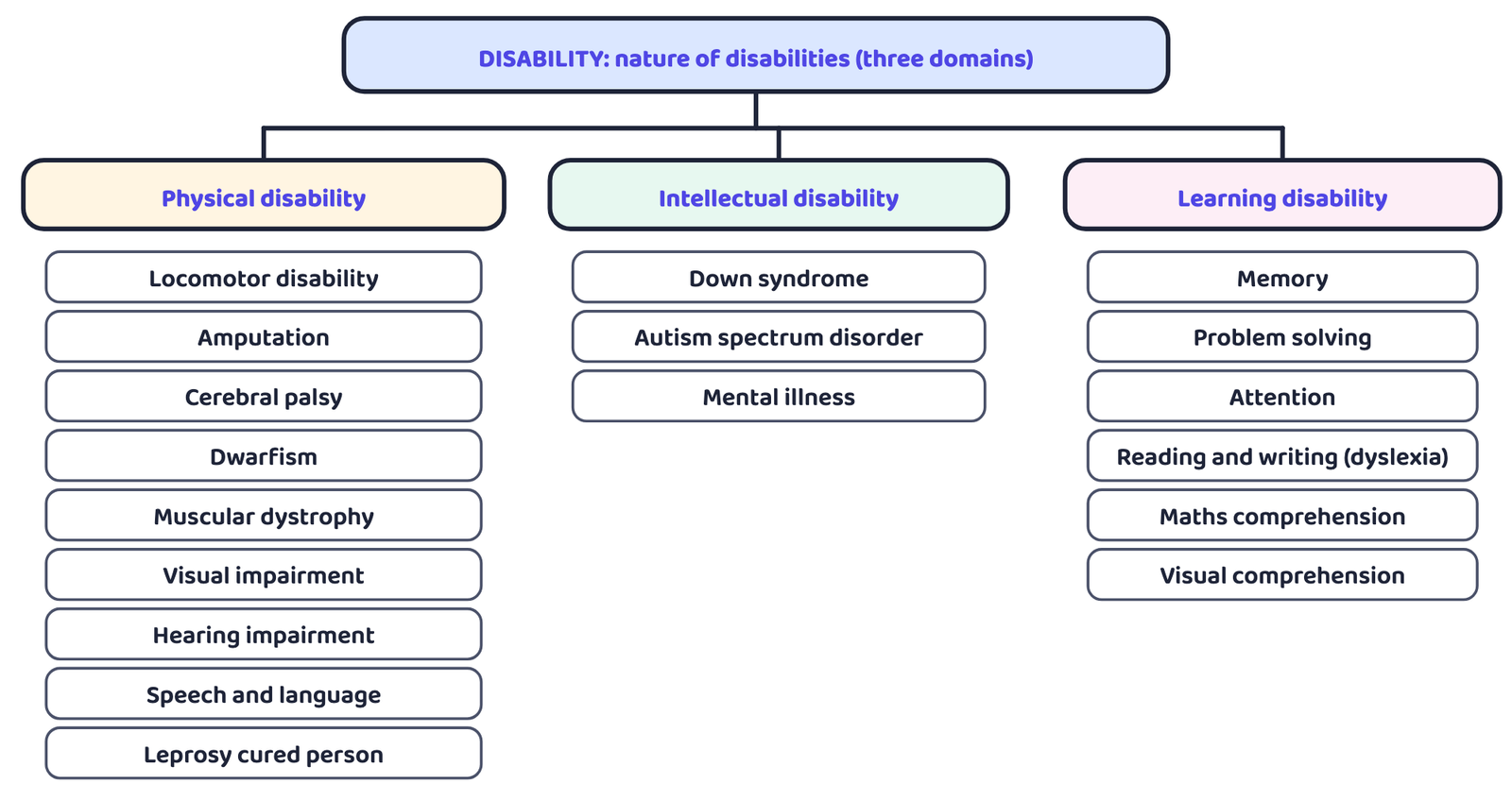
Nature of disabilities: students with disabilities face difficulties in personal, academic and sports areas. Broadly, these are caused by three major domains: physical, intellectual and learning disabilities.
4 Physical Disability
A physical disability is the long-term loss or impairment of part of a person’s body function, resulting in a limitation of physical functioning, mobility, dexterity or stamina.
Because of the functional loss, the person cannot perform normal movements such as walking, sitting and standing, using the hands and arms, or controlling muscles. The Paralympics Committee divides athletes into groups by the degree of activity limitation linked to the impairment.
| Type | What it means (book) |
|---|---|
| A. Locomotor disability | Inability to do activities linked to moving oneself and objects, from an affliction of the musculoskeletal system, the nervous system or both |
| B. Amputation | Removal of a limb by trauma, medical illness or surgery; as surgery, used to control pain or a disease in the limb such as malignancy or gangrene. The person is called an amputee. |
| C. Cerebral palsy (CP) | Cerebral = to do with the brain; palsy = weakness or problems with body movement. Caused by damage to the parts of the brain that control movement, balance and posture: a group of non-progressive neurological conditions affecting body movement and muscle coordination, usually occurring before, during or shortly after birth. |
| D. Dwarfism | A medical or genetic condition giving an adult height of 4 feet 10 inches (147 cm) or less |
| E. Muscular dystrophy | A group of hereditary genetic muscle diseases that weaken the muscles that move the body. Faulty or missing information in the genes prevents the making of proteins needed for healthy muscles: progressive skeletal muscle weakness, defects in muscle proteins and death of muscle cells and tissue. |
| F. Visual impairment | Best corrected visual acuity worse than 20/40 or 20/60; causes difficulty in driving, reading, socialising and walking. It cannot be corrected by glasses, medicine or surgery. |
| G. Hearing impairment | Inability to hear sounds adequately, from improper development, damage or disease of any part of the hearing mechanism. A child learns to speak by hearing others, so hearing is a prerequisite for normal speech and language. |
| H. Speech and language disability | A permanent disability from conditions such as laryngectomy or aphasia, affecting one or more components of speech and language, due to organic or neurological causes |
| I. Leprosy cured person | Cured of leprosy but suffering from (i) loss of sensation in hands or feet, and loss of sensation and paresis in the eye and eyelid, with no visible deformity; or (ii) visible deformity and paresis but enough mobility to work normally; or (iii) extreme deformity plus advanced age that prevents any gainful work |
4.1 Blindness, low vision, deaf and hard of hearing
Blindness (after best correction)
- Total absence of sight; or
- Visual acuity less than 3/60 (10/200 Snellen) in the better eye; or
- Field of vision less than 10 degrees
Low vision
- Visual acuity not exceeding 6/18 (less than 20/60) up to 3/60 (10/200) in the better eye; or
- Field of vision less than 40 degrees up to 10 degrees
Deaf
- 70 dB hearing loss in speech frequencies in both ears
Hard of hearing
- 60 dB to 70 dB hearing loss in speech frequencies in both ears
Students write that cerebral palsy gets worse with time. It does not: the book calls it a group of non-progressive conditions. It is muscular dystrophy that is progressive.
5 Intellectual Disability
Intellectual disability is a condition of significantly subaverage general intellectual functioning that impacts adaptive behaviours.
5.1 Two areas of limitation and three domains
A person with intellectual disability has limitations in two areas:
- Intellectual functioning: the ability to learn, reason, make decisions and solve problems.
- Adaptive behaviours: skills needed for day-to-day life, such as communicating well, interacting with others and taking care of oneself.
Conceptual
Language, reading, writing, maths, reasoning, knowledge, memory
Social
Empathy, social judgement, interpersonal communication, making and keeping friends
Practical
Self-management, personal care, job duties, money management, recreation, organising school and work tasks
These three are the domains of adaptive behaviour; they decide how well a person copes with everyday tasks.
5.2 Classification by IQ
| Category | IQ | Common attributes (book’s table) |
|---|---|---|
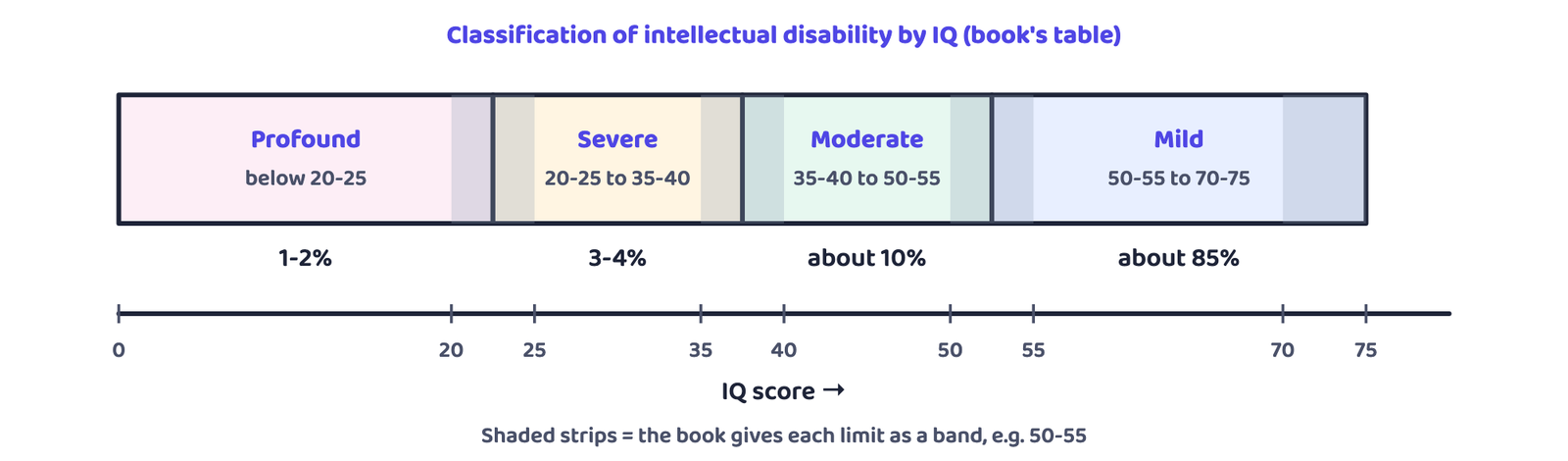
| Mild | 50-55 to 70-75 | Largest group (about 85%). Develop communication and social skills from ages 0-5, minimal impairment in sensorimotor areas; often not distinguishable from other children until a later age. |
| Moderate | 35-40 to 50-55 | About 10%. Acquire communication skills in early childhood; benefit from vocational training; can attend to personal care with supervision; struggle beyond a second-grade level in academics; in adolescence, difficulty recognising social norms may hurt peer relationships. |
| Severe | 20-25 to 35-40 | 3% to 4%. Little or no communicative speech in early childhood; may learn to talk and basic self-care in school years; limited benefit from instruction in basics like the alphabet; as adults may do simple tasks if closely supervised. |
| Profound | below 20-25 | 1% to 2%. Considerable impairment in sensorimotor functioning in early childhood; need highly structured environments with constant individual support and supervision; motor, self-care and communication skills may improve with proper training; they may learn simple tasks under close supervision. |
5.3 Down syndrome
Down syndrome (also called trisomy 21) is a genetic disorder, a subtype of intellectual disability, caused by the presence of all or part of a third copy of chromosome 21.
- Usually linked with physical growth delays, mild to moderate intellectual disability and characteristic facial features.
- Average IQ of a young adult with Down syndrome: 50, equal to the mental ability of an 8- or 9-year-old child (can vary widely).
Signs at birth
- Flat facial features
- Small head and ears
- Short neck
- Bulging tongue
- Eyes that slant upward
- Atypically shaped ears
- Poor muscle tone
Mental and social delays may cause
- Impulsive behaviour
- Poor judgement
- Short attention span
- Slow learning capabilities
5.4 Autism spectrum disorder (ASD)
Autism spectrum disorder (ASD) is an umbrella term for a group of developmental disorders, neurological in origin, that cause social, communication and behavioural challenges. It is mainly marked by impaired social interaction and communication, and repetitive behaviours or restricted interests.
- Sensory sensitivity may be affected: under- or over-sensitive to loud noises, certain fabrics and so on.
- Symptoms are typically recognised between one and two years of age.
- Long-term problems: difficulty in daily tasks, in making and keeping relationships, and in keeping a job.
| Symptom group | Signs (book) |
|---|---|
| Developmental delay in initial years | No interest, not responding to name; delayed imaginative play; regression in communication, social cognitive and self-help skills |
| Problems with social interaction | Prefers not to play or interact; little awareness of others’ thoughts or feelings; attention-seeking behaviour; poor eye contact (may not look up when called by name); cannot read facial expressions; unusual speech pattern (at least half of children with autism speak in a flat, monotone voice; some may speak loudly in libraries or cinemas) |
| Difficulty in communication | Repetitive or rigid language and restricted interests in conversation; weak pragmatic skills (hard to start a conversation or consider the listener); language impairment (uneven development, or nonverbal for life) |
| Behaviour problems | Stereotyped behaviours (rocking, hand flapping, finger flicking, head banging, repeating sounds) when stressed; resistance to change, need for routines (meltdown if the routine breaks); excessive interest in one topic; oversensitivity to loud sounds, bright lights, strong smells or touch |
5.5 Mental illness
Mental illness means a substantial disorder of thinking, mood, perception, orientation or memory that grossly impairs judgement, behaviour, the capacity to recognise reality or the ability to meet the ordinary demands of life. It does not include retardation, which is arrested or incomplete development of mind, marked by sub-normal intelligence.
6 Learning Disabilities
A person with a learning (cognitive) disability has trouble remembering, learning new things, concentrating or making decisions that affect everyday life.
It ranges from mild (the person can still do everyday activities) to severe (the person may lose the ability to understand meaning, to talk or write, and cannot live independently).
6.1 Functional cognitive deficits

Memory
The ability to recall what was learned over time. Three types: working (immediate), short-term and long-term memory. Some people have difficulty with one, two or all three.
Problem solving
Difficulty solving problems as they arise; resilience is often low, so frustration makes them give up.
Attention
Difficulty focusing on the task; a sound, colour or design shifts attention. Some with attention deficits are highly creative in short bursts; people with ADHD find it hard to stay on one task for long.
Reading, linguistic, verbal and writing comprehension
Difficulty in reading, speaking, understanding and writing.
Dyslexia (reading disorder) is trouble with reading despite normal intelligence: difficulty in spelling, reading quickly, writing words, “sounding out” words in the head, pronouncing words aloud and understanding what one reads. It may be mild or severe.
The book notes that bright minds such as Albert Einstein, Thomas Edison and Henry Ford have suffered from some sort of language or text comprehension difficulty.
7 Causes of Disabilities and Disorder
The causes are further sub-divided into nine:
| Cause | Explanation (book) |
|---|---|
| 1. Biological | Disorder of genes, infectious disease, gland malfunction, illness: e.g. Down syndrome, muscular dystrophy, polio, developmental disorders |
| 2. Psychological | Mental health problems such as depression and bipolar disorder; very hard to diagnose; among the most misunderstood disabilities |
| 3. Delay in early screening and poor management | How a child plays, learns, speaks, moves and behaves gives clues; delayed milestones may signal challenges; early screening, identification and intervention give a strong start |
| 4. Lifestyle | The mother’s lifestyle in pregnancy: smoking harms fetal growth; alcohol and substance abuse are the most common causes of developmental disabilities (cognitive, learning, ADHD, behaviour). A diagnosed child should be kept meaningfully occupied with good eating, sleeping and exercise habits. |
| 5. Accidents and war | Workplace, road, chemical or nuclear accidents, radiation; unsafe working conditions; biological warfare, nuclear radiation, bomb trauma |
| 6. Poor approach to healthcare | Lack of proper care during difficult labour and birth; lack of immunisation; poor facilities in remote areas |
| 7. Lack of education and awareness | Not knowing precautions during or after pregnancy; nutrition and exercise awareness prevents disabilities; superstitions misguide people |
| 8. Exposure to chemicals | Pesticides, insecticides and other harmful chemicals in food may cause disabilities and birth defects |
| 9. Illness | Cancer, diabetes and heart disease cause long-term disabilities such as arthritis and musculoskeletal disorders |
For “What are the causes of intellectual disability?” (5 marks), first write the three stages (pre-natal, perinatal, post-natal) with one example each, then explain any five of the nine sub-divided causes under separate headings.
8 Disability Etiquette
Disability etiquette is a set of guidelines dealing specifically with how to approach a person with a disability. It refers to communicating and interacting respectfully and courteously with people who have disabilities.
8.1 Four kinds of disability etiquette
Positive and energetic attitude
Warm and friendly; no sympathy or fear.
Communication
Two-way, direct, slow and clear; people-first language (8.2).
Social etiquette
Disabled-friendly surroundings; no assumptions; respect independence (8.3).
Physical etiquette
Eye level, eye contact, respect personal space (8.4).
8.2 People-first language
Communication etiquette: communication should be two-way: speak directly to the person, not to the person accompanying him or her. Establish rapport; use a communication aid (communication book or device) if required; keep your tone low; speak slowly and clearly; give the person time to respond. While writing or talking about a person with a disability, use “people first” language.
✓ Say
- “A person with disability”
- “She has epilepsy.”
- “She uses a wheelchair.”
✗ Avoid
- “the disabled”, “the handicapped”
- “She is an epileptic.”
- “wheelchair-bound”, “confined to a wheelchair” (most users find the wheelchair liberating)
- “cripple”, “deaf and dumb”, “retarded”
- Euphemisms such as “physically challenged”, “differently abled”
- “suffering from Cerebral Palsy or Parkinson’s”
8.3 Social etiquette in detail
- Make the surroundings disabled-friendly and comfortable; do not make assumptions about what the person can or cannot do.
- Never play with their equipment.
- The impact of a disability varies widely from person to person, so do not assume someone needs help. In an accessible setting, people with disabilities usually get around fine.
- Adults with disabilities want to be treated as independent people. A person with a disability will often say when help is needed; if so, ask how before you act.
- Acknowledge their ability to make decisions on their own behalf. Never bully them physically or verbally.
- Ask questions about their disability only if you know the person. Develop a culture of inclusion.
8.4 Physical etiquette in detail

- The height difference between a wheelchair user and a standing person can create an unspoken feeling of superiority and inferiority. Sit or stand at eye level when possible.
- Sitting at a table removes visible differences such as the wheelchair. Sitting in a chair is better than kneeling, which may make the person feel like a child.
- Make eye contact; never avoid someone with a disability.
- Some people depend on their arms for balance; grabbing them, even to help, could knock them off balance.
- Avoid patting a person on the head or touching his or her wheelchair or cane: people with disabilities consider their equipment part of their personal space.
9 Adaptive Physical Education
Adapted (Adaptive) Physical Education (APE) is the art and science of developing, implementing and monitoring a carefully designed Physical Education instructional programme for a learner with a disability, based on a comprehensive assessment, to give the learner the skills necessary for a lifetime of rich leisure, recreation and sport experiences to enhance physical fitness and wellness.
According to the Adapted Physical Education National Standards (APENS), Adapted Physical Education is Physical Education which has been adapted or modified so that it is as appropriate for the person with a disability as it is for a person without a disability.
- APE generally refers to school-based programmes for students aged 3-21 years.
- It makes PE and sports accessible to all with modified instruction, resources, space and environment as per each CWSN’s ability.
- It is designed so that PE activities are safe, achievable and enjoyable, and therefore a successful experience.
- It is safe and beneficial even for infants and toddlers who need early intervention, and for people of all ages.
Aim of APE: to provide every individual an opportunity to participate in Physical Education and sports, and to make Physical Education accessible to all as per their need.
Section 4.4.2 of the book
9.1 Objectives of Adaptive Physical Education
| Objective | What it means | Book’s example |
|---|---|---|
| 1. Programme to meet the needs of CWSN | The student is assessed on PE parameters and an individual education plan is designed | Autism: a structured programme with fixed timings, day, coach, start and finish, and skills shown with visual cards |
| 2. Capacity to be functionally active for lifetime | Daily life skills are hard due to restricted movement, coordination, lifestyle, behaviour and cognitive challenges; APE conditions the brain, muscles and movements for functional tasks | A student with cerebral palsy crossing a ladder hurdle: lifting the knee, judging space, landing to keep balance |
| 3. Safe and accessible PE and sports programme | Safety is a primary concern; environment, instruction and equipment are modified; special equipment and support for those not benefiting from general or modified PE | A guided rope for running for a visually impaired person; light equipment; behaviour management for hyper or emotionally challenged students |
| 4. Active participation and transition to integrated PE (inclusion) | Moves the student from specially designed PE to integrated PE; for basic fitness, motor movements, skills, competitive sport, integration and inclusion | Severe intellectual disability: passive participation or physical help; mild disability: one sports skill such as dribbling, shooting or floating |
| 5. Develop self-esteem | Success and recognition raise self-esteem and self-image and encourage higher goals | A student with cognitive disability who succeeds in a sport shows enhanced self-image and behavioural change |
| 6. Promote regularity and discipline | Activity gives a feeling of wellbeing, which promotes regularity, discipline and a healthy lifestyle | A child with ADHD: energy channelised gainfully; activity is also therapeutic |
| 7. Promote sportsmanship | Following rules such as regularity, waiting for one’s turn, listening, accepting defeat, celebrating victory, respecting authority modifies behaviour on and off the field | Collins dictionary: sportsmanship is behaviour and attitudes that show respect for the rules of a game and for the other players |
“Need Life Safe Inclusion Esteem Regular Sport”
The seven objectives in book order: meet needs, active for life, safe programme, inclusion, self-esteem, regularity and discipline, sportsmanship.
9.2 Inspiring Indian athletes
Deepa Malik
Padma Shri and Arjuna Award winner; India’s first female para-athlete to win a Paralympic medal: silver in shot put, Rio 2016. Paralysed from the waist down after a spinal tumour (1999) and three surgeries; started sport at 36. First paraplegic Indian woman biker, swimmer and car rallyist.
Yash Singh
“Water Baby”; autistic swimmer; first and youngest Indian to win a medal at the Special Olympics World Summer Games 2015, Los Angeles: bronze, 25-metre backstroke. Born 14 November 2001; supported by his school, Step by Step School; bronze at the SO Bharat Delhi Aquatics State Championship 2013. “Pursuing swimming helps me to achieve my dreams by focusing on my strengths.”
9.3 Need of sports for children with special needs
Putting the chapter’s points together, sport and physical activity matter for CWSN because they:
- build the capacity to be functionally active for life (APE objective 2);
- raise self-esteem and self-image through success and recognition (objective 5);
- promote regularity, discipline and a healthy lifestyle, and channel surplus energy (objective 6);
- teach sportsmanship: rules, waiting for one’s turn, accepting defeat (objective 7);
- lead to inclusion in regular PE and in society (objective 4);
- make children independent and self-reliant: Yash Singh’s story says sport taught him to be independent and never to give up;
- give confidence and change society’s attitude, as the Manchester 2002 Games showed;
- are a right: the RPwD Act 2016 asks the Government and sports authorities to ensure effective participation.
10 Role of Various Professionals for CWSN
CWSN form one of the largest groups still outside the general education system. Inclusive education gives them a chance to enter formal education, so schools need professionals who help them reach their full potential physically and academically, improve motor and communication skills, and promote mental and physical health.

10.1 School counsellor
The specialist who works with CWSN in schools and provides a comprehensive programme for their academic goals and their social, personal and career development. Counsellors involve parents, teachers, other school staff and the community, create a positive school climate, ensure a coordinated team effort and give students access to school and community resources. Through individual and small-group counselling they help students develop:
- skills in communicating, cooperating and resolving conflict;
- behaviours that foster good physical and mental health (and avoiding those that harm it);
- planning and decision-making skills, giving higher self-efficacy and personal responsibility;
- awareness of educational and vocational opportunities and how to access them;
- positive attitudes towards oneself as a student and future worker;
- appreciation of both genders and of cultural diversity;
- a comprehensive plan for school and work through high school and beyond.
10.2 Physiotherapist
Probably the best-known therapist working with CWSN. Uses exercises to help children gain and keep the best possible use of their bodies, improve breathing, prevent deformities and slow the deterioration caused by progressive diseases. Evaluates movement with attention to mobility, balance, posture, fatigue and pain. Role:
- assessing the mechanics of the body;
- improving mobility: joint movement, gross motor and fine motor movement;
- managing children and young people with movement disorders and disability;
- maintaining and conditioning bones, joints and muscles to prevent degeneration;
- rehabilitation through massage, manipulation, exercise and movement, electrotherapy, cryotherapy and hydrotherapy.
10.3 Occupational therapist
Trains CWSN in daily-life and self-care skills, fine motor skills and hand-eye coordination, and helps them take part in play with others. Role:
- activities of daily living: toilet training, eating, dressing, bathing, grooming;
- fine motor skills: buttoning shirts, tying shoelaces, handwriting, finger movement;
- classroom activities such as writing, grasping and releasing toys and objects;
- sensory intervention and sensory integration: techniques to reduce self-harm, a sensory diet for visual and vestibular needs;
- skills such as hitting a ball or copying from the blackboard.
10.4 Physical Education teacher
Determines the abilities of CWSN and the measures that support their participation in sports, games and fitness through general, modified and specially designed PE programmes. Role:
- improving general movement, movement skills and patterns;
- improving hand-eye coordination, flexibility, muscular strength and endurance;
- developing sports-specific skills, e.g. in basketball, soccer, swimming;
- improving social skills: listening, understanding, playing in groups, responsibility, leadership;
- psychological support: channelising energy to reduce anxiety, hyperactivity, tension and depression, building self-esteem, reducing isolation.
10.5 Speech therapist
Provides treatment, support and care for CWSN who have difficulties in communication, helping them communicate through speech and language. Trains students who have difficulty producing sounds or syllables or who say words incorrectly, and helps those with fluency disorders (stoppages, repetitions, prolonged sounds). Modifies two-way communication with different tools and strategies.
10.6 Special educator
Plays a critical role in weaving together all the stakeholders at school and at home; assesses the child’s level and observes performance or behaviour to bring improvement. Role:
Do not mix up the two therapists. The physiotherapist works on body mechanics, mobility, posture and rehabilitation therapies. The occupational therapist works on daily-life skills (dressing, eating), fine motor skills (buttoning, handwriting) and sensory integration.
- Disorder = disturbance of normal body functions, a medical characteristic, can be reversed. Disability = long-term functional limitation in daily living.
- 15% of people (over a billion) live with a disability; 2 billion by 2050. UN Convention: 13 Dec 2006; RPWD Act: 27 Dec 2016; 21 disabilities. World Disability Day: 3 December.
- Impairment, activity limitation, participation restriction. Models: medical, social, biopsychosocial (ICF).
- 1995 Act: 7 types. Three domains: physical, intellectual, learning.
- Physical: locomotor, amputation, cerebral palsy (non-progressive), dwarfism (147 cm or less), muscular dystrophy (progressive), visual, hearing (deaf 70 dB), speech, leprosy cured.
- IQ: mild 50-55 to 70-75 (85%), moderate 35-40 to 50-55 (10%), severe 20-25 to 35-40, profound below 20-25.
- Down syndrome = trisomy 21, average IQ 50. ASD = neurological, recognised at 1-2 years. Dyslexia = reading trouble despite normal intelligence.
- Causes: pre-natal, perinatal, post-natal; nine sub-divided causes.
- Etiquette: positive attitude, communication (people-first language), social, physical (eye level).
- APE: ages 3-21, APENS definition, aim = opportunity for every individual; seven objectives.
- Six professionals: counsellor, physiotherapist, occupational therapist, PE teacher, speech therapist, special educator (IEP).
- Can I write three differences between a disorder and a disability?
- Can I draw the classification chart of disabilities from memory?
- Can I give the IQ range of each category of intellectual disability?
- Can I list five signs of Down syndrome at birth and four symptoms of autism?
- Can I explain the four kinds of disability etiquette with one example each?
- Can I write all seven objectives of APE with examples?
- Can I state two roles of each of the six professionals?