
1 What is Secularism?
Jews faced discrimination for centuries throughout Europe, yet even today, in Israel, Arab Christian and Muslim minorities are excluded from benefits Jewish citizens get. Subtle discrimination against non-Christians persists in parts of Europe, and religious minorities in neighbouring Pakistan and Bangladesh remain a concern. Such examples remind us why secularism still matters in today’s world.
1.1 Inter-religious Domination
The Constitution declares that every Indian citizen has a right to live with freedom and dignity anywhere in the country, yet exclusion and discrimination persist in reality. Three stark examples:
| Event | What happened |
|---|---|
| 1984, Delhi and other parts | More than 2,700 Sikhs were massacred. The families of the victims feel that the guilty were not punished. |
| Kashmiri pandits | Several thousands of Hindu Kashmiri pandits were forced to leave their homes in the Kashmir valley; they have not been able to return for more than two decades. |
| 2002, Gujarat | More than 1,000 persons were killed during the post-Godhra riots. Many surviving family members could not go back to the villages they had been driven from. |
In each case, members of one religious community were targeted for their religious identity, and their basic freedoms were denied: instances of inter-religious domination and religious persecution.
Secularism is first and foremost a doctrine that opposes inter-religious domination (domination of one religious group by another). This is only one aspect of the concept; an equally important second aspect is opposing intra-religious domination (domination hidden within a religion itself).
1.2 Intra-religious Domination
Some believe religion is merely the “opium of the masses” that will vanish once everyone’s basic needs are met. This comes from an exaggerated sense of human potential: humans will never become immortal, and disease, accident and luck can never be fully eliminated. Religion, art and philosophy are responses to this irreducible suffering, which is precisely why secularism, accepting this too, is not anti-religious.
Yet religion has deep-rooted problems of its own. One can hardly think of a religion that treats its male and female members on an equal footing. In Hinduism, dalits have been barred from Hindu temples, and in some parts Hindu women cannot enter temples either. Organised religion is frequently taken over by its most conservative faction, intolerant of dissent, as with religious fundamentalism in parts of the US, endangering peace within and outside the country. Many religions also fragment into sects, causing sectarian violence and persecution of dissenting minorities.
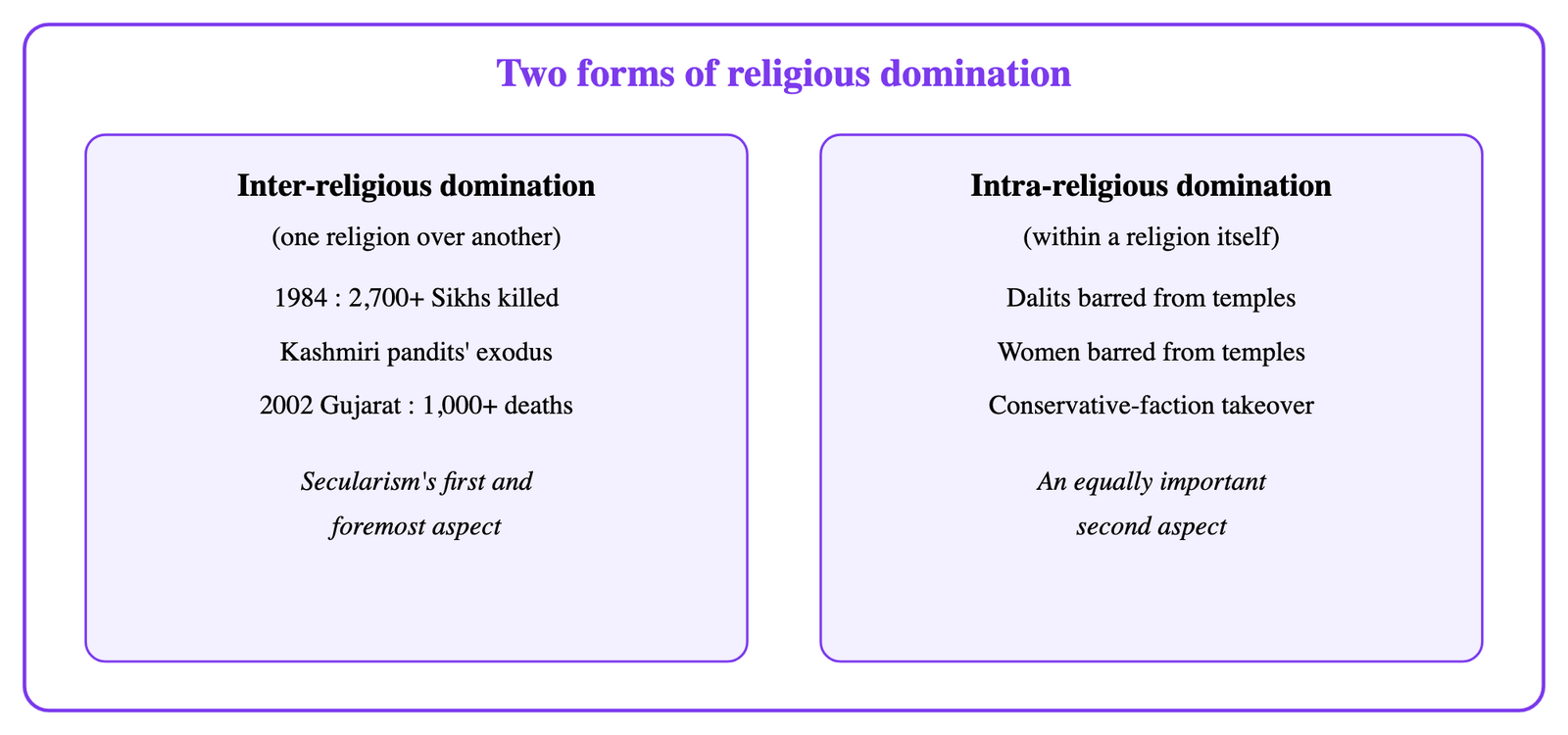
Religious domination, then, is not just inter-religious, it also takes the intra-religious form, and secularism, opposed to all institutionalised domination, has to challenge both. Put positively, secularism promotes freedom within religions, and equality between as well as within religions.
2 Secular State
List some of the ways in which you feel communal harmony could be promoted.
Education can help change mindsets, and stories of Hindus saving Muslims or Muslims saving Hindus amid communal riots are always inspiring, but mere education or individual goodness is unlikely to eliminate religious discrimination. Modern states hold enormous public power, and how they function makes a crucial difference to any struggle against inter-community conflict, which is why we must ask what kind of state can prevent religious conflict and promote harmony.
A theocratic state is one governed directly by the heads of a particular religion, a priestly order. Examples: the Papal states of medieval Europe, and in recent times, the Taliban-controlled state. Such states are known for their hierarchies, oppressions, and reluctance to allow religious freedom to members of other religious groups.
If we value peace, freedom and equality, religious and state institutions must be separated, but is this alone sufficient? No: many non-theocratic states still maintain a close alliance with a particular religion.
| Country | Situation |
|---|---|
| England (16th century) | The state was not run by a priestly class, but it clearly favoured the Anglican Church and its members, an established religion that was the official religion of the state. |
| Pakistan (today) | Sunni Islam is Pakistan’s official state religion. Such regimes leave little scope for internal dissent or religious equality. |
To be truly secular, a state must refuse to be theocratic AND avoid any formal legal alliance with any religion. Separation of religion and state is necessary but not sufficient: a secular state must also be committed to goals partly derived from non-religious sources, peace, religious freedom, freedom from religiously grounded oppression and exclusion, and inter- as well as intra-religious equality.
The nature and extent of this separation can take different forms, depending on which values are promoted and how. We now consider two conceptions: the mainstream western one, best represented by the American state, and an alternative, best exemplified by the Indian state.
3 The Western Model of Secularism
All secular states share one thing: they are neither theocratic nor do they establish a religion. In the most prevalent conception, inspired mainly by the American model, separation of religion and state is understood as mutual exclusion.
The state will not intervene in the affairs of religion, and religion will not interfere in the affairs of the state. Each has a separate sphere of its own with independent jurisdiction. No policy of the state can have an exclusively religious rationale, and no religious classification can be the basis of any public policy.
The state cannot aid any religious institution financially, and cannot hinder their activities either, as long as they stay within the law. So if a religious institution forbids a woman from becoming a priest, or excommunicates dissenters, or bars some members from a temple’s sanctum, the state stays a silent witness in all three cases. On this view religion is a private matter, not one for state policy or law.
This conception interprets liberty and equality individualistically: liberty and equality both belong to individuals, leaving little scope for community-based or minority rights, because except for the Jews, western societies were largely religiously homogeneous and so naturally focused on intra-religious domination. This model also has no place for state-supported religious reform, following directly from treating separation as mutual exclusion.
A very different secularism was practised in Turkey in the early twentieth century: not principled distance from organised religion but active intervention in and suppression of it. Mustafa Kemal Ataturk, who came to power after World War I, was determined to end the institution of Khalifa in Turkey’s public life. He changed his own name to Kemal Ataturk (“Father of the Turks”), banned the Fez (the traditional Muslim cap) through the Hat Law, encouraged Western clothing, replaced the Turkish calendar with the Gregorian one, and in 1928 adopted a new Turkish alphabet in modified Latin form. Can you imagine a secularism that denies you the freedom to keep your name, wear the dress you choose, or speak the language you communicate in?
Asked what secularism meant in independent India, Nehru replied: “Equal protection by the State to all religions.” He wanted a secular state that protects all religions without favouring one over others or adopting any as the state religion. Nehru, the philosopher of Indian secularism, practised no religion and did not believe in God, yet for him secularism did not mean hostility to religion, unlike Ataturk. Nor was he for complete separation: a secular state, in his view, could interfere in religion for social reform, and he himself helped enact laws abolishing caste discrimination, dowry and sati, extending legal rights and freedom to Indian women. On one thing he was always firm: complete opposition to communalism of all kinds, especially of the majority community. For Nehru, secularism was not just a principle but the only guarantee of India’s unity and integrity.
4 The Indian Model of Secularism
It is sometimes said that Indian secularism merely imitates western secularism, but a careful reading of the Constitution shows this is not so: it is fundamentally different, and does not focus only on church-state separation, inter-religious equality matters just as much.
What makes Indian secularism distinctive? It arose amid deep religious diversity that predated western modern ideas and nationalism. A culture of inter-religious “tolerance” already existed, but tolerance is compatible with religious domination: it gives everyone some limited space, and merely lets us put up with people we find deeply repugnant. That is a great virtue for a society recovering from civil war, but not in peacetime, when people struggle for equal dignity.
The French government’s decision to ban the use of religious markers like turbans and veils in educational institutions triggered a heated debate. It is striking that both France and India are secular states, yet in India there is no prohibition on wearing or displaying such religious markers in public institutions. That is because the ideal of secularism envisaged in India is different from that of France.
Western modernity brought previously neglected notions of equality to the fore in Indian thought, sharpening a focus on equality within the community, and ushering in inter-community equality to replace hierarchy. Indian secularism thus took shape from the interaction between society’s pre-existing religious diversity and ideas from the west, giving equal focus to both intra-religious and inter-religious domination.
4.1 Three distinct differences of Indian secularism
This third difference is why the Constitution bans untouchability, and the state has enacted laws abolishing child marriage and the taboo on inter-caste marriage. Can a state support religious reforms and still be secular? The Indian state’s secular character rests on being neither theocratic nor having a state religion; beyond that, it has adopted a sophisticated policy that lets it either disengage from religion American-style, or engage with it if required.
| Mode of engagement | Example |
|---|---|
| Negative (opposing religious tyranny) | Ban on untouchability |
| Positive (support/assistance) | Religious minorities’ right to establish and run their own educational institutions, which may receive assistance from the state |
4.2 Comparing the western and Indian models
Western Secularism
- Mutual exclusion of religion and state (neither interferes in the other’s affairs)
- Equality between different sects of a religion is emphasised
- Less attention to community-based rights
- Individual and his/her rights at the centre
Indian Secularism
- State-supported religious reforms allowed
- Equality between different religious groups is a key concern
- Attention to minority rights
- Rights of both individual and religious community protected
The complexity of Indian secularism cannot be captured by the phrase “equal respect for all religions”: if it means peaceful coexistence or inter-religious toleration, that is not enough, secularism goes much further; if it means equal respect for all religious practices, there is an ambiguity that needs clearing.
Under principled distance, a secular state may keep a distance from religion to promote peace between communities, and it may also intervene to protect the rights of specific communities: it can disengage from religion in American style if need be, or engage with it if required. Indian secularism allows for principled intervention by the state in all religions. Such intervention can betray disrespect to some aspects of every religion, for example, religiously sanctioned caste hierarchies are not acceptable within Indian secularism. The secular state does not have to treat every aspect of every religion with equal respect; it also allows equal disrespect for some aspects of organised religions.
Is secularism compatible with the following?
(a) Subsidising a pilgrimage for a minority community.
(b) Performing religious rituals in government offices.
5 Criticisms of Indian Secularism
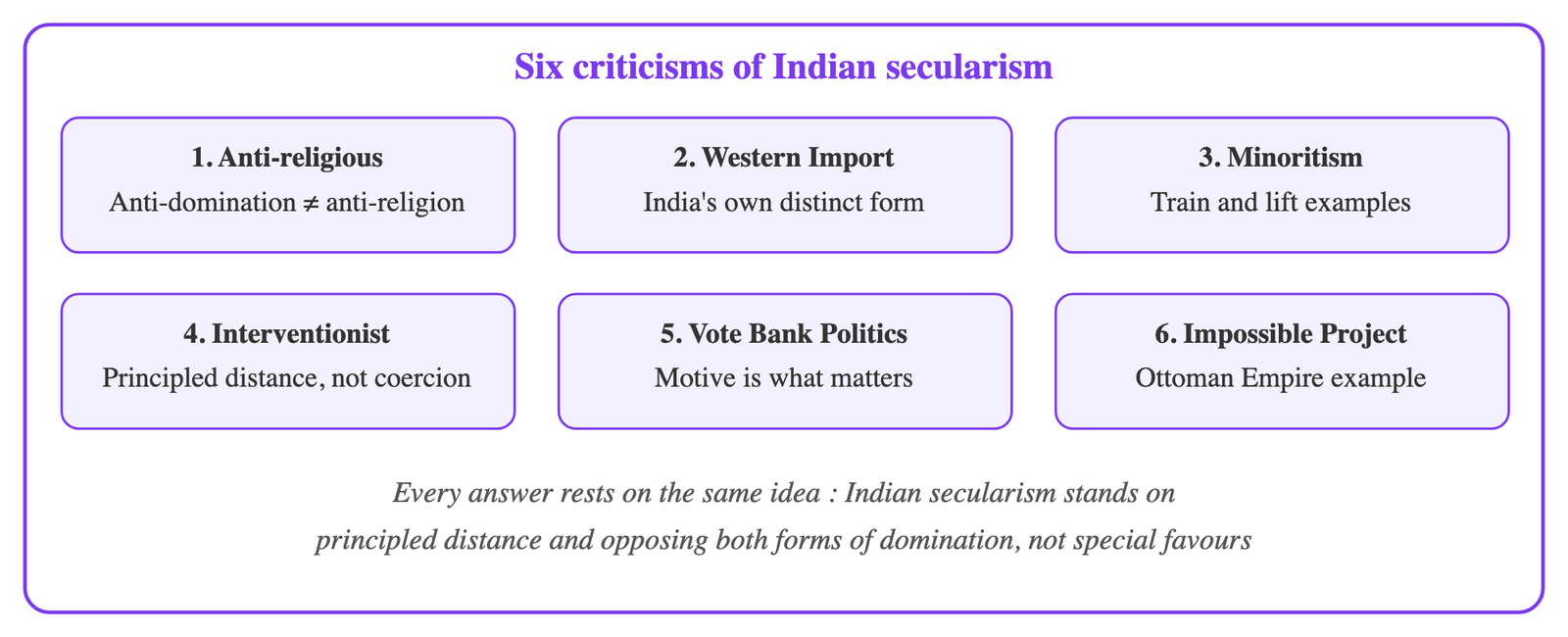
Indian secularism has been subjected to fierce criticism. The textbook lists six criticisms, and answers each one in turn.
5.1 Anti-religious
First criticism: secularism is anti-religious. Answer: it opposes institutionalised religious domination, not the same as being anti-religious. Secularism promotes religious freedom and equality, so it protects religious identity rather than threatening it, though it does undermine identities that are dogmatic, violent, fanatical, exclusivist, or that foster hatred of other religions. The real question is not whether something is undermined, but whether it is intrinsically worthy or unworthy.
5.2 Western Import
Second criticism: secularism is a western concept, unsuited to Indian conditions. A shallow response: trousers, the internet and parliamentary democracy are western too, does any European refuse zero because India invented it? More importantly, a truly secular state must have ends of its own. Western states became secular when, at an important level, they challenged the control of established religious authority over social and political life, so the western model of secularism is not a product of the Christian world. Mutual exclusion, supposedly the ideal of western secular societies, is also not the defining feature of all secular states; the idea of separation can be interpreted differently by different societies. A secular state may keep a principled distance from religion to promote peace between communities, and it may also intervene to protect the rights of specific communities. This is exactly what happened in India, which evolved a variant of secularism that is not just an implant from the west: secularism has both western and non-western origins, church-state separation was central in the west, while peaceful coexistence of communities has mattered more in countries like India.
5.3 Minoritism
Third criticism: secularism is charged with minoritism, favouring minorities unfairly. The textbook answers with two examples:
Four adults travel in the fastest train imaginable. One wants to smoke, a second objects, the other two smoke too but stay silent. A vote is taken: the silent smokers side with the addict, and the non-smoker loses by two votes, seemingly fair since a proper democratic procedure was followed. Now alter the situation: the non-smoker has asthma, and smoking could trigger a life-threatening attack. The majority decision is no longer fair, because voting is not appropriate when fundamental interests are at stake. What holds for individuals holds for communities too: the most fundamental interest of minorities must not be harmed and must be protected by constitutional law, as it is in the Indian Constitution. Minority rights are justified as long as these rights protect their fundamental interests.
Everyone can reach a first-floor cinema hall by climbing the stairs, but is everyone really free to? Some film-goers are old, some have a broken leg, some are physically challenged, none can climb the stairs. A lift or ramp for them is not a special favour, it simply lets them get what everyone else gets via the stairs, with the same respect and dignity. This is why minority rights should not be seen as special privileges.
5.4 Interventionist
Fourth criticism: secularism is coercive, interfering excessively with religious freedom. This misreads Indian secularism: rejecting mutual exclusion does not rule out interference in religion, but that does not make it excessively interventionist. Indian secularism follows principled distance, which allows for non-interference too, and interference need not mean coercion.
Indian secularism permits state-supported religious reform, but this should not be equated with change imposed from above. So why haven’t personal laws (marriage, inheritance, family matters, governed differently by religion) been reformed consistently? This is a real dilemma: such laws can be seen as community-specific rights protected by the Constitution, or as an affront to secularism because they treat women unequally. Such internal conflicts are natural to any complex doctrine, not permanent. Personal laws can be reformed to keep exemplifying both minority rights and gender equality, but such reform must come neither from state or group coercion, nor from the state keeping total distance; the state must act as a facilitator, supporting liberal and democratic voices within every religion.
5.5 Vote Bank Politics
Fifth criticism: secularism encourages vote bank politics. Not entirely false empirically, but politicians seeking votes is simply part of democratic politics, so blaming them for it alone is unfair. The real question is the motive: self-interest alone, or the group’s welfare too? A politician whose voters get no benefit deserves blame; one who delivers what minorities wanted has made the secular project a success.
But if the group’s welfare is sought at the cost of the welfare and rights of other groups, or the interests of the majority are undermined, then a new injustice is born. Vote bank politics also becomes a problem when it mobilises an entire social group to vote en masse for one candidate or party, treating it as a monolithic unit despite internal diversity, distorting electoral politics, and pushing parties to chase short-term gains over long-term governance. In India, parties often focus on emotive over substantive issues, and competitive vote bank politics can deepen social division by pitting groups against each other. It is also linked with minority appeasement: parties disregard equality among citizens to prioritise one minority group, which ironically deepens that group’s alienation, and its internal diversity gets ignored too, making social reform within it harder.
Does the list of gazetted holidays below uphold the case for secularism in India? Give your arguments.
| Holiday | Date |
|---|---|
| Republic Day | Jan 26 |
| Maha Shivaratri | Mar 4 |
| Holi | Mar 21 |
| Mahavir Jayanti | Apr 17 |
| Good Friday | Apr 19 |
| Buddha Purnima | May 18 |
| Id-ul-Fitr | Jun 5 |
| Id-ul-Zuha (Bakrid) | Aug 12 |
| Independence Day | Aug 15 |
| Janmashtami | Aug 24 |
| Muharram | Sep 10 |
| Mahatma Gandhi’s Birthday | Oct 2 |
| Dussehra | Oct 8 |
| Diwali | Oct 27 |
| Milad-un-Nabi | Nov 10 |
| Guru Nanak’s Birthday | Nov 12 |
| Christmas Day | Dec 25 |
5.6 Impossible Project
The final, most cynical criticism: secularism cannot work because people with deep religious differences will never live together in peace. Experience shows this false, Indian civilisation’s own history shows such coexistence is realisable, and so does the Ottoman Empire. Critics may counter that such coexistence was possible only under inequality, and won’t work today when equality is a dominant cultural value.
The textbook’s answer: far from an impossible objective, Indian secularism mirrors the world’s future. A great experiment is under way in India, watched keenly by the whole world, because migration from former colonies and intensifying globalisation are making Europe, America and parts of the Middle East resemble India’s own religious-cultural diversity.
- Secularism opposes two kinds of domination: inter-religious (1984, Kashmir, 2002 Gujarat) and intra-religious (dalit/women temple-entry bans)
- Theocratic state = ruled by priests (Papal states, Taliban); religion-state separation is necessary but not sufficient (England, Pakistan)
- Western model : mutual exclusion, individualist, no room for state-supported reform; Ataturk’s Turkey practised a very different secularism (active intervention in and suppression of religion), unlike Nehru’s
- Indian model : principled distance, three differences, state-supported religious reform (ban on untouchability)
- Six criticisms and answers : not anti-religious, not a western import, not minoritism (train/lift examples), not excessively interventionist, vote bank politics is wrong when voters get no benefit or other groups’ rights are sacrificed, not an impossible project (Ottoman Empire)
- Can I recall all three examples each of inter-religious and intra-religious domination separately?
- Do I remember the definition of a theocratic state and the England-Pakistan examples?
- Is the difference between mutual exclusion and principled distance clear to me?
- Can I recall all three differences of Indian secularism in order?
- Can I recall all six criticisms and their answers separately?
- Is the contrast between Ataturk’s and Nehru’s secularism clear to me?