
Covers T.R. Jain & V.K. Ohri (2026-27) ch 1. Based on: NCERT Indian Economic Development, Chapter 1 (Reprint 2026-27) and the CBSE curriculum 2026-27, Unit 6.
Board note: CBSE teaches this book in Class 12; UP, Bihar, Rajasthan and MP Boards teach it in Class 11.
- State the real aim of British economic policy in India and explain its effects
- Write the causes of agricultural stagnation, including the zamindari system and commercialisation of agriculture
- Explain the two-fold motive of deindustrialisation, the start of modern industry and its shortfalls
- Explain the composition and direction of foreign trade, the export surplus and the drain of wealth
- Recall the facts and figures on the demographic condition, occupational structure and infrastructure
- List the economic challenges India faced in 1947
1 Introduction: why study this chapter
- The structure of today’s Indian economy has its roots in history, especially the period of British rule.
- British rule lasted almost two centuries; India won independence on 15 August 1947.
- To judge the development achieved after 1947, we must first know the state of the economy in 1947.
- That state of the economy shaped India’s post-independence development strategy.
India is the pivot of our Empire… If the Empire loses any other part of its Dominion we can survive, but if we lose India, the sun of our Empire will have set.
Viceroy of British India, 1894 (quoted at the start of the chapter)
The sole purpose of British colonial rule in India was to reduce the country to being a raw material supplier for Great Britain’s own rapidly expanding modern industrial base. Understanding this exploitative relationship is essential to assess India’s development after independence.
2 Low level of economic development under colonial rule
2.1 Before the British: an independent economy
- India had an independent economy before British rule.
- Agriculture was the main source of livelihood for most people.
- Yet the economy also had many kinds of manufacturing activity.
- India was well known for its handicraft industries: cotton and silk textiles, metal work and precious stone work.
- These products had a worldwide market because of the fine quality of material and the high standard of craftsmanship.
Muslin is a cotton textile that originated in Bengal, especially in and around Dhaka (spelled Dacca before independence, now the capital of Bangladesh). Daccai Muslin won worldwide fame as an exquisite cotton textile. The finest variety was called malmal. Foreign travellers called it malmal shahi or malmal khas, meaning it was worn by, or fit for, royalty.
2.2 Policies served Britain
- Colonial economic policies protected and promoted the economic interests of Britain, not the development of the Indian economy.
- These policies brought a fundamental change in the structure of the Indian economy.
- India became a supplier of raw materials to Britain and a consumer of finished industrial products from Britain.
2.3 Estimates of national income
- The colonial government never made a sincere attempt to estimate India’s national and per capita income.
- Some individuals tried, but their results were conflicting and inconsistent.
| Notable estimators (in the book’s order) | Remember |
|---|---|
| Dadabhai Naoroji | All five estimated India’s income during colonial rule. V.K.R.V. Rao’s estimates were considered very significant. |
| William Digby | |
| Findlay Shirras | |
| V.K.R.V. Rao | |
| R.C. Desai |
Do not write “the British government estimated India’s national income.” It never made a sincere attempt; the estimates were made by individuals. Also do not mix up the two growth figures: below 2% is aggregate output, 0.5% is per capita output.
3 Agricultural sector: stagnation
- Under colonial rule India remained fundamentally agrarian.
- About 85 per cent of the population lived in villages and depended directly or indirectly on agriculture.
- Despite this, agriculture suffered stagnation and, not infrequently, unusual deterioration.
- Total output grew a little because the area under cultivation expanded, but agricultural productivity (output per hectare) stayed low.
Agricultural stagnation means that although the largest part of the population depended on agriculture, its productivity stayed low and the sector did not really improve; the little growth in output came only from expansion of the area under cultivation.
The French traveller Bernier described seventeenth-century Bengal as richer than Egypt. It exported cottons, silks, rice, sugar and butter in abundance; based on his two visits, it produced wheat, vegetables, grains, fowls, ducks and geese amply for its own consumption, had immense herds of pigs and flocks of sheep and goats, and fish of every kind in profusion; and from Rajmahal to the sea ran an endless number of canals cut from the Ganges for navigation and irrigation. About 200 years later, when the British left, the same agriculture had stagnated.
3.1 Causes of stagnation
Land settlement systems (main cause)
The systems of land settlement introduced by the colonial government, especially the zamindari system in the then Bengal Presidency (parts of today’s eastern states). The profit from agriculture went to the zamindars instead of the cultivators.
Attitude of zamindars
The zamindars’ only interest was to collect rent, regardless of the cultivators’ condition. A considerable number of zamindars, and not just the colonial government, did nothing to improve agriculture. This caused immense misery and social tension among cultivators.
Terms of revenue settlement
Dates for depositing fixed sums of revenue were fixed; a zamindar who failed lost his rights. So zamindars squeezed rent out of the cultivators.
Low technology and investment
Low levels of technology, lack of irrigation and negligible use of fertilisers. Despite some progress in irrigation, agriculture was starved of investment in terracing, flood control, drainage and desalinisation of soil.
Commercialisation of agriculture
Some areas had higher yields of cash crops, but farmers gained little: instead of food crops they now grew cash crops to be used by British industries.
No means for small cultivators
Only a small section of farmers switched to commercial crops. A large section of tenants, small farmers and sharecroppers had neither the resources nor the technology nor the incentive to invest.
The zamindari system was the land settlement introduced by the British in the Bengal Presidency, under which zamindars collected rent from cultivators and paid fixed revenue to the government, so that the profit from agriculture went to the zamindars instead of the cultivators.
Commercialisation of agriculture means growing cash (commercial) crops for sale in the market instead of food crops for the farmer’s own use. In colonial India these crops were grown for British industries.
“Total agricultural output fell” is not what the book says. Output grew a little through expansion of area; it was productivity that stayed low. Use the word “productivity” in your answer.
4 Industrial sector
4.1 Deindustrialisation
- As in agriculture, India could not develop a sound industrial base under colonial rule.
- The world-famous handicraft industries declined, and no modern industrial base was allowed to take their place.
Deindustrialisation is the process by which India’s traditional handicraft industries declined while no corresponding modern industrial base was allowed to come up. The British did this systematically.
Two-fold motive: first
- Reduce India to a mere exporter of important raw materials for the new modern industries in Britain
Two-fold motive: second
- Turn India into a sprawling market for the finished products of those industries, so that their expansion served Britain to the maximum
4.2 Beginning of modern industry
- Modern industry took root in the second half of the nineteenth century, but progress was very slow.
- At first it was limited to cotton and jute textile mills.
- Iron and steel industries came up at the beginning of the twentieth century.
- The Tata Iron and Steel Company (TISCO) was incorporated in 1907; it was set up at Jamshedpur (now in Jharkhand).
- A few other industries (sugar, cement, paper) came up after the Second World War.
| Basis | Cotton textile mills | Jute mills |
|---|---|---|
| Dominated by | Mainly Indians | Foreigners |
| Location | Western India: Maharashtra and Gujarat | Mainly concentrated in Bengal |
Capital goods industry means industries which produce machine tools which are, in turn, used for producing articles for current consumption.
4.3 Shortfalls of the industrial sector
No capital goods industry
There was hardly any capital goods industry to promote further industrialisation.
No substitute
A few manufacturing units here and there were no substitute for the near wholesale displacement of traditional handicrafts.
Slow growth, small share
The growth rate of the new industrial sector and its contribution to Gross Domestic Product (GDP) or Gross Value Added (GVA) remained very small.
Limited public sector
The public sector was confined to railways, power generation, communications, ports and some departmental undertakings.
5 Foreign trade
- India has been an important trading nation since ancient times.
- The colonial government’s restrictive policies of commodity production, trade and tariff hurt the structure, composition and volume of India’s foreign trade.
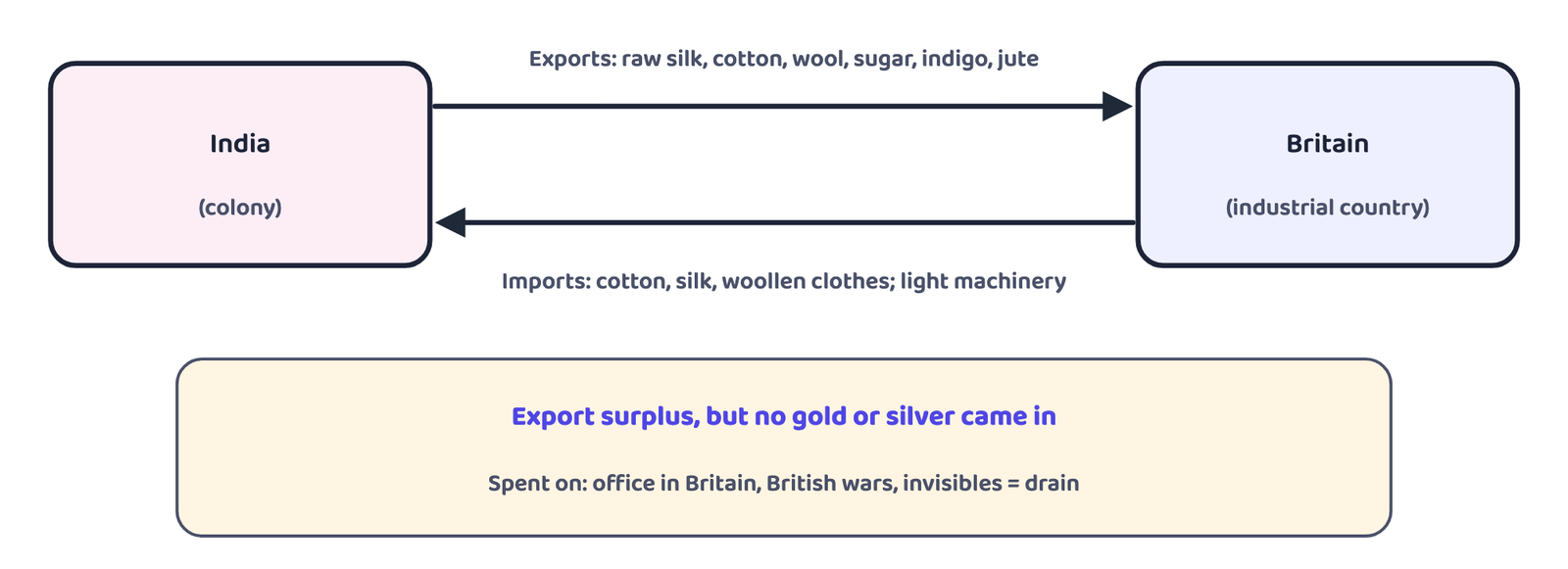
| Aspect | Position under colonial rule |
|---|---|
| Exports (composition) | Primary products: raw silk, cotton, wool, sugar, indigo, jute |
| Imports (composition) | Finished consumer goods (cotton, silk and woollen clothes) and capital goods (light machinery made in British factories) |
| Direction | Britain kept a monopoly over India’s exports and imports; more than half of trade was with Britain; the rest with a few countries: China, Ceylon (Sri Lanka) and Persia (Iran) |
| Most important feature | A large export surplus |
The Suez Canal is an artificial waterway running north to south across the Isthmus of Suez in north-eastern Egypt. It connects Port Said on the Mediterranean Sea with the Gulf of Suez, an arm of the Red Sea. Ships between European or American ports and ports in South Asia, East Africa and Oceania no longer had to sail around Africa. Strategically and economically, it is one of the most important waterways in the world. Its opening in 1869 cut transport costs and made access to the Indian market easier. It further intensified British control over India’s foreign trade and served as a “highway” between India and Britain.
5.1 Export surplus and the drain of wealth
An export surplus is the situation in which the value of a country’s exports is greater than the value of its imports. It was the most important characteristic of India’s foreign trade in the colonial period.
- The surplus came at a huge cost: essential commodities such as food grains, clothes and kerosene were scarcely available in the domestic market.
- The surplus did not bring any flow of gold or silver into India.
- Instead it was used to pay for three things:
- expenses of an office set up by the colonial government in Britain
- expenses on wars fought by the British government
- import of invisible items (services)
The drain of Indian wealth means the use of India’s export surplus to pay for the colonial government’s office in Britain, Britain’s wars and the import of invisible items, so that India’s wealth flowed to Britain without anything coming back in return.
An export surplus is usually good for a country. In colonial India it was not, because (1) essential goods became scarce at home and (2) it brought no gold or silver; it went into the drain. Write both points.
6 Demographic condition
- Details of the population of British India were first collected through a census in 1881.
- Despite its limitations, it showed the unevenness of India’s population growth.
- After that, a census was held every ten years.
- Before 1921, India was in the first stage of demographic transition; the second stage began after 1921. So 1921 is the defining year.
- At this stage neither the total population nor its growth rate was very high.
6.1 Social development indicators
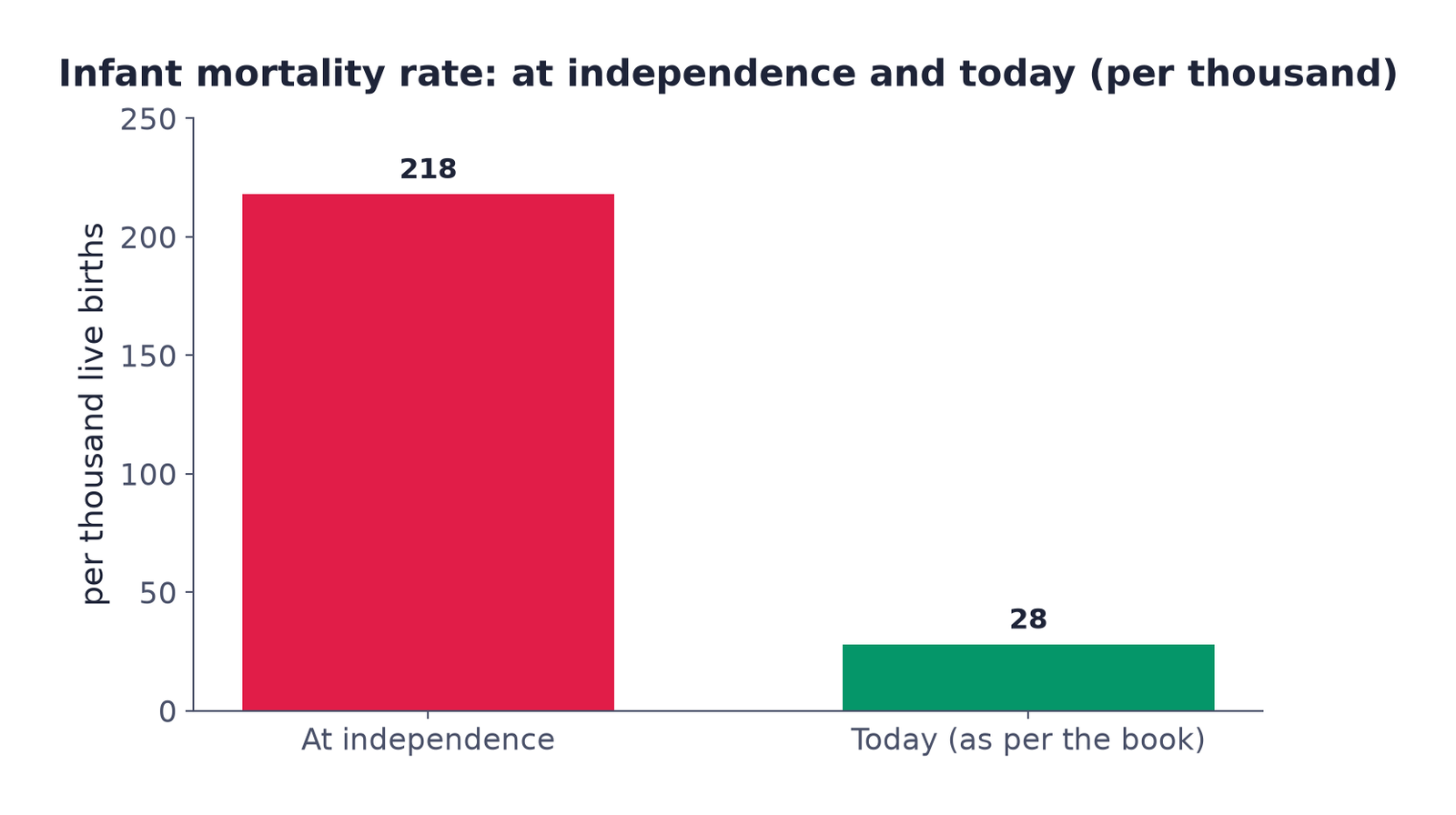
- Public health facilities were unavailable to large sections of people, and highly inadequate where available.
- So water- and air-borne diseases were rampant and took a huge toll on life.
- The overall mortality rate was very high; the infant mortality rate was quite alarming.
- A large section of the population did not have basic needs such as housing (Fig. 1.3 in the book).
- Famines were frequent; the book suggests Nobel Laureate Amartya Sen’s book Poverty and Famines to study their causes.
- Reliable data are lacking, but there is no doubt that extensive poverty prevailed, which worsened the profile of the population.
The infant mortality rate is the number of infants who die before the age of one year, per thousand live births. On the eve of independence it was about 218 per thousand.
Life expectancy is the average number of years a person is expected to live. On the eve of independence it was only 32 years.
7 Occupational structure
Occupational structure means the distribution of working persons across different industries and sectors.
- During the colonial period the occupational structure showed little sign of change.
- Agriculture had the largest share of the workforce, usually 70-75 per cent.
7.1 Growing regional variation
| Dependence on agriculture fell (manufacturing and services rose) | Share of workforce in agriculture rose |
|---|---|
| Parts of the Madras Presidency (areas of present Tamil Nadu, Andhra Pradesh, Kerala and Karnataka) | Orissa |
| Bombay | Rajasthan |
| Bengal | Punjab |
For “features of the occupational structure”, write three points: (1) dominance of agriculture at 70-75%, (2) small shares of manufacturing (10%) and services (15-20%), (3) growing regional variation, naming the regions on both sides.
8 Infrastructure
- Under colonial rule, basic infrastructure such as railways, ports, water transport, posts and telegraphs did develop.
- But the real motive was not to provide amenities to the people; it was to subserve colonial interests.
8.1 Roads
- Roads built before British rule were not fit for modern transport.
- The roads the British built served two purposes: mobilising the army within India, and drawing raw materials from the countryside to the nearest railway station or port for shipment to England or other foreign markets.
- There was always an acute shortage of all-weather roads to reach rural areas during the rainy season.
- So people in these areas suffered grievously during natural calamities and famines.
8.2 Railways (1850)
- The British introduced railways in India in 1850; it is considered one of their most important contributions.
- The first railway bridge, linking Bombay with Thane, dates from 1854 (Fig. 1.4 in the book).
Effect 1 of railways (positive)
- People could undertake long-distance travel
- Geographical and cultural barriers were broken
Effect 2 of railways (negative)
- Fostered commercialisation of Indian agriculture
- This adversely affected the self-sufficiency of village economies
- The volume of India’s exports expanded, but its benefits rarely reached the Indian people.
- So the social benefits of railways were outweighed by the country’s huge economic loss.
8.3 Waterways, telegraph and post
| Facility | What happened |
|---|---|
| Inland trade and sea lanes | Measures were taken, but they were far from satisfactory |
| Inland waterway: Coast Canal on the Orissa coast | Built at huge cost to the exchequer, it could not compete with the railway that ran parallel to it, and was finally abandoned. Inland waterways, at times, proved uneconomical |
| Electric telegraph | An expensive system that served to maintain law and order |
| Postal services | Served a useful public purpose but remained inadequate throughout |
| Aviation | Tata Airlines, a division of Tata and Sons, was established in 1932, inaugurating the aviation sector in India (Fig. 1.5 in the book) |
9 The economy in 1947: one table
| Sector | Position in 1947 | Main cause |
|---|---|---|
| Agriculture | Stagnant, low productivity, surplus labour | Zamindari system, low technology, lack of irrigation, negligible fertiliser use, commercialisation |
| Industry | Handicrafts ruined, little modern industry, no capital goods industry | Policy of deindustrialisation |
| Foreign trade | Raw materials out, finished goods in; British monopoly | Restrictive policies, Suez Canal |
| Demography | Literacy below 16%, IMR 218, life expectancy 32 years | No public health facilities, famines, poverty |
| Occupational structure | Agriculture 70-75%, manufacturing 10%, services 15-20% | Little sign of change; growing regional variation |
| Infrastructure | Railways, roads, posts and telegraph, built for colonial needs | Needs of the army and of raw material movement |
10 Conclusion: India’s economic challenges in 1947
By independence, the impact of two centuries of British rule showed on every aspect of the economy. The country faced these challenges:
10.1 Five main challenges
Agriculture
Saddled with surplus labour and extremely low productivity.
Industry
Crying for modernisation, diversification, capacity building and more public investment.
Foreign trade
Oriented to feed the Industrial Revolution in Britain.
Infrastructure
Including the famed railway network, needed upgradation, expansion and public orientation.
Poverty and unemployment
Rampant poverty and unemployment required a welfare orientation of public economic policy.
10.2 Were there any positive contributions of the British?
✓ Contributions usually cited
- Railways (1850), enabling long-distance travel and breaking geographical and cultural barriers
- Ports, water transport, posts and telegraphs
- Higher yields of cash crops in some areas through commercialisation
- Start of some modern industries (cotton, jute mills, TISCO)
- Regular census from 1881
✗ But their limits
- The motive was colonial interest, not public welfare
- The social benefits of railways were outweighed by economic loss
- Cash crop gains did not reach farmers
- Industry grew slowly; no capital goods industry
- Postal services inadequate; telegraph for law and order
In a “positive contributions of the British” answer, do not just list the benefits. Write the colonial motive next to each one; that is what makes the answer a balanced (critical) appraisal.
- Knowing the pre-independence economy is necessary to appreciate the development achieved after independence.
- Colonial policies protected and promoted British economic interests, not the development of India and its people.
- Agriculture stagnated and deteriorated though most Indians depended on it; the main cause was the land settlement system.
- World-famous handicrafts collapsed and were not replaced by a modern industrial base.
- The export surplus brought no gold or silver; it went into the drain of wealth.
- Lack of public health, frequent natural calamities and famines impoverished people and kept mortality high.
- Infrastructure efforts had selfish motives; independent India had to build on this base through planning.