
1 Meaning of a Human Settlement
People live everywhere on the earth’s surface, but not in the same way everywhere. Wherever people build houses and other structures to live in, and hold some area around them as their economic support-base, a settlement comes into being.
A human settlement is a cluster of dwellings of any type or size where human beings live. The process of settlement inherently involves two things: the grouping of people and the apportioning of territory to them as their resource base.
Settlements vary hugely in size and type: from a single hamlet to a metropolitan city. As size changes, so does everything about a settlement: its economic character, its social structure, its ecology and its technology. Small, sparsely spaced settlements specialising in agriculture or other primary activities are called villages; fewer but larger settlements specialising in secondary and tertiary activities are called urban settlements.
1.1 Rural and urban settlements: the basic differences
Rural settlements
- Derive life support from land-based primary economic activities
- People are less mobile; social relations are intimate
Urban settlements
- Depend on processing raw materials, manufacturing finished goods, and a variety of services
- Way of life is complex and fast; social relations are formal
Cities also act as nodes of economic growth: they provide goods and services to their own residents and to the rural settlements in their hinterland, in return for food and raw materials. This functional relationship between urban and rural settlements works through a transport and communication network.
A 3-mark answer on “differences between rural and urban settlements” should always cover all three angles: economic base, the city’s role as an economic node, and social relationships, not just one.
2 Types of Rural Settlements
The type of a rural settlement is determined by the extent of its built-up area and the inter-house distance. India shows many different types because several factors act together:
2.1 What decides a rural settlement’s pattern
Physical factors
Nature of terrain, altitude, climate, and the availability of water.
Cultural & ethnic factors
Social structure, caste and religion.
Security factors
Defence against theft and robbery.
On this basis, India’s rural settlements can broadly be put into four types.
| Type | What it looks like | Where found in India |
|---|---|---|
| Clustered (agglomerated / nucleated) | A compact, closely built-up area of houses, distinct and separated from the surrounding farms, barns and pastures. Streets show a recognisable geometric shape: rectangular, radial, linear. | Fertile alluvial plains and north-eastern states; also for security (Bundelkhand region, Nagaland); Rajasthan, where water scarcity forces maximum use of available sources. |
| Semi-clustered (fragmented) | Comes from a tendency to cluster within a restricted area of an otherwise dispersed settlement, OR from the segregation/fragmentation of one large compact village: the dominant, land-owning community keeps the central part while lower-strata and menial workers settle on the outer flanks. | Widespread in the Gujarat plain and parts of Rajasthan. |
| Hamleted | Fragmented into several units, physically separated from each other, but all sharing one common name. The units are called panna, para, palli, nagla, dhani in different parts of the country: usually caused by social and ethnic factors. | Middle and lower Ganga plain, Chhattisgarh, and the lower valleys of the Himalayas. |
| Dispersed (isolated) | Isolated huts, or a hamlet of a few huts, in remote jungles or on small hills, with farms or pasture on the slopes: caused by extreme fragmentation of the terrain and of habitable land. | Many areas of Meghalaya, Uttarakhand, Himachal Pradesh and Kerala. |
Do not mix up hamleted and semi-clustered settlements. A hamleted village is fragmented into several units that are physically separated from each other but bear a common name; a semi-clustered village is one compact village with just its outer, lower-strata section pulled a little away from the main cluster.
3 Urban Settlements
Unlike rural settlements, urban settlements are generally compact and larger in size. They are engaged in a variety of non-agricultural, economic and administrative functions, and remain functionally linked to the rural areas around them, sometimes directly, sometimes through a series of market towns and cities.
The Census of India, 1991 defines urban settlements as: “All places which have a municipality, corporation, cantonment board or notified town area committee and have a minimum population of 5,000 persons, at least 75 per cent of male workers are engaged in non-agriculture pursuits and a density of population of at least 400 persons per square kilometer are urban.”
4 Evolution of Towns in India
Towns have flourished in India since prehistoric times: even at the time of the Indus Valley Civilisation, towns like Harappa and Mohenjodaro already existed. Evolution continued through periodic ups and downs until Europeans arrived in the eighteenth century. On the basis of their period of evolution, Indian towns are classified into three groups.
5 Urbanisation in India
The level of urbanisation is measured in terms of the percentage of urban population to the total population.
In 2011, India’s level of urbanisation was 31.16%, still quite low compared to developed countries. Yet the total urban population increased eleven-fold during the twentieth century, driven by the enlargement of existing urban centres and the emergence of new towns. The growth rate of urbanisation has, however, slowed down over the last two decades.
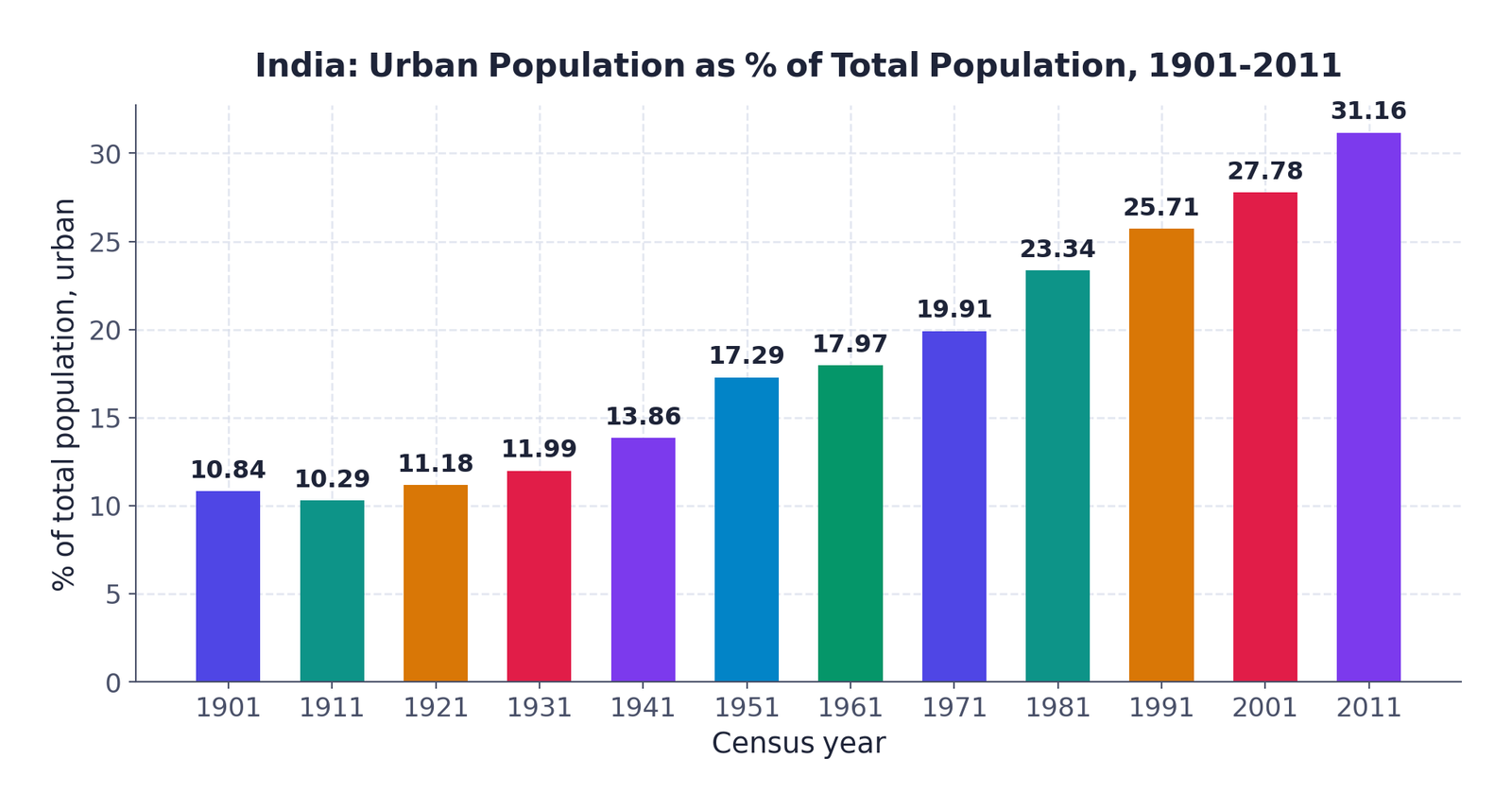
| Year | No. of Towns/UAs | Urban Population (thousands) | % of Total Population | Decennial Growth (%) |
|---|---|---|---|---|
| 1901 | 1,827 | 25,851.9 | 10.84 | – |
| 1911 | 1,815 | 25,941.6 | 10.29 | 0.35 |
| 1921 | 1,949 | 28,086.2 | 11.18 | 8.27 |
| 1931 | 2,072 | 33,456.0 | 11.99 | 19.12 |
| 1941 | 2,250 | 44,153.3 | 13.86 | 31.97 |
| 1951 | 2,843 | 62,443.7 | 17.29 | 41.42 |
| 1961 | 2,365 | 78,936.6 | 17.97 | 26.41 |
| 1971 | 2,590 | 1,09,114 | 19.91 | 38.23 |
| 1981 | 3,378 | 1,59,463 | 23.34 | 46.14 |
| 1991 | 4,689 | 2,17,611 | 25.71 | 36.47 |
| 2001 | 5,161 | 2,85,355 | 27.78 | 31.13 |
| 2011* | 6,171 | 3,77,000 | 31.16 | 31.08 |
The objective of the Smart Cities Mission is to promote cities that provide core infrastructure, a clean and sustainable environment, and a decent quality of life to their citizens, for example, making areas less vulnerable to disasters, using fewer resources, and providing cheaper services. The focus is on sustainable and inclusive development, looking at compact areas and creating a replicable model that can act like a “lighthouse” to other aspiring cities.
6 Functional Classification of Towns
Apart from their role as central or nodal places, many towns and cities perform specialised services and are known for specific activities, products or services, though every town actually performs a number of functions. On the basis of their dominant or specialised function, Indian towns and cities are broadly classified as follows.
| Functional class | Example towns/cities named in the chapter |
|---|---|
| Administrative | Chandigarh, New Delhi, Bhopal, Shillong, Guwahati, Imphal, Srinagar, Gandhinagar, Jaipur, Chennai |
| Industrial | Mumbai, Salem, Coimbatore, Modinagar, Jamshedpur, Hugli, Bhilai |
| Transport | Ports: Kandla, Cochin, Kozhikode, Vishakhapatnam · Inland hubs: Agra, Dhulia, Pandit Deendayal Upadhyay Nagar, Itarsi, Katni |
| Commercial | Kolkata, Saharanpur, Satna |
| Mining | Raniganj, Jharia, Digboi, Ankaleshwar, Singrauli |
| Garrison / Cantonment | Ambala, Jalandhar, Mhow, Babina, Udhampur |
| Educational | Roorki, Varanasi, Aligarh, Pilani, Prayagraj |
| Religious & cultural | Varanasi, Mathura, Amritsar, Madurai, Puri, Ajmer, Pushkar, Tirupati, Kurukshetra, Haridwar, Ujjain |
| Tourist | Nainital, Mussoorie, Shimla, Pachmarhi, Jodhpur, Jaisalmer, Udagamandalam (Ooty), Mount Abu |
Cities are not static in their function: even a specialised city becomes multifunctional as it grows into a metropolis, because industry, business, administration and transport all become important together. The functions get so intertwined that the city can no longer be put into one single functional class.
- Can I define a human settlement, and name the three basic rural-urban differences?
- Can I name all four types of rural settlement, and one region where each is found?
- Can I state the Census of India, 1991 definition of an urban settlement, with all three numbers?
- Can I list the three historical periods of Indian towns with two examples of each?
- Can I state India’s 2011 urbanisation level and explain why it is still called “low”?
- Can I name at least five of the nine functional classes of towns, with one example each?
- A human settlement = grouping of people + apportioning of territory as their resource base
- Rural: land-based primary activities, intimate social relations. Urban: manufacturing/services, cities are economic nodes, formal social relations
- Four rural settlement types: clustered (compact, geometric shape), semi-clustered (clustering within a restricted area of a dispersed settlement, or fragmentation of a large compact village), hamleted (many separated units, one name), dispersed (isolated huts/hamlets)
- Census 1991: urban = municipality/corporation/cantonment/notified town area + population ≥5,000 + ≥75% male workers non-agriculture + density ≥400/km²
- Town periods: Ancient (2,000+ yrs, religious: Varanasi), Medieval (~100 towns, fort towns: Delhi, Agra), Modern (British ports → 3 nodes → industrial towns → post-Independence admin/industrial/satellite towns)
- 2011 urbanisation level: 31.16%, still low vs developed countries; urban population grew 11-fold in the 20th century; growth rate has slowed in the last two decades
- Smart Cities Mission: core infrastructure + clean/sustainable environment + decent quality of life, a replicable “lighthouse” model
- Nine functional classes of towns: administrative, industrial, transport, commercial, mining, garrison/cantonment, educational, religious & cultural, tourist, but cities become multifunctional as they grow
- Human settlement: a cluster of dwellings of any type or size where human beings live, involving the grouping of people and the apportioning of territory as their resource base.
- Clustered settlement: a compact, closely built-up area of houses, distinct from surrounding farms, showing a recognisable geometric shape.
- Semi-clustered settlement: a settlement formed by clustering within a restricted area of dispersed settlement, or by the fragmentation of a large compact village.
- Hamleted settlement: a settlement fragmented into several physically separated units that share one common name.
- Dispersed settlement: isolated huts or a small hamlet, separated by farms/pasture, caused by extreme fragmentation of terrain.
- Urban settlement (Census of India, 1991): a place with a municipality/corporation/cantonment board/notified town area committee, minimum population 5,000, at least 75% male workers in non-agriculture, and a density of at least 400 persons per sq km.
- Level of urbanisation: the percentage of urban population to total population.
- 1 markWhich one of the following towns is NOT located on a river bank?
(a) Agra(b) Bhopal(c) Patna(d) Kolkata - 1 markAccording to the Census of India, which of these is NOT part of the definition of a town?
(a) Population density of 400 persons per sq km(b) Presence of a municipality or corporation(c) More than 75% of the population engaged in the primary sector(d) Population of more than 5,000 persons - 1 markIn which of the following environments would you expect to find dispersed rural settlements?
(a) Alluvial plains of the Ganga(b) Arid and semi-arid regions of Rajasthan(c) Lower valleys of the Himalayas(d) Forests and hills of the north-east - 1 markClustered settlements are common in Rajasthan mainly because of:
(a) scarcity of water(b) fertile alluvial soil(c) dense forest cover(d) hilly terrain - 1 markThe local names panna, para, palli, nagla and dhani belong to which type of settlement?
(a) Hamleted(b) Clustered(c) Semi-clustered(d) Dispersed - 1 markWhich of these is an example of an ancient town, as named in the chapter?
(a) Chandigarh(b) Varanasi(c) Durgapur(d) Jaipur - 1 markThe three principal nodes the British consolidated their hold around were Mumbai, Chennai and:
(a) Surat(b) Goa(c) Kolkata(d) Pondicherry - 1 markIndia’s level of urbanisation, as recorded in the 2011 Census, was:
(a) 21.16%(b) 25.71%(c) 27.78%(d) 31.16%
- 1 mark
Assertion (A): Rural settlements in India often show a clustered pattern in Rajasthan.
Reason (R): Scarcity of water in Rajasthan necessitates compact settlement for maximum use of available water resources.(a) Both A and R are true, and R is the correct explanation of A(b) Both A and R are true, but R is not the correct explanation of A(c) A is true, but R is false(d) A is false, but R is true
- 1 mark
Assertion (A): A city, once it grows into a metropolis, can always be placed neatly into a single functional class.
Reason (R): As cities grow, industry, business, administration and transport all become important together, and functions get intertwined.(a) Both A and R are true, and R is the correct explanation of A(b) Both A and R are true, but R is not the correct explanation of A(c) A is true, but R is false(d) A is false, but R is true
- 1 mark
Assertion (A): India’s rate of urbanisation growth has slowed down over the last two decades.
Reason (R): India’s total urban population has been falling continuously since 1991.(a) Both A and R are true, and R is the correct explanation of A(b) Both A and R are true, but R is not the correct explanation of A(c) A is true, but R is false(d) A is false, but R is true
- 1 markDefine a human settlement in one line.
- 1 markName the two things the process of settlement always involves.
- 1 markWhat is a hamleted settlement?
- 1 markWhat is the minimum population a place needs to be called “urban” by the Census of India, 1991?
- 1 markName any two ancient towns mentioned in the chapter.
- 1 markWhat was India’s level of urbanisation in 2011?
- 1 markName the three principal nodes the British built up on the coast.
- 1 markGive one example each of an industrial town and a mining town.
- 1 markWhat is the objective of the Smart Cities Mission?
- 3 marksWhat are garrison towns? What is their function?
- 3 marksWhat are the main factors responsible for the location of villages in desert regions?
- 3 marksDistinguish between clustered and semi-clustered settlements.
- 3 marksState the Census of India, 1991 definition of an urban settlement.
- 3 marksWhat role do cities play as “nodes of economic growth”?
- 3 marksBriefly describe the three periods into which Indian towns are classified, with one example of each.
- 3 marksWhat are transport cities? Give examples of two kinds.
- 3 marksWhat are administrative towns? Name any three examples.
- 5 marksDiscuss the features of the different types of rural settlements. What factors are responsible for the settlement patterns found in different physical environments?
- 5 marksCan one imagine the presence of only a one-function town? Why do cities become multifunctional?
- 5 marksTrace the evolution of towns in India from ancient to modern times, with examples at each stage.
- 5 marksDescribe the trend of urbanisation in India from 1901 to 2011, using the figures given in the chapter.
- 5 marksExplain any five functional classes of Indian towns, with examples of each.