
bilateral trademultilateral tradeMFNfree trade
dumpingGATTWTOtrade blocentrepot port
1What Is Trade?
Trade means people voluntarily exchanging goods and services. It always needs two parties: one sells, one buys. Sometimes, instead of money, people simply swap one good for another. Whichever way it happens, trade is meant to benefit both sides.
Trade is the voluntary exchange of goods and services between two parties, where one sells and the other buys.
Trade happens at two levels:
National trade
- Exchange of goods and services within one country
International trade
- Exchange of goods and services among different countries, across national boundaries
Countries trade because they need commodities they either cannot produce themselves, or can buy from elsewhere at a lower price.
1.1 The barter system
The earliest form of trade, in primitive societies, had no money at all. This was the barter system, where goods were exchanged directly for other goods.
The barter system is a form of trade in which goods are exchanged directly for other goods, without using money.
Suppose you are a potter and need a plumber’s help. Under barter, you would have to find a plumber who himself needed pots, and trade your pots for his plumbing work. If no such plumber existed, the trade simply could not happen. That is the exact problem money solves.
Every January, after the harvest, the Jon Beel Mela is held at Jagiroad, 35 km from Guwahati (Assam), possibly the only fair in India where the barter system is still practised.
Barter’s biggest difficulty was matching two people who each had exactly what the other wanted. Money solved this. Before paper and coin currency, high-value rare objects served as money: flintstones, obsidian, cowrie shells, tiger’s paws, whale’s teeth, dogs’ teeth, skins, furs, cattle, rice, peppercorns, salt, small tools, copper, silver and gold.
The word salary comes from the Latin word salarium, meaning payment made in salt. Salt from sea water was unknown then, and rock salt was rare and expensive, which is why it was used to pay people.
2History of International Trade
Trade did not become global overnight. It grew in stages, and each stage changed both how much was traded and what kind of goods moved.
An 1829 American advertisement for a slave auction shows buyers often paying up to US$2,000 for a skilled, healthy enslaved person. Auctions like these frequently separated families forever.
3Why Does International Trade Exist?
International trade exists because countries specialise. When a country focuses on producing what it is best suited to produce, and trades for the rest, the whole world economy gains, provided different countries actually practise specialisation and division of labour.
International trade is based on the principle of comparative advantage: trading partners specialise in what they can produce relatively more efficiently, and exchange goods and services so that, in principle, both sides gain. It also rests on the complementarity and transferability of goods and services between countries.
In modern times, trade is the basis of the world’s economic organisation, and it is closely tied to a nation’s foreign policy. With transport and communication as developed as they now are, no country wants to give up the gains of international trade.
4Basis of International Trade
Why does one country trade a particular good with another? Five things decide this.
Difference in national resources
Resources are spread unevenly across the world because countries differ in geology, relief, soil and climate.
- Geological structure: decides the mineral resource base; different landforms give a country different crops and animals. Lowlands suit agriculture; mountains attract tourists.
- Mineral resources: unevenly distributed worldwide; they form the base for a country’s industrial development.
- Climate: decides which plants and animals can survive in a region, e.g. wool comes from cold regions, while bananas, rubber and cocoa come from the tropics.
Population factors
The size, spread and diversity of a country’s population affect what kind of goods, and how much, it trades.
- Cultural factors: distinct arts and crafts develop in different cultures and are valued worldwide, e.g. China’s fine porcelain and brocades, Iran’s carpets, North African leatherwork, Indonesian batik cloth.
- Size of population: densely populated countries consume most of their own production locally, so they trade a lot internally but little externally. A population’s standard of living decides the demand for imported goods; a low standard of living means only a few people can afford costly imports.
Stage of economic development
What a country trades changes as its economy develops. Agriculturally important countries exchange agricultural products for manufactured goods, while industrialised nations export machinery and finished products, and import food grains and raw materials.
Extent of foreign investment
Foreign investment boosts trade in developing countries that lack the capital needed for mining, oil drilling, heavy engineering, timber and plantation agriculture. By building such capital-heavy industries in developing countries, industrial nations secure imports of food and minerals, and create markets for their own finished goods, a cycle that raises the overall volume of trade.
Transport
In earlier times, weak transport kept trade local; only very valuable goods like gems, silk and spices travelled long distances. As rail, ocean and air transport expanded, and refrigeration and preservation improved, trade spread across greater distances.
5Balance of Trade
The balance of trade is the record of the volume of goods and services a country imports and exports to other countries.
Favourable (positive) balance
- Value of exports is more than value of imports
- Good for the country’s economy
Unfavourable (negative) balance
- Value of imports is more than value of exports
- The country spends more buying goods than it earns selling them; this can exhaust its financial reserves
Balance of trade and balance of payments are common 2-3 mark questions. Learn the favourable/unfavourable definitions word for word, and always mention “exhaustion of financial reserves” as the consequence of a negative balance.
6Types of International Trade
Bilateral trade
- Trade carried on between two countries
- The two countries agree to trade specified commodities between themselves
Multi-lateral trade
- Trade carried on with many trading countries at once
- A country may give some trading partners “Most Favoured Nation” (MFN) status
Most Favoured Nation (MFN) status is a trade status a country grants to some of its trading partners, giving them favourable trading terms.
7Case for Free Trade
Opening up an economy for trading, by bringing down trade barriers such as tariffs, is called free trade or trade liberalisation. It lets goods and services from anywhere compete with domestic products and services.
Dumping is the practice of selling a commodity in two countries at a price that differs for reasons unrelated to cost.
Free trade lets goods move more easily, but along with it comes the risk of dumping: cheaper dumped goods from one country can undercut and harm producers inside another country. This is one reason countries stay cautious about opening their markets completely.
8World Trade Organisation (WTO)
The World Trade Organisation (WTO) is the only international organisation dealing with the global rules of trade between nations. It sets the rules for the global trading system, resolves disputes between member nations, and also covers trade in services (like telecommunication and banking) and issues such as intellectual property rights.
WTO headquarters are in Geneva, Switzerland. 166 countries were WTO members as of December 2024, and India has been one of its founder members.
8.1 Criticism of the WTO
The WTO has been criticised by those worried about the effects of free trade and globalisation:
- Free trade, critics argue, does not make ordinary people’s lives more prosperous. It widens the gap between rich and poor by making rich countries richer, because influential nations in the WTO focus on their own commercial interests.
- Many developed countries have not fully opened their own markets to products from developing countries.
- Issues like health, workers’ rights, child labour and the environment are said to be ignored.
9Regional Trade Blocs
Regional trade blocs have come up to encourage trade between countries that are geographically close and have similar or complementary goods to trade, and to reduce restrictions on trade for developing countries.
These blocs grew as a response to global organisations being too slow at speeding up trade within a region. Regional blocs remove tariffs among their own member nations and encourage free trade within the bloc. But in future, it could get harder for free trade to happen between different trading blocs.
10Concerns Related to International Trade
✓ Trade helps a nation when it leads to
- Regional specialisation and a higher level of production
- Better standard of living
- Worldwide availability of goods and services
- Equalisation of prices and wages
- Spread of knowledge and culture
✗ Trade harms a nation when it leads to
- Dependence on other countries
- Uneven levels of development
- Exploitation
- Commercial rivalry that can lead to wars
Global trade also affects the environment, health and well-being of people everywhere. As countries compete to trade more, the use of natural resources spirals up. Resources get used faster than they can be replenished. Marine life is depleting, forests are being cut down, and river basins are being sold to private drinking-water companies. Multinational companies in oil, gas mining, pharmaceuticals and agri-business keep expanding their operations without following sustainable-development norms, creating more pollution. If organisations chase only profit and ignore environment and health concerns, this could have serious implications for the future.
Students often write that free trade is good for everyone equally. The chapter is clear that globalisation with free trade can hurt developing economies if it does not give them an equal playing field, and that developed countries want access to other markets while keeping their own protected.
11Gateways of International Trade: Ports
The chief gateways of world trade are harbours and ports. Cargo and travellers move from one part of the world to another through them.
A port is a place that provides facilities for docking ships, and for loading, unloading and storing cargo. Port authorities also maintain navigable channels and arrange tugs, barges, and labour and managerial services.
A port’s importance is judged by the size of cargo and number of ships it handles. The quantity of cargo a port handles is a good indicator of how developed its hinterland (the inland area it serves) is.
11.1 Ports by the cargo they handle
| Type of port | What it handles |
|---|---|
| Industrial ports | Specialise in bulk cargo: grain, sugar, ore, oil, chemicals and similar materials |
| Commercial ports | Handle general cargo, packaged and manufactured goods, and also passenger traffic |
| Comprehensive ports | Handle bulk and general cargo in large volumes; most of the world’s great ports fall in this class |
11.2 Ports by location
| Type of port | Description | Examples |
|---|---|---|
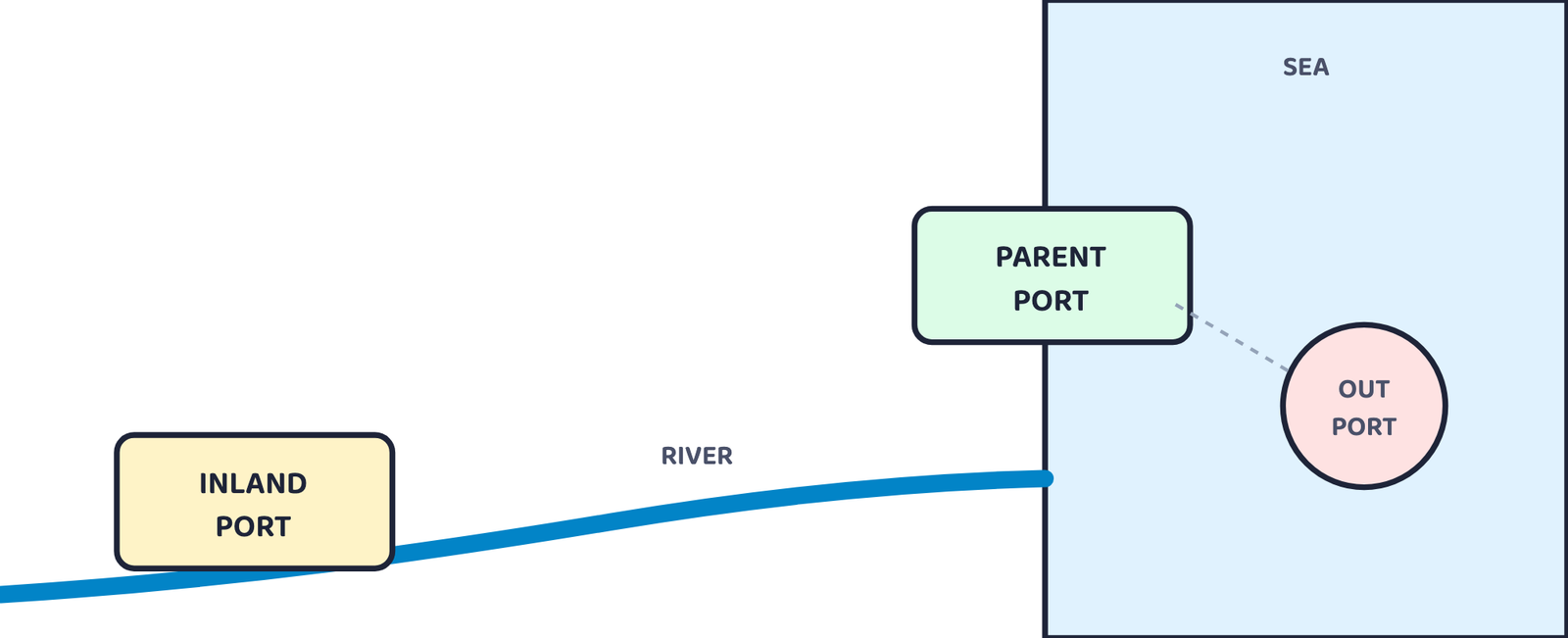
| Inland ports | Located away from the sea coast, linked to the sea by a river or canal; accessible to flat-bottom ships or barges | Manchester (canal); Memphis (river Mississippi); Mannheim and Duisburg (river Rhine); Kolkata (river Hooghly, a branch of the Ganga) |
| Out ports | Deep-water ports built away from the actual port, receiving large ships that cannot approach the parent port directly | Piraeus, the out port of Athens (Greece) |
11.3 Ports by specialised function
| Type of port | Description | Examples |
|---|---|---|
| Oil ports | Deal in processing and shipping oil: either tanker ports or refinery ports | Tanker ports: Maracaibo (Venezuela), Esskhira (Tunisia), Tripoli (Lebanon). Refinery port: Abadan (Gulf of Persia) |
| Ports of call | Developed as stopping points on main sea routes, where ships once refuelled, took on water and food; later grew into commercial ports | Aden, Honolulu, Singapore |
| Packet stations (ferry ports) | Deal only with passengers and mail across short water bodies; occur in facing pairs | Dover (England) and Calais (France), across the English Channel |
| Entrepot ports | Collection centres where goods from different countries are brought together for re-export | Singapore (for Asia), Rotterdam (for Europe), Copenhagen (for the Baltic region) |
| Naval ports | Have only strategic importance; serve warships and have repair workshops | Kochi and Karwar (India) |
An entrepot port is a collection centre where goods from different countries are brought together before being sent onward for export.
- Trade is a voluntary, mutually beneficial exchange of goods and services; barter came before money.
- Trade history moved from local barter, through the Silk Route and the slave trade, to industrial-era raw-material-for-finished-goods trade, to GATT after the World Wars.
- International trade rests on comparative advantage, complementarity and transferability of goods and services.
- Five bases of trade: national resources, population factors, stage of economic development, foreign investment, transport.
- Favourable balance = exports > imports; unfavourable balance = imports > exports.
- Trade is bilateral (two countries) or multi-lateral (many countries, with MFN status possible).
- Free trade lowers tariffs; dumping is selling the same good at different, cost-unrelated prices in two countries.
- GATT (1948) became the WTO on 1 January 1995; WTO sets global trade rules and settles disputes, but is criticised for favouring rich nations.
- 120 regional trade blocs generate 52% of world trade.
- International trade can raise living standards or cause dependence, exploitation and environmental harm, depending on how it is conducted.
- Ports are classified three ways: by cargo handled, by location, and by specialised function.
- 1 markDefine trade.
- 1 markWhat is the barter system?
- 1 markName the two levels at which trade is conducted.
- 1 markWhat is dumping?
- 1 markIn which year was the WTO formed?
- 1 markName any two commodities that served as money before coins and paper currency.
- 1 markWhat does MFN stand for?
- 1 markName any two entrepot ports mentioned in the chapter.
- 3 marksWhat is the basic function of the World Trade Organisation?
- 3 marksWhy is it detrimental for a nation to have a negative balance of payments?
- 3 marksWhat benefits do nations get by forming trading blocs?
- 2 marksDistinguish between bilateral and multi-lateral trade.
- 2 marksDistinguish between a favourable and an unfavourable balance of trade.
- 3 marksExplain any three reasons why national resources are unevenly distributed across the world.
- 2 marksHow did the slave trade begin, and when was it finally abolished?
- 3 marksWhat is meant by free trade? How is it achieved?
- 2 marksDistinguish between an inland port and an out port, with one example each.
- 3 marksWhat is a comprehensive port? Why do most of the world’s great ports fall in this class?
- 2 marksWhat role did the Industrial Revolution play in changing the pattern of world trade?
- 3 marksExplain how the stage of a country’s economic development affects what it trades.
- 5 marksHow are ports helpful for trade? Give a classification of ports on the basis of their location.
- 5 marksHow do nations gain from international trade? Also explain how international trade can prove harmful to a nation.
- 5 marksTrace the history of international trade from ancient times to the formation of the WTO.
- 5 marksExplain the five factors that form the basis of international trade.
- 5 marksClassify ports on the basis of the specialised functions they perform, with examples.
- 5 marksWhat is the World Trade Organisation? Discuss the criticism it faces.
- 1 markMost of the world’s great ports are classified as:
(a) Naval Ports(b) Oil Ports
(c) Comprehensive Ports(d) Industrial Ports - 1 markThe Silk Route, an early example of long-distance trade, connected:
(a) Rome and China(b) London and India
(c) Venice and Japan(d) Lisbon and Brazil - 1 markGATT was transformed into the World Trade Organisation with effect from:
(a) 1 January 1948(b) 1 January 1994
(c) 1 January 1995(d) 1 January 2000 - 1 markA port linked to the sea through a river or a canal, and located away from the sea coast, is called:
(a) an out port(b) an inland port
(c) a naval port(d) a port of call - 1 markThe practice of selling a commodity in two countries at a price that differs for reasons unrelated to cost is called:
(a) bartering(b) liberalisation
(c) dumping(d) hedging - 1 markKochi and Karwar in India are examples of:
(a) entrepot ports(b) naval ports
(c) out ports(d) ports of call - 1 markTrade in which a country gives “Most Favoured Nation” status to some of its trading partners is called:
(a) bilateral trade(b) barter trade
(c) multi-lateral trade(d) protected trade
- 1 mark
Assertion (A): A country with a favourable balance of trade will eventually exhaust its financial reserves.
Reason (R): A favourable balance of trade means the value of a country’s exports is more than the value of its imports.(a) Both A and R are true, and R is the correct explanation of A(b) Both A and R are true, but R is not the correct explanation of A(c) A is true, but R is false(d) A is false, but R is true
- 1 mark
Assertion (A): Densely populated countries generally have a large volume of internal trade but comparatively little external trade.
Reason (R): Most of the agricultural and industrial production of a densely populated country is consumed within its own local markets.(a) Both A and R are true, and R is the correct explanation of A(b) Both A and R are true, but R is not the correct explanation of A(c) A is true, but R is false(d) A is false, but R is true
- 1 mark
Assertion (A): Regional trade blocs remove all barriers to free trade everywhere in the world.
Reason (R): Regional trade blocs remove tariffs within their own member nations, but it can become harder for free trade to happen between different trading blocs.(a) Both A and R are true, and R is the correct explanation of A(b) Both A and R are true, but R is not the correct explanation of A(c) A is true, but R is false(d) A is false, but R is true