
1 When, Where and How Big
Called Harappan after Harappa, the site where it was first identified, and also the Indus Valley Civilisation. It is named after a place, not a king, and that is the point: everything here comes from objects, because the writing has never been read.
Harappan pottery, bricks, seals, weights, beads and copper and bronze articles are found from Afghanistan, Baluchistan, Sind and Punjab in Pakistan across to Jammu and Kashmir, Punjab, Haryana, Rajasthan, Uttar Pradesh, Gujarat and Maharashtra. The urban phase was not sudden: the culture goes back to farming communities of about 7000 BCE and grew out of the Early Harappan phase by gradual internal development.
The rest are regional centres, agricultural villages, ports and manufacturing centres: a network of settlements with different jobs, not five cities alone.
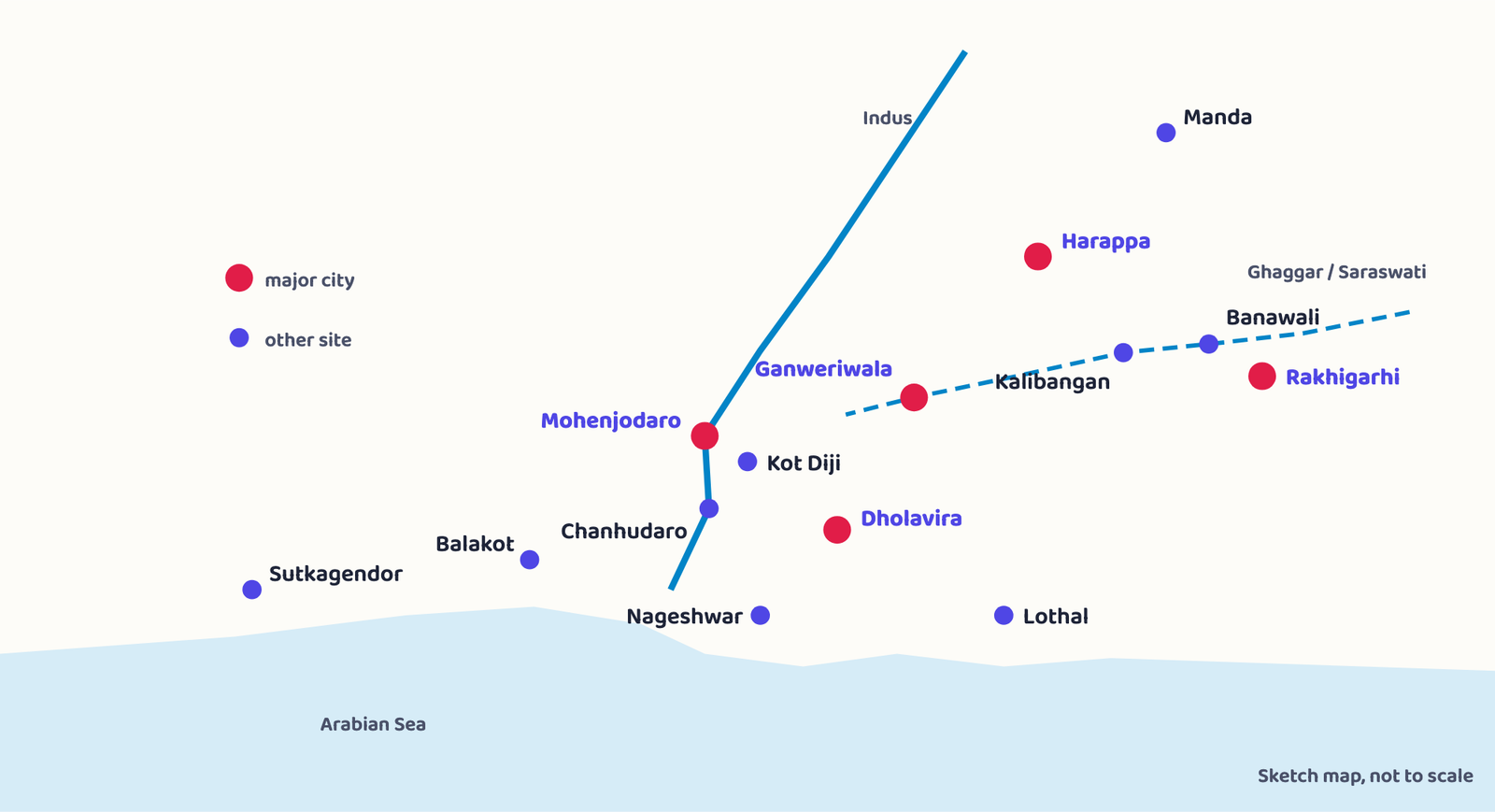
2 What People Ate and How They Farmed
Archaeo-botanists study ancient plant remains such as charred grains and seeds. Archaeo-zoologists, also called zoo-archaeologists, study ancient animal bones. Between them they reconstruct what people ate.
| Evidence | What it shows |
|---|---|
| Wheat, barley, lentil, chickpea, sesame | The main grains and pulses. Millets are found from sites in Gujarat; finds of rice are relatively rare. |
| Bones of cattle, sheep, goat, buffalo, pig | These animals were domesticated. |
| Bones of boar, deer, gharial, and of fish and fowl | Wild animals, fish and birds were eaten. Whether the Harappans hunted them or got meat from hunting communities is unknown. |
Grain proves farming happened, not how they farmed, and that gap is what the chapter wants you to notice.
| Question | What the evidence allows |
|---|---|
| Was the plough used? | Bulls on seals and terracotta sculpture suggest oxen pulled ploughs; terracotta plough models come from Cholistan and Banawali (Haryana) |
| Any actual field? | An Early Harappan ploughed field at Kalibangan (Rajasthan), with two sets of furrows at right angles, so two crops were grown together |
| How did they harvest? | Unsettled: stone blades set in wooden handles, or metal tools |
| Was there irrigation? | Probably, since most sites are semi-arid. Canal traces at Shortughai in Afghanistan but not in Punjab or Sind, where canals may have silted up. Wells were used, and the Dholavira reservoirs may have stored water |
Mackay sorted Mohenjodaro’s saddle querns into two kinds: one where a smaller stone was pushed to and fro, probably for grinding grain, and one where a second stone pounded a cavity into the lower stone, probably for herbs and spices, which the workmen called curry stones. The method to learn: an ancient object is identified by comparing it with a present-day object that looks like it. That is a comparison, not a proof.
3 Mohenjodaro: a Planned City
Harappa was found first; Mohenjodaro is better known because it survived better. Harappa was wrecked by brick robbers, and in 1875 Cunningham noted enough brick had been carted off to lay about 100 miles of the Lahore to Multan railway line.
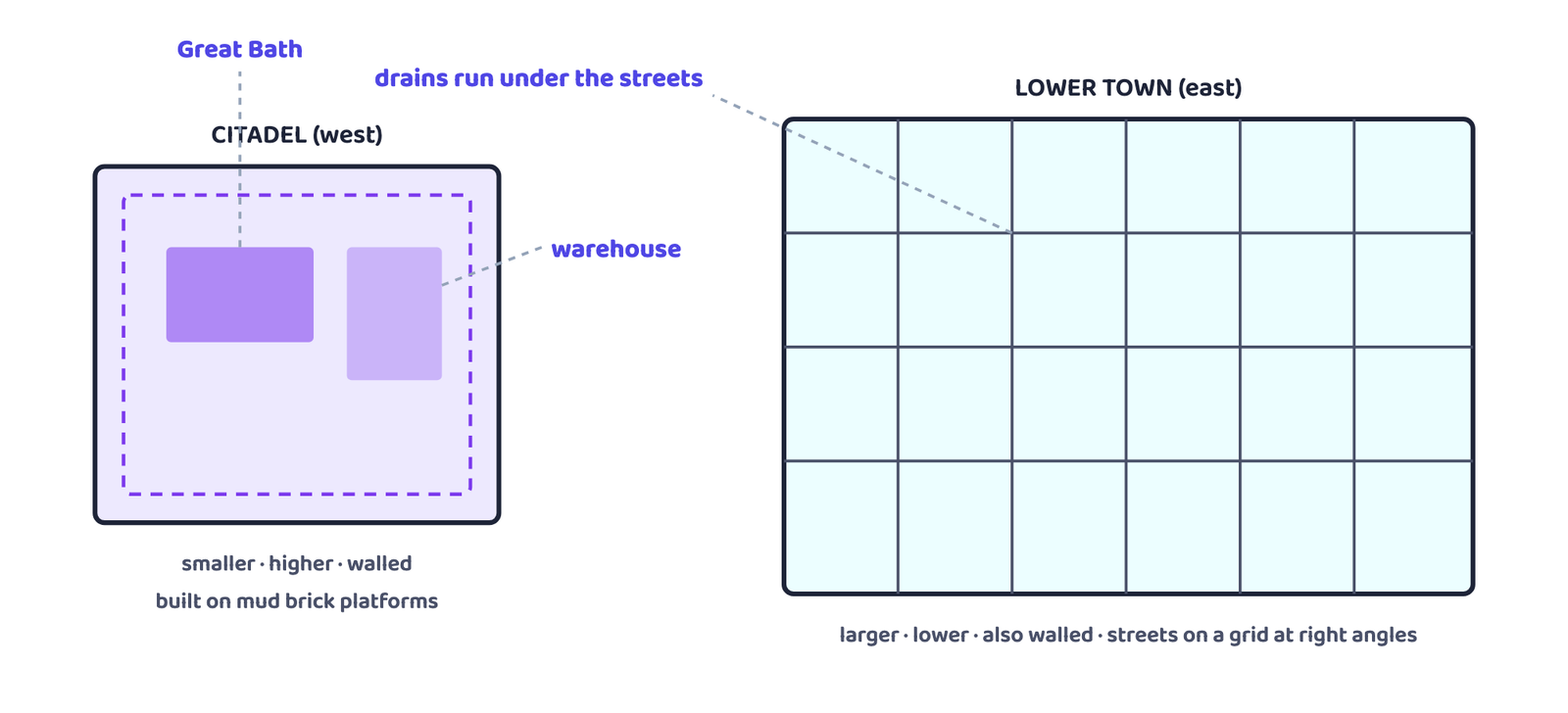
The Citadel is high because its buildings stand on mud brick platforms, and walled, so it is cut off from the Lower Town, which was walled too and also partly built on platforms. At roughly a cubic metre of earth per labourer per day, the foundations alone would have taken about four million person-days.
4 : 2 : 1
Bricks, sun-dried or baked, always kept length : breadth : height = 4 : 2 : 1, from Jammu to Gujarat. Nobody achieves that by accident.
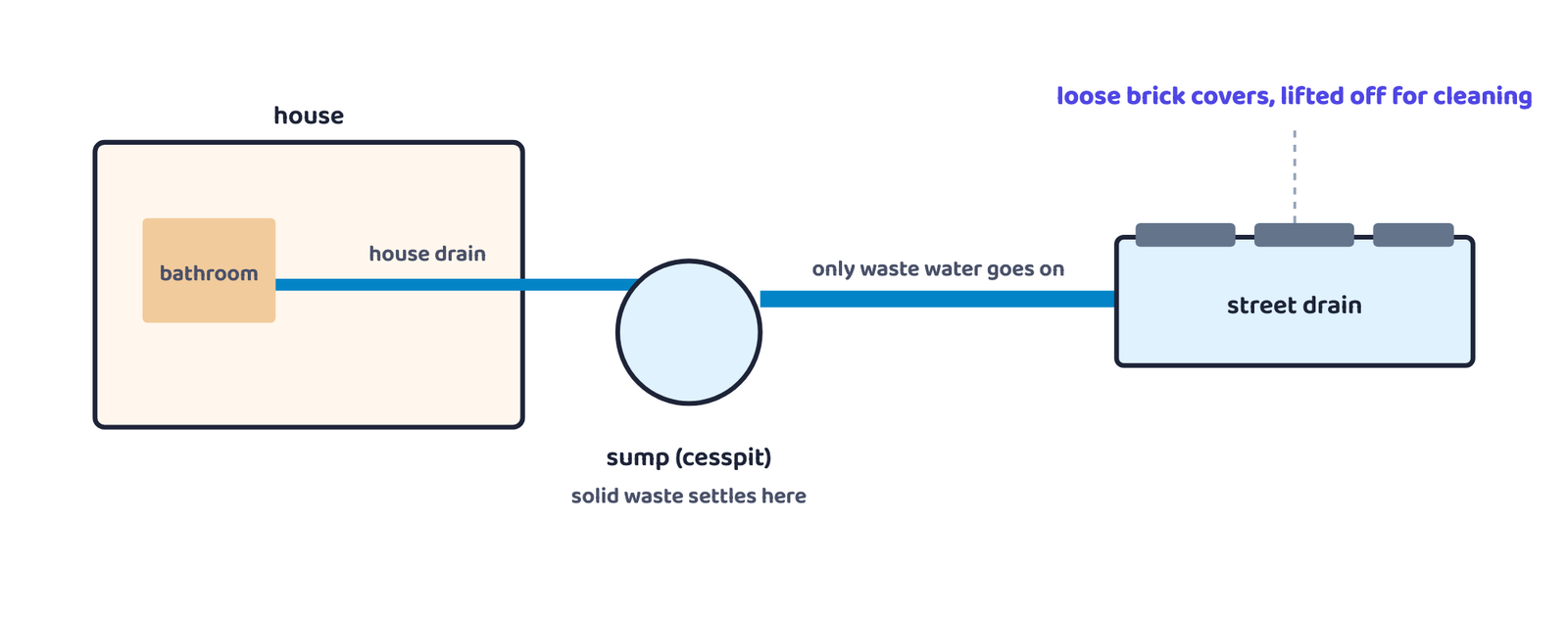
Main channels were brick set in mortar, covered with loose bricks or limestone slabs that lifted off for cleaning, with sumps at intervals. Heaps of sand still lie beside them, so cleaners did not always cart the debris away. Drains were not a big-city luxury: at Lothal the houses were mud brick while the drains were burnt brick.
| Feature of a Lower Town house | What it shows |
|---|---|
| Rooms around a central courtyard | Cooking and weaving were probably done there in hot, dry weather |
| No windows in outward-facing ground level walls; the entrance gives no direct view inside | A clear concern for privacy |
| A brick-paved bathroom draining through the wall to the street | Sanitation was built in, not added later |
| Staircases in many houses | A second storey or a usable roof |
| Wells, some entered from the street; about 700 in Mohenjodaro | Water at home, sometimes shared with passers-by |
The Citadel carries the public-looking buildings: a warehouse, whose lower brick portions survive while its upper wooden parts decayed, and the Great Bath.
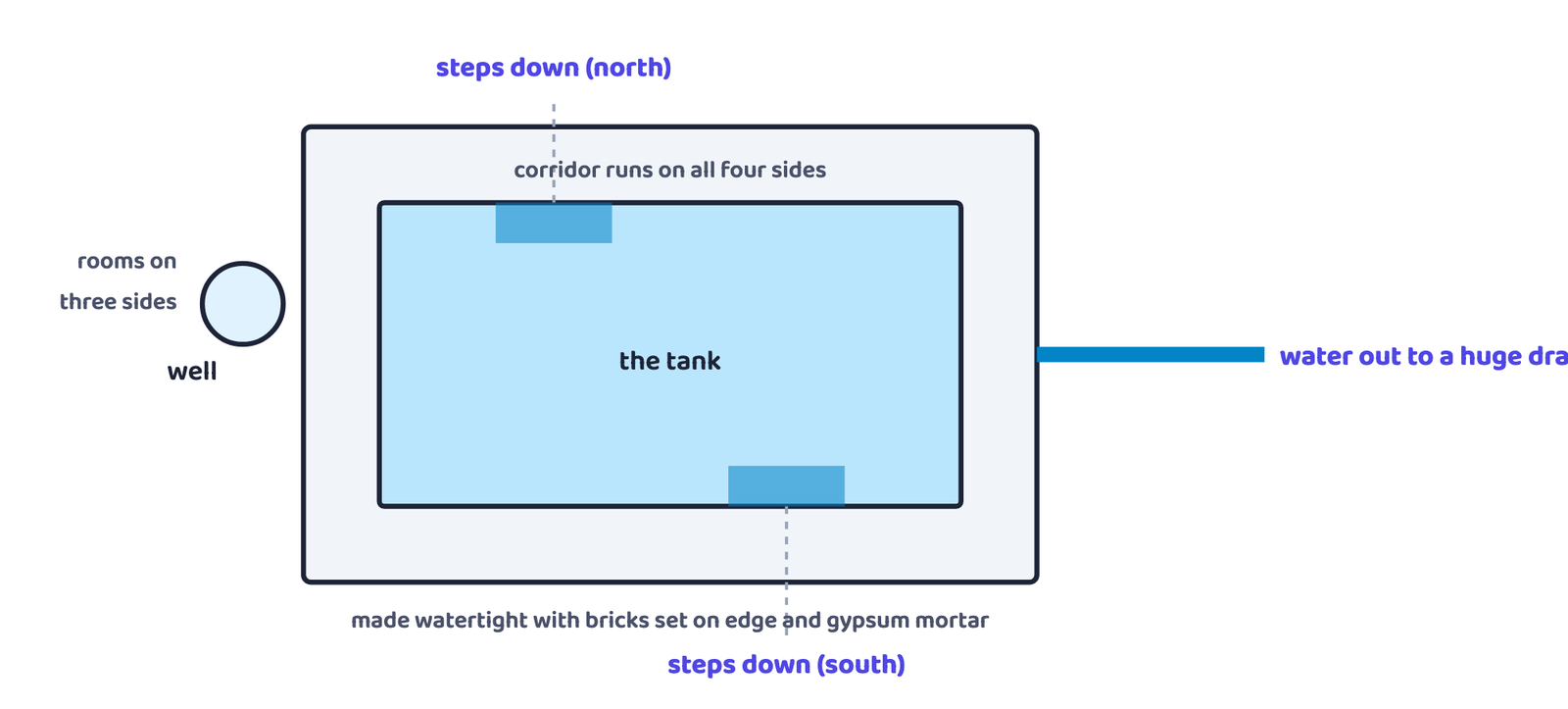
Across a lane to the north stood a smaller building with eight bathrooms, four each side of a corridor, all draining into a corridor channel. Because the structure is unique and sits among other unusual Citadel buildings, scholars suggest a special ritual bath.
Do not write that every Harappan city had a citadel in the west and a lower town in the east. That is the usual pattern, not a rule. At Dholavira and Lothal the whole settlement was fortified with inner walls too, and Lothal’s citadel was not walled off at all, only built at a height.
4 Were People Equal? Burials and Luxuries
There are no records of rich and poor, so archaeologists use two indirect strategies: burials, and sorting objects into ordinary and precious.
- The dead were laid in pits, sometimes lined with brick. Whether that variation marks a social difference, we cannot say.
- Some graves hold pottery and ornaments, which may point to a belief in an afterlife.
- Jewellery is found with both men and women. At the Harappa cemetery in the mid-1980s, three shell rings, a jasper bead and hundreds of micro beads lay near the skull of a male. Some dead were buried with copper mirrors.
- On the whole the Harappans did not bury precious things with the dead, unlike contemporary Egypt, whose royal burials were packed with wealth.
Faience is an artificial material of ground sand or silica mixed with colour and a gum, then fired. It was difficult to make, so faience objects were probably treated as precious.
A hoard is a group of objects kept carefully, often inside a container such as a pot. Jewellery or metal saved for reuse was hidden this way, and if the owners never returned for it, it stayed until an archaeologist found it.
The division is not clean: spindle whorls are everyday tools, yet some are faience. The distribution is clearer. Rare valuables cluster in big settlements: miniature faience pots, perhaps perfume bottles, appear at Mohenjodaro and Harappa but not at small Kalibangan, and every piece of gold jewellery found came out of a hoard.
5 Crafts, Raw Materials and Distant Trade
Mohenjodaro covers 125 hectares; Chanhudaro covers under 7, and almost everything found there is craft work. A tiny site given over entirely to manufacturing means the economy was specialised.
| Craft | Materials | Where |
|---|---|---|
| Bead-making | Carnelian (red), jasper, crystal, quartz, steatite; copper, bronze, gold; shell, faience, terracotta | Chanhudaro, Lothal, also the big cities |
| Shell bangles, ladles, inlay | Whole shells from the coast | Nageshwar and Balakot, both coastal |
| Metal-working, seal-making, weight-making | Copper, bronze, steatite, chert | Chanhudaro and the large urban centres |
Beads came disc-shaped, cylindrical, spherical, barrel-shaped and segmented, some joining two or more stones cemented together, some with gold caps, decorated by incising, painting or etching. Steatite is soft and was even moulded from a paste of its own powder, giving shapes harder stones could not; the steatite micro bead is still a puzzle. For carnelian, experiments showed the red came from firing the yellowish raw material at various stages.
Specialised drills come from Chanhudaro, Lothal and Dholavira, and finished beads travelled from these smaller centres to Mohenjodaro and Harappa.
To identify a craft centre, look for raw material (stone nodules, whole shells, copper ore), tools, unfinished objects, rejects and waste. Waste is the best indicator: cut shell and stone leave scraps where the work was done, and tiny bits stay behind even when larger scraps are reused. Waste in the big cities is how we know craft happened there too.
Clay was local; stone, timber and metal were not, because the Harappans lived on an alluvial plain. Goods moved by bullock cart, of which terracotta toy models survive, and along river and coastal routes. Materials came in two ways.
Settle where the material is
- Nageshwar and Balakot, for shell
- Shortughai in far-off Afghanistan, near the best source of lapis lazuli, a highly valued blue stone
- Lothal, near carnelian from Bharuch, steatite from south Rajasthan and north Gujarat, metal from Rajasthan
Send expeditions
- To Khetri in Rajasthan for copper, and to south India for gold
- These built contact with local communities, and Harappan objects such as steatite micro beads turn up there
- Khetri also has the Ganeshwar-Jodhpura culture, with non-Harappan pottery and an unusual wealth of copper objects. It may have supplied the Harappans with copper
Copper probably also came from Oman: nickel appears in both Omani and Harappan copper, and a large Harappan jar coated with thick black clay to stop liquid seeping through turns up at Omani sites, perhaps exchanged for copper. Mesopotamian texts of the third millennium BCE name three trading partners, and Mesopotamian copper also contains nickel.
| Mesopotamian name | Probably | Evidence |
|---|---|---|
| Magan | Oman | Texts say copper came from Magan, and the nickel traces match |
| Dilmun | Bahrain | Round “Persian Gulf” seals found there carry Harappan motifs, and Dilmun weights followed the Harappan standard |
| Meluhha | The Harappan region | Products listed as carnelian, lapis lazuli, copper, gold and varieties of wood; Meluhha is called a land of seafarers |
A Mesopotamian myth says of Meluhha: “May your bird be the haja-bird, may its call be heard in the royal palace.” Some think the haja-bird was the peacock. Ships and boats appear on Harappan seals, and a Mesopotamian cylinder seal carries a humped bull motif that seems to come from the Indus region.
6 Seals, Script and Weights
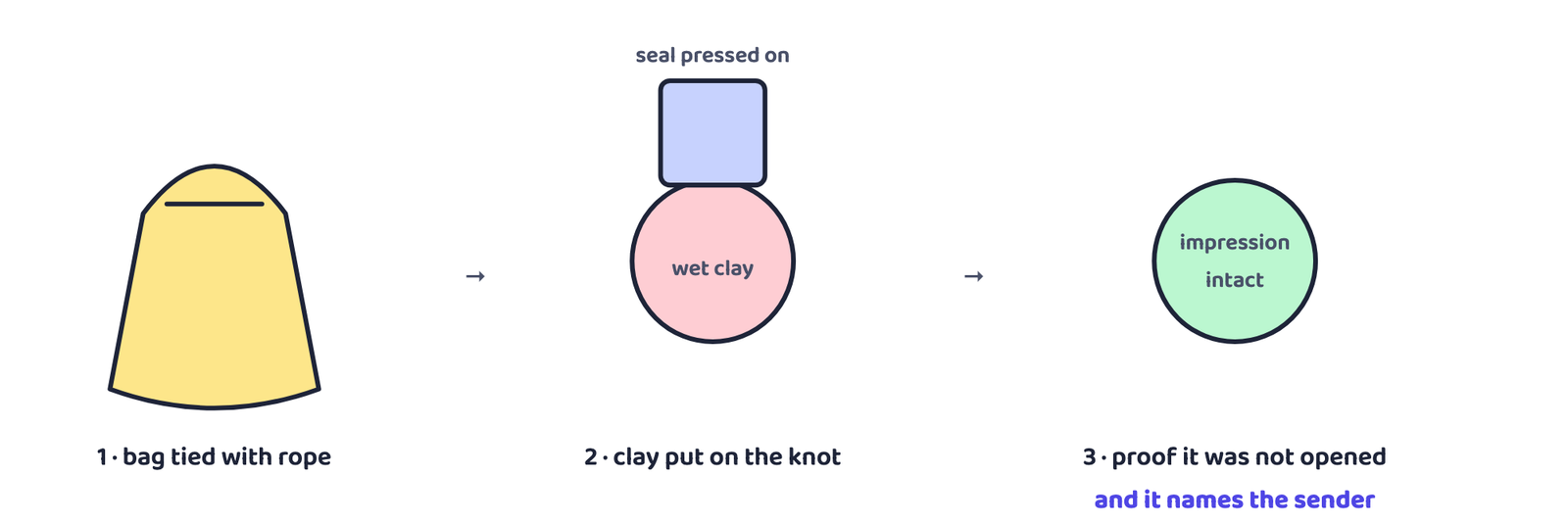
A seal usually carries a line of writing, probably the owner’s name and title, plus a motif, generally an animal, which likely carried meaning for people who could not read.
- Still undeciphered. Nobody can read it.
- Inscriptions are short; the longest has about 26 signs.
- Not alphabetical: there are 375 to 400 signs, far too many for one sign per sound.
- Written right to left. Some seals are widely spaced on the right and cramped on the left, as if the engraver started at the right and ran out of room.
- Found on seals, copper tools, jar rims, copper and terracotta tablets, jewellery, bone rods and a signboard at Dholavira. It may also have been written on perishable material, so how widespread literacy was cannot be said.
Exchange was regulated by weights of a stone called chert, generally cubical and with no markings. The lower denominations were binary (1, 2, 4, 8, 16, 32), probably for weighing jewellery and beads; the higher ones followed the decimal system (160, 200, 320, 640). Metal scale-pans have also been found, so the weights were used with a balance.
7 Who Was in Charge, and How It Ended
Somebody was clearly taking decisions and getting them carried out. The evidence is not a throne but a pattern: pottery, seals, weights and bricks are extraordinarily uniform, the brick ratio holds from Jammu to Gujarat although bricks were not made in one place, settlements were placed deliberately, and labour was mobilised for bricks, walls and platforms.
Yet archaeology shows no ruler. A large building at Mohenjodaro was labelled a palace, but nothing spectacular was found in it, and a stone statue is still called the priest-king only because early archaeologists knew Mesopotamian history and looked for a parallel. Harappan ritual is poorly understood, and there is no way of knowing whether whoever performed it held political power.
No rulers
There were no rulers and everybody enjoyed equal status.
Several rulers
Not one ruler but many: Mohenjodaro had its own, Harappa another.
A single state
One state, given the similar artefacts, planned settlements, standard brick ratio and settlements sited near raw materials.
NCERT adds that the Harappans likely practised some sort of democratic system, and that several of these structures appear to have been built for practical, utilitarian purposes.
By about 1800 BCE most Mature Harappan sites in regions such as Cholistan were abandoned, while population expanded into Gujarat, Haryana and western Uttar Pradesh. Where occupation continued after 1900 BCE, the material culture changed completely.
What disappeared
- Weights, seals and the special beads
- Writing, long-distance trade, craft specialisation
- Large public structures
- Good house construction techniques
What took its place
- Far fewer materials used to make far fewer things
- Local weights instead of the standard system
- A rural way of life, the Late Harappan or successor cultures
- Abandoned cities, and a wait of over a thousand years before new cities appeared, in a different region
Explanations offered include climatic change, deforestation, excessive floods, the shifting or drying up of rivers and overuse of the landscape. Each may explain particular settlements; none explains the whole collapse. The evidence points instead to a strong unifying element, perhaps the Harappan state, coming to an end: seals, script, distinctive beads and pottery vanish together, standard weights give way to local ones, and the cities empty out.
The claim. Marshall reported skeletal remains in a Mohenjodaro alley nicknamed Deadman Lane, and sixteen skeletons with their ornaments were found in the same part of the site in 1925. In 1947 Wheeler linked this with the Rigveda, which mentions pur, meaning rampart or fort, and calls the war-god Indra puramdara, the fort-destroyer: “On circumstantial evidence, Indra stands accused.”
The refutation. In 1964 George Dales showed the skeletons did not all belong to one period. There is no destruction level covering the city’s last phase, no extensive burning, no warriors in armour surrounded by weapons, and the citadel, the only fortified part, gave no evidence of a final defence.
The genetic evidence. DNA from skeletal remains at Rakhigarhi in Hisar district, Haryana, the biggest Harappan city at 550 hectares, was studied by Deccan College Pune with CCMB Hyderabad and Harvard Medical School. The Harappans were indigenous, with genetic roots to 10,000 BCE, and a majority of the South Asian population appears descended from them. Trade mixed in a small quantity of outside genes, and Harappan genes spread towards Iran and Central Asia. This continuity, genetic and cultural, rules out large-scale immigration of the so-called Aryans, and reconstructed 3D facial features closely resemble the modern population of Haryana: unbroken continuity for 5000 years.
The lesson: a careful re-examination of the same data can reverse an earlier interpretation completely.
Archaeogenetics is the study of the DNA of ancient populations, using molecular genetics to understand the history of a population.
8 How We Know: Finding and Reading the Evidence
When the cities fell into ruin people forgot them, and centuries later nobody knew what to make of the objects that floods, erosion and ploughs turned up. How archaeologists learned to read them is itself examinable.
| Who | Method | Result |
|---|---|---|
| Alexander Cunningham, first Director-General of the ASI, mid-1800s, the father of Indian archaeology | Text-first: the written word as guide, the accounts of Chinese Buddhist pilgrims of the fourth to seventh centuries CE to locate settlements, and inscriptions collected and translated. His interest was the Early Historic period, about 600 BCE to 400 CE. | Missed the civilisation. Harappa was on no pilgrim’s route and not Early Historic, so it fitted nothing in his framework. Given a Harappan seal, he could not place it: he believed Indian history began with the cities of the Ganga valley. |
| Daya Ram Sahni, then Rakhal Das Banerji, early 1900s | Seals at Harappa in layers older than Early Historic levels; then similar seals at Mohenjodaro. | Showed both sites belonged to one archaeological culture. |
| John Marshall, who announced the discovery in 1924 | First professional archaeologist in India, with experience from Greece and Crete, as interested in everyday life as in spectacular finds. But he dug in uniform horizontal units across the mound, ignoring its layers. | Gave the world a new civilisation, contemporary with Mesopotamia, where similar seals had turned up. S.N. Roy: “Marshall left India three thousand years older than he had found her.” Cost: finds from different layers were grouped together, so context was lost. |
| R.E.M. Wheeler, Director-General from 1944 | Followed the stratigraphy of the mound instead of digging along uniform lines. An ex-army brigadier, he brought military precision to excavation. | Fixed Marshall’s error and made layer-by-layer excavation standard. |
| After Partition, and since the 1980s | The major sites went to Pakistan, so Indian archaeologists surveyed Kutch, Punjab and Haryana; later, joint international teams used surface exploration and modern scientific techniques. | Kalibangan, Lothal, Rakhi Garhi and Dholavira found and excavated, and archaeogenetic work began at Rakhigarhi. |
Stratigraphy is the study of the layers of a site. A mound is the build-up of occupational debris where people lived and reused a place; sterile layers, with no traces of occupation, mark abandonment. The lowest layers are generally the oldest, so artefacts in a layer can be assigned to a cultural period.
The point of the Cunningham story is not that he was careless. It is that the questions an archaeologist starts with decide what they are able to see. That sentence answers half of any “how do archaeologists reconstruct the past” question.
8.1 Three problems that stand in the way
Most things rot
Cloth, leather, wood and reeds decompose in a tropical region. Only stone, burnt clay or terracotta and metal survive, so whole categories of Harappan life are missing.
Finds are accidental
People threw away only what was broken and recycled the rest. A valuable object found intact was lost or hoarded and never collected, so intact finds are accidents, not typical objects.
Function is a guess
Sorting by material is easy; by function it is not. Tool, ornament, both, or ritual object? Archaeologists judge from resemblance to present-day things and from context: house, drain, grave or kiln? For clothing only indirect evidence exists, traces of cotton plus depictions in sculpture.
8.2 The hardest thing to reconstruct: religion
Early archaeologists assumed anything unusual was religious. So terracotta figurines of heavily jewelled women with elaborate head-dresses became mother goddesses; seated stone statuary of men with one hand on the knee became the priest-king; the Great Bath and the fire altars at Kalibangan and Lothal were given ritual significance; plant motifs became nature worship; and conical stone objects were classified as lingas, polished stones worshipped as a symbol of Shiva. The one-horned “unicorn” is clearly a mythical composite creature. The famous case is the proto-Shiva seal: a figure seated cross-legged in a “yogic” posture, sometimes surrounded by animals, read as an early form of Shiva. Its reasoning is what the exam asks you to criticise.
Mackay wrote of beautifully cut cones of lapis lazuli, jasper and chalcedony under two inches high that they were thought to be lingas, but that it was “just as possible that they were used in the board-games”. The same object, two completely different histories.
What decades of work achieved
- A fairly good idea of the Harappan economy
- The ability to tease out social differences
- Some idea of how the civilisation functioned
Still open
- Was the Great Bath really a ritual structure?
- How widespread was literacy?
- Why do the cemeteries show so little social difference?
- Gender: did women make pottery or only paint pots, and what were the terracotta female figurines for?
- What was the relationship between the Harappans and the Vedic people? Some scholars argue they were the same
- Even deciphering the script may settle little, though a bilingual inscription would answer questions about language
9 Timelines and Revision
BP Before Present · BCE Before Common Era · CE Common Era · c. from Latin circa, meaning approximate. Writing “c.” before a disputed date shows you know it is not exact.
| Timeline 1 · major periods in early Indian archaeology (approximate) | |
|---|---|
| 2 million BP | Lower Palaeolithic |
| 80,000 BP | Middle Palaeolithic |
| 35,000 BP | Upper Palaeolithic |
| 12,000 BP | Mesolithic |
| 10,000 BP | Neolithic: early agriculturists and pastoralists |
| 6,000 BP | Chalcolithic: first use of copper |
| 2600 BCE | Harappan civilisation |
| 1000 BCE | Early iron, megalithic burials |
| 600 BCE to 400 CE | Early Historic |
| Timeline 2 · major developments in Harappan archaeology | |
|---|---|
| 1875 | Cunningham’s report on a Harappan seal |
| 1921 | Daya Ram Sahni begins excavations at Harappa |
| 1922 | Excavations begin at Mohenjodaro |
| 1946 | Wheeler excavates at Harappa |
| 1955 | S.R. Rao begins excavations at Lothal |
| 1960 | B.B. Lal and B.K. Thapar begin at Kalibangan |
| 1974 | M.R. Mughal begins explorations in Bahawalpur |
| 1980 | A German and Italian team begins surface exploration at Mohenjodaro |
| 1986 | An American team begins excavations at Harappa |
| 1990 | R.S. Bisht begins excavations at Dholavira |
| 1997 | Amrendra Nath starts excavations at Rakhigarhi |
| 2013 | Vasant Shinde begins archaeogenetic research at Rakhigarhi |
- Everything known about the Harappans comes from material remains, because the script is undeciphered.
- Three phases: Early 6000 to 2600 BCE, Mature and urban 2600 to 1900 BCE, Late and rural 1900 to 1300 BCE.
- Planning at Mohenjodaro: platforms, then grid streets with drains, then houses, in bricks of a fixed 4:2:1 ratio.
- Citadel means small, high, walled, public buildings; Lower Town means large, low, residential. Dholavira and Lothal break the pattern.
- Burials and the spread of luxuries suggest social differences existed but were modest by Egyptian standards.
- Craft was specialised, and raw materials came both from settlements planted at the source and from expeditions.
- Trade reached Oman, Bahrain and Mesopotamia, where the Harappan region was probably called Meluhha.
- No ruler can be identified; uniformity of bricks, seals and weights is the strongest argument for central authority.
- The collapse followed the end of a unifying element rather than any single environmental cause.
- Archaeology has its own history: Cunningham’s text-first method, Marshall’s lost context, Wheeler’s stratigraphy, and archaeogenetics at Rakhigarhi.
- 1 markWhy is this civilisation called Harappan?
- 1 markState the ratio of length, breadth and height in Harappan bricks.
- 1 markDefine a hoard.
- 1 markName the five major Harappan cities.
- 1 markWhat is faience, and why was it treated as precious?
- 2 marksWhat do archaeo-botanists and archaeo-zoologists each study?
- 2 marksWhat does the ploughed field at Kalibangan tell us about Harappan agriculture?
- 2 marksWhy is waste the best indicator of a craft production centre?
- 2 marksExplain the difference between a seal and a sealing.
- 2 marksWhat is stratigraphy, and why did Marshall’s method destroy the information it gives?
- 3 marksList the items of food available to people in Harappan cities, and identify the groups who would have provided them.
- 3 marksDescribe the drainage system of Harappan cities and explain why it proves town planning.
- 3 marksHow do archaeologists distinguish utilitarian objects from luxuries? Give one object that is hard to classify.
- 3 marksDescribe the process by which a carnelian bead was made.
- 3 marksWhat evidence shows contact between the Harappans and Oman, Dilmun and Mesopotamia?
- 3 marksGive the three views scholars hold about rulers in Harappan society.
- 3 marksLook at a Harappan burial. How is the body placed, what objects lie near it, and what do they suggest about beliefs regarding an afterlife?
- 3 marksDescribe the Harappan system of weights.
- 5 marksDescribe the distinctive features of Mohenjodaro as a planned urban centre.
- 5 marksHow do archaeologists trace socio-economic differences in Harappan society, and what differences do they notice?
- 5 marksList the raw materials required for craft production and discuss how these might have been obtained.
- 5 marksDiscuss how archaeologists reconstruct the past, and the problems they face.
- 5 marksDiscuss the functions that may have been performed by rulers in Harappan society.
- 5 marks“The end of the Harappan civilisation was not caused by any single event.” Examine this statement.
- 5 marksTrace the discovery of the Harappan civilisation from Cunningham to the archaeogenetic research at Rakhigarhi.
- 5 marksUsing the proto-Shiva seal, explain why reconstructing Harappan religion is so difficult.
- 5 marksOn an outline map of the subcontinent, locate and label Harappa, Mohenjodaro, Kalibangan, Lothal, Dholavira, Rakhigarhi, Chanhudaro, Banawali, Nageshwar, Balakot and Kot Diji.
- 1 markThe Mature Harappan phase is dated to:
(a) 6000 to 2600 BCE(b) 2600 to 1900 BCE(c) 1900 to 1300 BCE(d) 1300 to 600 BCE - 1 markAn Early Harappan ploughed field has been found at:
(a) Lothal(b) Banawali(c) Kalibangan(d) Dholavira - 1 markHarappan weights were usually made of:
(a) chert(b) steatite(c) faience(d) carnelian - 1 markMeluhha in Mesopotamian texts most probably means:
(a) Bahrain(b) Oman(c) the Harappan region(d) Afghanistan - 1 markWho announced the discovery of the Indus valley civilisation in 1924?
(a) Alexander Cunningham(b) John Marshall(c) R.E.M. Wheeler(d) Daya Ram Sahni - 1 markThe longest Harappan inscription contains about:
(a) 8 signs(b) 26 signs(c) 375 signs(d) 400 signs - 1 markArchaeogenetic research on Harappan skeletal remains was carried out at:
(a) Mohenjodaro(b) Harappa(c) Rakhigarhi(d) Chanhudaro
Choose: (a) both A and R are true and R explains A; (b) both true but R does not explain A; (c) A true, R false; (d) A false, R true.
Reason (R): Streets with drains were laid out first, and houses were then built along them.
Reason (R): The skeletons did not all belong to one period, and there is no destruction level or evidence of a final defence.
Reason (R): The Great Bath stands on the Citadel among other distinctive buildings.