
1 Setting the Scene, and the Man Who Unlocked It
This theme covers 1,500 years, c. 600 BCE to 600 CE, after the Harappan civilisation. Already happening in that span: the Rigveda composed along the Indus and its tributaries; agricultural settlements in north India, the Deccan Plateau and parts of Karnataka; pastoral populations in the Deccan and further south; and from the first millennium BCE, megaliths, elaborate stone structures over the dead in central and south India, often with iron tools and weapons buried alongside.
Then from about the sixth century BCE three things happen together, and the chapter is about how they connect: early states, empires and kingdoms emerge, agricultural production is reorganised, and new towns appear almost everywhere.
None tells the whole story, and the last section is entirely about that.
Epigraphy is the study of inscriptions. Inscriptions are writings engraved on hard surfaces such as stone, metal or pottery. They usually record the achievements, activities or ideas of whoever commissioned them: the exploits of kings, or donations made by women and men to religious institutions.
- They are virtually permanent records, and some carry dates.
- Undated ones are dated fairly precisely by palaeography, the study of styles of writing. The letter “a”, for instance, was written one way in c. 250 BCE and quite differently by c. 500 CE.
- The earliest inscriptions were in Prakrit, a name for the languages used by ordinary people. Pali, Tamil and Sanskrit were also used. People probably spoke other languages that were never written down.
In the 1830s James Prinsep, an officer in the East India Company mint, deciphered Brahmi and Kharosthi, the scripts of the earliest inscriptions and coins. Most of them named a king Piyadassi, “pleasant to behold”, and a few also called him Asoka, already famous from Buddhist texts. That link changed everything: scholars could now use inscriptions and texts in many languages to reconstruct the lineages of the major dynasties, and the broad outline of political history was in place by the early twentieth century. Scholars then asked a harder question, whether political change was connected to economic and social developments, and found the links were real but not always simple or direct.
2 The Earliest States: the Sixteen Mahajanapadas
The sixth century BCE is a major turning point: early states and cities, growing use of iron, the development of coinage, and diverse systems of thought including Buddhism and Jainism. Early Buddhist and Jaina texts name sixteen states called mahajanapadas. The lists vary, but Vajji, Magadha, Koshala, Kuru, Panchala, Gandhara and Avanti occur most often, so these were among the most important.
Janapada means the land where a jana, that is a people, clan or tribe, sets its foot or settles. The word is used in both Prakrit and Sanskrit. A mahajanapada is a great janapada.
Map 1 (textbook) · Early states and their capitals. Read from the map: the states and their capitals cluster most densely in the Ganga valley (Kuru, Panchala, Shurasena, Koshala, Vatsa, Kashi, Malla, Vajji, Magadha, Anga); there are fewer in the northwest (Gandhara, Kamboja) and central India (Avanti, Chedi), and only Ashmaka lies further south.
| Mahajanapada | Capital | Mahajanapada | Capital |
|---|---|---|---|
| Gandhara | Taxila | Vatsa | Kaushambi |
| Kuru | Indraprastha | Kashi | Varanasi |
| Panchala | Ahichchhatra | Koshala | Shravasti |
| Shurasena | Mathura | Malla | Kusinagara |
| Avanti | Ujjayini | Vajji | Vaishali |
| Chedi | (capital not shown on Map 1) | Magadha | Rajagaha, later Pataliputra |
| Anga | Champa | Kamboja | Pushkalavati (shown in the Kamboja-Gandhara area of Map 1) |
| Map 1 also shows Matsya, Ashmaka and Vanga, without capitals. | |||
2.1 Two kinds of state
Kingdoms
- Ruled by a single king
- The king was ideally a Kshatriya, as laid down in the Dharmasutras
- Some acquired standing armies and regular bureaucracies
- Others depended on militia, usually recruited from the peasantry
Ganas or sanghas
- Oligarchies: power shared by a number of men, collectively called rajas
- Both Mahavira and the Buddha belonged to such ganas
- In the Vajji sangha the rajas probably controlled land collectively
- Their histories are hard to reconstruct for want of sources, yet some lasted nearly a thousand years
Oligarchy is a form of government in which power is exercised by a group of men. The Roman Republic, despite its name, was an oligarchy.
Every mahajanapada had a capital city, often fortified. Fortifications, armies and a beginning bureaucracy all cost money. From about the sixth century BCE Brahmanas composed Sanskrit texts called the Dharmasutras, laying down norms for rulers and other social categories: rulers should collect taxes and tribute from cultivators, traders and artisans. Whether pastoralists and forest peoples were taxed is unknown. What is known is that raiding neighbouring states was a recognised, legitimate way of acquiring wealth.
2.2 First among the sixteen: Magadha
Between the sixth and fourth centuries BCE, Magadha (present-day Bihar) became the most powerful mahajanapada. Why is a favourite exam question, and the two kinds of answer must be kept separate.
Modern historians point to geography
- Especially productive agriculture
- Accessible iron mines in present-day Jharkhand, for tools and weapons
- Elephants from the region’s forests, an important part of the army
- The Ganga and its tributaries, giving cheap and convenient communication
Early Buddhist and Jaina writers point to individuals
- The policies of ruthlessly ambitious kings
- Bimbisara, Ajatasattu and Mahapadma Nanda are the best known
- Their ministers, who carried the policies out
The capital was first Rajagaha, Prakrit for present-day Rajgir, a fortified settlement among hills whose name means “house of the king”. In the fourth century BCE it moved to Pataliputra, present-day Patna, commanding the routes of communication along the Ganga.
3 An Early Empire: the Mauryas
Magadha’s growth culminated in the Mauryan Empire. Chandragupta Maurya founded it c. 321 BCE, extending control as far northwest as Afghanistan and Baluchistan. His grandson Asoka, arguably the most famous ruler of early India, conquered Kalinga, present-day coastal Orissa.
Asoka was the first ruler to inscribe messages to his subjects and officials on stone, on natural rocks and polished pillars, proclaiming what he understood to be dhamma.
Asoka’s dhamma included respect towards elders, generosity towards Brahmanas and those who renounced worldly life, kind treatment of slaves and servants, and respect for religions and traditions other than one’s own.
Most Asokan inscriptions are in the Prakrit language, written in the Brahmi script. Those in the northwest are in Aramaic and Greek, and some northwestern Prakrit ones are written in Kharosthi. The Aramaic and Greek scripts were used for the inscriptions in Afghanistan.
3.1 Administering the empire
Map 2 (textbook) · Distribution of Asokan inscriptions, by region:
| Region | Places marked on Map 2 |
|---|---|
| Northwest | Kandahar (Afghanistan), Shahbazgarhi, Mansehra; provincial centre Taxila |
| North India | Kalsi, Topra, Meerut, Bahapur, Bairat, Bhabru |
| Ganga valley | Nigalisagar, Rummindei, Rampurwa, Lauriya Nandangarh, Lauriya Araraj, Sarnath, Kaushambi, Ahraura, Sahasram; capital Pataliputra |
| Central and western India | Gujarra, Sanchi, Girnar, Sopara; provincial centre Ujjayini |
| East coast (Kalinga) | Shishupalgarh, Jaugada |
| Deccan and the south | Sannati, Maski, Gavimath, Palkigundu, Jatinga Rameshwar, Siddapur, Udegolam, Rajula Mandagiri, Nittur, Brahmagiri |
| Further south, beyond the inscriptions | Cholas, Keralaputras, Pandyas |
The map marks major rock edicts at Kandahar, Shahbazgarhi, Mansehra, Kalsi, Girnar, Sopara, Sannati, Shishupalgarh and Jaugada; the other places have minor rock edicts or pillar inscriptions.
Five major political centres are named in the inscriptions: the capital Pataliputra and the provincial centres Taxila, Ujjayini, Tosali and Suvarnagiri. Placement was deliberate: Taxila and Ujjayini sat on important long-distance trade routes, and Suvarnagiri, literally “golden mountain”, was probably for tapping the gold mines of Karnataka.
Do not write that the Mauryas ran a uniform administration across the empire. Virtually the same message was engraved everywhere, from the present-day North West Frontier Provinces of Pakistan to Andhra Pradesh, Orissa and Uttarakhand, but historians increasingly think a uniform system is unlikely: the regions were far too diverse. Compare the hilly terrain of Afghanistan with the coast of Orissa. Control was probably strongest around the capital and the provincial centres.
Communication along land and riverine routes was vital: a journey from the centre to a province could take weeks or months and needed provisions and protection, the latter supplied by the army. Megasthenes describes a committee with six subcommittees coordinating military activity.
Navy
Looked after the fleet.
Transport and provisions
Its activities were rather varied: arranging bullock carts to carry equipment, procuring food for soldiers and fodder for animals, and recruiting servants and artisans to look after the soldiers.
Foot-soldiers
The infantry.
Horses
The cavalry.
Chariots
The chariot force.
Elephants
Captured from forests under detailed rules laid down in the Arthashastra.
Asoka also held the empire together by propagating dhamma, whose principles were simple and virtually universally applicable and which he believed would ensure well-being in this world and the next. Special officers called dhamma mahamatta were appointed to spread the message.
Megasthenes records that great officers of state “superintend the rivers, measure the land, as is done in Egypt, and inspect the sluices by which water is let out from the main canals into their branches, so that every one may have an equal supply of it.” The same officers had charge of huntsmen with power to reward or punish them, collected taxes, and superintended the occupations connected with land: woodcutters, carpenters, blacksmiths, miners.
Source 2 · the Arthashastra on capturing elephants. Guards of elephant forests, helped by rearers, leg-chainers, boundary guards, forest dwellers and nurses, used five or seven female elephants to tether wild ones, tracing herds by the urine and dung they left. Greek sources credit the Mauryan ruler with 600,000 foot-soldiers, 30,000 cavalry and 9,000 elephants, figures some historians consider exaggerated.
3.2 How important was the empire?
Why it was seen as a landmark
- Nineteenth-century Indian historians, writing while India was itself part of the British empire, found the idea of an early Indian empire challenging and exciting
- Mauryan stone sculpture was regarded as spectacular art typical of empires
- Asoka’s message seemed unlike other rulers’: more powerful and industrious, yet more humble than later kings with grandiose titles
- Twentieth-century nationalist leaders regarded him as an inspiring figure
Why historians now qualify that
- It lasted only about 150 years, a short span in subcontinental history
- It did not cover the entire subcontinent
- Control was not uniform even within its frontiers
- By the second century BCE new chiefdoms and kingdoms had emerged in several parts of the subcontinent
4 New Notions of Kingship
4.1 Chiefs and kings in the south
New kingdoms in the Deccan and further south, including the chiefdoms of the Cholas, Cheras and Pandyas in Tamilakam, proved stable and prosperous. Tamilakam is the ancient Tamil country, including parts of present-day Andhra Pradesh and Kerala besides Tamil Nadu.
A chief is a powerful man whose position may or may not be hereditary. He draws support from his kinfolk, and his functions may include performing special rituals, leadership in warfare and arbitrating disputes. He receives gifts from his subordinates, unlike kings who collect taxes, and often distributes them among his supporters. Chiefdoms generally have no regular armies or officials.
We know these states from the early Tamil Sangam texts, whose poems describe chiefs and how they acquired and distributed resources. Other rulers, including the Satavahanas of western and central India (c. second century BCE to second century CE) and the Shakas, of Central Asian origin, who set up kingdoms in the northwest and west, drew revenue from long-distance trade. Their social origins were often obscure, and once powerful they claimed social status in various ways.
The Tamil epic Silappadikaram describes people coming down the mountain singing and dancing, showing the victorious chief respect and bringing gifts: ivory, fragrant wood, fans of deer hair, honey, sandalwood, red ochre, antimony, turmeric, cardamom, pepper; coconuts, mangoes, medicinal plants, fruits, onions, sugarcane, flowers, areca nut, bananas; and animals including baby tigers, lions, elephants, monkeys, bear, deer, musk deer, fox, peacocks, musk cat, wild cocks and speaking parrots.
Why it matters: gifts of forest and hill produce flowed up to the chief and he redistributed them. That is the contrast with a king collecting taxes.
4.2 Divine kings
One way of claiming high status was to identify with deities, and the Kushanas (c. first century BCE to first century CE), who ruled from Central Asia to northwest India, are the clearest case. Their history comes from inscriptions and textual traditions, but the kingship they wanted to project shows best in their coins and sculpture.
A Kushana coin · obverse
- King Kanishka (textbook Fig. 2.4)
A Kushana coin · reverse
- A deity
Putting the king on one face and a deity on the other links the ruler with the gods, a claim to divine status. Kushana gold coins were virtually identical in weight to those of contemporary Roman emperors and the Parthian rulers of Iran.
Colossal statues of Kushana rulers stood in a shrine at Mat near Mathura (UP), and similar statues in a shrine in Afghanistan, which some historians read as the Kushanas considering themselves godlike. Many also took the title devaputra, “son of god”, possibly inspired by Chinese rulers who called themselves sons of heaven.
By the fourth century there were larger states again, including the Gupta Empire. Many depended on samantas, men who maintained themselves from local resources including control over land, offering homage and military support. The arrangement cut both ways: a powerful samanta could become a king, a weak ruler could be reduced to subordination.
Prashastis are compositions in Sanskrit written by poets in praise of kings in particular and patrons in general. Historians often draw factual information from them, but those who composed and read them treasured them as works of poetry rather than literally true accounts.
Also the Allahabad Pillar Inscription, composed in Sanskrit by Harishena, court poet of Samudragupta (c. fourth century CE), arguably the most powerful Gupta ruler. It calls him without an antagonist on earth, having wiped off the fame of other kings with the soles of his feet; Purusha, the Supreme Being, cause of the prosperity of the good and the destruction of the bad; incomprehensible; his tender heart captured only by devotion and humility; compassionate; giver of many hundred-thousands of cows; his mind initiated for the uplift of the miserable, poor, forlorn and suffering; resplendent, embodied kindness to mankind; and equal to Kubera, Varuna, Indra and Yama.
Use it for “why did kings claim divine status?” The claim put the ruler beyond comparison with any rival, at a time when powerful samantas could become kings themselves.
5 A Changing Countryside
5.1 What did subjects think of their rulers?
Inscriptions do not answer this, because ordinary people rarely left accounts of their thoughts. Historians get around it with stories from anthologies such as the Jatakas and the Panchatantra, probably popular oral tales later written down. The Jatakas were written in Pali around the middle of the first millennium CE.
It describes a wicked king’s subjects: elderly women and men, cultivators, herders, village boys, even animals. When the king went in disguise to hear what people thought of him, every one cursed him, complaining they were attacked by robbers at night and by tax collectors by day. To escape they abandoned the village for the forest.
The relationship between king and rural subjects could be strained: kings filled their coffers by demanding high taxes and peasants found the demands oppressive. Escaping into the forest was one response; increasing production was the other, and that is what changed the countryside.
5.2 Strategies for increasing production
| Strategy | What it involved | Where it did and did not spread |
|---|---|---|
| Plough agriculture | The iron-tipped ploughshare turned alluvial soil, from c. sixth century BCE in fertile river valleys such as the Ganga and the Kaveri | Worked in high-rainfall areas. Cultivators in semi-arid parts of Punjab and Rajasthan did not adopt it until the twentieth century, and people in hilly tracts of the north-east and central subcontinent practised hoe agriculture, better suited to the terrain |
| Transplantation | Seeds are broadcast first; when the saplings have grown they are transplanted into waterlogged fields. This raises the survival ratio and the yield | Dramatically increased paddy production in parts of the Ganga valley, but meant back-breaking work for the producer |
| Irrigation | Wells and tanks, and less commonly canals | Organised by communities and by individuals. The individuals were usually powerful men including kings, who recorded such works in inscriptions |
An artificial reservoir known from a Sanskrit rock inscription near Girnar (c. second century CE) recording the achievements of the Shaka ruler Rudradaman. The lake, with embankments and water channels, was built by a local governor under the Mauryas; a terrible storm broke the embankments and the water gushed out; Rudradaman claimed to have repaired it from his own resources, without imposing any tax on his subjects. Another inscription on the same rock, c. fifth century, records a Gupta ruler repairing it again.
Notice what the inscription is doing. It is not a neutral record of an irrigation work; it is a ruler advertising that he paid for it himself.
5.3 Differences in rural society
The new technologies raised production, but the benefits were very uneven, and a growing differentiation appeared among those who worked the land.
A gahapati was the owner, master or head of a household, exercising control over the women, children, slaves and workers who shared a common residence, and owning the household’s resources: land, animals and other things. The word is sometimes also used as a status marker for men of the urban elite, including wealthy merchants. Pali texts use it for small peasants and large landholders alike.
Early Tamil Sangam literature names its own village categories: vellalar, large landowners; uzhavar, ploughmen; adimai, slaves. These differences rested on unequal access to land, labour and the new technologies, so control over land became crucial and was argued over in legal texts.
The Manusmrti, a best-known legal text of early India in Sanskrit, compiled c. second century BCE to second century CE, advises the king that because controversies constantly arise from ignorance of boundaries, he should bury concealed boundary markers at boundary intersections: stones, bones, cow’s hair, chaff, ashes, potsherds, dried cow dung, bricks, coal, pebbles, sand, and other substances that would not decay in the soil.
5.4 Land grants and new rural elites
From the early centuries CE, land grants begin, recorded in inscriptions: some on stone, most on copper plates handed to the recipients as their record of the transaction. Surviving records are generally grants to religious institutions or Brahmanas, mostly in Sanskrit, though from the seventh century part might be Sanskrit and the rest a local language such as Tamil or Telugu.
An agrahara was land granted to a Brahmana, who was usually exempted from paying land revenue and other dues to the king, and was often given the right to collect those dues from the local people himself.
Prabhavati Gupta, daughter of Chandragupta II (c. 375 to 415 CE), married into the Vakataka family, powerful in the Deccan. Sanskrit legal texts say women were not supposed to have independent access to land, yet her inscription shows she had a village and granted it away. She may have been exceptional as a queen, one of very few known from early Indian history, or the legal provisions may not have been uniformly implemented.
She commands the gramakutumbinas (householders or peasants), Brahmanas and others of Danguna that the village is donated to the Acharya Chanalasvamin, whose commands they must obey. The agrahara exemptions follow: not to be entered by soldiers and policemen; exempt from providing grass, animal hides as seats and charcoal to touring royal officers; from the royal prerogative of purchasing fermenting liquors and digging salt; from the right to mines and khadira trees; from supplying flowers and milk; and donated together with the right to hidden treasures and deposits and with major and minor taxes. Written in the thirteenth regnal year, engraved by Chakradasa.
Land grants show strength
- Part of a strategy by ruling lineages to extend agriculture into new areas
- Grants ranged from small plots to vast stretches of uncultivated land, which fits a policy of expansion
Land grants show weakness
- A sign of weakening political power: kings losing control over their samantas tried to win allies by granting land
- On this reading, kings projected themselves as supermen in prashastis precisely because they were losing control and needed at least a façade of power
Land grants tell you about cultivators and the state, but not about everybody. Pastoralists, fisherfolk, hunter-gatherers, mobile or semi-sedentary artisans and shifting cultivators were often beyond the reach of officials or samantas, and generally kept no detailed records of their lives. An answer that treats the countryside as only peasants and landlords has missed them.
The Harshacharita, a Sanskrit biography of Harshavardhana of Kanauj by his court poet Banabhatta (c. seventh century CE), gives a rare picture of a settlement on the edge of a forest in the Vindhyas. Small farmers apportioned rice-land, threshing ground and arable land. It was mainly spade culture, ploughing being difficult in sparsely scattered, grass-covered fields with black soil “stiff as black iron”. People carried bundles of bark, sacks of plucked flowers, loads of flax and hemp, honey, peacocks’ tail feathers, wreaths of wax, logs and grass, and village wives hurried to neighbouring villages with baskets of forest fruits to sell.
6 Towns and Trade
6.1 New cities and who lived in them
Urban centres appeared from about the sixth century BCE, many of them capitals of mahajanapadas. Virtually every major town stood on a route of communication: Pataliputra on riverine routes, Ujjayini on land routes, Puhar near the coast where sea routes began, and Mathura, a bustling centre of commercial, cultural and political activity.
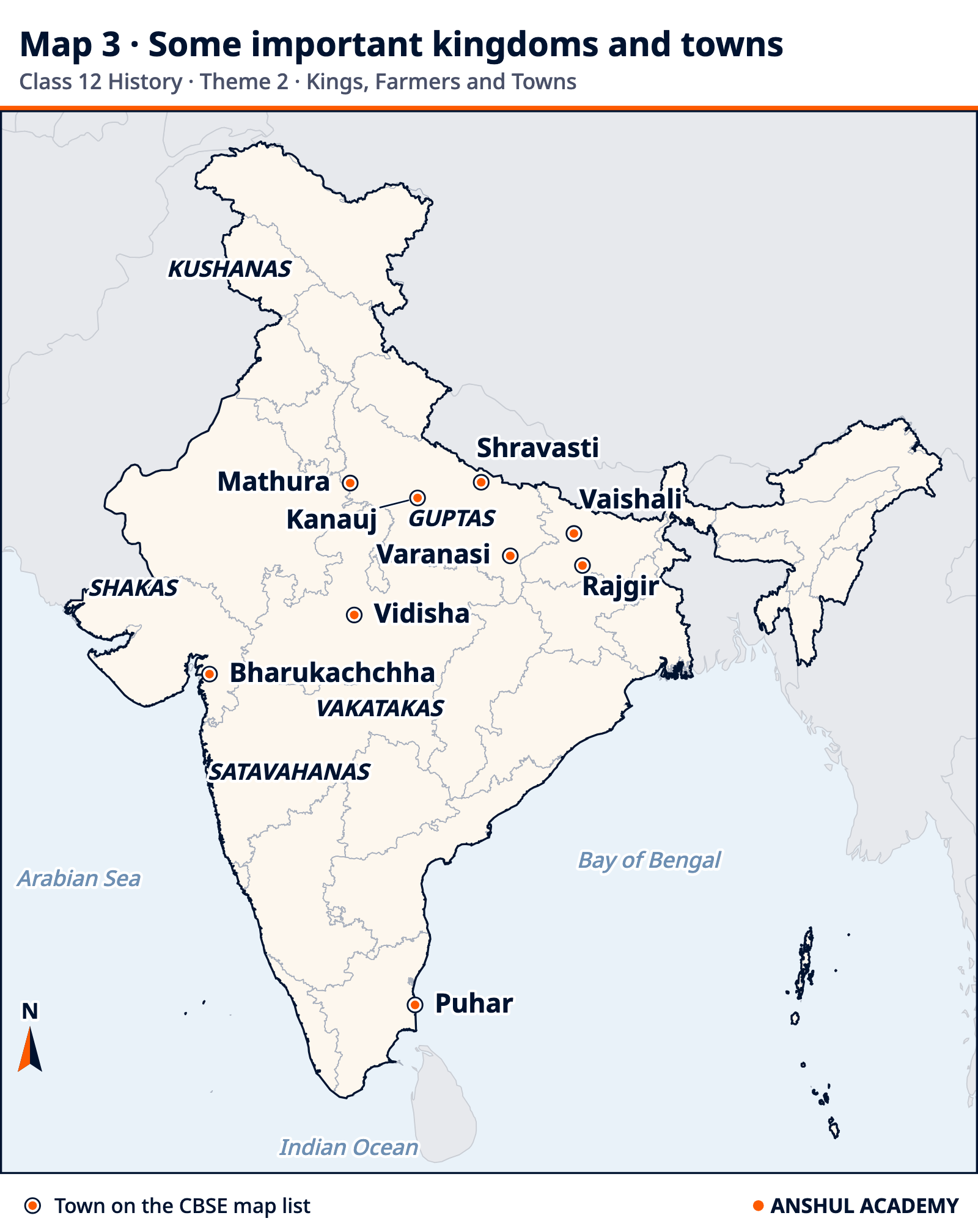
Map 3 (textbook) · Some important kingdoms and towns (on the CBSE map list):
| Kingdom or town | Where (Map 3) | Link in the chapter |
|---|---|---|
| Kushanas | North-west, around Taxila | Ruled a vast kingdom from Central Asia to northwest India (c. first century BCE to first century CE); colossal statues of Kushana rulers at Mat near Mathura |
| Shakas | Western India | A people of Central Asian origin with kingdoms in the north-western and western parts of the subcontinent; the Shaka ruler Rudradaman repaired the Sudarshana lake |
| Satavahanas | Western Deccan, around Paithan | Ruled parts of western and central India (c. second century BCE to second century CE) |
| Vakatakas | The Deccan | Prabhavati Gupta, daughter of Chandragupta II, was married into this family, powerful in the Deccan |
| Guptas | Ganga valley | Gupta rule began c. 320 CE; Samudragupta’s Prayaga Prashasti |
| Mathura | On the Yamuna (Uttar Pradesh) | A bustling centre of commercial, cultural and political activity |
| Kanauj | Ganga valley (Uttar Pradesh) | Capital of Harshavardhana (c. 606-647 CE) |
| Shravasti, Varanasi, Vaishali | Ganga valley (Uttar Pradesh, Bihar) | Also on Map 1: Shravasti in Koshala, Varanasi in Kashi, Vaishali in Vajji |
| Rajgir | Bihar | Rajagaha, the first capital of Magadha, a fortified settlement among hills |
| Vidisha | Central India (Madhya Pradesh) | Marked on Map 3 east of Ujjayini |
| Bharukachchha | West coast, at the mouth of the Narmada (present-day Bharuch, Gujarat) | A western coastal town on Map 3 |
| Puhar | East coast (Tamil Nadu) | Near the coast, from where sea routes began |
It began as a village called Pataligrama. In the fifth century BCE the Magadhan rulers shifted their capital there from Rajagaha and renamed it; by the fourth century BCE it was the Mauryan capital and one of the largest cities in Asia. Its importance later declined, and when the Chinese pilgrim Xuan Zang visited in the seventh century CE he found it in ruins with a very small population.
Excavation is difficult because, unlike the Harappan cities, people still live on most of these sites. Even so a wide range of artefacts has been recovered: Northern Black Polished Ware, fine glossy pottery bowls and dishes probably used by rich people, and ornaments, tools, weapons, vessels and figurines of gold, silver, copper, bronze, ivory, glass, shell and terracotta.
Votive inscriptions record gifts made to religious institutions. From the second century BCE short votive inscriptions appear in many cities, naming the donor and sometimes the donor’s occupation.
Those short records are how we know who lived in early historic towns: washing folk, weavers, scribes, carpenters, potters, goldsmiths, blacksmiths, officials, religious teachers, merchants and kings. One Mathura image carries a Prakrit inscription saying Nagapiya, wife of a goldsmith (sovanika) named Dharmaka, installed it in a shrine.
Guilds, or shrenis, were organisations of craft producers and merchants. They probably procured raw materials, regulated production and marketed the finished product.
6.2 Trade within the subcontinent and beyond
Rulers often tried to control these routes, possibly offering protection for a price. Those who used them ranged from peddlers on foot to merchants with caravans of bullock carts and pack-animals to seafarers, whose ventures were risky but highly profitable. Successful merchants, masattuvan in Tamil and setthis and satthavahas in Prakrit, could become enormously rich. Goods carried included salt, grain, cloth, metal ores and finished products, stone, timber and medicinal plants. Spices, especially pepper, were in high demand in the Roman Empire, along with textiles and medicinal plants, all crossing the Arabian Sea to the Mediterranean.
Periplus is Greek for “sailing around” and Erythraean was the Greek name for the Red Sea. This account by an anonymous Greek sailor, c. first century CE, describes the Malabar coast (present-day Kerala). Traders from abroad sent large ships there for pepper and malabathrum, possibly cinnamon. Imported: a great quantity of coin, topaz, antimony, coral, crude glass, copper, tin, lead. Exported: pepper, fine pearls, ivory, silk cloth, transparent stones of all kinds, diamonds, sapphires, tortoise shell. A bead-making industry using precious and semi-precious stones has been found at Kodumanal in Tamil Nadu, so local traders probably carried stones from such sites down to the coastal ports.
6.3 Coins and kings
Numismatics is the study of coins, including their visual elements such as scripts and images, metallurgical analysis, and the contexts in which they have been found.
Hoards of Roman coins have been found at sites in south India, which was never part of the Roman Empire: the neatest proof in the chapter that trade networks were not confined within political boundaries.
The puzzle after c. 600 CE
- Finds of gold coins taper off from about the sixth century CE
- Was this an economic crisis? Historians are divided
The two answers
- Some argue that the collapse of the Western Roman Empire ended long-distance trade, hurting the states, communities and regions that had prospered from it
- Others argue that new towns and trade networks were emerging then, that coins are still mentioned in inscriptions and texts, and that fewer finds may simply mean coins were circulating rather than being hoarded
7 Back to Basics: How Inscriptions Are Deciphered
Kharosthi was cracked differently. Coins of the Indo-Greek kings who ruled the northwest c. second and first centuries BCE carry the same royal names in both Greek and Kharosthi, so scholars who could read Greek compared the letters: the symbol for “a” appears in both scripts in a name such as Apollodotus. Once Prinsep identified the language as Prakrit, longer inscriptions could be read too.
7.1 What historians do with an inscription once they can read it
“Thus speaks king Devanampiya Piyadassi: In the past, there were no arrangements for disposing affairs, nor for receiving regular reports. But I have made the following arrangement. Pativedakas should report to me about the affairs of the people at all times, anywhere, whether I am eating, in the inner apartment, in the bedroom, in the cow pen, being carried, or in the garden. And I will dispose of the affairs of the people everywhere.”
Identify the ruler
The name Asoka is not in this inscription. It uses the titles devanampiya, often translated “beloved of the gods”, and piyadassi, “pleasant to behold”. Asoka is named in other inscriptions that carry the same titles, and because all of them match in content, style, language and palaeography, epigraphists concluded one ruler issued them all.
Judge the claim
Asoka says earlier rulers made no arrangements to receive reports. Given the political history before him, is that true? Historians must constantly assess whether a statement in an inscription is true, plausible or an exaggeration.
Mark the additions
Epigraphists add words in brackets to make sentences clear, and must do it carefully so the author’s intended meaning is not changed.
Ask who could read it
If orders were engraved on rocks near cities and routes, would passers-by have stopped to read them when most people were probably not literate? Did everyone understand the Prakrit used in Pataliputra? Would the orders have been obeyed? These answers are not easy to find.
After eight years of rule, Devanampiya Piyadassi conquered the Kalingas. One hundred and fifty thousand men were deported, a hundred thousand killed, and many more died. Afterwards he devoted himself to intense study of Dhamma, love of Dhamma and instructing people in Dhamma, and the inscription records his repentance, calling the slaughter, death and deportation very painful and deplorable.
The complication. Asokan inscriptions have been found in present-day Orissa, but the one describing his anguish is missing there: the remorse is not recorded in the region actually conquered. Was the anguish too painful to address there? The chapter uses this to show that reading an inscription at face value is never enough.
8 The Limitations of Inscriptional Evidence
Technical limits
- Letters are sometimes very faintly engraved, so reconstructions are uncertain
- Inscriptions may be damaged or have letters missing
- The exact meaning of words is not always clear, and some are specific to a particular place or time, so scholars constantly debate alternative readings
- Of the several thousand inscriptions discovered, not all have been deciphered, published and translated, and many more must have existed and not survived. What we have is probably only a fraction of what was inscribed
The deeper limit
- Not everything politically or economically significant was recorded at all
- Routine agricultural practices and the joys and sorrows of daily life find no mention. Inscriptions focus on grand, unique events
- Their content almost invariably projects the perspective of whoever commissioned them, so they must be set beside other perspectives
- So epigraphy alone cannot give a full understanding of political and economic history
Question 7 in the NCERT exercise quotes D.C. Sircar: “There is no aspect of life, culture and activities of the Indians that is not reflected in inscriptions.” The expected answer is a balanced one. Agree that inscriptions cover kings, wars, donations, land, occupations, guilds and irrigation works, then use this section to show what they leave out and whose perspective they carry.
Historians’ interests have also shifted, changing what old sources are asked to reveal. Scholars of the late nineteenth and early twentieth centuries were mainly interested in kings. From the mid-twentieth century, economic change and the emergence of social groups mattered far more. Recent decades are preoccupied with the histories of marginalised groups, which will probably bring fresh investigation of old sources and new strategies of analysis.
9 Timelines and Revision
| Timeline 1 · major political and economic developments | |
|---|---|
| c. 600-500 BCE | Paddy transplantation; urbanisation in the Ganga valley; mahajanapadas; punch-marked coins |
| c. 500-400 BCE | Rulers of Magadha consolidate power |
| c. 327-325 BCE | Invasion of Alexander of Macedon |
| c. 321 BCE | Accession of Chandragupta Maurya |
| c. 272/268-231 BCE | Reign of Asoka |
| c. 185 BCE | End of the Mauryan empire |
| c. 200-100 BCE | Indo-Greek rule in the northwest; Cholas, Cheras and Pandyas in south India; Satavahanas in the Deccan |
| c. 100 BCE-200 CE | Shaka rulers in the northwest; Roman trade; gold coinage |
| c. 78 CE? | Accession of Kanishka (date uncertain) |
| c. 100-200 CE | Earliest inscriptional evidence of land grants, by Satavahana and Shaka rulers |
| c. 320 CE | Beginning of Gupta rule |
| c. 335-375 CE | Samudragupta |
| c. 375-415 CE | Chandragupta II; Vakatakas in the Deccan |
| c. 500-600 CE | Rise of the Chalukyas in Karnataka and the Pallavas in Tamil Nadu |
| c. 606-647 CE | Harshavardhana king of Kanauj; Xuan Zang comes in search of Buddhist texts |
| c. 712 CE | Arabs conquer Sind |
| Timeline 2 · major advances in epigraphy | |
|---|---|
| 1784 | Founding of the Asiatic Society (Bengal) |
| 1810s | Colin Mackenzie collects over 8,000 inscriptions in Sanskrit and Dravidian languages |
| 1838 | Decipherment of Asokan Brahmi by James Prinsep |
| 1877 | Alexander Cunningham publishes a set of Asokan inscriptions |
| 1886 | First issue of Epigraphia Carnatica, a journal of south Indian inscriptions |
| 1888 | First issue of Epigraphia Indica |
| 1965-66 | D.C. Sircar publishes Indian Epigraphy and Indian Epigraphical Glossary |
- Prinsep’s decipherment of Brahmi and Kharosthi in the 1830s made early Indian political history readable, and identified Piyadassi as Asoka.
- Sixteen mahajanapadas by the sixth century BCE; most were kingdoms, some were ganas or sanghas ruled by many rajas.
- Magadha won out on productive agriculture, iron, elephants and the Ganga, or on ambitious kings, depending on which source you follow.
- The Mauryan empire had five political centres and no uniform administration; Asoka held it together with dhamma and dhamma mahamattas.
- It lasted only about 150 years and never covered the whole subcontinent, so its importance must be stated carefully.
- Chiefs received and redistributed gifts; kings collected taxes. That is the difference the Sangam and Silappadikaram sources illustrate.
- Kushanas claimed divinity through colossal statues and the title devaputra; Guptas were praised in prashastis such as the Prayaga Prashasti.
- The countryside changed through the iron ploughshare, transplantation and irrigation, but unevenly, producing gahapatis, vellalar, uzhavar and adimai.
- Land grants are read either as extending agriculture or as evidence of kings losing control over samantas.
- Towns held guilds and a long list of named occupations; trade reached Rome, and Roman coin hoards in south India prove trade crossed political frontiers.
- Inscriptions are powerful but partial: they record grand events from the commissioner’s point of view, and miss ordinary life entirely.
- 1 markWhat is epigraphy?
- 1 markWho deciphered Brahmi and Kharosthi, and in which decade?
- 1 markWhat does the word janapada mean?
- 1 markName the five major political centres of the Mauryan empire.
- 1 markWhat is an agrahara?
- 1 markWho composed the Prayaga Prashasti, and about which ruler?
- 2 marksWhat were ganas or sanghas, and name two famous men who belonged to them.
- 2 marksDefine a gahapati.
- 2 marksWhat were shrenis, and what did they do?
- 2 marksWhat is transplantation, and why did it raise paddy yields?
- 2 marksHow was Kharosthi deciphered?
- 3 marksDescribe the salient features of the mahajanapadas.
- 3 marksWhy did Magadha become the most powerful mahajanapada? Give both the historians’ and the early writers’ explanations.
- 3 marksWhat was Asoka’s dhamma, and how did he try to spread it?
- 3 marksExplain the difference between a chief and a king, using the Silappadikaram list of gifts.
- 3 marksHow do historians reconstruct the lives of ordinary people in this period?
- 3 marksWhat does the Sudarshana lake inscription tell us about rulers and irrigation?
- 3 marksList some of the problems faced by epigraphists.
- 3 marksWhat evidence do we have for long-distance trade between south India and the Roman Empire?
- 5 marksDiscuss the main features of Mauryan administration. Which of these are evident in the Asokan inscriptions you have studied?
- 5 marks“How important was the Mauryan empire?” Examine both sides of this question.
- 5 marksDiscuss the notions of kingship that developed in the post-Mauryan period.
- 5 marksTo what extent were agricultural practices transformed in the period from c. 600 BCE to 600 CE?
- 5 marksExplain the debate among historians about what land grants tell us about royal power.
- 5 marksDiscuss the evidence of craft production in Early Historic cities. How is it different from the evidence from Harappan cities?
- 5 marksD.C. Sircar wrote that “there is no aspect of life, culture and activities of the Indians that is not reflected in inscriptions”. Discuss.
- 5 marksCompare the list of things given to the Pandyan chief with those produced in the village of Danguna. What similarities and differences do you notice?
- 5 marksOn an outline map of India, locate and label Taxila, Ujjayini, Pataliputra, Rajgir, Mathura, Kaushambi, Shravasti, Girnar and Sanchi.
- 1 markPiyadassi, the name found in most early inscriptions, means:
(a) beloved of the gods(b) pleasant to behold(c) son of god(d) king of kings - 1 markThe earliest inscriptions of the subcontinent were written in:
(a) Sanskrit(b) Prakrit(c) Pali(d) Tamil - 1 markSuvarnagiri was probably important because of nearby:
(a) iron mines(b) gold mines(c) ports(d) elephant forests - 1 markThe title devaputra was adopted by many rulers of the:
(a) Mauryas(b) Guptas(c) Kushanas(d) Satavahanas - 1 markThe first coins to bear the names and images of rulers were issued by the:
(a) Indo-Greeks(b) Kushanas(c) Yaudheyas(d) Guptas - 1 markAsokan Brahmi was deciphered in:
(a) 1784(b) 1838(c) 1877(d) 1888 - 1 markIn Sangam literature, uzhavar means:
(a) large landowners(b) ploughmen(c) slaves(d) merchants
Choose: (a) both A and R are true and R explains A; (b) both true but R does not explain A; (c) A true, R false; (d) A false, R true.
Reason (R): The regions inside the empire, from hilly Afghanistan to coastal Orissa, were far too diverse.
Reason (R): They were composed by court poets and were treasured as works of poetry.
Reason (R): Hoards of Roman coins have been found in south India, which was never part of the Roman Empire.