
This theme continues straight from Theme 2. Bringing new land under agriculture, craft specialists becoming distinct groups, unequal wealth: all of it reshaped society, not just economy and politics. Historians reconstruct that social history mainly from texts, and this chapter is built around one enormous text, the Mahabharata: over 100,000 verses, composed across roughly 1,000 years from c. 500 BCE, telling the story of two sets of warring cousins while also laying down norms of behaviour for society.
Every text was written from the perspective of a specific social category, so before using one a historian asks: who composed it, and for whom? In what language? Was it meant to be memorised, read, or heard and retold? When conformity with a stated norm and departures from it both appear in a story, both are evidence.
1 The Critical Edition of the Mahabharata
In 1919 the Sanskritist V.S. Sukthankar led a team that collected Sanskrit manuscripts of the Mahabharata from across the subcontinent, from Kashmir and Nepal to Kerala and Tamil Nadu, written in many scripts. Comparing verses across manuscripts, they published the ones common to most versions in volumes running to over 13,000 pages, over 47 years.
What the comparison found
- Several common elements ran across manuscripts from every region
What it also found
- Enormous regional variation in how the text was transmitted, documented in footnotes and appendices that make up more than half the 13,000 pages
Those variations are not noise. They reflect real dialogue, sometimes conflict, sometimes consensus, between a dominant Brahmanical tradition and resilient local ideas. Nineteenth and twentieth century historians who first studied social history from Sanskrit Brahmanical texts tended to take them at face value, assuming everything prescribed was actually practised. Later study of Pali, Prakrit and Tamil traditions showed the Sanskrit norms were recognised as authoritative, but were also questioned, and sometimes rejected.
2 Kinship and Marriage: Many Rules, Varied Practices
Kinfolk is the technical term for a family’s wider network of relatives. Sanskrit texts use kula for the family and jnati for the larger kin network; vamsha is used for lineage. Familial ties feel “natural” but are defined differently across societies, for instance whether cousins count as blood relations.
Historians can trace elite families fairly easily; reconstructing ordinary families is much harder. Attitudes towards kinship matter because they shaped action, and action reshaped attitudes in turn.
2.1 The ideal of patriliny
Patriliny means tracing descent from father to son to grandson. Matriliny traces descent through the mother.
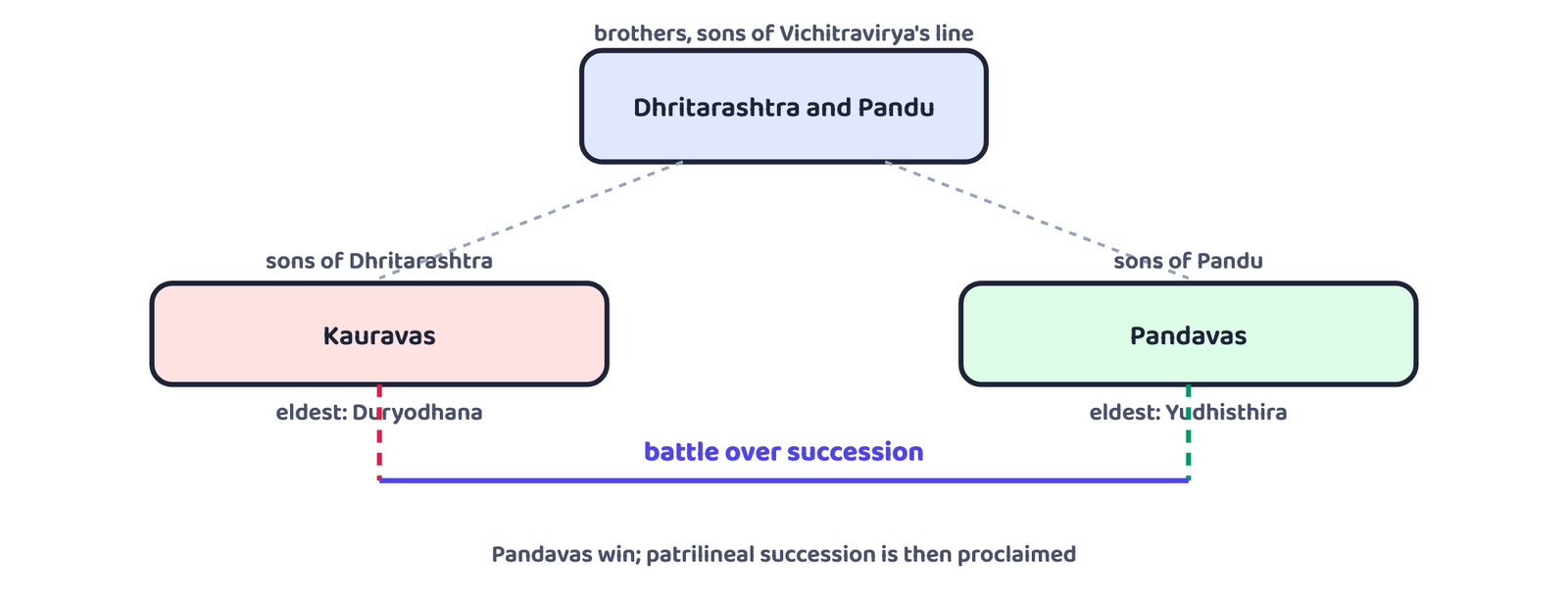
The Mahabharata’s central story is a feud over land and power between the Kauravas and Pandavas, cousins of the ruling Kuru lineage, dominant in one of the mahajanapadas. It ends in battle, the Pandavas win, and patrilineal succession is proclaimed. Patriliny existed before the epic, but the story reinforced it as the valuable norm: sons could claim a father’s resources, the throne included.
Most ruling dynasties from c. sixth century BCE claimed to follow patriliny, though practice varied: sometimes there were no sons and brothers succeeded, sometimes other kinsmen claimed the throne, and in very exceptional cases, such as Prabhavati Gupta, a woman held power. The concern with patriliny reaches beyond royal families too, visible in Rigvedic ritual mantras.
A Rigveda marriage mantra (probably inserted c. 1000 BCE), still chanted at many Hindu weddings: “I free her from here, but not from there. I have bound her firmly there, so that through the grace of Indra she will have fine sons and be fortunate in her husband’s love.” “Here” is the father’s house, “there” the husband’s.
The Adi Parvan explains the feud: Dhritarashtra was blind, so his younger brother Pandu became king; after Pandu’s early death Dhritarashtra ruled again as the princes were still young; as they grew, Hastinapura’s citizens preferred the more capable and virtuous Pandavas, which made Duryodhana jealous. He told his father that if a Pandava inherited the patrimony, his line would inherit it forever after, excluding the Kauravas.
What this passage is useful for: it may not be literally true, but it shows what the text’s authors thought mattered for kingship, and it holds conflicting criteria (birth, capability, virtue) side by side.
2.2 Rules of marriage
Endogamy is marriage within a unit (kin group, caste, or locality). Exogamy is marriage outside the unit. Polygyny is one man having several wives; polyandry is one woman having several husbands.
Sons mattered for continuing the patrilineage; daughters were viewed differently, and marrying them outside the kin group, exogamy, was considered desirable for high-status families. This gave rise to kanyadana, the gift of a daughter in marriage, seen as an important religious duty of the father. As towns grew and social life became more complex, older beliefs faced questioning. Brahmanas responded from c. 500 BCE by compiling detailed codes, the Dharmasutras and Dharmashastras, meant to bind Brahmanas especially and society generally. The most important, the Manusmriti, was compiled c. 200 BCE to 200 CE. These texts claimed universal validity, but given the subcontinent’s diversity and poor communication, Brahmanical influence was never all-pervasive.
The Manusmriti recognised eight forms of marriage; the first four were “good”, the rest condemned. First: the father gifts his daughter, dressed and jewelled, to a man learned in the Veda whom he himself invites. Fourth: the father gifts her after addressing the couple, “may both of you perform your duties together.” Fifth: the bridegroom receives the bride after giving as much wealth as he can to her kinsmen and to her. Sixth: the voluntary union of a maiden and her lover, springing from desire. The condemned forms were probably practised by those outside Brahmanical norms.
2.3 The gotra of women
From c. 1000 BCE, people (especially Brahmanas) were classed into gotras, each named after a Vedic seer, whose members were considered his descendants. Two rules mattered: a woman gave up her father’s gotra for her husband’s on marriage, and members of the same gotra could not marry.
Names sometimes derived from gotra names, and inscriptions of the Satavahanas (c. second century BCE to second century CE, western India and the Deccan) let historians test the rule.
Inscriptions give a uniform royal title raja, followed by a name ending in puta, Prakrit for “son”: Gotami-puta means “son of Gotami”. Gotami and Vasithi are feminine forms of Gotama and Vasistha, Vedic seers. Several Satavahana kings were Gotami-puta or Vasithi-puta, that is, named after their mothers, a practice called a metronymic. Some rulers were polygynous, and their wives kept names from their own father’s gotra rather than adopting the husband’s, and some wives shared a gotra with each other and with the king, showing endogamy in practice, the opposite of the exogamy the Brahmanical texts prescribed. This suited south Indian marriage patterns, where cousin marriage kept communities close-knit.
Careful conclusion: metronymics might suggest mothers were important, but Satavahana succession itself was still generally patrilineal, so the naming pattern alone does not prove maternal power.
As war neared, Gandhari appealed to her son Duryodhana: making peace honours his parents and well-wishers; greed and anger drag a man from his own profits; there is no dharma, artha or happiness in war, nor even certain victory. Duryodhana ignored her, fought, and lost.
3 Social Differences: Caste and What Lay Beyond It
Caste refers to a set of hierarchically ordered social categories. The Dharmasutras and Dharmashastras defined four varnas by qualification, occupation and ability.
| Varna | Prescribed role |
|---|---|
| Brahmana | Study and teach the Vedas, perform and get sacrifices performed, give and receive dana (gifts) |
| Kshatriya | Warfare, protect people, administer justice, plus study, sacrifice and dana |
| Vaishya | Agriculture, pastoralism and trade, plus study, sacrifice and dana |
| Shudra | Assist the other three varnas in the functioning of society |
Other traditions pushed back on rigidity. The Bhagavad Gita says the fourfold order rested on guna (qualities) and karma (actions), not birth; Buddhist traditions carry similar ideas.
A Rigvedic hymn has its speaker describe his own family’s occupational diversity: he is a poet, his father a physician, his mother a grinder of corn.
Drona, a Brahmana teaching archery to the Kuru princes, refused to teach Ekalavya, a forest-dwelling nishada. Ekalavya made a clay image of Drona and practised alone until he surpassed every prince, including Drona’s favourite, Arjuna. When Drona learned of this and demanded his fee, he asked for Ekalavya’s right thumb, ensuring Arjuna stayed unrivalled. Ekalavya cut it off without hesitation.
Why it is asked about: it shows a Brahmana enforcing varna boundaries against a “low”-born but more skilled outsider, and raises whether Drona, teaching archery himself, was even following his own varna’s prescribed duties.
3.1 Non-Kshatriya kings
The Shastras say only Kshatriyas could be kings, but many ruling lineages had different origins. The Mauryas’ social background is hotly debated: later Buddhist texts call them Kshatriyas, Brahmanical texts call them low-born. Their successors, the Shungas and Kanvas, were Brahmanas. In practice, political power went to whoever could gather support and resources.
The Shakas, from Central Asia, were dismissed as mlechchhas, barbarians, by Brahmanas, yet an early Sanskrit inscription describes the Shaka ruler Rudradaman rebuilding the Sudarshana lake, showing familiarity with Sanskritic tradition. The Satavahana king Gotami-puta Siri-Satakani claimed to be a unique Brahmana and a destroyer of Kshatriya pride, claimed to have stopped intermarriage across the four varnas, yet married into Rudradaman’s own family. Claims of caste purity and the reality of alliance rarely matched.
Unlike the fixed four varnas, the number of jatis had no limit and kept growing as society met new groups and occupations. Jatis sharing an occupation sometimes organised into shrenis, guilds.
A c. fifth century CE inscription at Mandasor (Madhya Pradesh) records a guild of silk weavers who migrated there from Lata (Gujarat) with their families, drawn by the local king’s reputation. Membership rested on shared craft, but members had also taken up other occupations, from music and poetry to religious discourse and even warfare, and had collectively funded a temple to the sun god.
3.3 Beyond the four varnas
Populations whose practices Brahmanical ideas never shaped were often described in Sanskrit texts as odd, uncivilised, even animal-like: forest-dwellers who hunted and gathered, such as the nishada category Ekalavya belonged to, and nomadic pastoralists who fit no settled-agriculturist framework. Speakers of non-Sanskritic languages were labelled mlechchhas.
Hiding in the forest, the Pandava Bhima killed a man-eating rakshasa; the rakshasa’s sister Hidimba, who had fallen for him, was accepted by the Pandavas as his wife on the condition that they roam by day but he return every night. Their son Ghatotkacha later promised to return whenever the Pandavas needed him. Some historians read “rakshasa” here as a label for people whose practices lay outside Brahmanical norms.
3.4 Untouchability
Some groups were placed entirely outside the system as “untouchable”, on the idea that ritual activities were sacred and “pure”, while handling corpses and dead animals was “polluting”. Those who did such work, the chandalas, sat at the very bottom.
Do not write that untouchability was invisible or unresisted. The Manusmriti laid down chandala “duties”: live outside the village, use discarded utensils, wear the clothes of the dead and iron ornaments, no moving about villages or cities at night, dispose of unclaimed bodies, serve as executioners. The Chinese pilgrim Fa Xian (c. fifth century) wrote that untouchables sounded a clapper in the streets to warn people away; Xuan Zang (c. seventh century) noted executioners and scavengers lived outside the city.
The Bodhisattva was born a chandala’s son, Matanga. In Banaras, a merchant’s daughter, Dittha Mangalika, called seeing him “inauspicious” and washed her eyes; her attendants beat him. He protested by lying at her door until, on the seventh day, she was given to him. He renounced the world, gained spiritual powers, returned and married her; their son Mandavya studied the Vedas and fed 16,000 Brahmanas daily. When Matanga later begged at his son’s door, Mandavya refused him as unworthy. Matanga replied that pride of birth, not virtue, disqualifies a person from gifts, then rose into the air and vanished.
What it shows: a chandala’s own perspective survives in a non-Brahmanical (Pali) text, and it directly rejects the idea that birth determines worth.
4 Beyond Birth: Resources and Status
4.1 Gendered access to property
Duryodhana invited Yudhisthira to dice, and, deceived, Yudhisthira staked and lost his wealth, kingdom, brothers and finally himself, then staked and lost their shared wife Draupadi too. She asked whether Yudhisthira, having lost himself first, had any right to stake her at all. One view: as his wife, she remained under his control regardless. The other: an unfree man could not stake another person. The question was left unresolved; Dhritarashtra eventually restored everyone’s freedom.
Under the smriti tradition, paternal property was divided equally among children after both parents died, with an extra share for the eldest. Women kept marriage gifts as stridhana, “a woman’s wealth”, inheritable by her children without her husband having any claim. Yet cumulative epigraphic and textual evidence shows that beyond exceptions like Prabhavati Gupta, land, cattle and money were generally controlled by men: unequal access to resources sharpened the social gap between men and women.
The Manusmriti lists seven means for men to acquire wealth: inheritance, finding, purchase, conquest, investment, work, and gifts from good people. For women, six: gifts given at the wedding fire or bridal procession, tokens of affection, and gifts from brother, mother or father, plus later gifts and whatever an affectionate husband gives. Every one of the women’s routes runs through a relationship; several of the men’s do not.
4.2 Varna and access to property
Varna was the second gate on wealth. Shudras’ only prescribed “occupation” was servitude, while the first three varnas had many options, so under the rules the wealthiest men should be Brahmanas and Kshatriyas. Other textual traditions do broadly show kings as wealthy and priests as usually rich, with only occasional poor Brahmanas. Even so, other traditions, especially early Buddhism (c. sixth century BCE onwards), developed critiques: differences existed, but were not natural or fixed, and claims to status by birth were rejected outright.
King Avantiputta describes Brahmanical claims to Kachchana, a disciple of the Buddha: Brahmanas are the best caste, others low; Brahmanas fair, others dark; only Brahmanas pure; Brahmanas born of Brahma’s own mouth. Kachchana asks: if a Shudra grew wealthy, could he not have another Shudra, or even a Kshatriya, Brahmana or Vaishya, as an obedient, polite servant? Avantiputta agrees he could. Kachchana concludes the four varnas are then exactly the same. Avantiputta concedes the point.
4.3 An alternative: sharing wealth
Not every value system rewarded accumulation. In ancient Tamilakam, chiefs patronised bards and poets, and the Tamil Sangam anthologies show that while rich and poor existed, those who held resources were expected to share them.
A Purananuru bard describes his patron: he has no everyday wealth to give away, nor the pettiness to claim he has nothing and refuse. He lives at Irantai and is “an enemy to the hunger of bards”. If bards show him their hunger-thinned ribs, he will go to his village blacksmith and order a straight-bladed spear, presumably to raid for the wealth he lacks, so he can be generous again.
5 Explaining Social Differences: A Social Contract
The Buddhist Sutta Pitaka offers a myth for how kingship and inequality began. Originally, beings lived in an idyllic peace, taking from nature only what one meal required. As greed, vindictiveness and deceit grew, people decided: “What if we were to select a certain being who should be wrathful when indignation is right, who should censure that which should rightly be censured and should banish him who deserves to be banished?” In return they would give him a share of the rice they grew; chosen by all the people, he became mahasammata, “the great elect”.
This myth makes kingship a matter of human choice, not divine right or birth, with tax as payment for a service. It follows that if people created the system, they could also change it, a very different premise from the Brahmanical order rooted in varna.
6 Handling Texts: Historians and the Mahabharata
Every source in this chapter has been read through the same checklist: language, kind of text, author and intended audience, and probable date and place of composition. Only after that does content become evidence.
6.1 Language and content
The Sanskrit of the Mahabharata is far simpler than that of the Vedas or the Chapter 2 prashastis, so it was probably widely understood. Historians split its content into narrative (stories) and didactic (prescriptions of social norms), a division that is not watertight since narrative carries social messages and didactic sections contain stories, but historians broadly agree the epic began as a dramatic story and had didactic material added later.
Didactic means meant for instruction. The text is called an itihasa in early Sanskrit tradition, literally “thus it was”, usually translated “history”; whether an actual war lies behind it remains uncertain, since there is no corroborating evidence.
6.2 Authors and dates
6.3 The search for convergence
In 1951-52 the archaeologist B.B. Lal excavated Hastinapura in Meerut (Uttar Pradesh). The name and the site’s location in the Upper Ganga doab, where the Kuru kingdom sat, suggest it may be the epic’s capital, though the name match alone could be coincidence.
| Occupation phase | What Lal found |
|---|---|
| Second (c. 12th-7th centuries BCE) | No definite house plans in the excavated area, but mud and mud-brick walls, and mud-plaster with reed marks suggesting reed walls plastered over |
| Third (c. 6th-3rd centuries BCE) | Houses of mud-brick and burnt brick; soakage jars and brick drains for waste water; terracotta ring-wells possibly used as both wells and drainage pits |
The Adi Parvan describes the city as “bursting like the ocean, packed with hundreds of mansions”, its gateways, arches and turrets like massing clouds, matching “the splendour of Great Indra’s city”. A grand, urban description like this fits the sixth-century-BCE-onwards flourishing of towns better than it fits Lal’s earlier, humbler layers, raising the question of whether the description was added once cities like this actually existed nearby, or was simply poetic invention that no excavation could confirm either way.
Arjuna won an archery contest and Draupadi’s hand, but Kunti, before seeing her, told her sons to share whatever they had brought; her word could not be broken, so Yudhisthira ruled Draupadi their common wife. When her father Drupada objected, the sage Vyasa gave two more explanations: the Pandavas were reborn incarnations of Indra, whose one wife was reborn as Draupadi; and separately, a woman who had prayed to Shiva for a husband five times over was reborn as Draupadi, and Shiva was fulfilling all five prayers at once.
Why three explanations for one marriage: historians read the presence of polyandry itself as evidence it existed among ruling elites, while the sheer number of justifications offered suggests the practice was already falling out of favour by the time these were written, needing extra cover. Other historians point to polyandry’s continuing presence in the Himalayan region regardless of Brahmanical disapproval, or to a wartime shortage of women, or simply note that a dramatic narrative need not literally mirror social reality.
7 A Dynamic Text
The Mahabharata’s growth never stopped with the Sanskrit version. Retellings in many languages, an ongoing dialogue between peoples and writers, absorbed regional stories, retold the central plot differently, and supplied material for sculpture, painting, plays and dance for centuries after.
The epic tells how Duryodhana tried to burn the Pandavas alive in a house of lac; they escaped through a tunnel, and a nishada woman and her five sons, left behind drunk at Kunti’s feast, died in the fire meant for the Pandavas, their bodies mistaken for the escapees’. The Bengali writer Mahashweta Devi continues the story from Kunti’s old age: a nishadi who often overhears Kunti’s private confessions reveals she is the daughter-in-law of the woman who died in that fire, and asks why Kunti, so absorbed in her own guilt, never once remembered the six innocent lives lost to save her own sons. As new flames approach, the nishadi escapes; Kunti does not move.
8 Timelines and Revision
| Timeline 1 · major textual traditions | |
|---|---|
| c. 500 BCE | Ashtadhyayi of Panini, a work on Sanskrit grammar |
| c. 500-200 BCE | Major Dharmasutras (Sanskrit) |
| c. 500-100 BCE | Early Buddhist texts including the Tripitaka (Pali) |
| c. 500 BCE-400 CE | Ramayana and Mahabharata (Sanskrit) |
| c. 200 BCE-200 CE | Manusmriti; composition and compilation of Tamil Sangam literature |
| c. 100 CE | Charaka and Sushruta Samhitas, works on medicine |
| c. 200 CE onwards | Compilation of the Puranas |
| c. 300 CE | Natyashastra of Bharata, on dramaturgy |
| c. 300-600 CE | Other Dharmashastras |
| c. 400-500 CE | Sanskrit plays including Kalidasa’s; astronomy and mathematics by Aryabhata and Varahamihira; compilation of Jaina works in Prakrit |
| Timeline 2 · major landmarks in the study of the Mahabharata | |
|---|---|
| 1919-66 | Preparation and publication of the Critical Edition |
| 1973 | J.A.B. van Buitenen begins its English translation, left incomplete after his death in 1978 |
- The Critical Edition (1919-66) proved the Mahabharata carries both a common core and enormous regional variation.
- Patriliny was the ideal for elite succession; the epic reinforced it, but real practice included brothers, other kinsmen and exceptional women like Prabhavati Gupta.
- Exogamy and gotra rules were the Brahmanical prescription for women; Satavahana metronymics and shared-gotra marriages show real endogamous practice instead.
- The four varnas were fixed and ideally birth-linked; jatis were unlimited and occupation-linked, and guilds like the Mandasor silk weavers cut across both.
- Kingship rarely respected the “Kshatriyas only” rule: Mauryas, Shungas, Shakas and Satavahanas all complicate it.
- Chandalas were placed outside the varna order entirely by “polluting” occupations; the Matanga Jataka gives their own perspective on it.
- Access to property was gated by both gender (stridhana versus land, cattle, money) and varna (Shudra servitude versus Brahmana-Kshatriya wealth).
- The Buddhist social contract myth makes kingship a human, revisable choice rather than a birth-based, permanent order.
- The epic itself grew in layers: bardic sutas, then Brahmanas from c. 500 BCE, a Vaishnava phase c. 200 BCE-200 CE, and a didactic phase c. 200-400 CE.
- B.B. Lal’s Hastinapura excavation neither proves nor disproves the epic; it shows what convergence between text and archaeology can and cannot do.
- 1 markWho led the preparation of the Critical Edition of the Mahabharata, and in what year did it begin?
- 1 markDefine patriliny and matriliny.
- 1 markWhat is a metronymic? Give one Satavahana example.
- 1 markWhat were chandalas required to do, according to the Manusmriti?
- 1 markWhat is stridhana?
- 2 marksDistinguish between endogamy and exogamy, with one example of each from the chapter.
- 2 marksWhat is the difference between a varna and a jati?
- 2 marksWhat does itihasa mean, and why is the term significant for the Mahabharata?
- 2 marksName the seven means by which men could acquire wealth according to the Manusmriti.
- 3 marksExplain why patriliny may have been particularly important among elite families.
- 3 marksDiscuss whether kings in early states were invariably Kshatriyas.
- 3 marksWhat does the story of Ekalavya suggest about the enforcement of varna boundaries?
- 3 marksHow does the Matanga Jataka present a chandala’s own point of view?
- 3 marksCompare men’s and women’s means of acquiring wealth according to the Manusmriti.
- 3 marksWhat does the inscription of the Mandasor silk weavers reveal about the nature of guilds?
- 3 marksIn what ways was the Buddhist theory of a social contract different from the Brahmanical view of a birth-based social order?
- 5 marksCompare and contrast the dharma or norms mentioned in the stories of Drona and Ekalavya, Hidimba, and Matanga.
- 5 marksDiscuss the evidence that suggests Brahmanical prescriptions about kinship and marriage were not universally followed.
- 5 marksHow important were gender differences in early societies? Give reasons for your answer.
- 5 marksDiscuss whether the Mahabharata could have been the work of a single author.
- 5 marks“Just because the Mahabharata represents more of an entire literature… it gives us an insight into the most profound depths of the soul of the Indian folk” (Winternitz). Discuss.
- 5 marksDiscuss the three explanations offered in the epic for Draupadi’s marriage to the five Pandavas, and what historians make of them.
- 5 marksUsing B.B. Lal’s excavation at Hastinapura, discuss the possibilities and limits of using archaeology to verify an epic text.
- 1 markThe Critical Edition of the Mahabharata was prepared under the leadership of:
(a) B.B. Lal(b) V.S. Sukthankar(c) J.A.B. van Buitenen(d) Maurice Winternitz - 1 markThe Manusmriti was compiled approximately between:
(a) 1000-500 BCE(b) 500-200 BCE(c) 200 BCE-200 CE(d) 200-400 CE - 1 markGotami-puta means:
(a) son of Gotama(b) son of Gotami(c) descendant of Vasishtha(d) beloved of Gotami - 1 markThe original story of the Mahabharata was probably first composed by:
(a) Brahmanas(b) charioteer-bards or sutas(c) Kshatriya kings(d) Buddhist monks - 1 markMahasammata, “the great elect”, appears in a myth explaining the origin of:
(a) varna(b) kingship(c) untouchability(d) gotra - 1 markB.B. Lal excavated Hastinapura in:
(a) 1919-66(b) 1938(c) 1951-52(d) 1973
Choose: (a) both A and R are true and R explains A; (b) both true but R does not explain A; (c) A true, R false; (d) A false, R true.
Reason (R): This reflects a practice of endogamy, marriage within the kin group, rather than the exogamy prescribed by Brahmanical texts.
Reason (R): It describes the first king as chosen by the people, with taxes paid in return for his services.